Aesop fable Live

“The Boy Who Cried Wolf” is an Aesop fable about a shepherd boy who tricks villagers into thinking a wolf is attacking his sheep. But there was no wolf. The story teaches that people who lie will not be believed, even when they are telling the truth. 

President Donald Trump has threatened new tariffs on Canadian lumber and dairy products, potentially as soon as Friday, just one day after providing Canada a one-month reprieve from 25% tariffs. The tariff on dairy products and lumber Trump threatens is 250%. 

Is Trump serious or is it just noise?

Trump’s repeated threats of tariffs applied to Mexico and Canada are getting tiresome because he seems to change his mind daily.

Canada, Mexico, and other countries will soon tire of his threats.

Because of his power as president of the United States we all need to be concerned.

A new report from ABC News concludes that many Americans who voted for Donald Trump do not necessarily support most of his policies. The study, which analyzed 300 poll questions from publicly available surveys conducted since Trump took office on Jan. 20, reveals that while voters largely support his immigration policies, they disapprove of several other aspects of his agenda.​

Trump and the Courts

Many of the things Trump is doing are illegal or unconstitutional. His attempt to undo birthright citizenship is a blatant contradiction of the 14th Amendment. His refusal to spend money already appropriated by Congress violates both the Constitution’s assignment of spending power to Congress and the Impoundment Act of 1974. He has no authority to disband agencies created by Congress, like USAID or the Consumer Financial Protection Bureau. His treatment of federal employees violates the laws establishing the civil service, as well as union contracts signed by previous administrations.

But laws do not enforce themselves if lawbreakers are determined to ignore them. Victims of the law-breaking have to go to court. Judges have to rule in accordance with the law in spite of executive pressure against them. Court orders can be appealed, so the process can take a long time.

So far, the lower courts are following the law and the Constitution, so Trump is losing most of the cases.

This is all leading up to two questions:

  • Will the Supreme Court invent new interpretations of our laws to back Trump up, essentially ending the rule of law as we have known it?
  • If the Court does rule against Trump, will he defy the Court’s orders?

Trump Dares the Courts to Stop Him

New York Times Editorial Board

Feb. 13, 2025, 5:03 a.m. ET

The U.S. Constitution established three branches of government, designed to balance power — and serve as checks on one another. That constitutional order suddenly appears more vulnerable than it has in generations. President Trump is trying to expand his authority beyond the bounds of the law while reducing the ability of the other branches to check his excesses. It’s worth remembering why undoing this system of governance would be so dangerous to American democracy and why it’s vital that Congress, the courts and the public resist such an outcome.

Among legal scholars, the term “constitutional crisis” usually refers to a conflict among the branches of government that cannot be resolved through the rules set out in the Constitution and the system of checks and balances at its heart.

Say, a president who openly disregards the 22nd Amendment’s two-term limit and asserts a right to remain in office indefinitely.

But there’s no need to get ahead of ourselves. Right now, in February 2025, only weeks into President Trump’s second term, he and his top associates are stress-testing the Constitution, and the nation, to a degree not seen since the Civil War.

A partial list would include flouting the express requirements of multiple federal laws, as though Congress were an advisory board and not a coequal branch of government. It would include feeding entire agencies into the “wood chipper” (their words), an intentionally gory metaphor for the firing of thousands of civil servants without the legally mandated congressional approval. It would include giving an unelected “special government employee” access to the private financial information of millions of Americans, in violation of the law. And it would include issuing an executive order that purports to erase one of the foundational provisions of the Constitution on Mr. Trump’s say-so.

There is also reason to fear that powers that solely rest with the president, and therefore don’t raise direct constitutional concerns, are being abused in ways that weaken the constitutional order. His mass pardon of Jan. 6 rioters, for instance, is technically legal, but it both celebrates and gives license to anyone who wishes to engage in violence to keep Mr. Trump in power.

Any one of these acts sets off major alarms. Taken as a whole, they are a frontal assault on the laws and norms that underpin American government — by the very people who are meant to execute the law.

So are we in a constitutional crisis yet?

The most useful way to answer that question is to focus less on discrete events and more on the process, in which one branch pushes the limits of its authority and then the others push back. When those in power understand that their first obligation is to the Constitution and the American people, this process can be normal, even healthy.

When they don’t — well, that’s what we are watching play out.

Voters gave Mr. Trump a Republican-controlled Congress, and those lawmakers are within their right to try to pass the president’s agenda through the legislative process. That doesn’t relieve either chamber of its constitutional responsibility to the American people to serve as a check on the power of the president.

With virtually no exception, Republican leaders in Congress have made clear through their inaction that as long as they and Mr. Trump hold power — until January 2027, at least — they will stay out of his way. One reason, however, that Mr. Trump is using executive orders so often is that many of his plans would find resistance from Congress because of the Republicans’ slim majorities and the Senate’s 60-vote filibuster threshold.

While it may seem that the Republican leaders in Congress are free to abdicate their power to the president if they choose, that is not the case. As the sole branch granted lawmaking authority, they can repeal a law only by passing another one — not by failing to complain when a president chooses not to follow the ones he doesn’t like. That ensures that every law passed has the support of a majority of members elected to represent this diverse, divided country.

The United States Agency for International Development, for example, is funded through the congressional appropriations process. Would the current Congress vote to cut that funding? Perhaps. But at the very least, the House speaker and Senate majority leader should be putting the question up for a vote.

And Congress plays another important role: When the president or his administration is believed to have broken the law, it’s up to Congress to investigate and, when appropriate, use its censure powers. There is no sign that lawmakers plan to hold Mr. Trump accountable in this manner.

The willingness of Republican congressional leadership to watch passively as its own rights and responsibilities as a coequal branch of government are undermined leaves only one other branch actively checking the excesses of this overreaching presidency: the federal courts, where nearly all intragovernmental disputes eventually wind up.

The courts exist to define the bounds of the Constitution and the laws and to tell the other branches when they have strayed past those bounds. They also tend to slow everything down — frustrating, perhaps, for those who are impatient to wield their power or who wish to see justice done quickly — but that deliberation is essential to the rule of law and due process. So far, the federal courts have done their job, blocking several of Mr. Trump’s more brazenly illegal moves, including his executive order ending the 14th Amendment’s guarantee of birthright citizenship. He has already refused to comply at least once: A Rhode Island judge ruled on Monday that the president has defied a federal court order to release billions of dollars in federal grants. This is a dangerous trial balloon that Mr. Trump is daring someone to pop.

It’s fine for presidents to disagree, even strongly, with court rulings. That’s part of America’s evolving constitutional conversation, and it can lead to important changes. But the way to handle such disagreements is through the appeals process or passing legislation or even an amendment. “That’s how the rule of law works,” one federal judge said last week in blocking Mr. Trump’s birthright citizenship order.

In short, change needs to happen through the established channels of litigation in, and obedience to, the courts. Chief Justice John Roberts emphasized this last December, when he warned of the dangers of disobeying court rulings. “Every administration suffers defeats in the court system,” he wrote, but until recently people didn’t dare ignore decisions they didn’t like. Now we live with “the specter of open disregard for federal court rulings.”

He did not name Mr. Trump, but it was clear whom he was talking about. Of course, Chief Justice Roberts and his colleagues made their jobs harder with their 2024 decision in Trump v. United States, which granted astonishingly broad presidential immunity — a decision that emboldened Mr. Trump and his allies to see how far he can expand his powers without resistance.

Some may argue that defying a lower court order is not as serious as defying a final ruling of the Supreme Court. The complication is that the judiciary depends on the executive branch to enforce its orders. When the executive branch is the defendant, as it is in these cases, and refuses to follow a court order, who can compel it to do so? This is the predicament Mr. Trump and his allies have put the nation in.

However it may play out, the refusal to obey a Supreme Court ruling — from which there is no appeal — would be the moment that America’s constitutional order completely fails. That is a clear red line separating countries that operate under the rule of law from those that do not. If he crosses it, Mr. Trump will have created the precise scenario the nation’s founders fought a war and established an entirely new government to avoid. And if that happens, no part of society can remain silent.

There is disagreement among even legal scholars about whether the country is all the way to a constitutional crisis yet. Regardless, the statements from the White House and the unwillingness of Republican leaders in Congress to even consider acting as a check should be taken as a flashing warning sign. If we have learned anything from the past decade of living with Donald Trump, it’s that when he tells you about what he will do with power, believe him.
America has Surrendered to a Madman

This column and introductory commentary was forwarded to me. Mike Greenberg of Texas wrote the opening comments. This is exhausting.

I don’t think any US journalist has written as tough (and spot-on) a portrayal of the threat facing us as this Canadian, Andrew Coyne of the Toronto Globe and Mail. If you read to the end, you will be rewarded with the most flattering photograph yet of the convicted-felon-in-chief:

“Nothing mattered, in the end. Not the probable dementia, the unfathomable ignorance, the emotional incontinence; not, certainly, the shambling, hate-filled campaign, or the ludicrously unworkable anti-policies.

The candidate out on bail in four jurisdictions, the convicted fraud artist, the adjudicated rapist and serial sexual predator, the habitual bankrupt, the stooge of Vladimir Putin, the man who tried to overturn the last election and all of his creepy retinue of crooks, ideologues and lunatics: Americans took a long look at all this and said, yes please.

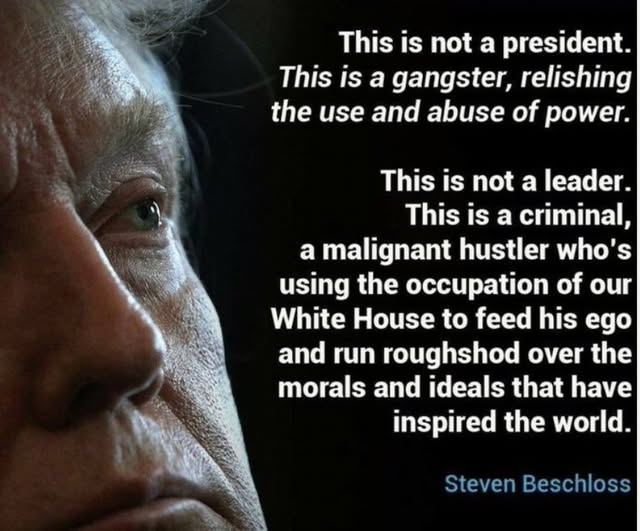
There is no sense in understating the depth of the disaster. This is a crisis like no other in our lifetimes. The government of the United States has been delivered into the hands of a gangster, whose sole purpose in running, besides staying out of jail, is to seek revenge on his enemies. The damage Donald Trump and his nihilist cronies can do – to America, but also to its democratic allies, and to the peace and security of the world – is incalculable. We are living in the time of Nero.

The first six months will be a time of maximum peril. NATO must from this moment be considered effectively obsolete, without the American security guarantee that has always been its bedrock. We may see new incursions by Russia into Europe – the poor Ukrainians are probably done for, but now it is the Baltics and the Poles who must worry – before the Europeans have time to organize an alternative. China may also accelerate its Taiwanese ambitions.

At home, Mr. Trump will be moving swiftly to consolidate his power. Some of this will be institutional – the replacement of tens of thousands of career civil servants with Trumpian loyalists. But some of it will be … atmospheric.

At some point someone – a company whose chief executive has displeased him, a media critic who has gotten under his skin – will find themselves the subject of unwanted attention from the Trump administration. It might not be so crude as a police arrest. It might just be a little regulatory matter, a tax audit, something like that. They will seek the protection of the courts, and find it is not there.

The judges are also Trump loyalists, perhaps, or too scared to confront him. Or they might issue a ruling, and find it has no effect – that the administration has called the basic bluff of liberal democracy: the idea that, in the crunch, people in power agree to be bound by the law, and by its instruments the courts, the same as everyone else. Then everyone will take their cue. Executives will line up to court him. Media organizations, the large ones anyway, will find reasons to be cheerful.

Of course, in reality things will start to fall apart fairly quickly. The huge across-the-board tariffs he imposes will tank the world economy. The massive deficits, fueled by his ill-judged tax policies – he won’t replace the income tax, as he promised, but will fill it with holes – and monetized, at his direction, by the Federal Reserve, will ignite a new round of inflation.

Most of all, the insane project of deporting 12 million undocumented immigrants – finding them, rounding them up and detaining them in hundreds of internment camps around the country, probably for years, before doing so – will consume his administration. But by then it will be too late.

We should not count upon the majority of Americans coming to their senses in any event. They were not able to see Mr. Trump for what he was before: why should that change? Would they not, rather, be further coarsened by the experience of seeing their neighbours dragged off by the police, or the military, further steeled to the necessity of doing “tough things” to “restore order?”

Some won’t, of course. But they will find in time that the democratic levers they might once have pulled to demand change are no longer attached to anything. There are still elections, but the rules have been altered: there are certain obstacles, certain disadvantages if you are not with the party of power. It will seem easier at first to try to change things from within. Then it will be easier not to change things.

All of this will wash over Canada in various ways – some predictable, like the flood of refugees seeking escape from the camps; some less so, like the coarsening of our own politics, the debasement of morals and norms by politicians who have discovered there is no political price to be paid for it. And who will have the backing of their patron in Washington.

All my life I have been an admirer of the United States and its people. But I am frightened of it now, and I am even more frightened of them.”

The only thing standing between democracy and dictatorship in America

Opinion by Thom Hartmann on Alternet https://www.alternet.org/

Trump wants FBI agents who investigated his coup attempt, his facilitating espionage, or his other financial and criminal activities fired.

Let’s be very clear: this is how dictatorships start.

A guy who wants to be a dictator always begins by changing how the government works. Even though the majority of the nation had agreed previously that the government should do certain things in certain ways, he reassures everybody he’s got a better way and it’ll all work out.

In the process, he breaks a bunch of laws, but people mostly shrug because they don’t directly affect them. Pastor Niemöller wrote about this in 1930s Germany; to paraphrase: First they came for the government workers…

Then people start resisting, which is when he begins to use the police power of the state. The people who show up in the streets, the people who speak out in the media, the people who try to fight him in the legislatures and the courts: he figures out ways to get them fired, harassed, and ultimately imprisoned.

When she was being confirmed, Attorney General Pam Bondi refused to say that she would not executed an illegal order on Donald Trump’s behalf. Like if he directed her to investigate somebody who irritated him. Or prosecute somebody who had investigated him. Or imprison — perhaps only temporarily, at first — somebody who has spoken out against him.

We’re there now. Bondi just announced that the political prosecutions are about to begin. At first they will be going after the police agencies themselves, as a way of bringing them to heel: Terrify the terrifiers.

Next will be the Press. First they will use financial terror to force compliance; we’re already seeing that with Trump’s lawsuits against all three major networks and multiple newspapers. That will expand. Eventually it will turn into shutdowns and arrests.

He will remake our schools so they become indoctrination factories for his white, male supremacist worldview and the new authoritarianism.

He will realign our democratic country away from democratic allies and toward countries run by dictators like he aspires to become.

He will purge the military of leadership that might resist him and of troops who might refuse his orders.

He will remake our criminal justice system so it becomes more violent and brutal, opening prisons for “the worst of the worst“ in places beyond the reach of law, like Auschwitz in Poland or Guantánamo in Cuba.

He will remake our media so it becomes a Greek chorus, singing his praises and carrying his every word.

By proclaiming, as every dictator does, that divine providence and the blessings of God put him where he is, he will bring the country‘s largest religious institutions to heel.

He will proclaim grand plans and spectacular efforts, like the Autobahn or remaking Gaza, Greenland, and Panama. They will distract the public from the relentless, grinding destruction of the guardrails of government itself.

He and his allies will empower civilian militias who will then become his terror shock troops against the people who oppose him. Hitler had his Brownshirts; Republicans in Nassau County are right now trying to field America’s first armed private militia.

He will remake commerce and business, so the most successful companies are those that throw money and resources at him. Fritz Tyson wrote a book about this, about his shame at facilitating it, titled I Paid Hitler. Someday, perhaps, Jeff Bezos or Tim Cook will write a similar book.

America today is early in this process, although it doesn’t typically take very long. It took Hitler 53 days. It took Putin about a year. It took Victor Orban about two years. It took Pinochet less than a week, although he had the help of Richard Nixon and Henry Kissinger.

Trump and his project 2025 friends, however, have been preparing for this for four years: They hit the ground running.

This moment proves that the preservation of democracy requires constant attention and a collective commitment to uphold the integrity of its institutions.

Right now, though, the only thing standing between democracy and dictatorship in America are public opinion, the media, and the Democratic Party; Republicans have completely caved and the courts move too slowly to stop him.

Elon Musk and Donald Trump seem to think they can pull this off in a matter of weeks, and so far — because of the cowardice of Republican legislators and the disorganization and lack of leadership among Democrats — they may be right.

Unless we all stand up and speak out now.

Say Goodbye to the American Democracy

On July 19,2024 Donald Trump told a gathering of Christian conservatives: “I love you. You got to get out and vote. In four years, you don’t have to vote again. We’ll have it fixed so good, you’re not going to have to vote.”

His interviewer on the following Monday, Fox News’s Laura Ingraham, noted that Democrats have highlighted that quote as evidence that Mr. Trump would end elections, and urged Mr. Trump to rebut what she called a “ridiculous” criticism.

But Mr. Trump declined to do so, repeating a pattern he frequently employs in which he makes a provocative statement that can be interpreted in varying ways, and makes no attempt to quiet the uproar. This comment was especially striking, given his attempts to overturn the 2020 electionand his shattering of other democratic norms.

Today Donald Trump has been in office just over 2 weeks and has given a non-elected, non-authorized by congress, Elon Musk, to discharge federal government employees en masse. This includes all employees in USAID, the FBI, and other agencies.  Musk now has access to all Treasury files including the IRS, Social Security and all medical agencies (Medicare etc.).

Republicans have largely cheered on the moves — though there are a few exceptions. Some senators have said they want more information about Musk’s access to the Treasury Department’s payment system, which prompted the resignation of a longtime civil servant who refused to turn over the system last week.

Trump has stated that the United States will take control of Gaza not for months but years.

The idea of a 100-day action plan, the milestone set by Franklin D. Roosevelt when he took office in the midst of the nation’s worst depression, now seems almost quaint, like snail mail. Helped by a compliant Congress, Trump 2.0 is moving at fiber-optic speed, with more discipline and bigger ambitions than during his first term.

The press has mostly been silent as the owners of most media stop broadcasting and printing news that reports anything that puts Trump in a negative light.

Say hello to King Donald Trump!

Goodbye to Free Speech

We are witnessing the end of freedom of speech in America as Trump has made the press bow to his demands.

CNN’s top boss told his show hosts to show some deference to the most powerful person on earth.

The owners of the Los Angeles Times and the Washington Post have stopped their editorial boards from endorsing Harris. The Times owner, Patrick Soon-Shiong, has taken on the paper’s liberal philosophy and has added known conservatives to its editorial board.

The absolute dictatorship of the United States is going forward. Donald Trump’s family and friends will soon have absolute control. Sadly, the majority of Americans handed the power to make this a reality.

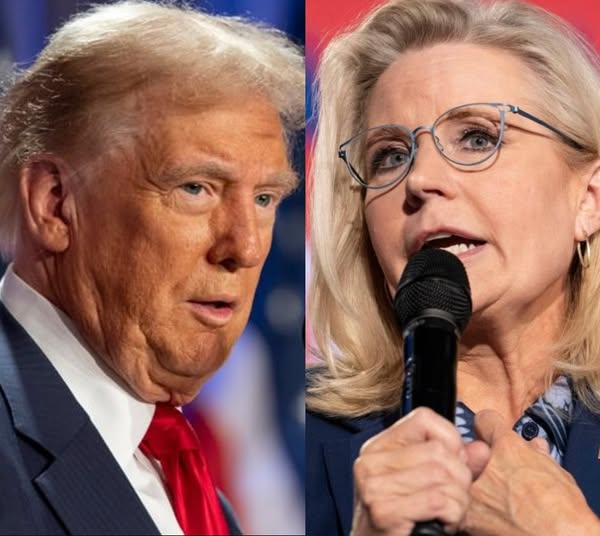
Republican Liz Cheney hits back Hard at Donald Trump

BREAKING: Republican Liz Cheney hits back hard at Donald Trump for his “assault on the rule of law” after he threatens to imprison those like her who served on the House January 6th committee.

And she wasn’t done there…

“Here is the truth: Donald Trump attempted to overturn the 2020 presidential election and seize power,” Cheney said in a statement provided to several outlets.

“He mobilized an angry mob and sent them to the United States Capitol, where they attacked police officers, invaded the building and halted the official counting of electoral votes,” she went on.

“Trump watched on television as police officers were brutally beaten and the Capitol was assaulted, refusing for hours to tell the mob to leave,” Cheney continued.

“This was the worst breach of our Constitution by any president in our nation’s history,” she stated. “Donald Trump’s suggestion that members of Congress who later investigated his illegal and unconstitutional actions should be jailed is a continuation of his assault on the rule of law and the foundations of our republic.”

Over the weekend, Trump told Meet the Press that Cheney’s actions were “inexcusable” and said “honestly, they should go to jail” of the members of the January 6th committee.

The fact that these people have done nothing wrong and were simply trying to protect our democracy matters not to Trump. He’s beginning his revenge tour.

My America Is Gone!

America fell for gaslighting.

Like so many of you I am gagging.

Nine days before Election DayDonald Trump delivered his closing argument at a Madison Square Garden rally that drew comparisons to a 1939 pro-Nazi rally in the same arena and characterized by similar anti-democratic themes: demonization of immigrants and political enemies, invocation of strongman leadership, threats of violent retribution, denunciations of the press.

Responding to criticism of this self-evident hate-fest, Trump characterized it as “a lovefest.” He wasn’t just lying. That’s too simple an explanation of how Trump behaves in general, and what he’s doing here. Lying is deceiving people about the state of the world, and Trump routinely does that too. But simply tallying up the lies gives no insight into their purpose. Bulls***ting is deceiving people about one’s motives — using true or false claims indiscriminately — and is a more accurate description of his routine behavior. But calling that rally calls a “lovefest,” is doing something more: That’s gaslighting, an effort to undermine people’s entire sense of reality and impose an invented reality in its place.

Trump was saying, in effect: The hate you saw was really love, and if you can’t see that, you’re the hateful one. It’s the kind of upside-down logic commonly found in abusive relationships, whenever the abuser is challenged. They may lie all the time, but when the chips are down, they gaslight. 

“I’m not perfect” = Your expectations I behave like a human being are unreasonable

“I’ve never pretended to be someone I’m not” = You fell in love with me so it’s your fault

“This more than decade old video” = It was a long time ago, why the fuss? You’re so unreasonable.

“These words do not reflect who I am” = The reality you just experienced didn’t actually happen.

“I said it … I apologize” = Get over it already — I said I’m sorry, you’re being hysterical.Expand article logo