Soap Opera Government

What a wonderful way to distract the public from the issues that really matter.  Most likely a series of worthless congressional hearings followed by more new regulations.

 If ever there was a real soap opera it’s the events now surrounding David Petraeus.  Now involved is General John Allen, Congressman Eric Cantor, Paula Broadwell, Jill Kelly, unnamed FBI agent, Holly Petraeus, Director of National Intelligence James Clapper and President Barack Obama.
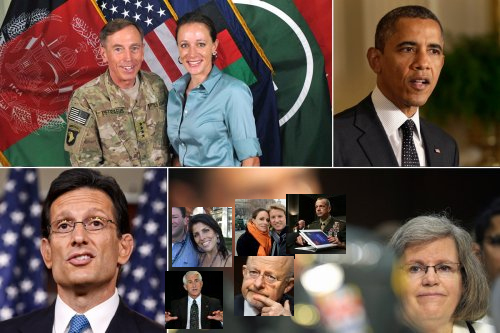
The sequence of events as reported by blaze.com.  This really could be made into a soap opera.

Spring 2012:

  • FBI starts investigation, intercepting Petraeus’ emails and      reviewing older emails going back to his time in Afghanistan, where he was commander of U.S. Forces from      July 2010 to July 2011 (Newsmax, Nov. 9).

Week of October 21:

Oct. 26:

  •  Broadwell delivers speech at University of Denver, discussing      details about how Petraeus handled the attack on the U.S. consulate in      Benghazi and revealing possibly classified information about alleged      Libyan militia members being held prisoner at that consulate and that      situation may have been a potential catalyst for the attack (Fox News, Nov. 12).
  • Glenn Beck predicts that David      Petraeus would take the blame on Libya: “Who have they tried to sell down the river      every step of the way? The intelligence,” Glenn said. “You watch. Petraeus      is going to be the fall guy. They’re going to have him step down. They’re      going to point all fingers to him.” (TheBlaze TV, Oct. 26)

Week of October 28:

  • Federal investigators interview Petraeus. Prosecutors conclude      afterward they likely will not bring criminal charges. (Reuters, Nov. 11)

Oct. 31:

  •  House Majority Leader Eric Cantor’s office contacts FBI to inform them about information from an FBI whistle blower who told Cantor (R-Va.)      in late October that Petraeus had been involved in an extramarital affair      and was potentially putting national security at risk (New York Times, Nov. 10, 2012).

Nov. 6 (Election Day):

  • At about 5 p.m.: the FBI notifies Director of National Intelligence James Clapper,      who oversees the CIA and other intelligence agencies, about      Petraeus. Clapper speaks to Petraeus that evening and again Wednesday and      advises him to step down (Reuters, Nov. 11).

Nov. 7:

  • Clapper informs White House National Security Council official that      Petraeus may resign and President Barack Obama should be informed. The president      is told about it later that day (Reuters, Nov. 11).

Nov. 8:

  • At 11 a.m. A Petraeus meeting with foreign dignitaries scheduled for 2:30 p.m. is canceled and his visitors are informed he      has to go to the White House to meet with Obama. Petraeus meets with Obama  at the White House and offers his resignation, explaining the circumstances behind it. Obama did not immediately accept the resignation      (Reuters, Nov. 11).

Nov. 9:

  • In a statement to CIA    employees Friday, Petraeus said he submitted his resignation to President    Barack Obama on Thursday and Obama accepted it Friday afternoon (CIA).
  • Fox News reported the affair was with his biographer and      was discovered during the course of an FBI investigation on an “unrelated      and much broader case.” According to Fox, journalist and biographer Paula      Broadwell’s name came up during the investigation, which led to uncovering      the affair (Fox News, Nov. 9).
  • Fox News analyst Ralph Peters, a retired Army lieutenant colonel,      speculates that Obama administration knew of the affair and waited for the      right moment to “play the card” (Fox News, Nov. 9)

Nov. 11:

  •  A senior U.S. military official says Broadwell sent harassing      emails to a woman who was the State Department’s liaison to the military’s      Joint Special Operations Command. The official, who asked to remain      anonymous, says 37-year-old Jill Kelley in Tampa, Fla., received the emails from Petraeus biographer      Paula Broadwell that triggered an FBI investigation. (TheBlaze/AP).

Nov. 13:

  • To be continued.  Tune into to your local newspaper, favorite web site, or television station for the latest episode.

Obama vs. Israel: Priority No.1? Stop Israel

Although Charles Krauthammer is an excellent commentator I rarely agree with his opinion. This time he does make me think.

Is this an uh-oh moment for Israel?

By Charles Krauthammer, published in a local paper today

IT’S Lucy and the football, Iran-style. After ostensibly tough talk about preventing Iran from going nuclear, the Obama administration acquiesced to yet another round of talks with the mullahs.

This, 14 months after the last group-of-six negotiations collapsed in Istanbul because of blatant Iranian stalling and unseriousness. Nonetheless, the new negotiations will be both without precondition and preceded by yet more talks to decide such trivialities as venue.

These negotiations don’t just gain time for a nuclear program about whose military intent the IAEA is issuing alarming warnings. They make it extremely difficult for Israel to do anything about it (while it still can), lest Israel be universalfy condemned for having aborted a diplomatic solution.

If the administration were serious about achievement rather than appearance, it would have warned that this was the last chance for Iran to come clean and would have demanded a short timeline. After all, President Obama insisted on deadlines for the Iraq withdrawal, the Afghan surge and Israeli-Palestinian negotiations .. Why leave these crucial talks open-ended when the nuclear clock is ticking?

This re-engagement comes immediately after Obama’s campaign-year posturing about Iran’s nukes. Last Sunday in front of AlPAC, he warned that “Iran’s leaders should have no doubt about the resolve of the United States.” This just two days after he’d said (to the Atlantic) of possible U.S. military action, “I don’t bluff.” Yet on Tuesday he returns to the very engagement policy that he admits had previously failed.

Won’t sanctions make a difference this time, however? Sanctions are indeed hurting Iran economically. But when Obama’s own director of national intelligence was asked by the Senate intelligence committee whether sanctions had any effect on the course of Iran’s nuclear program, the answer was simple: No. None whatsoever.

Obama garnered much AlPAC applause by saying that his is not a containment policy but a prevention policy. But what has he prevented? Keeping a coalition of six together is not success. Holding talks is not success. Imposing sanctions is not success.

Success is halting and reversing the program. Yet Iran is tripling its uranium output, moving enrichment facilities deep under a mountain near Qom and impeding IAEA inspections of weaponization facilities.

So what is Obama’s real objective? “We’re trying to make the decision to attack as hard as possible for Israel,” an administration official told the Washington Post in the most revealing White House admission since “leading from behind.”

Revealing and shocking. The world’s greatest exporter of terror (according to the State Department), the systematic killer of Americans in Iraq and Afghanistan, the self-declared enemy that invented “Death to America Day” is approaching nuclear capability – and the focus of U.S. policy is to prevent a democratic ally threatened with annihilation from pre-empting the threat?

Indeed it is. The new open-ended negotiations with Iran fit well with this strategy of tying Israel down. As does Obama’s “I have Israel’s back” reassurance, designed to persuade Israel and its supporters to pull back and outsource to Obama what for Israel are life-and-death decisions.

Yet 48 hours later, Obama tells a news conference that this phrase is just a historical reference to supporting such allies as Britain and Japan – contradicting the intended impression he’d given AlP AC that he was offering special protection to an ally under threat of physical annihilation.

To AlPAC he declares that “no Israeli government can tolerate a nuclear weapon in the hands of a regime that denies the Holocaust, threatens to wipe Israel off the map, and sponsors terrorist groups committed to Israel’s destruction” and affirms “Israel’s sovereign right to make its own decisions … to meet its security needs.”

And then he pursues policies – open-ended negotiations, deceptive promises of tough U.S. backing for Israel, boasts about the efficacy of sanctions, grave warnings about “war talk” – meant, as his own official admitted, to stop Israel from exercising precisely that sovereign right to self-protection.

Yet beyond these obvious contradictions and walk-backs lies a transcendent logic: As with the Keystone pipeline postponement, as with the debt-ceiling extension, as with the Afghan withdrawal schedule, Obama wants to get past Nov. 6 without any untoward action that might threaten his re-election.

For Israel, however, the stakes are somewhat higher: the very existence of a vibrant nation and its 6 million Jews. The asymmetry is stark. A fair-minded observer might judge that Israel’s desire to not go gently into the darkness carries higher moral urgency than the political future of one man, even if he is president of the United States.