President Donald J. Trump—It Could Happen

The following article was posted by The Nation magazine on February 23, 2016.  That is well before Donald Trump became the presumptive nominee of the Republican Party.  It now appears even more likely that Mr. Trump will be the next president of the United States.

His promise to protect jobs and change trade policies could win over blue-collar workers, especially in the industrialized swing states.

by John Nichols, in The Nation

February 23, 2016


Donald_Trump_2016_rtr_imgIn the middle of the political food fight that was the ninth Republican presidential debate, the front-runner suddenly abandoned the petty politics of the moment and delivered a message that mattered less to the scramble for South Carolina primary votes and more to the November fight for the battleground states that ring the Great Lakes.

“This country is dying. And our workers are losing their jobs,” Donald Trump declared. Noting the announcement of plans by the air-conditioner company Carrier to transfer production (and 1,400 union jobs) from Indianapolis to Mexico, the billionaire said, “Carrier is moving. And if you saw the [workers]…. They were crying.” Promising a no-more-tears presidency, Trump said he’d renegotiate “trade pacts that are no good for us and no good for our workers” and tell corporations to keep production in the United States or “we’re going to tax you.”

The pundits and political insiders who have missed every other warning sign from the 2016 race missed that one as well. But Trump’s recognition of shuttered plants and crying workers struck Ohio Congresswoman Marcy Kaptur. “I heard him. I heard exactly what he was saying, and so did the people of Indianapolis and Indiana,” Kaptur said. “So did everyone else who has lost a job to offshoring and outsourcing, or who knows they are just one more trade deal away from losing a job.”

Kaptur, a Democrat who represents a multiethnic, multiracial district stretching from Toledo to Cleveland, has decried Trump’s divisive remarks as shameful deviations from the American promise of “unity, not hatred.” But she cautions Democrats against assuming that the revulsion to Trump’s hateful language and crude politics will immediately disqualify him in the eyes of scared and angry voters in states that have been essential building blocks for Democratic wins in presidential races of recent decades. Kaptur’s not alone in this view.

Service Employees International Union president Mary Kay Henry warns that Trump could win a good many union votes—and perhaps the presidency—if he secures the Republican nod. “I think this is a very dangerous political moment in our country,” said the head of the SEIU, which has endorsed Hillary Clinton for the Democratic nomination, during a January discussion of Trump’s appeal. “I think he’s touching this vein of terrible anxiety that working-class people feel about their current status, but more importantly, how terrified they are for their kids not being able to do as well as they have, never mind doing better.” Henry noted that internal polls of union members across the country reveal a “broken sense of the future” and raise the prospect of an emotion-driven election in which it is “easier [to] appeal to fear than to what’s possible.”

“I don’t think the Democrats are ready for this,” adds Ralph Nader, the consumer activist and former presidential candidate. “Once he gets these wildcats off his back, once he gets the Republican nomination, then Trump becomes the builder again. He’s already said he’s going to be the greatest jobs president in history. He hasn’t pushed that line too hard in the primaries because he doesn’t want to come off as something other than a conservative. But if he’s the nominee, watch out.”

“Watch out”? Really? Isn’t Trump supposed to be unelectable? Isn’t he too bigoted, too crude, to be taken seriously? That’s what Republicans told themselves for most of 2015. But since his big wins in the New Hampshire and South Carolina primaries, the GOP establishment has begun to adjust to the prospect of a billionaire nominee with a flair for grabbing media attention, shaping the debate, and shredding opponents.

Yes—watch out. “This is an unprecedented election in so many ways that we don’t know what electability is,” cautions Ilyse Hogue, president of NARAL Pro-Choice America, which has backed Clinton. “What we do know is that Trump is better positioned to pivot, to Etch-A-Sketch his message, than the other Republicans. That constitutes a threat.”

Trump has already proved to be competitive with Clinton and her insurgent challenger, Vermont Senator Bernie Sanders, in the polls from battleground states like Florida, North Carolina, and Colorado. Measures of hypothetical match-ups should always be considered with skepticism when the parties are in the midst of nomination fights—and when potential independent candidacies are being explored. But poll numbers and interviews with Democrats in key states like Ohio, Pennsylvania, and Wisconsin indicate that the 2016 Democratic nominee could face a fight for industrial states that provided vital support for Barack Obama in 2008 and 2012. And Trump has yet to make his play for those states.

Right now, Trump is still peddling the snake-oil blend of xenophobia and bigotry that plays well in Republican primaries (one recent survey in South Carolina found that 38 percent of his backers believe the Confederacy should have won the Civil War). If he’s the Republican nominee, however, he’ll be confident about South Carolina. And Trump is all but certain to have what Hogue refers to as his “Etch-A-Sketch” moment, pivoting toward economic-populist themes that, while still crudely nationalistic, might attract independents and Democrats in key states. Republican pollster Frank Luntz says that in the focus groups he’s conducted, he has regularly found people who voted for Obama twice but now say “they would consider Trump.” Why? Because Trump is speaking to the fears of Americans who have lost faith not just in establishment politics, but in establishment economics. And he is likely to do a lot more of that.

It’s in the industrialized swing states where Trump’s promise to protect jobs and change trade policies could resonate among blue-collar workers. AFL-CIO president Richard Trumka acknowledges that workers are “talking to me about Donald Trump.” Union leaders fret about internal surveys that show the billionaire is attracting greater support than is usually afforded Republicans. While much of it comes from white male voters, these union leaders say they’ve seen some evidence of a broader openness to Trump’s message. Luntz claims that his candidacy “would get the highest percentage of black votes since Ronald Reagan in 1980.” That’s not a high bar—exit polls gave Reagan 14 percent—but the prospect of losing any working-class votes in states like Wisconsin, Indiana, Michigan, Ohio, and Pennsylvania should be a wake-up call for Democrats.

“The two major parties will have to change, or they are likely to be changed by voters who have had enough,” argues the Rev. Jesse Jackson. But what if one party changes—however cynically or crudely—to address the fears of the moment, while the other does not? What if Trump turns up the volume on a populist message while the Democrats run a more cautious campaign?

Sanders supporters point to polls in some battleground states that show him faring better than Clinton in matchups with Trump. “Bernie’s where the Democrats need to be,” says RoseAnn DeMoro, executive director of the National Nurses United union, regarding Sanders, a longtime critic of corporate-friendly trade pacts. “He’s speaking to fears that working families have about the future, but he’s not dividing people the way Trump is.”

Kaptur, who has not endorsed a candidate in the Democratic race, made a similar point on a drive from Toledo to Lorain, where the steel mills are cutting production and in some cases shutting down. “These people have been hit over and over and over again. They’ve retrained. They’ve done everything they can to survive—but the plants keep closing. They’ve been battered, and they’re sick of it. They want security, and this country is not delivering security. When Bernie talks about this, I think it touches people. Clinton says a lot of the same things, but I don’t hear the same passion.”

That’s a fair critique. But the counter to Trump’s appeal can’t merely be to debate on his terms. “It won’t work to go ‘My populism is bigger than your populism,’” Hogue says. A smart challenge must involve a full-spectrum response to the billionaire’s appeal as “a builder and a doer,” Nader says. “He reaches millions of people by making them comfortable with their prejudices. The press sometimes goes after him on that, which is good. But the press never gets to his vulnerabilities—his tax returns. There’s so much there, but Trump has diverted attention from a real examination of his financial dealings. Progressives can’t get distracted the way conservatives have. They have to expose him.”

Exposing the billionaire as a crony capitalist means pursuing the question of whether a candidate who opposes a minimum-wage hike would really take on multinational corporations in order to save jobs in Flint and Youngstown. In addition to challenging Trump himself, savvy observers say, it is vital to challenge Trumpism—the politics of division that scapegoats, stereotypes, and appeals to bigotry. Trumka says that “a campaign fueled by contempt and exclusion is bad for working families,” and labor unions are preparing to make that point with an aggressive campaign similar to their 2008 push to get union members behind Obama’s candidacy.

The challenge to Trump must address economic anxiety while also emphasizing pluralism, says Hogue. “Where Trump’s weakness is, and where his opponent will have an advantage, is that the way this country genuinely experiences economic inequality has everything to do with your race, your gender, your treatment as an immigrant—all these issues.” Clinton has begun speaking to this. Even if Wall Street is reined in and economic challenges are addressed, she warned in the Democratic debate in Milwaukee, “we would still have racism holding people back. We would still have sexism preventing women from getting equal pay. We would still have LGBT people who get married on Saturday and get fired on Monday.” That’s smart—as was Sanders’s call in the same debate for “a political revolution in which millions of Americans stand up, come together, [and] not let the Trumps not let the Trumps of the world divide us.”

Clinton and Sanders are both evolving—and improving—as candidates. This is important, because if Trump is the GOP nominee, he will not be beaten with old talking points or a cautiously calculated message. “The Democrats have to get much better at making the connections between the water crisis in Flint and the closing of factories in Flint,” Kaptur says. “They have to make all the connections between trade and poverty, between deindustrialization and hollowed-out cities. People are hurting for a lot of reasons. Democrats have to recognize that hurt, and they have to explain that a politics of division is never going to address it.

“Dividing people doesn’t make positive change possible,” Kaptur adds. “Dividing people makes the changes that are necessary impossible.”
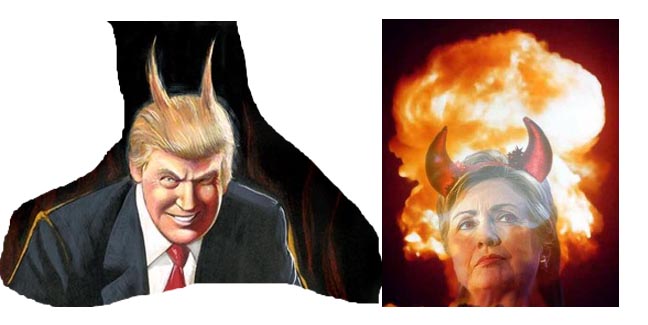
The Nominees

The Nominees

Neither of these candidates are good for America. I see two Twilight Zone Devils.

In other words they appear reasonable until the until the last moment when they will do their nasty acts.  Of course we won’t know that until it has happened.

Hillary Clinton is an insider who has too many donors that will have the final say on her actions as president. She is most likely to follow the philosophy of her husband (former President Bill Clinton). Recall that he signed the law revoking the Glass-Steagall act of 1933 that prohibited commercial banks from engaging in the investment business. He also signed into law NAFTA, a law proposed by Republicans and pushed by President George H.W. Bush that resulted in numerous companies relocating to Mexico.

Donald Trump has no experience in public office and does not appear to understand the workings of the federal government. He clearly does not understand the total significance of the Bill of Rights. “One of the things I’m going to do if I win… I’m going to open up our libel laws so when they write purposely negative and horrible and false articles, we can sue them and win lots of money,” Trump said during a rally in Fort Worth, Texas. He has limited understanding of the relations the United States has with other countries and like most of us does not know a great deal about our military capabilities. He is a scholar of business.

Let’s start with Hillary Clinton.

  1. There is no explanation to be found where she tells where she was and what she was doing when Benghazi, Libya was attacked.
  2. The use of her private e-mail server does not appear to have compromised anything. However, her use of that device calls into question her judgement.
  3. There is no theme to her campaign for president. Her entire theme seems to be she will continue the Obama administration and the banners saying “She’s with Us” and “Fighting for us.” The number one reason Hillary should be our next president according to her web site is “As a former secretary of state, U.S. senator, first lady, and a lifelong advocate for women and families, no one is more qualified to be president than Hillary.”

Let’s look at Donald Trump.

  1. He has never held any elected office.
  2. People might ask “How is Donald Trump able to file for bankruptcy so many times?” The answer is “He didn’t.” Trump himself has never filed for bankruptcy. His corporations have filed for Chapter 11 bankruptcy four times. This information from http://thelawdictionary.org/.
  3. Is he a buffoon? A genius? An exploration of the man, his brand, and his chronic bluster at The Atlantic offers a perspective.
  4. Foreign trade is a big part of the Trump campaign. Donald Trump’s trade war could kill millions of U.S. jobs contends Jim Tankersley in The Washington Post.

Go ahead and choose your devil. Just understand that in four years you will be ready for another unacceptable president. Ugh!!

When a Cartoon Character Thinks he is Real

The idea of Donald Trump as president of the United States is the same as imagining a cartoon character being depicted as the president. To the best of my knowledge no one has ever done that. Donald Trump is trying.

First consider that Mr. Trump has never held ANY elected office anywhere. He is obviously a smart man in many ways, having built a multibillion dollar business mostly through his own efforts.

In all of his negotiations and business dealings government actions or inactions have been of no consequence to him as long as they did not impact has intentions.   As a consequence he was not an expert or perhaps even an interested party in law or international affairs.

Other than his earlier contention that Barack Obama was not a natural born citizen and thus not entitled to hold the presidency (the birther question) he did not appear to give any attention to any government policies.

I am going to build the biggest wall.
They are rapists and murderers.
We must stop all Muslims entering this country until we understand what the hell is going on.
NATO has no value anymore.
South Korea and Japan should have their own nuclear weapons.
Women who have abortions should pay a penalty.

You could not have made this up.

On the Friday night ABC national news there was a report of two men, with backpacks scale a 20 foot was on the border between Arizona and Mexico. It was accomplished in 12 seconds. For reason no one knows the men become concerned and returned to Mexico. The entire event was captured on a monitoring camera.

President Obama commented on Trump’s lack of international knowledge at a news conference on nuclear proliferation. CNN report: President Barack Obama said Donald Trump’s suggestion that Japan and South Korea should consider obtaining nuclear weapons demonstrates the Republican presidential front-runner’s lack of understanding about foreign policy and the world at large. He concluded, “We don’t want someone in the Oval Office who doesn’t recognize how important that is.”

Like Who Framed Roger Rabbit? and Honey, I Shrunk the Kids, cartoons do not reflect the real world. The real world is not The Apprentice.

Americans Are Struggling with Behavior that Contradict with their Beliefs

Ted Cruz and Donald Trump understand Americans real beliefs and hatreds and are playing on those viewpoints.

Strictly religious Christians and Jews have very rigid laws about human behavior. They really do not want any behavior by anyone that conflict with their beliefs

Thus we see laws proposed (and some signed into law) in Arkansas, Georgia, and Indiana that would protect the rights of people who choose to discriminate. Specifically these laws give people the right to discriminate against homosexuals and gay marriage. Similarly many states have created laws that limit the right to an abortion.

All of these laws are a response to evangelical Christians, orthodox Catholics and Jews.

However, Muslim beliefs are not to be tolerated by those religious Christians and Jews.

It now appears that money may impact their willingness to tolerate those that are different. The Walt Disney Co. would stop film production in Georgia if they sign into law their right to discriminate law. It is estimated that $106 million is spent in Georgia by Disney. Other companies are contemplating similar action in the three states I have identified. So far, lawmakers in Georgia haven’t heeded those concerns. Legislators in Indiana and Arkansas passed similar bills last year.

What does this situation tell us about Americans? The answer is sadly obvious.

March 28, 2016

Good news!  Under increasing pressure from major corporations that do business in Georgia, Gov. Nathan Deal announced Monday he will veto a bill that critics say would have curtailed the rights of Georgia’s LGBT community.

Hillary Clinton is for … Hillary Clinton

At the outset I must write that Hillary Clinton as president will most likely replicate the presidency of her husband, Bill Clinton. The latest polls indicate that she will be president if the GOP nominee is Donald Trump.

Working class Americans should be concerned about how Mrs. Clinton will act towards them. We need only to look at Bill Clinton’s presidency to learn what to expect.

Bill Clinton signed a law that ended the Glass-Steagall Act. That law passed in 1933 prohibited commercial banks from engaging in the investment business. The consequence was the 2008 Great recession that brought about the collapse of many of America’s largest financial institutions. Some of those institutions were saved by The Emergency Economic Stabilization Act of 2008. On September 19, 2008 President Bush announced his financial bailout plan, the Emergency Economic Stabilization Act of 2008 to confront the financial crisis. This plan was initially rejected by the U.S House of Representatives on September 29. After a great deal of public lobbying, on October 1, the U.S. Senate passed an amended version of the bill, which was subsequently accepted by the House two days later. This legislation created the $700 billion Troubled Assets Relief Program (TARP).

NAFTA is the North American Free Trade Agreement. It was envisioned at least 30 years ago to reduce trading costs, increase business investment, and help North America be more competitive in the global marketplace. The impetus for NAFTA actually began with President Ronald Reagan, who campaigned on a North American common market. Prior to NAFTA, Mexican tariffs on U.S. imports were 250% higher than U.S. tariffs on Mexican imports. In 1991, Canada requested a trilateral agreement, which then led to NAFTA. NAFTA was signed into law by President Bill Clinton on December 8, 1993 and entered force January 1, 1994. Although it was signed by President Bush, it was a priority of President Clinton’s, and its passage is considered one of his first successes.

The Commodity Futures Modernization Act of 2000, which ensured that over-the-counter, or OTC, financial derivatives would remain almost entirely unregulated and which was signed into law by President Bill Clinton in December 2000, just before he left the White House. Thanks to the 2000 act, according to 2010 Congressional testimony by Michael Greenberger of the University of Maryland law school, the “multi-trillion-dollar OTC derivatives market was removed from almost all pertinent federal and state enforcement to which trading markets had been subject since the New Deal….In effect, almost no law applied to this market.”

As reported in the New York Times on February 9, 2016 Mrs. Clinton’s top donors:

-George Soros, Billionaire philanthropist and investor.                   $7.0 million

-Cheryl Saban, Philanthropist and wife of Haim Saban, an entertainment mogul.
$2.5 million

-Haim Saban, California media investor, major Democratic donor and husband of Cheryl Saban, philanthropist.
$2.5 million

-Herbert M. Sandler, Founder, with his wife, Marion, of Golden West Financial, the giant California savings and loan bought by the Wachovia Corporation in 2006.
$2.5 million

-S. Donald Sussman, Founder and chairman of Paloma Partners LLC.
$2.5 million

-Laure Woods, Bay Area philanthropist.                                           $2.3 million

-Barbara Lee, Philanthropist in Cambridge, Mass.; founder of the Barbara Lee Family Foundation and the Barbara Lee Political Office.                                                     $1.7 million

-Patricia A. Stryker, Heir to a fortune from a medical supplies company. Owner of the Stryker Sonoma winery.                                                                       $1.3 million

-Jeffrey Katzenberg, Chief executive of DreamWorks Animation. $1.0 million

-Stephen M. Silberstein, Co-founder of Innovative Interfaces, a company that develops automated systems for libraries, in 1978 and served as its first president.  $1.0 million

-Steven Spielberg, Filmmaker and chairman of Amblin Partners.   $1.0 million

-Bernard L. Schwartz, Chairman and chief executive of BLS Investments.
$1.0 million

-S. Daniel Abraham, Billionaire philanthropist and former chairman of the company that created Slim Fast diet products.                                                             $1.0 million

As Donald Trump pointed out the big donors are not giving those millions of dollars for nothing. They expect to be remembered. Their interests will come before the American people. You can expect the TPP and the TAP to be signed into law if Hillary Clinton is elected president.

My conclusion is there really is no one running for president to protect the American people.

A Supreme Court Nomination Scenario

merrick-garland--supreme-court-nominee-

Donald Trump’s lead to win the Republican Party nomination could easily provide a path to Judge Merrick Garland’s ascent to the Supreme Court.

Here is my logic. Donald Trump has been behind Hillary Clinton in all the polls showing their likelihood to win in a general election. As of now the Clinton lead is relatively small but as the calendar approaches November and Clinton is still leading, the GOP leadership in the Senate may soften. For sure after an election of Clinton the Senate may rush to approve the Garland nomination because they might fear a more liberal nomination.

Garland has an impeccable record and at 63 his time on the Supreme Court is probably limited.

Donald Trump is Don Rickles in Disguise

Donald Jay “Don” Rickles (born May 8, 1926) is an American stand-up comedian, voice actor, and actor. Best known as an insult comic.  Donald Trump (Does anyone call him Don?) seems to think Rickles is someone to emulate.  Trump would be a great replacement in Las Vegas for the Rickles insult show.

Do you really want this man to be president of the United States?

Dec 22, 2015 – Republican presidential candidate Donald Trump used crude … He said schlong is a more specific and dirty word than schmuck.

February 8, 2016: At a rally on Monday night in Manchester, New Hampshire, Donald Trump repeated a woman’s shouted remark that Ted Cruz was a “pussy” for his comments about waterboarding during the previous Saturday’s Republican debate.

Following are quotes from Donald Trump.

“Robert Pattinson should not take back Kristen Stewart. She cheated on him like a dog & will do it again – just watch. He can do much better!”

Clearly Donald is a Team Edward kind of guy…

“Ariana Huffington is unattractive, both inside and out. I fully understand why her former husband left her for a man – he made a good decision.”

Trump always has charming things to say about successful, prominent women – but he stooped particularly low with this comment about Huffington Post founder.

“You know, it really doesn’t matter what the media write as long as you’ve got a young, and beautiful, piece of ass.” 

Trump proves (again) that he views a woman’s looks over anything else…

“I will build a great wall – and nobody builds walls better than me, believe me – and I’ll build them very inexpensively. I will build a great, great wall on our southern border, and I will make Mexico pay for that wall. Mark my words.” 

Oh for goodness sake.

“When Mexico sends its people, they’re not sending the best. They’re not sending you, they’re sending people that have lots of problems and they’re bringing those problems with us. They’re bringing drugs. They’re bring crime. They’re rapists… And some, I assume, are good people.” 

Just another casually racial slur, then…

“Our great African-American President hasn’t exactly had a positive impact on the thugs who are so happily and openly destroying Baltimore.” Don’t worry, his racist outbursts aren’t just directed at Mexico.

“If I were running ‘The View’, I’d fire Rosie O’Donnell. I mean, I’d look at her right in that fat, ugly face of hers, I’d say ‘Rosie, you’re fired.’”

Trump has infamously hated on Rosie O’Donnell, making crude, sexist and misogynistic remarks about her on multiple occasions.

“All of the women on The Apprentice flirted with me – consciously or unconsciously. That’s to be expected.” Because of course, no woman can resist Trump’s charms. [Throws up on keyboard]

“One of they key problems today is that politics is such a disgrace. Good people don’t go into government.”

Well at least he’s showing some self awareness.

“The beauty of me is that I’m very rich.”

And not that fabulous barnet of yours?

“It’s freezing and snowing in New York – we need global warming!”

Definitely not missing the point…

“I’ve said if Ivanka weren’t my daughter, perhaps I’d be dating her.”

Possibly (/definitely) one of the creepiest things we’ve ever heard…

“My fingers are long and beautiful, as, it has been well documented, are various other parts of my body.” Ew.

“I have never seen a thin person drinking Diet Coke.”

We’re glad he’s so concerned about the obesity crisis.

“I think the only difference between me and the other candidates is that I’m more honest and my women are more beautiful.”

Women aren’t possessions, Donald. They can’t belong to you.

“You’re disgusting.”

To put this into context, Donald Trump said this to the opposing lawyer during a court case when she asked for a medical break to pump breast milk for her three-month-old daughter.

“The point is, you can never be too greedy.”

Campaign slogan = sorted.

“Sorry, there is no STAR on the stage tonight!”

In his Twitter liveblogging of the Democratic debate, Trump seemed to think he was watching a talent show rather than looking for the next POTUS.

“My Twitter has become so powerful that I can actually make my enemies tell the truth.”

We think Donald may be overestimating the power of Twitter.

“My IQ is one of the highest — and you all know it! Please don’t feel so stupid or insecure; it’s not your fault.”

Don’t worry, we won’t.

“I have so many fabulous friends who happen to be gay, but I am a traditionalist.”

What does that even mean?

“The other candidates — they went in, they didn’t know the air conditioning didn’t work. They sweated like dogs…How are they gonna beat ISIS? I don’t think it’s gonna happen.” 

Because sweating = the inability to solve a political crisis. Gotcha.

“Look at those hands, are they small hands? And, [Republican rival Marco Rubio] referred to my hands: ‘If they’re small, something else must be small.’ I guarantee you there’s no problem. I guarantee.”

The Final GOP Primary Debate-It Was Civil

Perhaps it was the warm weather of Florida or maybe they all came to their senses and realized that name calling is not presidential. Finally the four remaining candidates had a civil discussion on some of the issues facing the United States. Sadly, like most politicians, their solutions to problems were vague.

Missing from the discussion was an explanation of how they could get along with Democrats. Donald Trump was the only one who said he is flexible and was willing to consider compromise with those damn Democrats.

Ben Shapiro, editor-in-chief at The Daily Wire and editor-at-large for Breitbart News Network.
“Trump gets an A not because he says anything of particular value (he never does) or because he has actual solutions (nope) or any basic principles (try again). He gets an A because he’s already winning. All he has to do is keep on winning and avoid a major slip-up. He did that tonight.”

In other words, all Trump needs to do is avoid saying anything foolish, look presidential and play out the clock until the convention and he will have the nomination.

Donald Trump, the Great Betrayer

The Washington Post Masthead

Now, at long last, the big guns are being brought to bear. Now, at long last, some major Republicans like Mitt Romney are speaking up to lay waste to Donald Trump.

For months Trump’s rivals and other Republicans have either retreated in silence or tentatively and ineptly criticized him for exactly those traits that voters like about him: for being a slapdash, politically incorrect money-hungry bully.

But now finally — at long last — major Republicans are raising their heads and highlighting Trump’s actual vulnerability: his inability to think for an extended time about anybody but himself.

He seduces people with his confidence and his promises. People invest time, love and money in him. But in the end he cares only about himself. He betrays those who trust him and leaves them high and dry.

It’s unpleasant to have to play politics on this personal level. But this is a message that can sway potential Trump supporters, many of whom have only the barest information on what Trump’s life and career have actually been like.

This is a message that can work in a sour and cynical time among voters who already feel betrayed. This is a message that can work because it’s a personality type everyone understands. This is a time when it is not in fact too late, when it may still be possible to prevent his nomination.

The campaign against Trump has to be specific and relentless: a series of clear examples, rolled out day upon day with the same message. Donald Trump betrays.

It can start with Trump University, where Trump betrayed schoolteachers and others who dreamed of building a better life for themselves.

Trump billed his university as a place people could go to learn everything necessary about real estate investing. According to a 2013 lawsuit filed by New York’s attorney general, Eric Schneiderman, more than 5,000 people paid $40 million, a quarter of which went to Trump himself.

Internal Trump University documents suggest that the university wasn’t really oriented around teaching, but rather around luring customers into buying more and more courses.

According to the New York lawsuit, instructors filled out course evaluations themselves or had students fill out the non-anonymous forms in front of them, pressuring them into giving positive reviews. During breaks students were told to call their credit card companies to increase their credit limits. They were given a script encouraging them to exaggerate their incomes. The Better Business Bureau gave the school a D- rating in 2010.

“They lure you in with false promises,” one student, Patricia Murphy, told The Times in 2011. Murphy said she had spent about $12,000 on Trump University classes, much of it racked up on her credit cards. “I was scammed,” she said.

The barrage can continue with Trump Mortgage. On the campaign trail, Trump tells people he saw the mortgage crisis coming. “I told a lot of people,” he has said, “and I was right. You know, I’m pretty good at that stuff.”

Trump’s biggest lies are the ones he tells himself. The reality is that Trump opened his mortgage company in 2006. Others smelled a bubble, but not Trump. “I think it’s a great time to start a mortgage company,” he told CNBC. “The real estate market is going to be very strong for a long time to come.”

Part of the operation was a boiler room where people cold-called clients, sometimes pushing subprime loans and offering easy approval.

Jennifer McGovern had trusted Trump and went to work for him. But she got stiffed in the end. In 2008 a New York State Supreme Court judge ordered Trump Mortgage to pay her the $298,274 she was owed. The bill wasn’t paid. “The company was set up in a way that we could never recover what we were owed,” she told The Washington Post.

The stories can go on and on. The betrayal of investors when his casino businesses went bankrupt. The betrayal of his first wife with his flagrant public affair with Marla Maples. The betrayal of American workers when he decided to hire illegals. The people left in the wake of other debacles: Trump Air, Trump Vodka, Trump Financial, etc.

These weren’t just risks that went bad. They were shams, built like his campaign around empty promises and on Trump’s fragile and overweening pride.

The burden of responsibility now falls on Republican officials, elected and nonelected, at all levels. For years they have built relationships in their communities, earned the right to be heard. If they now feel that Donald Trump would be a reckless and dangerous president, then they have a responsibility to their country to tell those people the truth, to rally all their energies against this man.

Since the start of his campaign Trump has had more energy and more courage than his opponents. Maybe that’s now changing.

Who does Donald Trump remind you of?

Is Donald Trump the new Hitler or a reincarnation of William Jennings Bryan?  In a piece on U.S, News and World Report web site Daniel Klinghard, on March 4, 2016, thinks Trump is reminiscent of Bryan.  Following is a slightly abridged version of the article.


Pundits and academics toyed for a while with branding Donald Trump with the scarlet H – warning of his rise as a replay of the fall of Weimar Germany and the emergence of Adolf Hitler. Trump’s suggestions that the government surveil mosques, deport undocumented Mexicans and prevent Muslims from entering the U.S. was originally hailed as more Nazi than American, until we reflected on the pervasiveness of NSA surveillance, the treatment of Japanese-Americans during World War II and the mass deportations of Operation Wetback in 1954. Indeed, there are enough examples of such Trumpisms in the American tradition for comparisons of demagoguery without having to conjure up Hitler.

Consider William Jennings Bryan, who captured the Democratic presidential nomination 120 years ago in 1896. He made a name for himself as a journalist (both before and after serving as a member of the House of Representatives) and importantly as an orator who toured the country to speak to populist groups and agitate for the abandonment of the gold standard and the adoption of a silver-based currency. In his appeal to lowbrow tastes, his ability to turn politics into popular entertainment and his willingness to play to prejudice against judgment, Bryan was closer to a modern-day reality TV star than Trump is to Hitler.

To secure the nomination, Bryan applied the same rhetorical style that he had honed in prairie schoolhouses and southern convention halls – a popular forum that had been all but ignored by party elites, but through which he generated a “silent majority” that struck the establishment by surprise in 1896.

Among the most popular tools of the Bryan campaign were a series of ill-informed and wildly popular pamphlets featuring a young boy who lectured bankers on the intricacies of global finance. Witty, anti-Semitic and grossly simplistic, they reassured voters that there were solutions to America’s economic woes – solutions so clear that a child could see them. Like Trump, Bryan appealed to what he deemed to be common sense and warned his listeners that anyone preaching moderation only intended to keep the common man in the dark.

Fifteen Democratic candidates received votes for the nomination at the 1896 convention, including six governors, five senators and the sitting vice president of the United States. They never overcame their interpersonal opposition to present a united front against Bryan, a former two-term representative and newspaper editor. Indeed, they hardly considered Bryan a serious contender until the convention met and he delivered his famous “Cross of Gold” speech decrying the gold standard and calling Democrats to an apocalyptic battle against the “Eastern Elites” who dominated both parties.

The elevation of Bryan had long-term implications for his party. His predecessor as Democratic nominee, President Grover Cleveland, had made his career following a formula of running on reform principles and governing pragmatically. After 1896, Cleveland was a man without a party. He refused to support Bryan and retired in despair when Republican nominee William McKinley trounced Bryan and set up the GOP for a thirty-year period of dominance.

Bryan remained the master of what was left of the Democratic Party, despite the clear flaws in his candidacy and his isolation from the party’s establishment – particularly from its traditional major donors, nearly all of whom abandoned the party after 1896.

It is easy to imagine the emergence of an analogous situation under a Republican collapse today, even if it is one with different policy objectives. In fact, if you look at a map of the 1896 electoral college results demonstrating Bryan’s loss, you’re looking at the basic parameters of a Trump loss (with some give and take around the edges, particularly Washington, Virginia and Florida).

If the Republicans of 2016 go the direction Democrats went with Bryan in 1896, it could mean years of wandering in the wilderness. We might look toward such a proposition with hope that the polarized politics of the past fifteen years would at last be broken. But we should also be warned of a democratic deficit, in which the incentives to mobilize in support of Democratic politics would wither along with the possibility of real party competition.