
We Are Not Criminals
Kirk spread hate!
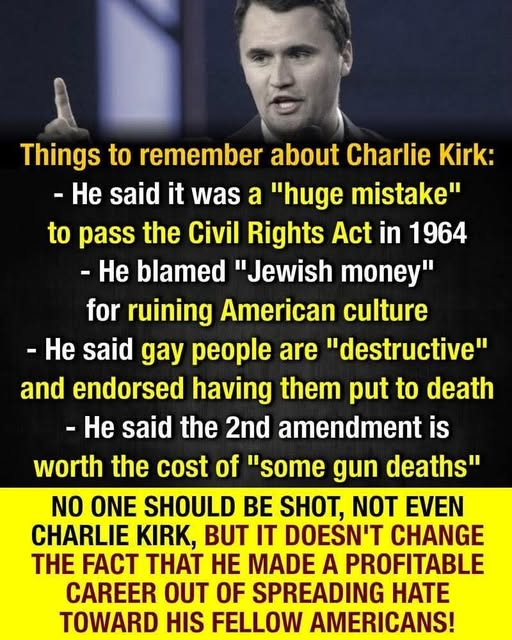
Kirk was known to be a gun owner himself and regularly spoke out on the issue, including on behalf of the National Rifle Association in the aftermath of the massacre at Marjory Stoneman Douglas High School in Parkland, Florida, in February 2018.
At a Turning Point event in Salt Lake City in April 2023, he said, “It’s worth it to have a cost of, unfortunately, some gun deaths every single year so that we can have the Second Amendment.”
Kirk adopted a traditional Christian conservative stance in his approach to many contemporary issues, telling an audience at a Trump election rally in Georgia last fall that Democrats “stand for everything God hates” and adding: “This is a Christian state. I’d like to see it stay that way.”
He also lashed out at the gay community, denouncing what he called the “LGBTQ agenda,” expressing opposition to same-sex marriage and suggesting that the Bible verse Leviticus 20:13, which endorses the execution of homosexuals, serves as “God’s perfect law when it comes to sexual matters.”
Generally Kirk was loyal to Trump, whom he saw as key to establishing the conservative Christian America he wanted to help realize, one in which abortion is heavily restricted to cases of medical emergency in which the mother’s life cannot be saved by any other means, women enter higher education to find husbands and “woke” ideologies play no part in public life.
Sadly we’re heading in that direction
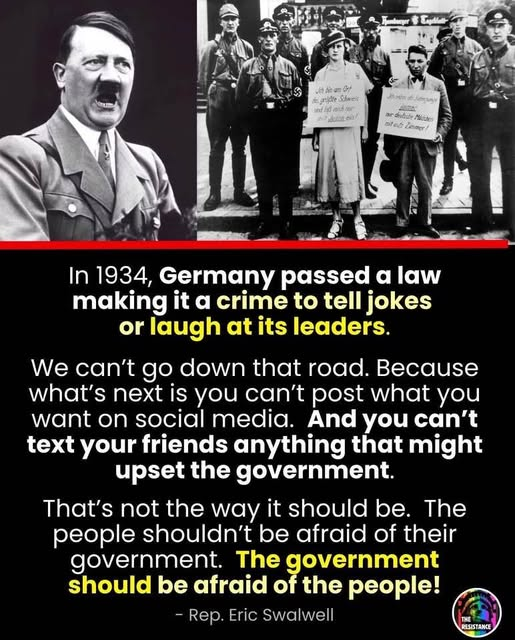
The war on the United States Constitution is now on full display. President Donald Trump is the leader of the war. Being no fool, Trump is chipping away rather than a full declaration that the Constitution is obsolete. Why doing his plan this way he appears to believe he can accomplish his goal without an uprising of most people. He is succeeding!
Trump’s attack on the free press began as he was running for his second term. The Washington Post and Los Angeles Times owners nixed their editorial boards endorsements of Kamala Harris. The Times went even further than the Post when it canceled its editorial board. Why did they block the endorsements? They feared the attacks that Trump would bring to their businesses if he was elected that they were anticipating.
Now that Trump has been elected that same fear is being felt among the communication corporations. ABC, NBC, CBS are Trump’s targets and they too have decided that it is better to accede to Trump’s demands.
From todays news:
First Amendment
Congress shall make no law respecting an establishment of religion, or prohibiting the free exercise thereof; or abridging the freedom of speech, or of the press; or the right of the people peaceably to assemble, and to petition the Government for a redress of grievances.
So what is next? Laws about religion?
Trump is succeeding.
The Bureau of Labor Statistics (BLS) has again handed President Donald Trump a bleak set of jobs numbers, just one month after he fired the agency’s commissioner over weak employment data.
On Friday morning, the BLS reported that nonfarm payroll employment rose by only 22,000 in August. Analysts had forecast that the economy would add 75,000 jobs during the month. According to the agency, gains made in health care were offset by losses in federal government employment, as well as mining, quarrying and oil and gas extraction.
While July’s figures were revised up to 79,000 from 73,000, June’s numbers were revised down by 27,000, dropping from 14,000 to minus-13,000. Meanwhile, the unemployment rate edged up to 4.3 percent from 4.2 percent.
Lowering interest rates to stimulate the economy is known as expansionary monetary policy. This policy aims to reduce borrowing costs, encouraging households and businesses to increase spending and investment, which helps boost economic activity.
Given that the employment rose by only 22,000 in August it is likely that the Fed will lower the interest rate as Donald Trump has been pushing.
The newest Nobel Peace Prize will be announced 10 October 2025.

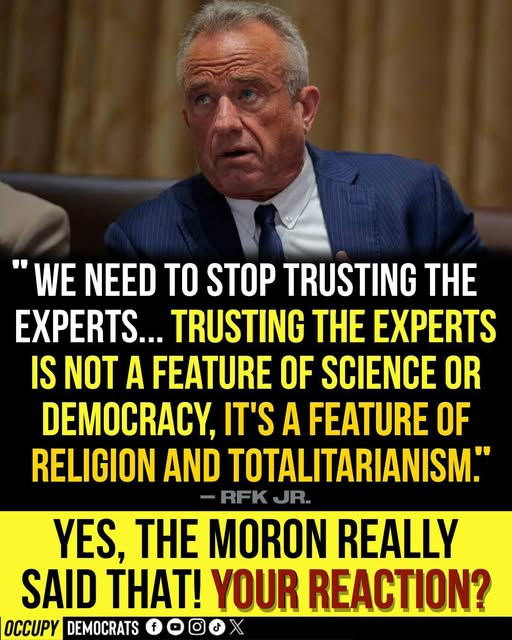
This lunatic—a barking carnival clown with ZERO medical education, training, experience or degree—is going get us all killed.

What to do about this? I like Option 3
WE ARE NOW IN A FASCIST DICTATORSHIP, BUT THERE IS YET HOPE
Edited For Brevity
By Raul Maseda
“In 1933, German conservatives thought they could control Hitler. Two years later, they were being executed in their own homes. I spent weeks researching this question, desperately looking for counter-examples, for hope, for any time in history where people successfully stopped fascists after they started winning elections.
The pattern is so consistent it’s almost funny if it weren’t so terrifying. Every single time it goes like this: Conservatives panic about socialism or progressives or whatever. They ally with fascists as the ‘lesser evil.’ Fascists take power. Fascists immediately purge the conservatives who helped them. Then it’s 30-50 years of dictatorship. This happened in Germany, Italy, Spain, Chile, Argentina, Brazil, Greece, Portugal, Croatia, Romania, and Hungary.
Want to know how many times conservatives successfully ‘controlled’ the fascists they allied with? Zero. Want to know how many times fascists purged the conservatives after taking power? All of them. Every single time.
And here’s the part that breaks your heart. Violence works. For them. Fascists use violence while claiming to be victims. They create chaos that ‘requires’ their authoritarian solution. Then they purge anyone who opposes them. Meanwhile, democrats keep insisting on following rules that fascists completely ignore. They file lawsuits. They write editorials. They vote on resolutions. And fascists just laugh and keep consolidating power.
The Supreme Court declared Trump above the law. He’s threatening to arrest political opponents. He’s already sent the FBI after elected officials when they haven’t committed crimes. Congress is his. Most state governments are his. Billionaire oligarchs openly coordinate with him.
So let’s start talking about what you do when fascists already control the institutions but haven’t fully consolidated power yet. Because historically, nobody’s been here before, not like this.
But that also means the old rules about what’s possible might not apply.
Option 1: The Blue State Coalition
California’s economy is bigger than the UK’s. New York controls global finance. The blue states collectively represent over 60% of America’s GDP. They could, theoretically, make the federal government irrelevant.
Imagine if California, Oregon, Washington, New York, Massachusetts, and others started coordinating directly. Ignoring federal mandates. Creating their own interstate compacts for everything from climate policy to civil rights. They already started this with climate agreements when Trump pulled out of Paris. But I’m talking about going much further.
State-level cryptocurrency to avoid federal monetary control. State-funded healthcare systems that ignore federal restrictions. State-level immigration policies that simply refuse to cooperate with ICE. Make the federal government have to physically enforce every single policy, stretching their resources to breaking.
The precedent? The way Northern states nullified fugitive slave laws in the 1850s. The way states are currently ignoring federal marijuana prohibition. But coordinated and comprehensive.
Option 2: Selective Compliance and Irish Democracy
The Irish called it ‘Irish Democracy’ when they were under British rule, the silent, dogged resistance of millions who simply ignored laws they found illegitimate. Don’t protest. Don’t riot. Just don’t comply.
Red states need blue state money. Blue state taxes fund red state governments. What if millions of people in blue states simultaneously decided to claim exempt on their W-4s and simply… stopped paying federal taxes? Not as protest but as a coordinated ‘forgetting.’ Overwhelm the IRS. Make enforcement impossible.
Doctors in blue states could ignore abortion restrictions. Teachers could ignore curriculum mandates. State police could refuse to enforce federal laws. Not dramatically, just… incompetently. ‘Sorry, we couldn’t find them.’ ‘The paperwork got lost.’ ‘Our systems are down.’
Make every single act of authoritarian control require physical enforcement, then make that enforcement impossibly expensive and difficult.
Option 3: Secession
We already have two incompatible visions of what America should be. One side wants a multi-ethnic democracy with a social safety net. The other wants a white Christian ethnostate with unlimited corporate power. These cannot coexist indefinitely.
What if blue states started seriously discussing secession? Not threatened as political theater but actually planned. Constitutional conventions. Referendums. Negotiations for national debt division. Military base transfers. Currency agreements.
Yes, the last time states tried to leave it caused a civil war. But that was over slavery, with clearly defined geographic boundaries and two relatively equal economic systems. This would be the economic powerhouses leaving the welfare states. What would the red states do, invade California? With what money?
The mere serious threat might be enough to force structural changes. Quebec nearly left Canada twice and got massive concessions both times just from credible threats.
We’re past normal. The fascists already won round one. They control the institutions. They have their judges. They have their media ecosystem. They have their army of true believers who will excuse anything.
But they don’t have the money. They don’t have the cities. They don’t have the educated workforce. They don’t have the young. And most importantly, they don’t have legitimacy in the eyes of the majority.
The historical record says once fascists gain power, they stay for 30-50 years. But the historical record doesn’t have examples of fascists taking over a country where their opposition controls most of the economy, technology, and cultural production. We’re in uncharted territory, which means we need unprecedented responses.
The German conservatives who said ‘we can control him’ were all dead or fled within two years. We’re just months into our version of this story. The question is: are we going to be the first generation that finds a new way out, or are we going to be another cautionary tale future historians write about?
At least we’re finally asking the right questions.”
– Chris Armitage

 Coast Contact