The only way Trump is going to be stopped

Opinion by Robert Reich, a professor of public policy at Berkeley and former secretary of labor. 

If the Trump regime can dictate what the universities of America teach or research or publish, or what students can learn or say, no university is safe.

Not even the truth is safe.

If the Trump regime can revoke student visas because students exercise their freedom of speech on a university campus, freedom of speech is not secure for any of us.

If the Trump regime can abduct a permanent resident of the United States and send him to a torture prison in El Salvador, without any criminal charges, no American is safe.

What do we do about this?

We stand up to it. We resist it. We denounce it. We boldly and fearlessly reject it —regardless of the cost, regardless of the threats.

As columnist David Brooks writes in his column yesterday (I’m hardly in the habit of quoting David Brooks):

It’s time for a comprehensive national civic uprising. It’s time for Americans in universities, law, business, nonprofits and the scientific community, and civil servants and beyond to form one coordinated mass movement. Trump is about power. The only way he’s going to be stopped is if he’s confronted by some movement that possesses rival power.

But what does a national civic uprising look like?

It may look like a general strike — a strike in which tens of millions of Americans refuse to work, refuse to buy, refuse to engage in anything other than a mass demonstration against the regime.

And not just one general strike, but a repeating general strike — a strike whose numbers continue to grow and whose outrage, resistance, and solidarity continue to spread across the land.

I urge all of you to start preparing now for such a series of general strikes. I will inform you of what I learn about who is doing what. (One possible place to begin is here.)

In the meantime: This evening, Friday, April 18, bells will be sounded in Boston’s Old North Church (the one-if-by-land church where lanterns signaled Paul Revere to warn the Minutemen of the approaching troops) and in churches across the country, to celebrate the 250th anniversary of the Battles of Lexington and Concord, which began the American Revolution. I urge you to have your place of worship join in the ringing. (More information can be found here.)

Tomorrow, Saturday, April 19, protests are being organized around the country by 50501. See here.

My friends, what the Trump regime has unleashed on America is intolerable. It is time — beyond time — for a national civic uprising. We must take action.

Should you be interested, here’s what I said yesterday at a rally on Berkeley’s famed Sproul Plaza, the site of the beginning of the Free Speech Movement, a little over 60 years ago.

This is not going to happen in the near term because a majority of Americans today support Trump.

Having launched a historic global trade war that set the stock market on rollercoaster week, Trump’s approval ratings were bound to change. His presidential approval rating remained steady over the first two months and even reached his all time highest rating in either of his terms.

However, his third month in office is showing that the American public’s opinion has soured amid the onslaught of tariffs and trade wars and the mounting fears of a possible recession.

According to the HarrisX polls, Trump’s approval rating has dropped since he took office, but still above water with an overall job approval rating of 48% versus 46% that disapprove. 

Amid last week’s tariff turmoil, the Quinnipiac University Poll shows 72% of voters think tariffs will hurt the U.S. economy in the short-term while only 53% think the tariffs will hurt in the long-run and 41% think it will help the economy in the long-run.

According to Rasmussen Reports daily polling, Trump has enjoyed over a steady job approval rating over over 50% on any given day since his inauguration — until April 3 — the day after the sweeping tariff announcement. His rating has since slipped lower every day to a current 47% approval and 51% disapproval.

An Eradic Behavior

“Trump’s ‘will he, won’t he’ tariff chaos is just one more con on working people.”

That’s what Melinda St. Louis, Global Trade Watch director at the watchdog group Public Citizen, said in a Wednesday statement after U.S. President Donald Trump announced a 90-pause for what he has called “reciprocal” tariffs, excluding China.

It seems Donald Trump wants a recession. Why? A recession will drive down the price of real estate, companies, and shares of stock. Trump and his fellow billionaires want o buy everything on the cheap and then enjoy the ride upward-no matter the cost to working people.

“OUR PLAN IS WORKING PERFECTLY AND IS JUST A NEGOTIATING TACTIC BUT IT IS ALSO GOING TO BE PERMANENT AND WE WILL BE THE WORLD LEADER IN TEXTILES AND NOW THERE IS A PAUSE AND EVERYONE NEEDS TO CHILL BUT ALSO WE WILL NEVER BACK DOWN AAAAAAHHHHHH.”

US stocks tumbled today after the White House clarified that its tariff on all Chinese goods was at least 145% — even higher than previously believed. This comes a day after US stocks skyrocketed following President Donald Trump’s announcement of a 90-day pause on all “reciprocal” tariffs, except for China. Beijing, meanwhile, implemented its own retaliatory tariffs of 84% on US goods.

• Trade negotiations: Trump just defended his tariff policy in a Cabinet meeting, saying his administration is “working on deals” with multiple countries. Earlier today, the EU announced it would pause its retaliatory US tariffs for negotiations. Even after Trump’s U-turn, economists say the damage is done.

DOW down 1,835.94, S&P 500 down 281.5 5.5% mid-day April 10,2025

A majority of Americans voted for Donald Trump!

Freedom of Speech and Thought under Attack

Speaking your mind shouldn’t cost you your job, your education, or your rights. But right now, that’s exactly what’s happening all across America.

Example One:

President Trump on Thursday renewed a call to defund NPR and PBS a day after top executives from the public broadcasters faced an intense grilling from GOP lawmakers on Capitol Hill.

“NPR and PBS, two horrible and completely biased platforms (Networks!), should be DEFUNDED by Congress, IMMEDIATELY,” Trump wrote late Wednesday on Truth Social. “Republicans, don’t miss this opportunity to rid our Country of this giant SCAM, both being arms of the Radical Left Democrat Party. JUST SAY NO AND, MAKE AMERICA GREAT AGAIN!!!”

Example Two:

Students at public colleges and universities are protected by the First Amendment freedoms of religion, speech, press, assembly and petition. Private schools do not have that protection.                         

Columbia University, officially Columbia University in the City of New York, is a private Ivy League research university in New York City. 

On 8 March, Immigration and Customs Enforcement (Ice) agents arrested Mahmoud Khalil, a graduate student at Columbia University, as he was returning from dinner with his wife in New York. The agents said the state department had revoked his student visa and green card, though he had never been accused of, let alone convicted for, a crime. He was held in detention in New Jersey, then transferred to Louisiana. He has still not been accused a crime.

Nevertheless, Donald Trump’s state department, headed by Marco Rubio, seeks to deport him under a provision of federallaw that gives him the power to deport someone if their presence in the country is deemed to “have potentially serious adverse foreign policy consequences for the United States”. Khalil’s crime? He was a lead organizer of Columbia’s protests for Palestinian rights.

“Who has the right to have rights? It is certainly not the humans crowded into the cells here,” Khalil, a Palestinian raised in exile in a Syrian refugee camp, wrote in a letter proclaiming his status as a “political prisoner”. He is the one of the most prominent targets of a chilling federal crackdown over pro-Palestinian advocacy in the US, particularly on college campuses. And he is one of the most forceful voices in The Encampments, a new documentary on the campus movement for Palestine that has drawn ire from across the US political spectrum, in particular the right.

Example Three:

The nation’s legal profession is being split between those that want to fight back against President Trump’s attacks on the industry and those that prefer to engage in the art of the deal.

Two big firms sued the Trump administration on Friday, seeking to stop executive orders that could impair their ability to represent clients. The lawsuits filed by Jenner & Block and WilmerHale highlight how some elite firms are willing to fight Mr. Trump’s campaign targeting those he doesn’t like, while others, like Paul Weiss and Skadden, have cut deals to appease the president.

In recent weeks, Mr. Trump has issued similarly styled executive orders against firms that he perceives as enemies and threats to national security. The orders could create an existential crisis for firms because they would strip lawyers of security clearances, bar them from entering federal buildings and discourage federal officials from interacting with the firms.

Tyrants

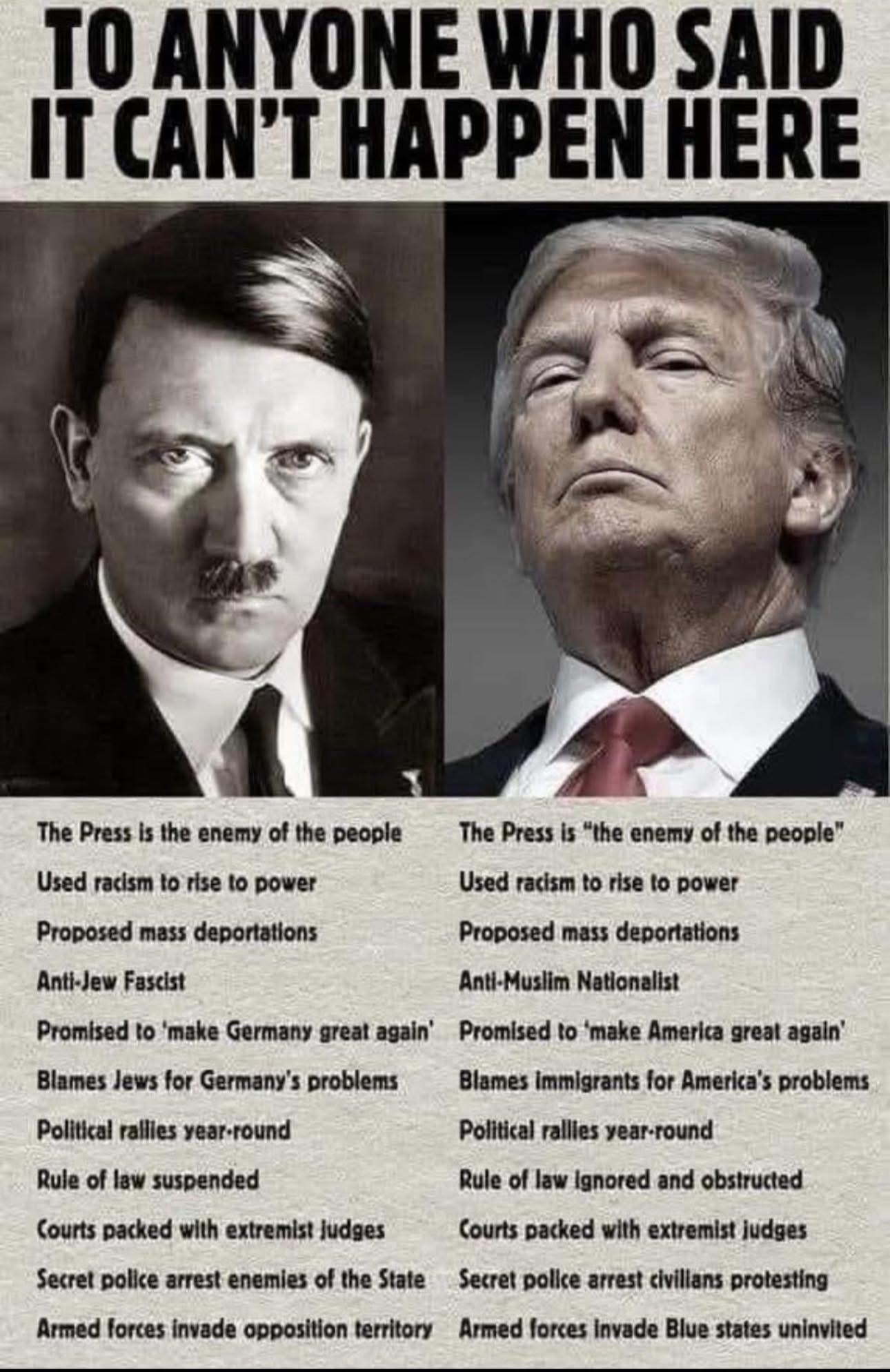
Tyrants view educated citizens as their greatest enemy. Slaveholders stopped the enslaved from learning to read. Nazis burned books. Dictators censor media. That’s why Trump is attacking education, science, museums, and the arts. Ignorance is the handmaiden of tyranny.

Trump consistently frames policy around ‘fairness,’ trading on American frustration

A long article worth reading.

By Kevin Rector, Staff Writer for the Los Angeles Times

In a sit-down interview with Fox News last month, President Trump and his billionaire “efficiency” advisor Elon Musk framed new tariffs on foreign trading partners as a simple matter of fairness.

“I said, ‘Here’s what we’re going to do: reciprocal. Whatever you charge, I’m charging,’” Trump said of a conversation he’d had with Indian Prime Minister Narendra Modi. “I’m doing that with every country.”

“It seems fair,” Musk said.

Trump laughed. “It does,” he said.

“It’s like, fair is fair,” said Musk, the world’s richest person.

The moment was one of many in recent months in which Trump and his allies have framed his policy agenda around the concept of fairness — which experts say is a potent political message at a time when many Americans feel thwarted by inflation, high housing costs and other systemic barriers to getting ahead.

“Trump has a good sense for what will resonate with folks, and I think we all have a deep sense of morality — and so we all recognize the importance of fairness,” said Kurt Gray, a psychology professor at University of North Carolina at Chapel Hill and author of the book “Outraged: Why We Fight About Morality and Politics and How to Find Common Ground.”

“At the end of the day,” Gray said, “we’re always worried about not getting what we deserve.”

In addition to his “Fair and Reciprocal Plan” for tariffs, Trump has cited fairness in his decisions to pull out of the Paris climate agreement, ban transgender athletes from competing in sports, scale back American aid to embattled Ukraine and pardon his supporters who stormed the U.S. Capitol on Jan. 6, 2021.

Trump has invoked fairness in meetings with a host of world leaders, including Japanese Prime Minister Shigeru Ishiba and British Prime Minister Keir Starmer. He has suggested that his crusade to end “diversity, equity and inclusion” programs is all about fairness, couched foreign aid and assistance to undocumented immigrants as unfair to struggling American taxpayers, and attacked the Justice Department, the media and federal judges who have ruled against his administration as harboring unfair biases against him.

Trump and Musk — through his “Department of Government Efficiency,” which is not a U.S. agency — have orchestrated a sweeping attack on the federal workforce largely by framing it as a liberal “deep state” that either works in unfair ways against the best interests of conservative Americans, or doesn’t work at all thanks to lopsided work-from-home allowances.

“It’s unfair to the millions of people in the United States who are, in fact, working hard from job sites and not from their home,” Trump said.

In a Justice Department speech this month, Trump repeatedly complained about the courts treating him and his allies unfairly, and reiterated baseless claims that recent elections have been unfair to him, too.

“We want fairness in the courts. The courts are a big factor. The elections, which were totally rigged, are a big factor,” Trump said. “We have to have honest elections. We have to have borders and we have to have courts and law that’s fair, or we’re not going to have a country.”

Before a meeting with NATO Secretary-General Mark Rutte this month, Trump complained — not for the first time — about European countries not paying their “fair share” to defend Ukraine against Russian aggression, and the U.S. paying too much.

“We were treated very unfairly, as we always are by every country,” Trump said.

Almost exclusively, Trump’s invocations of fairness cast him, his supporters or the U.S. as victims, and his critics and political opponents as the architects and defenders of a decidedly unfair status quo that has persisted for generations. And he has repeatedly used that framework to justify actions that he says are aimed at tearing down that status quo — even if it means breaching norms or bucking the law.

Trump has suggested that unfavorable media coverage of him is unfair and therefore “illegal,” and that judges who rule against him are unfair liberal activists who should be impeached.

The politics of feeling heard

Of course, grievance politics are not new — nor is the importance of “fairness” in democratic governance. In 2006, the late Harvard scholar of political behavior Sidney Verba wrote of fairness being important in various political regimes but “especially central in a democracy.”

Verba noted that fairness comes in different forms — including equal rights under the law, equal voice in the political sphere, and policies that result in equal outcomes for people. But the perception of fairness in a political system, he wrote, often comes down to whether people feel heard.

“Democracies are sounder when the reason why some lose does not rest on the fact that they are invisible to those who make decisions,” Verba wrote. “Equal treatment may be unattainable, but equal consideration is a goal worth striving for.”

According to several experts, Trump’s appeal is in part based on his ability to make average people feel heard, regardless of whether his policies actually speak to their needs.

Gray said there is “distributive fairness,” which asks, “Are you getting as much as you deserve?” and “procedural fairness,” which asks, “Are things being decided in a fair way? Did you get voice? Did you get input?”

One of Trump’s skills, Gray said, is using people’s inherent sense that there is a lack of distributive fairness in the country to justify policies that have little to do with such inequities, and to undermine processes that are in place to ensure procedural fairness, such as judicial review, but aren’t producing the outcomes he personally desires.

“What Trump does a good job at is blurring the line between rules you can follow or shouldn’t follow,” he said. “When he disobeys the rules and gets called out, he goes, ‘Well those moral rules are unjust.’”

People who voted for Trump and have legitimate feelings that things are unfair then give him the benefit of the doubt, Gray said, because he appears to be speaking their language — and on their behalf.

“He’s not just saying that it’s him. He’s saying it’s on behalf of the people he’s representing, and the people he’s representing do think things are unfair,” Gray said. “They’re not getting enough in their life, and they’re not getting their due.”

Lawrence Rosenthal, chair of the Center for Right-Wing Studies at UC Berkeley and author of “Empire of Resentment: Populism’s Toxic Embrace of Nationalism,” said Trump and his supporters have built him up as a leader “interested in fixing the unfairness to the working class.”

But that idea is premised on another notion, even more central to Trump’s persona, that there are “enemies” out there — Democrats, coastal elites, immigrants — who are the cause of that unfairness, Rosenthal said.

“He names enemies, and he’s very good at that — as all right-wing authoritarians are,” Rosenthal said.

Such politics are based on a concept known as “replacement theory,” which tells people to fear others because there are only so many resources to go around, Rosenthal said. The theory dovetails with the argument Trump often makes, that undocumented immigrants receiving jobs or benefits is an inherent threat to his MAGA base.

“The sense of dispossession is absolutely fundamental and has been for some time,” Rosenthal said.

John T. Woolley, co-director of the American Presidency Project at UC Santa Barbara, said Trump has “a remarkable capacity for constructing the world in a way that favors him” — even if that’s as the victim — and appears to be an “outlier” among presidents in terms of how often he focuses on fairness as a political motif.

“Certainly since his first term with impeachment, ‘the Russia hoax,’ ‘dishonest media,’ ‘fake news’ and then ‘weaponizing’ of justice — he’s constructed a kind of victim persona, in battle with the deep state, that is now really basic to his interaction with his core MAGA constituency,” Woolley said.

An idea for Democrats

In coming to terms with Trump’s win in November, Democrats have increasingly acknowledged his ability to speak to Americans who feel left behind — and started to pick up on fairness as a motif of their own, in part by zeroing in on mega-billionaire Musk.

In an interview with NPR last month, Rep. Alexandria Ocasio-Cortez (D-N.Y.) evoked the idea of unfairness in the system by saying American government is working for rich people like Musk, but not for everyone else. “Everything feels increasingly like a scam,” she said.

She and Sen. Bernie Sanders (I-Vt.) have since embarked on a nationwide “Fighting Oligarchy” tour, where they have blasted Musk’s role in government and questioned how his actions, or those of Trump, have helped average Americans in the slightest.

“At the end of the day, the top 1% may have enormous wealth and power, but they are just 1%,” Sanders wrote Friday on X. “When the 99% stand together, we can transform our country.”

Trump Does Not Have Absolute Power

Did Donald Trump have a face to face meeting with Chief Justice John Roberts or was it a telephone call? Either way Trump was apparently told he does not have absolute power over everything.

The consequence was Trump administration reinstated thousands of probationary federal workers. The Trump administration is making the move after several court orders ruled that the firings were not legal.

The decision reinstates at least 24,500 recently fired probationary workers following a pair of orders from federal judges last week that found the terminations pushed by President Donald Trump were illegal.

The reinstatements, spanning 18 departments, are outlined in a filing Monday by the Department of Justice in federal court in Maryland after a judge asked for a report on efforts to reinstate the employees.

The separate declarations from Trump officials within each of the departments offer the most detailed public account yet of the administration’s firing of recently hired or promoted probationary workers as part of Elon Musk’s Department of Government Efficiency’s push to drastically cut the federal workforce.

Here are the tallies of recently fired probationary workers, by department, the Trump administration says it is working to reinstate:

  1. Environmental Protection Agency: 419
  2. Department of Energy: 555
  3. Department of Commerce: 791
  4. Department of Homeland Security: 310
  5. Department of Transportation: 775
  6. Department of Education: 65
  7. Department of Housing and Urban Development: 299
  8. Department of Interior: 1,710
  9. Department of Labor: 167
  10. Consumer Financial Protection Bureau: 117
  11. Small Business Administration: 298
  12. Federal Deposit Insurance Corp.: 156
  13. Human Capital and Talen Management: 270
  14. General Services Administration: 366
  15. Treasury Department: 7,613 (including 7,315 IRS employees)
  16. Department of Agriculture: 5,714
  17. Department of Veterans Affairs: 1,683
  18. Department of Health and Human Services: 3,248

Conservatives have a 6-3 advantage on the high court and Trump himself nominated three of the current justices. The court has frequently sided with him in major cases, most notably the decision last year to grant former presidents wide immunity from criminal prosecution for their official actions. But in a series of emergency orders since Trump’s return to the White House, the court has preliminarily ruled against him.

At the same time, Trump appeared especially eager to woo Roberts during his joint address to Congress earlier this month.

US green card holders, student visa holders can be deported

Can a green card holder be deported from the United States? The recent arrest of Mahmoud Khalil, a Palestinian activist involved in organising campus protests over the Israel-Hamas conflict at Columbia University in New York City, has raised questions about the protections foreign students and green card holders have against deportation from the US.

A green holder and student visa holders have been given a privilege. They have no rights

A green card holder has lawful permanent resident status, allowing them to live and work in the US indefinitely. However, this status is not absolute, and deportation remains a possibility under certain circumstances. 

Rights and responsibilities of green card holders 

According to US Citizenship and Immigration Services (USCIS), green card holders have the right to:

< Work in any legal job they qualify for, except some roles restricted to US citizens for security reasons

< Be protected by all US laws, including state and local regulations 

They are also subject to specific responsibilities: 

< Obey all US and local laws

< File income tax returns and report income to the Internal Revenue Service and state tax authorities

< Support the democratic form of government (without voting in elections)

< Register with the Selective Service if they are male and between 18 and 25 years old

< Work in any legal job they qualify for, except some roles restricted to US citizens for security reasons

< Be protected by all US laws, including state and local regulations 

 Can green card holders be deported? 

Yes, they can. 

“Generally, green card holders have the same First Amendment rights as US citizens. Constitutionally protected speech, including peaceful protest, would not normally be grounds for cancelling a green card. Green cards are typically revoked for serious crimes or other obvious violations,” Russell A Stamets, partner at Circle of Counsels told Business Standard. 

“While they have strong legal protections, such as the right to a hearing before an immigration judge and the ability to appeal deportation orders, they can still be removed for reasons like aggravated felonies, fraud, national security threats, or abandoning their residency by staying outside the US for too long,” Aurelia Menezes, partner at King Stubb & Kasiva, Advocates and Attorneys, explained to Business Standard.

As protests over the Gaza conflict ignited rancor and division at Columbia University last year, one student stood out for his role as a negotiator representing activists in talks with the school officials who were desperate to achieve peace on campus.

Mahmoud Khalil, 30, emerged as a public face of students opposed to the war, leading demonstrations and granting interviews. He delivered a message that his side viewed as measured and responsible but that has been branded by some, including the Trump administration, as antisemitic.

Mr. Khalil has been involved in demonstrations as recently as January, when four masked demonstrators entered a class on the history of Israel taught by an Israeli professor at Columbia to accuse the school of “normalizing genocide.” Videos of an unmasked Mr. Khalil at a related sit-in were soon circulated on social media among critics of Columbia’s protest movement, with some calling for him to be deported.

Over the weekend, Mr. Khalil was at the center of the news again. He was arrested by federal immigration officials in a drastic escalation of President Trump’s crackdown against what he has called antisemitic campus activity. Mr. Khalil, a permanent resident of the United States, had been living in Columbia’s student housing when he was detained and then transferred to the Central Louisiana ICE Processing Center in Jena, La.

A green card holder and student visa holders have been given a privilege. They have no rights. Deportation for bad behavior by ICE is a consequence of that behavior. Deporting Mr. Khalil and others who are guests in this country is the right thing to do.

Canada and Greenland

Yes, I was born in Canada. My parents moved to the United States when I was 6 months old. As a boy I visited Winnipeg every summer until I was 10 years old to see my grandparents. I have cousins in Winnipeg, Vancouver, and other cities in Canada. I have visited Canada many times as an adult. Toronto and Vancouver are fun places to tour.

That being said, I am concerned about Canada’s future.

It appears Donald Trump is serious about annexing Canada and Greenland. The difference between Donald Trump and Vladimir Putin is that Trump wants to accomplish his goals without a war.

Earlier this month, Canadian Prime Minister Justin Trudeau publicly said of President Donald Trump, “What he wants is to see a total collapse of the Canadian economy because that’ll make it easier to annex us.”

Trudeau’s accusation was extraordinary and unprecedented. Here was the leader of Canada, one of America’s closest and longest-standing allies, accusing the U.S. president of engaging in economic warfare. More and more, however, it seems Trudeau wasn’t making this argument up. The evidence is piling up that Trump has declared economic war on Canada for the express purpose of making our Northern neighbor the 51st state.

Trump first referred to Canada as the 51st state in a December 2024 meeting with Trudeau. At the time, the Canadian Prime Minister assumed Trump was joking. But then, in January, he said it again publicly, this time threatening the use of “economic force” to pursue annexation. In addition, he began referring to Trudeau as “Governor” rather than “Prime Minister.”

By this point, one could easily chalk this up to Trumpian bluster. He couldn’t possibly be serious about annexing Canada? Could he?

But, two weeks after Trump’s inauguration, a private call between him and Trudeau, which was supposed to be about tariffs, took an odd turn. According to The New York Times, Trump told “Trudeau that he did not believe that the treaty that demarcates the border between the two countries was valid and that he wants to revise the boundary.” He also mentioned revisiting long-standing treaties between the U.S. and Canada regarding the sharing of lakes and rivers.

Even the Canadians were taken aback by Trump’s statement — and it slowly began to dawn on them that perhaps the president was serious (or as serious as one can be about an insane notion like the U.S. annexing Canada).

Publicly, Trump wouldn’t let the matter die. In an interview broadcast before the Super Bowl, on February 9, Trump told Fox News’ Bret Baier his plans to annex Canada were a “real thing.” And to magnify Canada’s economic vulnerability, Trump told reporters that Canada was “not viable as a country” without U.S. trade. 

The problem for Canada is that Trump isn’t wrong on this front. Canada is so dependent on cross-border trade that if the U.S. were to turn the screws on The Great White North it could crater Canada’s economy. 

In the current context of the emerging trade war between the U.S. and Canada, it seems more than reasonable to believe that this is precisely Trump’s intention. 

Consider for a moment how this trade war has unfolded. When Trump first declared his intention to slap tariffs on Canada, he used the smuggling of fentanyl across the Canadian border as a justification (never mind that 19 kilograms of fentanyl came across the Canadian border last year, compared to 9,600 kilograms that crossed the U.S.-Mexico border). After Trudeau reminded Trump of Canada’s plan for slowing the smuggling of fentanyl, which was introduced late last year, he backed down.

But then last week, Trump returned to the trade spat with Canada, but this time blamed Canada because of its protectionist trade policies on dairy, lumber and banking. After Ontario’s premier, Doug Ford, announced a 25% surcharge on electricity exports to Michigan, Minnesota and New York, in response, Trump upped the ante announcing a new 25% tariff on Canada’s exports of steel and aluminum (which is in addition to already planned tariffs on steel and aluminum).

In announcing the new tariffs, Trump didn’t mention fentanyl as a justification, but instead wrote on TruthSocial that “the only thing that makes sense is for Canada to become our cherished Fifty First State. This would make all Tariffs, and everything else, totally disappear.” In a follow-up post, he wondered why the U.S. “allow(s) another Country to supply us with electricity, even for a small area?”

Trump’s zigzagging has left markets and the business community flummoxed. For Canadians, the confusion is even worse. How can they end these trade tensions if the reason Trump is slapping tariffs on their country keeps changing?

But perhaps the obvious answer is staring us in the face, and we’re all too dumbfounded to acknowledge it. Trump has been remarkably consistent in stating that Canada should become America’s 51st state — he has said this repeatedly for months now. Moreover, he has openly espoused using U.S. economic power to achieve that goal — and is doing precisely that. 

Just so we’re clear, this is not a Trump-only phenomenon. Yesterday, when asked if the U.S. still considers Canada a “close ally,” White House press secretary Katherine Leavitt said that Canada would “benefit greatly” from joining the United States and pointed to its high cost of living as a reason for surrendering sovereignty.  

Commerce Secretary Howard Lutnick sounded a similar theme, noting that “Canada is gonna have to work with us to really integrate their economy, and as the president said, they should consider the amazing advantages of being the 51st state.”

In recent days, the Trump administration has further imposed its will on Canada by requiring Canadians who visit the country for more than 30 days to register with the U.S. government. 

The first 51 days of Trump’s presidency have been, for lack of a better word, an odyssey. Crazy has been dropped on top of more crazy. But  in the year 2025, an American president, with no pushback from his Cabinet or Congress, has declared economic war on our closest neighbor to annex its land (which is larger than America’s) and wants to make its 40 million citizens part of the United States. This is the craziest notion of all.

The first three paragraphs of this posting are my words. The rest of this article was originally published on MSNBC.com