Donald Trump wants to annex Canada and Greenland. To accomplish that goal without an invasion he is using tariffs. Trump doesn’t want to use the military to obtain his objectives. Vladimir Putin’s effort to annex Ukraine using his military is a message that Trump should not use military force to reach his objectives.
Mr. Trump followed through on a threat at midnight Wednesday to slap 25-per-cent tariffs on aluminum and steel from all countries including Canada, Mexico, South Korea, Australia and Europe. The 27-nation European block joined Canada with retaliatory tariffs of US$28-billion on American goods.
“These tariffs are completely unjustified, unfair and unreasonable,” Canada Finance Minister Dominic LeBlanc told a news conference on Wednesday, warning U.S. protectionist measures will hurt American and Canadian consumers.
U.S. Commerce Secretary Howard Lutnick said the tariffs put in place Wednesday will stay in effect until there is a strong U.S. aluminum and steel industry. That is not a likely scenario.
Ontario premier Mr. Ford on Monday announced a 25-per-cent surcharge on electricity exports to three U.S. states, but suspended it Tuesday after a call with the Commerce Secretary. The Premier said Mr. Lutnick “extended an olive branch” to start a conversation about the future of the United States-Mexico-Canada Agreement.
Canadian Foreign Affairs Minister Mélanie Joly said she’ll once again told Mr. Rubio that Canadians are fed up with Mr. Trump’s call for the annexation of Canada. “Everything that has to do with the 51st state rhetoric is unacceptable,” she said.
The President also defended his whipsaw approach to tariffs, after weeks of threats followed by retreats – and then new rounds of levies.
“It’s called flexibility,” he said. “It’s not called inconsistency.”
Will the American congress assert itself? The authoritarian has control for now.
“The Boy Who Cried Wolf” is an Aesop fable about a shepherd boy who tricks villagers into thinking a wolf is attacking his sheep. But there was no wolf. The story teaches that people who lie will not be believed, even when they are telling the truth.
President Donald Trump has threatened new tariffs on Canadian lumber and dairy products, potentially as soon as Friday, just one day after providing Canada a one-month reprieve from 25% tariffs. The tariff on dairy products and lumber Trump threatens is 250%.
Is Trump serious or is it just noise?
Trump’s repeated threats of tariffs applied to Mexico and Canada are getting tiresome because he seems to change his mind daily.
Canada, Mexico, and other countries will soon tire of his threats.
Because of his power as president of the United States we all need to be concerned.
A new report from ABC News concludes that many Americans who voted for Donald Trump do not necessarily support most of his policies. The study, which analyzed 300 poll questions from publicly available surveys conducted since Trump took office on Jan. 20, reveals that while voters largely support his immigration policies, they disapprove of several other aspects of his agenda.
Nobel laureate Paul Krugman on Friday took exception to comments made by Republican presidential primary candidate Nikki Haley.
Haley offered a bleak take on the economy in a campaign speech in her home state of South Carolina on Wednesday. Criticizing her GOP rival Donald Trump for throwing a temper tantrum, Haley said, “He [Trump] didn’t talk about the American people once he talked about revenge. He didn’t talk about the fact that we’ve got an economy in shambles and an inflation that’s run out of control.”
Sharing excerpts of Haley’s comments from OK Magazine on X, Krugman said the economy grew 3% and core inflation was back at 2%. Haley repeated those claims on her Meet the Press interview on the Sunday January 28 program.
Krugman also said the six-month annualized rate of the core price consumption expenditure index should be considered as a more accurate inflation measure than the core annual inflation rate.
“Using annual core CPI puts you way behind the curve, for 2 reasons. First, annual: even core CPI was 4.6 in the first half of 2023, 3.2 in the second half. Second, known lags in official shelter prices lagging far behind market rents,” he said.
“So annual CPI creates a spurious impression of stubborn inflation, with a difficult last mile to cover.”
He observed that shelter receives a lower weight in the calculation of price consumption expenditure.
“It’s the economy stupid” was a phrase coined by James Carville in 1992, when he was advising Bill Clinton in his successful run for the White House. And it is still true today.
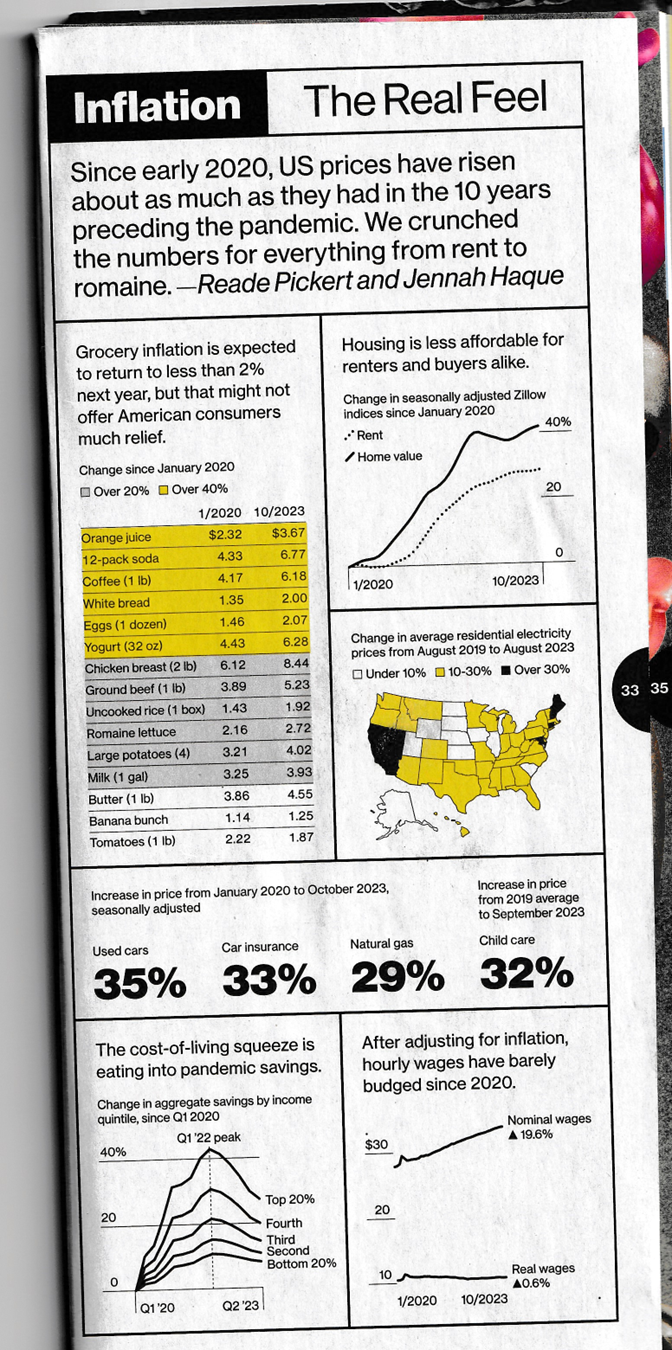
The Biden administration may want you to believe that inflation is not real but they are telling you a lie. This report from the latest Bloomberg Business Week provides the facts. In my own personal life my Quaker Oats Apple and Cinnamon now provides 8 packets down from 10 in a box. My shaving cream is now in a 7 ounce container down from 10 ounces. Next year’s inflation rate of an expected 2% won’t be bringing prices down.
Real wages are down. Is it any wonder that labor unions are on the rise?
Child poverty rate is up
Credit card debt and defaults are at record levels. Many people use their credit card when they run out of cash.
Inflation is clearly not under control. Gasoline in Los Angeles rose 20 cents a gallon since the beginning of September. My oatmeal now at the same price but a smaller amount in the package.
Medicare trustees say the Part A program will begin running deficits again in 2025, drawing down the trust fund until it depleted in 2031. Part A covers inpatient hospital stays, care in a skilled nursing facility, hospice care, and some home health care.
The combined Social Security trust funds – which help support payouts for the elderly, survivors and disabled – are projected to be unable to pay out full benefits in 2034.
There has been no legislation to save Social Security and Medicare.
Neither the Democratic Party nor the Republican Party have proposed any legislation to address these issues. Instead the Democrats focus on climate change and abortion rights while the Republicans focus on protection against LGBTQ people, illegal immigration, and enabling everyone to own a gun. None of those issues, while important, effect many Americans.
The fact is that the rich get richer and the rest of us are still confronted with a minimum wage that has not changed since July 24, 2009. That is $7.25 per hour. There is no national health insurance plan. Going to jail ensures that you will have a roof over your head, food to eat and health care.
A new MacBook Pro. There are none in the local stores. Order today and it will be shipped in two to three weeks. Charmin Toilet Paper at Costco. Sorry all we have is our own Kirkland Signature in stock. Orville Redenbacher Kettle Corn at the local supermarket. There will be a delivery sometime next week. Rice Krispies. Try our house brand, it’s really good.
What’s going on? Why all the shortages? It’s called logistics or the supply chain. Logistics is the network of supply chain participants engaged in storage, handling, transfer, transportation, and communications functions that contribute to the efficient flow of goods.
Of course some of this situation is due to high demand but the real issue is the lack of personnel in warehouses, port workers, and the shortage of truck drivers.
When any of the functions don’t work as expected we have shortages and stock-outs.
Why now? Low paying jobs and the impact of COVID-19 causing many people to remain unemployed or searching other work opportunities. This is a worldwide issue. A shortage of truck drivers in the UK resulted from that country’s departure from the EU. Non-citizens were forced to leave that country. The result is not enough drivers to deliver gasoline (petrol) and other products.
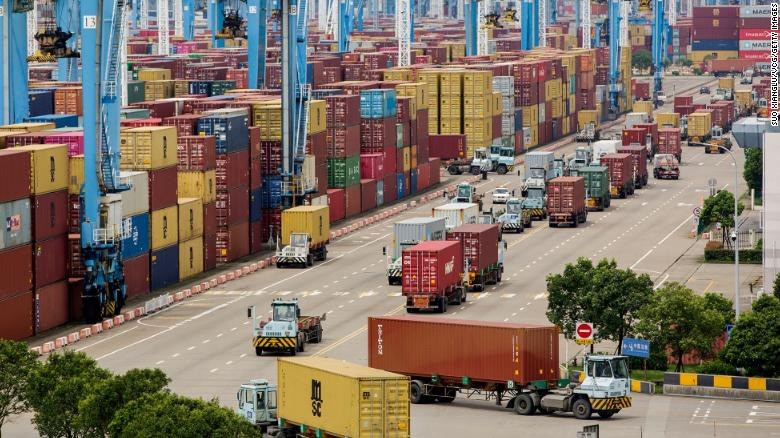
China Ningbo-Zhoushan container port on August 15, 2021
This presentation is worth watching or read the transcript below the Youtube video. I support her points. Unfortunately many do not. It is a mystery to me why so many people do not want a growing middle class. This does tie in to my commentary The Great economic Divide.
WASHINGTON, D.C. –(ENEWSPF)—January 7, 2015. Today, United States Senator Elizabeth Warren spoke at the AFL-CIO National Summit on Raising Wages. The text of Senator Warren’s remarks as prepared for delivery follows, and a PDF copy of her remarks is available here:
Good morning, and thank you MaryBe for the introduction, and for your work with the North Carolina AFL-CIO. Your efforts make a real difference for our families.
I want to start by thanking Rich Trumka and Damon Silvers for your leadership on economic issues, for your good counsel, and, for a long time now, your friendship. I also want to give special thanks to my good friends from the Massachusetts AFL-CIO who are here today, Steve Tolman and Lou Mandarini.
I love being with my labor friends, and I’m especially glad to join you today for the AFL’s first-ever National Summit on Wages. You follow in the best tradition of the American labor movement for more than a century-always fighting for working people, both union and non-union. Today you’ve spotlighted an economic issue that is central to understanding what’s happening to people all over this country.
I recently read an article in Politico called “Everything is Awesome.” The article detailed the good news about the economy: 5% GDP growth in the third quarter of 2014, unemployment under 6%, a new all-time high for the Dow, low inflation.(i)
Despite the headline, the author recognized that not everything is awesome, but his point has been repeated several times: On many different statistical measures, the economy has improved and is continuing to improve. I think the President and his team deserve credit for the steps they’ve taken to get us here. In particular, job growth is a big deal, and we celebrate it.
I’ve spent most of my career studying what’s happening to America’s middle class, and I know that these four widely-cited statistics give an important snapshot of the success of the overall economy. But the overall picture doesn’t tell us much about what’s happening at ground level to tens of millions of Americans. Despite these cheery numbers, America’s middle class is in deep trouble.
Think about it this way: The stock market is soaring, and that’s great if you have a pension or money in a mutual fund. But if you and your husband or wife are both working full time, with kids in school, and you are among the half or so of all Americans who don’t have any money in stocks,(ii) how does a booming stock market help you?
Corporate profits(iii) and GDP are up. But if you work at Walmart, and you are paid so little that you still need food stamps to put groceries on the table, what does more money in stockholders’ pockets and an uptick in GDP do for you?
Unemployment numbers are dropping. But if you’ve got a part-time job and still can’t find full-time work — or if you’ve just given up because you can’t find a good job to replace the one you had — you are counted as part of that drop in unemployment,(iv) but how much is your economic situation improving?
Inflation rates are still low. But if you are young and starting out life with tens of thousands of dollars in student loan debt locked into high interest rates by Congress, unable to find a good job or save to buy a house, how are you benefiting from low inflation?
A lot of broad national economic statistics say our economy is getting better, and it is true that the economy overall is recovering from the terrible crash of 2008. But there have been deep structural changes in this economy, changes that have gone on for more than thirty years, changes that have cut out hard-working, middle class families from sharing in this overall growth.
It wasn’t always this way.
Coming out of the Great Depression, America built a middle class unlike anything seen on earth. From the 1930s to the late 1970s, as GDP went up, wages went up pretty much across the board. In fact, 90% of all workers-everyone outside the top 10%-got about 70% of all the new income growth.(v) Sure, the richest 10% gobbled up more than their share-they got 30%. But overall, as the economic pie got bigger, pretty much everyone was getting a little more. In other words, as our country got richer, our families got richer. And as our families got richer, our country got richer. That was how this country built a great middle class.
But then things changed.
By 1980, wages had flattened out, while expenses kept going up. The squeeze was terrible. In the early 2000s, families were spending twice as much, adjusted for inflation, on mortgages as they had a generation earlier. They spent more on health insurance, and more to send their kids to college. Mom and dad both went to work, but that meant new expenses like childcare, higher taxes, and the costs of a second car. All over the country, people tightened their belts where they could, but it still hasn’t been enough to save them. Families have gone deep into debt to pay for college, to cover serious medical problems, or just to stay afloat a while longer.(vi) And today’s young adults may be the first generation in American history to end up, as a group, with less than their parents.(vii)
Remember how up until 1980, 90% of all people-middle class, working people, poor people-got about 70% of all the new income that was created in the economy and the top 10% took the rest? Since 1980, guess how much of the growth in income the 90% got? Nothing. None. Zero. In fact, it’s worse than that. The average family not in the top 10% makes less money than a generation ago.(viii) So who got the increase in income over the last 32 years? 100% of it went to the top ten percent. All of the new money earned in this economy over the past generation-all that growth in the GDP-went to the top.(ix) All of it.
That is a huge structural change. When I look at the data here – and this includes years of research I conducted myself – I see evidence everywhere about the pounding that working people are taking. Instead of building an economy for all Americans, for the past generation this country has grown an economy that works for some Americans. For tens of millions of working families who are the backbone of this country, this economy isn’t working. These families are working harder than ever, but they can’t get ahead. Opportunity is slipping away. Many feel like the game is rigged against them – and they are right. The game is rigged against them.
Since the 1980s, too many of the people running this country have followed one form or another of supply side – or trickle down – economic theory. Many in Washington still support it. When all the varnish is removed, trickle-down just means helping the biggest corporations and the richest people in this country, and claiming that those big corporations and rich people could be counted to create an economy that would work for everyone else.
Trickle-down was popular with big corporations and their lobbyists, but it never really made much sense. George Bush Sr. called it voodoo economics.(x) He was right, and let’s call it out for what it is: Trickle-down was nothing more than the politics of helping the rich-and-powerful get richer and more powerful, and it cut the legs out from under America’s middle class.
Trickle-down policies are pretty simple. First, fire the cops-not the cops on Main Street, but the cops on Wall Street. Pretty much the whole Republican Party – and, if we’re going to be honest, too many Democrats – talked about the evils of “big government” and called for deregulation. It sounded good, but it was really about tying the hands of regulators and turning loose big banks and giant international corporations to do whatever they wanted to do-turning them loose to rig the markets and reduce competition, to outsource more jobs, to load up on more risks and hide behind taxpayer guarantees, to sell more mortgages and credit cards that cheated people. In short, to do whatever juiced short term profits even if it came at the expense of working families.
Trickle down was also about cutting taxes for those at the top. Cut them when times are good, cut them when times are bad. And when that meant there was less money for road repairs, less money for medical research, and less money for schools and that our government would need to squeeze kids on student loans, then so be it. And look at the results: The top 10% got ALL the growth in income over the past 30 years-ALL of it-and the economy stopped working for everyone else.
The trickle-down experiment that began in the Reagan years failed America’s middle class. Sure, the rich are doing great. Giant corporations are doing great. Lobbyists are doing great. But we need an economy where everyone else who works hard gets a shot at doing great!
The world has changed beneath the feet of America’s working families. Powerful forces like globalization and technology are creating seismic shifts that are disrupting our economy, altering employment patterns, and putting new stresses on old structures. Those changes could create new opportunities-or they could sweep away the last vestiges of economic security for 90% of American workers. Those changes demand new and different economic policies from our federal government. But too many politicians have looked the other way. Instead of running government to expand opportunity for 90% of Americans and to shore up security in an increasingly uncertain world, instead of re-thinking economic policy to deal with tough new realities, for more than 30 years, Washington has far too often advanced policies that hammer America’s middle class even harder.
Look at the choices Washington has made, the choices that have left America’s middle class in a deep hole:
the choice to leash up the financial cops,
the choice in a recession to bail out the biggest banks with no strings attached while families suffered,
the choice to starve our schools and burden our kids with billions of dollars of student loan debt while cutting taxes for billionaires,
the choice to spend your tax dollars to subsidize Big Oil instead of putting that money into rebuilding our roads and bridges and power grids,
the choice to look the other way when employers quit paying overtime, reclassified workers as independent contractors and just plain old stole people’s wages,
the choice to sign trade pacts and tax deals that let subsidized manufacturers around the globe sell here in America while good American jobs get shipped overseas.
For more than thirty years, too many politicians in Washington have made deliberate choices that favored those with money and power. And the consequence is that instead of an economy that works well for everyone, America now has an economy that works well for about 10% of the people.
It wasn’t always this way, and it doesn’t have to be this way. We can make new choices – different choices – choices that put working people first, choices that aim toward a better future for our children, choices that reflect our deepest values as Americans.
One way to make change is to talk honestly and directly about work, about how we value the work that people do every day. We need to talk about what we believe:
We believe that no one should work full time and still live in poverty – and that means raising the minimum wage.
We believe workers have a right to come together, to bargain together and to rebuild America’s middle class.
We believe in enforcing labor laws, so that workers get overtime pay and pensions that are fully funded.
We believe in equal pay for equal work.
We believe that after a lifetime of work, people are entitled to retire with dignity, and that means protecting Social Security, Medicare, and pensions.
We also need a hard conversation about how we create jobs here in America. We need to talk about how to build a future. So let’s say what we believe:
We believe in making investments – in roads and bridges and power grids, in education, in research – investments that create good jobs in the short run and help us build new opportunities over the long run.
And we believe in paying for them-not with magical accounting scams that pretend to cut taxes and raise revenue, but with real, honest-to-goodness changes that make sure that we pay-and corporations pay-a fair share to build a future for all of us.
We believe in trade policies and tax codes that will strengthen our economy, raise our living standards, and create American jobs – and we will never give up on those three words: Made in America.
And one more point. If we’re ever going to un-rig the system, then we need to make some important political changes. And here’s where we start:
We know that democracy doesn’t work when congressmen and regulators bow down to Wall Street’s political power – and that means it’s time to break up the Wall Street banks and remind politicians that they don’t work for the big banks, they work for US!
Changes like this aren’t easy. But we know they are possible. We know they are possible because we have seen David beat Goliath before. We have seen lobbyists lose. We’ve seen it all through our history. We saw it when we created the new Consumer Financial Protection Bureau, when we passed health care reform. We saw it when President Obama took important steps to try and reform our immigration system through executive order just weeks ago. Change is difficult, but it is possible.
This is personal for me. When I was 12, my big brothers were all off in the military. My mother was 50 years old, a stay at home mom. My daddy had a heart attack, and it turned our little family upside down. The bills piled up. We lost the family station wagon, and we nearly lost our home. I remember the day my mother, scared to death and crying the whole time, pulled her best dress out of the closet, put on her high heels and walked to the Sears to get a minimum wage job. Unlike today, a minimum wage job back then paid enough to support a family of three. That minimum wage job saved our home-and saved our family.
My daddy ended up as a maintenance man, and my mom kept working at Sears. I made it through a commuter college that cost $50 a semester and I ended up in the United States Senate. Sure, I worked hard, but I grew up in an America that invested in kids like me, an America that built opportunities for kids to compete in a changing world, an America where a janitor’s kid could become a United States Senator. I believe in that America.
I believe in an America that builds opportunities. An America that ensures that all hardworking men and women earn good wages. An America that once again grows a strong, vibrant middle class.
I believe in that America, and I will fight for that America! And if we fight-side-by-side-I know we will build that America again.
“Taper” may be easier to define (and spell) than “sequester” but both caused the same headache for financial markets.
“Taper” is the latest buzzword that describes the Federal Reserve’s pledge to gradually drawdown the ultra-loose borrowing conditions fueled by its bond buying (the Fed’s demand drives up bond prices and drives down borrowing rates pinned to those bonds). “Sequester” you’ll remember was the S-word that emerged from federal budget-balancing attempts. It had investors bracing, however briefly, for an expensive and inconvenient government service disruption. Words can be potent once they’ve entered the investing vernacular. We get it. It’s noise that can be hard to tune out. And who wants to turn a deaf ear when our portfolios are at stake? Frankly, the negative use of the word “tapering” has muddled the fact that the Fed is simply readying for actions that most investors have expected for some time—which ironically, are tailored responses to an improving economy.
The formidable line here is an uptrend. The S&P 500 closed at an all-time high 1,669.16 on May 21, 2013, up over 130% from its financial-crisis low of 676.53 reached March 9, 2009, but it wasn’t a straight path to that high. From election uncertainty to fiscal-cliff vertigo to rumblings from Europe, and now, intense focus on the Fed–we’ve been here before. Data source: TD Ameritrade/Standard & Poors.
Of course there are no guarantees. Today panic seems to be in the air.
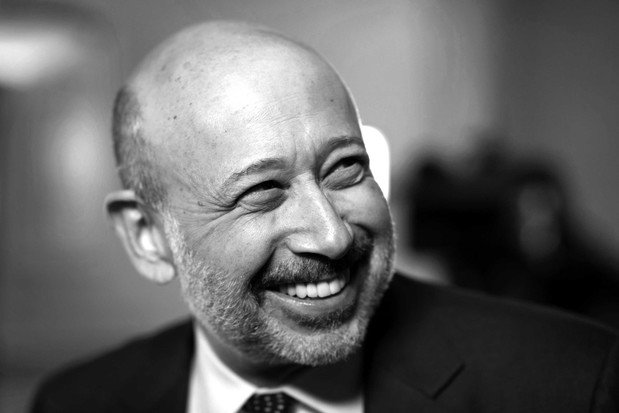
Lloyd Blankfein is the CEO of Goldman Sachs. The company cut 900 jobs last year. He earned $26 million in 2012. Wouldn’t you be smiling? But he is not alone!
John Stumpf, the head of Wells Fargo Bank was awarded $19.3 millionin 2012.
The Capital One chief, Richard Fairbank, was the third highest-paid bank CEO in North America even after taking a 8.9 percent pay cut, dropping his compensation to a mere $17.5 million for 2012.
Poor Jamie Dimon, CEO of JP Morgan Chase, saw his 2012 compensation cut in half to $11.5 million after a loss of more than $6.2 billion on a failed bet on derivatives.
The pay of the top 20 bank CEOs increased an average of 7.7 percent for 2012 compared with a year earlier, according to data compiled by Bloomberg. The tally is based on salaries, stock, bonuses and long-term incentive pay awarded to the CEOs for 2012.
The annual earnings of the heads of America’s largest corporations average is over $28 million.
Meanwhile the United States BLS reported last September that Median family household income declined by 1.7 percent in real terms between 2010 and 2011 to $62,273.
In other words the leaders of our largest companies earn more than 456 times the average family household earnings.
I hear the constant drum beat that 47 million Americans pay no taxes. That those people are on the dole. All those people don’t really want to work. The argument goes they are happy sitting in their homes doing nothing.
Is this all really true? If so, how did this happen?
A Google search [percentage of Americans paying income taxes] confirms that about one half of all Americans do not pay income taxes. The sites How Stuff Works, Fox News, The Washington Post, Reuters, and others all offer their take on why this is fact and some offer arguments about changing the taxing system. All the postings do affirm that everyone pays Social Security and Medicare taxes.
From How Stuff Works: So who are the 49 percent of Americans who don’t pay income taxes? The vast majority are the lowest income households, the elderly and young working families with children.
The reason this situation exists and is becoming worse was clearly defined in a Market Watch article posted on April 24, 2012.
Manufacturing employment as a fraction of total employment has been declining for the past half century in the United States and the great majority of other developed countries. A 1968 book about developments in the American economy by Victor Fuchs was already entitled “The Service Economy.”
Although the absolute number of jobs in American manufacturing was rather constant at about 17 million from 1969 to 2002, manufacturing’s share of jobs continued to decline from about 28% in 1962 to only 9% in 2011.
From CNN: A very large portion of U.S. apparel imports comes from Bangladesh. Many companies have been shifting orders there, because labor costs in the country are so low. Bangladesh is on track to surpass China within the next seven years as the largest apparel manufacturer in the world.
It is already the third biggest exporter of apparel to the U.S., behind China and Vietnam. The value of clothing imported from Bangladesh into the U.S. has quadrupled over the last decade to $4.5 billion annually, according to the apparel group.
Go into any store in the United States and you will find most products have been made in another country. Talking to a lady at Trader Joe’s just yesterday and she complained that the fresh produce is primarily from Mexico.
Back in 2007 the total unemployed that included part time workers and those who have given up searching for a job was below 8.5% of the likely working population. Today that number is 13.9%. That is the BLS number referred to as U6 on the monthly reports. It’s an improvement from the maximum number of 17.1% reached in October 2009.
I can’t prove it but I believe no one wants to live poorly when they see the things they can have with an income. Unfortunately the poor are also the least educated. That condition of poor education is partially lack of opportunity and partially lack of capability. Not all of us are capable of working in Silicon Valley or performing surgery at the Mayo Clinic. Those less technical jobs have been sent to the places where labor costs less. Every company has the right to lower their costs. Middle class and blue collar America has paid the price for those off shored jobs.
So the wealthy of America (they pay most of the taxes) have concluded that welfare is a cheap price to pay to keep peace in the United States. It’s the thing the royalty of France and Russia did not understand. We all know how that worked out. There is no royalty in the United States but there is a wealthy class that is the equivalent of royalty. Once again the U.S. leads the list with 442 billionaires the most of any nation in the world says Forbes magazine. The New York Daily News reports that there are 9 million members of the millionaires club in the U.S.
My prediction is that the welfare class will continue to exist in the United States and is likely to grow throughout the 21st century. This is not negative. It is reality.


 Coast Contact