You Can Be Richer Too!

Stupid articles and papers telling us the obvious wastes our time.  Businessweek featured such a totally wasteful piece discussing someone named Justin Wolfers, a University of Michigan professor, who wrote an article titled “Economists Nail It: You Can Never Be Too Rich.”  Do I need someone to tell me that it is better to be rich than poor?  Even the reporter, Peter Coy, who is a primary commentator/reporter for the magazine offered the obvious remark, That may seem to deserve a Homer Simpson “Duh!” award for most obvious research finding of the month.  So why even post this report?  The answer must be that he has space to fill.

This has been a great year to be just a little bit richer.  If you were already rich you might have become a lot richer.

In just the four months of this year the Dow Jones Average increased by 14.3% and the S&P 500 increased by 13.2%.  Understand that you did not have to be particularly smart to choose the right stocks to have earned that money.  You simply had to buy an S&P 500 index account and your $1,000 would now be worth $1,132 today.  If that investment had been $10,000 you could sell your gains now and have $1,320.  Enough to buy that new giant TV or pay down a burdensome credit card.

So what’s the problem.  “Your Money” reported that 55% of the people surveyed did not believe this has been a good time to invest.

So when is a good time?

You see article after article crying about the wealth gap between the rich and everyone else.

Sad to say it but the average man on the street is unwilling to take the chances that the rich take.  Perhaps that is one of the reasons you may never be rich.

America’s Dying Industries

Shoe Manufacturing

This comes as no surprise.  Still it hurts to see these numbers.  As you read each of these items you know the reason for the decline in business.  This was published on Huffington Post.  The reasons are as follows:

  1. The photofinishing decline was the result of the digital camera era and the sharing of photos on internet web sites.
  2. The high cost of labor now makes appliance repair more expensive than buying a new item.
  3. Advertising revenue has declined at most newspaper and magazine publications thanks to the internet and smartphones.
  4. Manufacturing of consumer products is now cheaper in most other nations of the world.

Photofinishing

Revenue decline 2002 to 2012  -70%.  $15.509 million to $897 million

Recordable Media Manufacturing

Revenue decline 2002 to 2012  -53.6%.  $4.144 billion to $3.311 billion

Money Market and Other Banking

Revenue decline 2002 to 2012  -51.2%.  Industry revenue in 2012 $834 million

DVD, Game and Video Rentals

Revenue decline 2002 to 2012  -49.6%.  Industry revenue in 2012 $5.894 billion

Newspaper Publishing

Revenue decline 2002 to 2012  -48.1%.  Industry revenue in 2012 $29.302 billion

– Women’s/Girls’ Apparel Manufacturing

Revenue decline 2002 to 2012  -57.7%.  Industry revenue in 2012 $8.603 billion

Costume/Team Uniform Manufacturing

Revenue decline 2002 to 2012  -49.9%.  Industry revenue in 2012 $986 million

Appliance Repair

Revenue decline 2002 to 2012  -44.5%.  Industry revenue in 2012 $3.684 billion

Hardware Manufacturing

Revenue decline 2002 to 2012  -44.5%.  Industry revenue in 2012 $7.484 billion

Shoe/Footwear Manufacturing

Revenue decline 2002 to 2012  -39.6%.  Industry revenue in 2012 $1.712 billion

The 1% aren’t like the rest of us

This Op-Ed from the Los Angeles Times is really worth the read.   I admit to being part of the 47% that Mitt Romney mocked.  The findings of this survey confirm what I always knew.
Monopoly Game Box

The ultra-rich share few of the priorities of most Americans, but their access to policymakers is greater, a study finds.

By Benjamin I. Page and Larry M. Bartels

March 22, 2013

Over the last two years, President Obama and Congress have put the country on track to reduce projected federal budget deficits by nearly $4 trillion. Yet when that process began, in early 2011, only about 12% of Americans in Gallup polls cited federal debt as the nation’s most important problem. Two to three times as many cited unemployment and jobs as the biggest challenge facing the country.

So why did policymakers focus so intently on the deficit issue? One reason may be that the small minority that saw the deficit as the nation’s priority had more clout than the majority that didn’t.

We recently conducted a survey of top wealth-holders (with an average net worth of $14 million) in the Chicago area, one of the first studies to systematically examine the political attitudes of wealthy Americans. Our research found that the biggest concern of this top 1% of wealth-holders was curbing budget deficits and government spending. When surveyed, they ranked those things as priorities three times as often as they did unemployment — and far more often than any other issue.

If the concerns of the wealthy carry special weight in government — as an increasing body of social scientific evidence suggests — such extreme differences between their views and those of other Americans could significantly skew policy away from what a majority of the country would prefer. Our Survey of Economically Successful Americans was an attempt to begin to shed light on both the viewpoints and the political reach of the very wealthy.

While we had no way to measure directly the political influence of those surveyed, they did report themselves to be highly active politically.

Two-thirds of the respondents had contributed money (averaging $4,633) in the most recent presidential election, and fully one-fifth of them “bundled” contributions from others. About half recently initiated contact with a U.S. senator or representative, and nearly half (44%) of those contacts concerned matters of relatively narrow economic self-interest rather than broader national concerns. This kind of access to elected officials suggests an outsized influence in Washington.

On policy, it wasn’t just their ranking of budget deficits as the biggest concern that put wealthy respondents out of step with other Americans. They were also much less likely to favor raising taxes on high-income people, instead advocating that entitlement programs like Social Security and healthcare be cut to balance the budget. Large majorities of ordinary Americans oppose any substantial cuts to those programs.

While the wealthy favored more government spending on infrastructure, scientific research and aid to education, they leaned toward cutting nearly everything else. Even with education, they opposed things that most Americans favor, including spending to ensure that all children have access to good-quality public schools, expanding government programs to ensure that everyone who wants to go to college can do so, and investing more in worker retraining and education.

The wealthy opposed — while most Americans favor — instituting a system of national health insurance, raising the minimum wage to above poverty levels, increasing the Earned Income Tax Credit and providing a “decent standard of living” for the unemployed. They were also against the federal government helping with or providing jobs for those who cannot find private employment.

Unlike most Americans, wealthy respondents opposed increased regulation of large corporations and raising the “cap” that exempts income above $113,700 from the FICA payroll tax. And unlike most Americans, they oppose relying heavily on corporate taxes to raise revenue and oppose taxing the rich to redistribute wealth.

Some of the differences between the political views of the wealthy and other Americans may be explained by differences in the two groups’ economic experiences and self-interest. The wealthy are likely to have better information about the costs of government programs (for which they pay a lot of taxes) than about the benefits of those programs. They don’t usually have to rely on Social Security, for example, let alone food stamps or unemployment insurance.

Another possibility is that the wealthy — who tend to be highly educated, well informed and committed to charitable giving — seek the common good as they see it, and in fact know better than average Americans what sorts of policies would benefit us all. On the issue of federal deficits, for example, the public has come to see government debt as an increasingly important problem over the last two years, reducing the gulf between their views and those of the wealthy. Is that because the wealthy were ahead of the curve, or because their concern helped stimulate a steady drumbeat of deficit alarmism in the media and in Washington?

Our pilot study included a relatively small number of wealthy citizens, and they were all from a single metropolitan area. A larger-scale national study is needed to pin down more precisely the views of wealthy Americans about public policy. We need to understand how they formed the preferences they have, and how wealthy people from different regions, industries, and social backgrounds differ in their political views and behavior. We also need to understand more about their political clout.

Our initial results suggest the wealthy have very different ideas than other Americans on a variety of policy issues. If their influence is far greater than that of ordinary people, what does that mean for American democracy?

Benjamin I. Page is a political science professor at Northwestern University and co-author of “Class War? What Americans Really Think About Economic Inequality.” Larry M. Bartels is a political science professor at Vanderbilt University and author of “Unequal Democracy: The Political Economy of the New Gilded Age.”

// Copyright © 2013, Los Angeles Times

We Are Too Big to Fail!

The Senate passed the $700 billion bank bailout bill on October 3 2008. The guts of the bill was the same as the three-page document submitted on September 21 2008, by Treasury Secretary Henry Paulson. Paulson had asked Congress to approve a $700 billion bailout to buy mortgage-backed securities that were in danger of defaulting. By doing so, Paulson wanted to take these debts off the books of the banks, hedge funds and pension funds that held them. The goal was to instill confidence in the functioning of the global banking system, which had narrowly avoided collapse.

Then came the annual bank stress tests.  The official name is Comprehensive Capital Analysis and Review, or CCAR.  The results of these tests would be to identify those banks and associated companies that were adequately capitalized. Those not having sufficient funds would be required to take action to resolve the issue.  The test is required for all banking institutions with $50 billion in total capital assets.

No banks were split apart and nothing was done to confront the fact that the four largest banking organizations overwhelmingly impact the entire nation.

Largest banks and thrifts in US by total assets

Total                 Total

Company                         City, State                 assets            deposits

JPMorgan Chase & Co.        New York, NY            2,250.8          1,127.8

Bank of America Corp.        Charlotte, NC             2,129.0           1,033.0

Citigroup Inc.                      New York, NY          1,873.9              865.9

Wells Fargo & Co.               San Francisco, CA      1,313.9             920.1

If any of these banks failed the United   States would step in to protect their well being.

Federal Reserve press release dated March 14, 2013.  “The Federal Reserve on Thursday announced it has approved the capital plans of 14 financial institutions in the Comprehensive Capital Analysis and Review (CCAR). Two other institutions received conditional approval, while the Federal Reserve objected to the plans of two firms.”

As to breaking apart the behemoths, not a word.

I Don’t Shop at Wal-Mart

Not only do I not shop at Wal-Mart, I do not have my oil changed at Jiffy Lube.  Companies like Wal-Mart do bring low cost goods to America and the world but they also treat their vendors and their employees like dirt.  As to Jiffy Lube, I prefer the attention of a capable mechanic.  I will never forget my one time at a quick lube franchise.  I had to have my car towed to another garage.

I am willing to pay a little more for the competent workers that are employed by the independent stores and garages that really give me the kind of services I want.

Yes, I shop at Costco.  The reason is that they pay their employees so well that the employee turnover is low.  My next door neighbor, a Costco employee, bought his home at the bottom of the housing collapse but still paid $333,000.  His wife has a part time at home business.  The pay at Costco can’t be too bad.

JobsMeanwhile the working poor are employed by the big and very successful national chains.  Those chains depend on low wage workers.  The companies are Wal-Mart, Target, Pizza Hut, McDonald’s, etc. etc.  The top 50 executives at each of those companies were paid an average of $9.4 Million a year.  The typical worker at those companies has an adjusted gross income of $13,900 a year.

Focusing on Wal-Mart, it’s subsidized by the taxpayers of America.  It has the most workers on public assistance. In 2007, the company shifted from regular shifts to flexible shifts, a change labor activists said was designed to force full-time workers to downgrade their status to part-time, so they would not qualify for health insurance or other benefits. The result is that hundreds of thousands of Wal-Mart employees rely on state benefits or Medicaid. Most of the company’s warehouses are contracted out to temp agencies, so even if a warehouse loader works full-time in a Wal-Mart warehouse for years, he gets no benefits.  Wal-Mart has also spent at least $1 billion since 2005 settling lawsuits over unpaid wages or illegal working conditions. One study estimated that Wal-Mart workers cost taxpayers more than $1 Billion every year.

Source for part of this article is The Week magazine.

The Rich are Getting Richer

Ford Factory - It Looks Good

Workers build a Ford Focus on the assembly line at Ford Motor Co.’s Michigan assembly plant in 2011.  (Bill Pugliano, Getty Images /December 14, 2011)

—————————————————————————-

Let’s start with the positive news that 236,000 jobs were added to payrolls in the United States during February.  The most optimistic forecasts were 160,000 new jobs.  This was a marvelous wonderful surprise.  We can only hope that this is the beginning of a trend.

Meanwhile the 100 wealthiest people on the planet added $28.7 billion to their collective net worth this week after the Dow Jones Industrial Average surged to a record, according to the Bloomberg Billionaires Index.

It was not just Bloomberg that pointed out the discrepancy between us and the wealthiest.  Michael Hiltzik’s Los Angeles Times column hit the very same fact.  He wrote, “Wages peaked at nearly 53% of GDP in 1970, but they never saw that number again. Through expansions and recessions that percentage has fallen almost without surcease. As of the end of last year, it was below 44%.”

“Try to find a statistical measure that shows the middle class and working class keeping up with growth in corporate wealth and affluence at the top reaches of the income scale. Viewed in isolation, of course, growth in corporate wealth would be a good thing for everybody. But the figures show that the people most responsible for this growth — the workers who contribute their sweat and brainpower — are being mulcted of their fair share.”

Am I being too harsh on the richest in our society?  My view is that no society can thrive if everyone is not included.

Politicians Use Fear to Get Their Way

Politicians use fear to motivate each other and the general public.

The President is wrong to use fear to motivate Congress!

In California the governor, Jerry Brown, used fear to motivate voters to vote for a .25% sales tax increase and an income tax increase on the wealthy.  It worked!  Now there are indications that the state may be able to restore many programs that had been canceled and save others that were scheduled for major reductions.  The problem is that the additional state income may be spent on unnecessary new programs.

The city of Los Angeles wants voters to approve another .5% sales tax increase to bail out their shortfall.  Their fear motivation is that the city will go bankrupt without the higher tax. That will be decided in a March 5 election.

President Obama is using the same tactic in his campaign to stop sequestration.  The threat is long lines at airports, reduced food inspection, criminal illegal aliens will be let out onto our streets, companies doing business with the government may have to layoff half of their employees, we can’t send patrol ships to the Persian Gulf, etc.  All of this the result of a 2.4% reduction in this year’s budget that must be absorbed in the next seven month.

The stock market is not panicked and we can only hope that it doesn’t panic.  There are no demonstrations in the streets.  Mr. President, you are alienating the public when you use fear as a tactic to get your way!

Impact of Technology on the U.S. Economy

If only businesses would start re-hiring all those people who lost their jobs in the Great Recession everything would be as it was.  It won’t happen like that!  Globalization and technology have changed everything.

The Mobile World Congress is a show of the latest cell phone and tablet technologies.  It will occur February 24 to February 28 in Barcelona, Spain.  The facility used is a new state of the art convention centre called Fira Gran Via consisting of eight halls.  With over 1,500 exhibits, it is a reminiscent of CES and Comdex that have been held at the Las Vegas Convention CenterThis is a wake-up call that the United States is not necessarily the center for new technologies.

  Fira Gran Via, Barcelona Spain

  The Gran Via Convention Centre

 Fira Gran Via mwc_carousel_networking gardens_final                                                                                


No business will hire employees in the western world when the job can be done for far less in developing countries.  Workers in China, Mexico, and elsewhere are willing to work for $1USD an hour.  Workers in the United States, Canada, U.K., Germany and other industrialized nations cannot pay their bills on that rate of pay.

Businesses of all types try to solve their employment needs by looking for automated equipment rather than hiring.  The benefit is lower cost for services rendered where ever labor is needed.

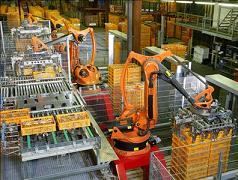
  factory-robots

From cars to bread, robots dominate modern production

On-line Digital Camera Review owner/editor Jeff Keller, “The smartphone became the preferred photo tool for many.”  The web site closed down effective December 31, 2012.

Newsweek’s final print publication mailed out on December 24, 2012.  The final issue is dated December 31, 2012.  The cause was a decline in advertising revenue.  The magazine’s owner will attempt a digital version that will be available only to subscribers.

Borders bookstores have closed.  Barnes and Noble stores are closing too.  E-readers are this year’s sought after device.  Barnes and Noble’s Nook is one of those readers.

Modern manufacturing isn’t based on human labour; it’s based on the robot. Still, most people cannot grasp the breadth of automation in factories. We still picture plants full of human workers toiling to make our cars and furniture, just as we imagine our meat comes from animals in a barn. The truth is much more awe-inspiring, perhaps even frightening. The factories of today have some human workers, but huge portions of assembly lines are 100% mechanized. The US Bureau of Labor Statistics expects automotive jobs to decline 18% by 2018 despite expected increases in production. Robots eliminate the need for more workers.

What is the United States doing to sustain its lead in technology and grow its economy?  Arguing about gun control, immigration, and government debt.

Economic Facts

I have waited to write about this until this weekend hoping that economists and responsible government officials could offer reasonable explanations.  They have not!

The United States economy is in trouble and no one wants to talk about it!

The U.S. economy shrank by .1% in the last quarter of 2012.  That number would not be too bad if it weren’t for the fact that the economy grew by 3.1% in the third quarter of the year.  That is a change in direction of 3.2%.  No one wants to admit the economy is in trouble. Instead all the talking heads and all the government leaders are talking up positive data.  The reasoning appears to be “if we ignore the situation maybe it will go away. Let’s be positive.”

Some worthwhile points:

  • Every wage earner saw his take home pay decrease by 2% thanks to the expired payroll tax holiday.
  • Companies don’t expand and don’t hire when there is no demand for their products.
  • The real unemployment rate is not publicized because it is too frightening for most people (especially those in government) to confront.  It is the “Total unemployed…” from a monthly labor report in Table A-15 called U-6.  The rate was 14.4% for January.  The number has been unchanged for the past three months.  This real unemployment rate peaked at 17.1% in October 2009.  The historical typical rate has been between 7% and 8.5%.
  • The United States must add more than 200,000 jobs a month to reduce the unemployment rate.  150,000 new jobs simply meets the requirements of the growing work force.  This fact has been repeated on newscast after newscast.  Thus 157,000 new jobs in January are not satisfactory.
  • Housing prices may have leveled off but they are far from those that existed in 2007.
  • Corporate profits are for the most part up and that has been great for those who have significant stock ownership.  Most Americans consider themselves well off if they have a $200,000 in retirement savings.  Government statistics indicate most families have $50,000 in savings.  Most people are not major beneficiaries of the past year’s increased S&P 500.
  • The coming sequestration or budget cuts will result in contractor and federal government employee layoffs.  Both political parties seem to have settled on this event starting March 2013.  There will be a cut of $85.4 billion of both defense and non-defense spending.  That is the law that congress passed.

Our Congress needs to start developing solutions rather than arguing.  Politics are destroying this nation.

Some Investments are Appropriate

Why are you relying in savings account interest?  Some banks are paying .05% APY on certificates of deposit.  I saw an ad this morning trumpeting 0.9% APY.  That is an unacceptable rate of return.

As we start the new year we are all looking at our savings and the earnings those savings provided.  Commentaries on financial networks like CNBC and in the financial sections of newspapers all say that most of us have put our money in low interest earning savings accounts at banks.  The reason is obvious.  We fear losing those hard gained savings.

Businessweek December 24-Janauary 6 edition cover story Titled “Get Rich Slow” points out that at today’s bank interest rates it would take 1,387 years to double your money.  Yes, the Federal Reserve is trying to encourage you to invest elsewhere.  Honestly there are many investments that pay more than FDIC insured savings accounts.  Some are just as safe as a savings account.  My favorite is Ginnie Mae Bonds that are “providing a guaranty backed by the full faith and credit of the United States” These bonds currently pay an interest rate of 2.68%.  They have earned higher interest rates in past years.  According to Morningstar, if you had invested $10,000 in January 2003 and had all interest re-invested in GNMA bonds, the current value would be $16,398.

There are other somewhat more risky investments but those risks are minimal.  Consider Procter and Gamble the world’s largest consumer goods company, whose products like Tide detergent and Gillette razors are in 98 percent of U.S. households.  Other products of theirs are Crest Toothpaste, Pantene Shampoo, Duracell, and Prilosec OTC.  That is not the complete list that encompasses at least 32 items.  The share price has varied over the decade but it has been a reliable dividend payer that now yields 3.19%.  As one lady told me, “I do not care what the share price is as long as I receive my dividends”.  She lives in an expensive independent living facility and draws her income to pay the bill from the dividends.

http://finance.yahoo.com/echarts?s=%5Egspc#symbol=^gspc;range=3m;compare=;indicator=volume;charttype=area;crosshair=on;ohlcvalues=0;logscale=off;source=undefined;

The S&P 500 was at 1257.60 on January 1, 2012.  Today the value is 1502.96.  That is a 19.5% increase in value.  There is no guarantee this growth will continue.  Is this a bubble?  Perhaps! 

Can you afford to be a non-participant?  If the market drops 10% just sell and you just might have more money than you do today.