What’s Wrong with the TPP?

What is wrong with NAFTA, TPP, and other free trade agreements that lower tariffs?

The United States is the dream country for capitalists. The limits on corporations are minimal. Very big companies buy each other out (called a merger) with few government efforts to control the likely outcome of near monopoly. The latest example in Walgreens drug company’s plan to buy Rite-Aid drug company.

Those same companies are now referred to as multi-nationals. General Electric is a creation of Thomas Edison but consider that the company now has facilities in 130 countries. GE has invested over $200 million in a flexible new “brilliant factory” in Pune, India. This information is from GE websites.

Heinz Ketchup sits on the tables of restaurants in Paris. It is not packaged in the United States.

The United States currently imposes low tariffs on most of the goods imported into this country. The TPP will eliminate those tariffs on the other 11 countries. That probably won’t impact the amount of goods being imported. The agreement also lowers the tariffs that other countries impose on imported American goods and that appears to be a good thing.

However when those goods are shipped overseas that are in limited supply in the United States that will drive up the prices in America. An example is chicken. Tyson Foods processes 41 million chickens a year. If they can sell some of those chickens in other countries that will reduce the number of chickens available for sale in America. Less supply translates to higher prices. That means higher profits for Tyson.

If you manufacture something in the United States where $15 to $25 per hour is a common pay rate, why not manufacture your goods in Vietnam, Peru or Malaysia where pay rates are significantly lower and import the products to America?

John Deere and Caterpillar are two companies that will benefit from lower tariffs in other countries. The problem is there are too few companies that are in the category of big machines.

The United States has lost millions of jobs to lower pay rate countries. The benefit to company shareholders is obvious.   The loss of jobs in America is obvious. The rich typically get their way. I predict capitalism will prevail. I also predict the end of the middle class in America.
Saying Goodbye to the Middle Class

In 1914, Henry Ford started an industrial revolution by more than doubling wages to $5 a day—a move that helped build the U.S. middle class and the modern economy. After World War II the return of the GIs and the benefits they received prompted an educated society that wanted homes and cars.   Union jobs with good benefits along with little competition from other nations made the United States into an industrial power house that lasted for decades.

Then big business realized that there was an opportunity to save money by outsourcing the manufacture of the things we buy.  The government accommodated those businesses by negotiating free trade agreements with many nations.  Communications with the entire world became easier and cheaper.

People in the poorest nations of the world could be trained to operate the machines that made things Americans want to buy.  They would work for one fourth the rate of pay or less than American workers.

Today my computer, television, home theater, camera, and my clothes are all made in another country.  The people who used to make those things are now either unemployed or working in low paid service jobs (tourism, retail, fast food, and other jobs that pay less than $15 an hour).  The middle management jobs are now part of those outsourced functions.  Call the help line for Earthlink or Hewlett-Packard and you will be speaking to someone in India or the Philippines.

“A middle-age middle manager who was laid off is not going to be miraculously rehired in that position or anything like it. Same with the factory worker and the receptionist and the copy editor. They’re finished. Many of the people who held those positions have already pulled out of the workforce and others are moving into different jobs (often at lower pay levels)” writes Mark Lacter on LA Observed.

Do not look for Congress or any government agency to solve this problem.  They have no solutions.

Those desperate people who have taken jobs that pay half of what they previously earned are no longer part of the middle class.  Those that have not obtained any job at this point are living on their accumulated wealth.  Neither of those groups will be spending money as they had in the past.  Thus the bifurcated economy of the wealthy and the poor.  This means the end of the middle class in America.  That is the big picture.

Jobs or Political Party – What’s Your Priority?

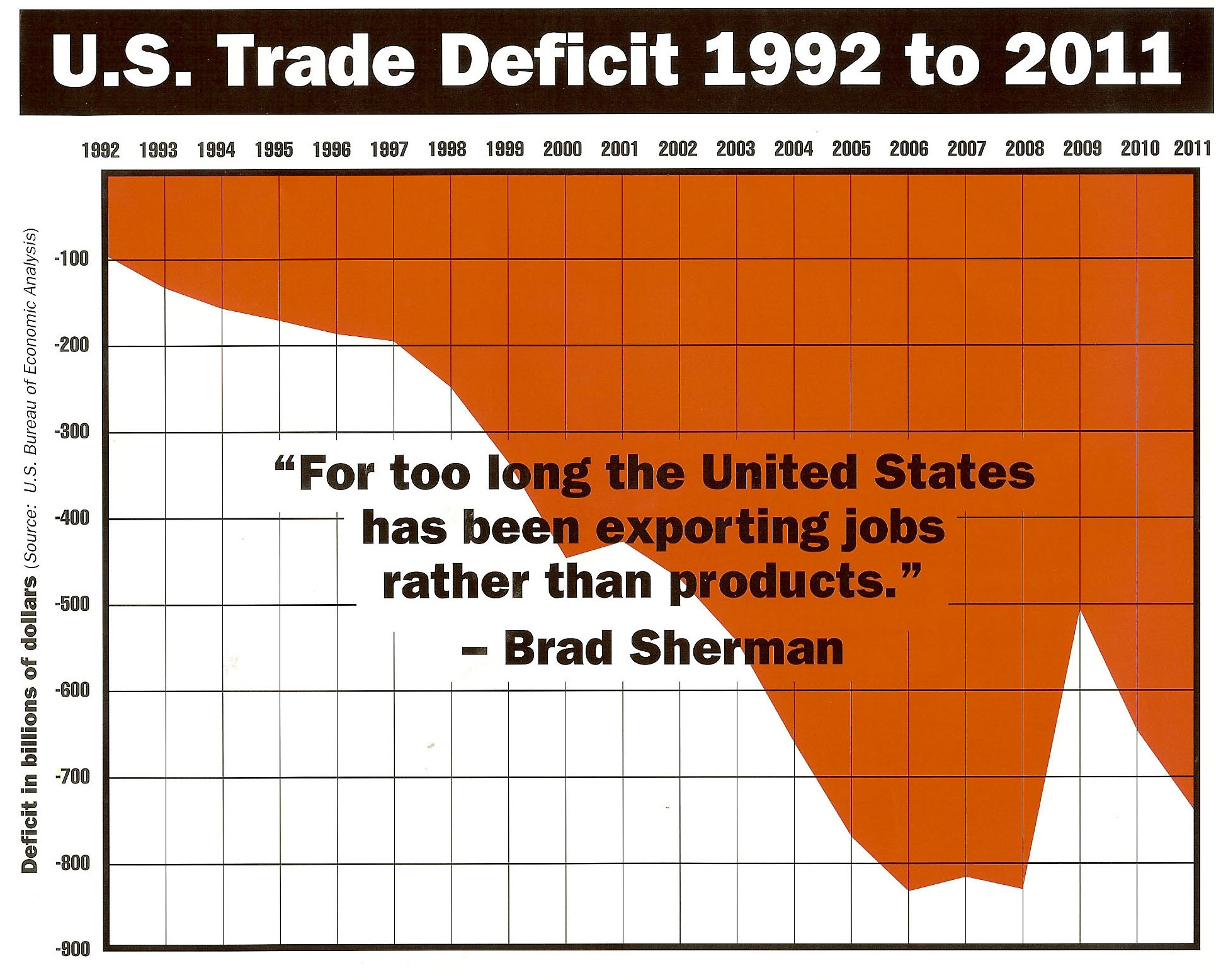
“Huge trade deficits cost millions of jobs, lower wages and place a massive debt burden on future generations.” –Brad   Sherman, United States Congressman

 Democratic Party member are not unified in many ways.  The question of abortion rights is simply the most well known issue.  Gay marriage rights is also another party dividing issue.  However, in this era of job growth, job creation ought to be the focus.  It isn’t.

In my own new California 30th district, redistricting has resulted in two long time Democratic congressman vying for the same seat. Howard Berman versus Brad Sherman.  On most issues they agree. Sherman has taken positions that have been contrary to Democratic Party leadership.  He opposed TARP as it was initially proposed and, I believe, only voted in favor of the final bill when he saw the stock market decline. Sherman has also taken an unusual view of free trade agreements.  He opposes them.

 Brad Sherman opposes NAFTA and CAFTA because they are shipping our jobs overseas.  “For too long the United States has been exporting jobs rather than products.” The latest free trade agreements are with Columbia and South Korea.  His take is supportable when you look at the American trade deficit.  It’s has been at or near the highest level since 2004. The amount has been in excess of $800 Billion Dollars.  This is a number supplied by the U.S. Bureau of Economic Analysis.

His concern for jobs is justified. It’s not just the high unemployment rate.  The employment to population ratio of Americans age 16-54 has barely begun to recover from levels last seen in 1983.  That number was 68.5% in April of this year.  This is a BLS statistic.  Meanwhile Berman is a supporter of free trade agreements.

I have not heard or read any positions taken by Republicans on the issue of free trade.  It should be a deciding factor when voting for a congressman or the president.