You should stay indoors due to record-breaking heat in Southern California, officials warned today.
While other parts of the world experience tornadoes, heavy rain, hurricanes, and snow storms, Los Angeles is facing another kind of storm that has been coined as “Heat Storms.”
Weather reporters on television in this city are constantly reminding viewers that Southern California has a Mediterranean climate that provides the coastal area with moderate temperatures throughout the year.
Unfortunately the climate has changed continuously over at least the past 30 years or more. Snails and slugs were prevalent in my garden in the early 80s but disappeared entirely by 1990.
This month we have already experienced eight days of 90 degree plus temperatures including a 108 and 104 degree temps. Unfortunately it has been even hotter in the inland valleys of the city. Temperatures have exceeded 100 degrees seven times in the San Fernando Valley this month. One day in the Valley the temp reached 117 degrees. The forecast is for at least another four more days of this current heat storm.
The consequence of the very hot temperatures has been the death of at least one postal worker among others.
A USC study of weather patterns for Southern California confirms my suspicions. The study is titled HISTORICAL TEMPERATURE TRENDS IN LOS ANGELES COUNTY, CALIFORNIA
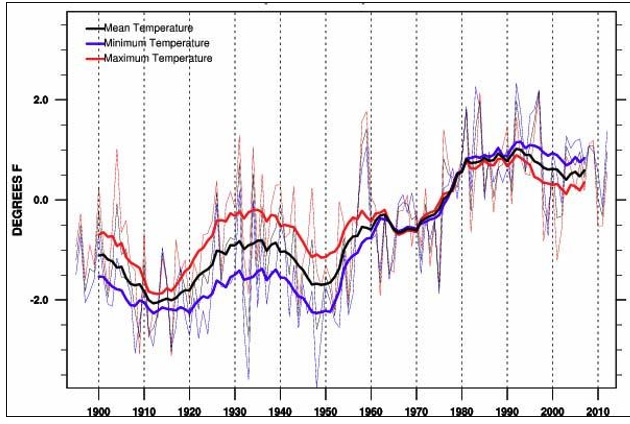
Departure from average for mean temperature, minimum temperature, and maximum temperature for the South Coast Region in the State of California. The bold line is 11-year running mean and the thin line is the departure from the mean for a region between Point Conception and the Mexico border. Source: Office of Environmental Health Hazard Assessment (http://www.wrcc.dri.edu/monitor/cal-mon/index.html)
The super hot days starting July 5 of this year were called a Heat Storm by the Los Angeles Department of Water and Power. 29,350 customers out of LADWP’s 1.5 million total customers lost power during that storm according to the DWP.
A Los Angeles Times article dated July 12, 2018 confirms my observations.
The record-breaking heat that baked Southern California and prompted mass power outages last weekend was just a taste of what is to come. Summers in SoCal have already been getting hotter over the last century. Climate change is expected to produce more frequent and more blistering heat waves in the coming years that will put unprecedented stress on the electrical grid and challenge utilities to keep the power on.
Los Angeles, apparently, isn’t ready for the new normal. The demand for electricity Friday, Saturday and Sunday overwhelmed the Los Angeles Department of Water and Power’s aged system, prompting power outages that affected more than 80,000 customers. The unluckiest people went 48 hours without electricity; they and many others had to evacuate their homes in search of air conditioning elsewhere.
The solar panel industry will be booming as we all receive our summer bills.
 Coast Contact