Women as Chattel

Men reading this column.  Are you out of your F*#%$@g minds?

Many American Men are one step away from their Muslim Arabic brethren!

Oxford Street, London UK - notice women wearing burqa with face covering niqab
Oxford Street, London UK – notice women wearing burqa with face covering niqab

The world has been controlled by men.  In the past women were considered chattel (things owned other than real property (real estate).  Men decided every action and every behavior of the women in their lives.  Thus An all-male panel testifying before Congress on birth control.  The lingering behavior of an American congressional, all-male panel, that doesn’t include one doctor. When Democrats proposed women to be on the panel, they were told the women weren’t “qualified.”

On our journey to Europe we spent five nights in London.  Our stay there was at the Cumberland Hotel.  The hotel is a very short block from the Marble Arch and the Oxford Street shopping area.

To our surprise the hotel guests were at least 90% Muslim.  At least one quarter of the women were dressed in burqas with the face covering niqab.  For the most part the women on the lifts (elevators) looked at the floor during their ride to their rooms.

When we went to the London Eye the buying ticket line was a 30 minute wait.  My wife did not need to accompany me in the line and she found a seat while I waited in line.  Behind me were a couple from Saudi Arabia waiting to buy the tickets.  I spoke to the husband but the wife never uttered a word during that wait accept her whispered words to her husband.  We know the reason. Women are not to go unescorted anywhere and never speak to another man.

The women are treated like chattel in Arabic countries.  Most of us say that is terrible.  Many Americans say that is not part of our Western culture. However, some of us in the USA want to tell women how to care for their bodies.  How to behave. How to dress.  And most significantly decide under what conditions they can obtain an abortion.

Michael Hulshof-Schmidt’s WordPress blog tells of Lousiana’s “17th Century” attitude towards women of all ages.  Mitt Romney says that he is in agreement with Paul Ryan on abortion/conception laws.  Ryan would deny abortion under all circumstances and declare that an abortion is murder.

“Rick Santorum’s biggest financial backer — and in the world of big-money politics, this means this guy has bucks, which in the US means he has power — “joked” that women should use aspirin as birth control.”

What a great country!  Freedom for all – as long as you are a man!!

Religion or Government – Which Laws Prevail?

Does the First Amendment permit religions to ignore secular law?

Dick Van Dyke
Dick Van Dyke

I was watching a Diagnosis Murder television show this evening.   You may recall that is the Dick Van Dyke program where he plays a doctor who solves crimes. In this particular episode a Catholic priest refuses to tell anyone including the police who committed a murder.  His reason is that his knowledge is the result of a “confession.”  I was astonished that he held the position that he is sworn to keep all confessions private.

Then I Google the question, “Can Catholic priests reveal confessed crimes to the police?”  Apparently I am mis-informed; it is an accurate fact that “confessions” are never to be revealed.  Perhaps that explains the reason that priests who are child abusers were not reported to the police.  The priests simply “confessed” their sins.

We all know how that turned out.  Still, the laws regarding religion seem to disregard society’s right to law enforcement.

If you are an Orthodox Jewish family and a relative dies under suspicious circumstances the law requires an autopsy.  Will an autopsy be preformed against Jewish law?

How will America’s response to Sharia Law be handled?  I contend that when religious law conflicts with government law, the government prevails.  How will the Supreme Court handle this?

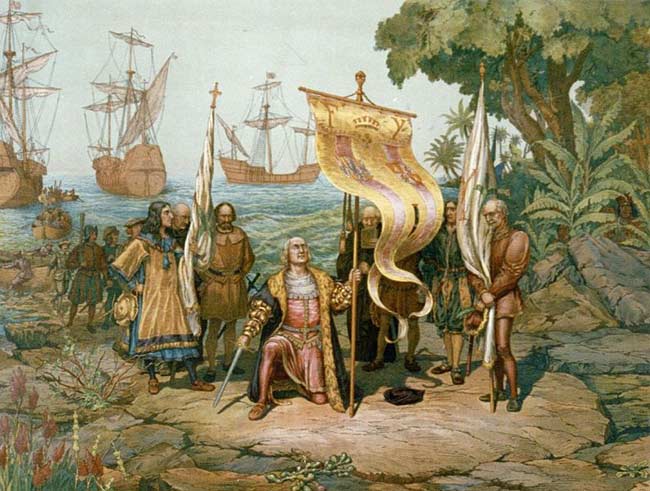
Was Christopher Columbus a Jew?

Hypothèse très intéressante et instrutive!……

The question: Was Columbus secretly a   Jew?

Today marks the 508th anniversary of the death of   Christopher Columbus.
Everybody knows the story of Columbus, right?  He was an Italian explorer from Genoa who set sail in 1492 to enrich the Spanish monarchs with gold and spices from the orient.  Not quite.

For too long, scholars have ignored Columbus’ grand passion: the quest to liberate Jerusalem from the Muslims.

During Columbus’ lifetime, Jews became the target of   fanatical religious persecution.  On March 31, 1492, King Ferdinand and Queen   Isabella  proclaimed that all Jews were to be expelled from Spain.  The edict especially targeted the 800,000 Jews who had never converted, and gave them   four months to pack up and get out.

The Jews who were forced to renounce Judaism and embrace Catholicism were known as “Conversos,” or   converts.  There were also those who feigned conversion, practicing Catholicism   outwardly while covertly practicing Judaism, the so-called “Marranos,” or swine.

Tens of thousands of Marranos were tortured by the Spanish   Inquisition. They were pressured to offer names of friends and family members,   who were ultimately paraded in front of crowds, tied to stakes and burned   alive. Their land and personal possessions were then divvied up by the church and crown.

Recently, a number of Spanish scholars, such as Jose Erugo,   Celso Garcia de la Riega, Otero Sanchez and Nicholas Dias Perez, have   concluded that Columbus was a Marrano, whose survival depended upon the   suppression of all evidence of his Jewish background in face of the brutal,   systematic ethnic cleansing.

Columbus, who was known in Spain as Crist   bal Col n and didn’t speak Italian, signed his last will and testament on May   19, 1506, and made five curious — and revealing — provisions.

Two of   his wishes — tithe one-tenth of his income to the poor and provide an   anonymous dowry for poor girls — are part of Jewish customs. He also decreed to give money to a Jew who lived at the entrance of the Lisbon Jewish Quarter.

On those documents, Columbus used a triangular signature of   dots and letters that resembled inscriptions found on gravestones of Jewish cemeteries in Spain. He ordered his heirs to use the signature in perpetuity.

According to British historian Cecil Roth’s “The History of   the Marranos,” the anagram was a cryptic substitute for the Kaddish, a prayer   recited in the synagogue by mourners after the death of a close relative.   Thus, Columbus’ subterfuge allowed his sons to say Kaddish for their crypto-Jewish father when he died. Finally, Columbus left money to support the   crusade he hoped his successors would take up to liberate the Holy Land.

Estelle Irizarry, a linguistics professor at Georgetown   University, has analyzed the language and syntax of hundreds of handwritten   letters, diaries and documents of Columbus and concluded that the explorer’s   primary written and spoken language was Castilian Spanish. Irizarry   explains that 15th-century Castilian Spanish was the “Yiddish” of Spanish Jewry, known as “Ladino.” At the top left-hand corner of all but one of the 13   letters written by Columbus to his son Diego contained the handwritten Hebrew   letters bet-hei, meaning b’ezrat Hashem (with God’s help). Observant Jews have   for centuries customarily added this blessing to their letters.  No letters to   outsiders bear this mark, and the one letter to Diego in which this was   omitted was one meant for King Ferdinand.

In Simon Weisenthal’s book,   “Sails of Hope,” he argues that Columbus’ voyage was motivated by a desire   to find a safe haven for the Jews in light of their expulsion from Spain.   Likewise, Carol Delaney, a cultural anthropologist at Stanford University,   concludes that Columbus was a deeply religious man whose purpose was to sail   to Asia to obtain gold in order to finance a crusade to take back Jerusalem and rebuild the Jews’ holy Temple.

In Columbus’ day, Jews widely believed that Jerusalem had to be liberated and the Temple rebuilt for the   Messiah to come.

Scholars point to the date on which Columbus set sail as further evidence of his true motives. He was originally going to sail on   August 2, 1492, a day that happened to coincide with the Jewish holiday of   Tisha B’Av, marking the destruction of the First and Second Holy Temples of   Jerusalem. Columbus postponed this original sail date by one day to avoid   embarking on the holiday, which would have been considered by Jews to be an   unlucky day to set sail. (Coincidentally or significantly, the day he set   forth was the very day that Jews were, by law, given the choice of converting,   leaving Spain, or being killed.)

Columbus’ voyage was not, as is   commonly believed, funded by the deep pockets of Queen Isabella, but rather by   two Jewish Conversos and another prominent Jew.  Louis de Santangel and Gabriel  Sanchez advanced an interest free loan of 17,000 ducats from their own pockets   to help pay for the voyage, as did Don Isaac Abrabanel, rabbi and Jewish  statesman.

Indeed, the first two letters Columbus sent back from his   journey were not to Ferdinand and Isabella, but to Santangel and Sanchez,   thanking them for their support and telling them what he had found.

The   evidence seem to bear out a far more complicated picture of the man for whom   our nation now celebrates a national holiday and has named its capital.

As we witness bloodshed the world over in the name of   religious freedom, it is valuable to take another look at the man who sailed the seas in search of such freedoms — landing in a place that would   eventually come to hold such an ideal at its very core.

This entire discussion was on CNN Opinion.  I thought others would find it interesting

David Bancroft

In Mexicali, a haven for broken lives

An article in the Los Angeles Times titled “A Heaven for broken lives” is really meant to stir my sympathy for people who have broken our immigration laws. The article details stories of deported Mexicans who entered the United States illegally and subsequently committed crimes.  The article was extended for an additional two pages and the print version included supporting photography.

The laws may be flawed but they are in place because a majority in the congress voted them into practice. The current administration has even tried to show empathy by not fully enforcing the law and only deporting those who commit crimes.

 The error in our law enforcement is that employers of illegal aliens are rarely punished. Rigorous enforcement of current laws would end this tragic situation. “Bleeding hearts” in America will use this article as proof of our misguided legal system.

I don’t blame those who try to sneak into the country. I would do the same thing if I was living in a poor Latin American country. I blame our government for not enforcing the law.

The rabbi who guided Reform Judaism

An obituary appearing in THE WEEK magazine dated February 24, 2012.  W. Gunther Plaut (1912-2012)

The rabbi whose commentary on the Torah helped introduce tens of thousands of Reform Jews to their faith got an early lesson in the importance of literary interpretation soon after arriving in America, in 1935. He saw a newspaper in Cincinnati that, to his eyes, announced surprising news of a revolution in Italy. The headline: “Reds Murder Cardinals.”

Wolf Gunther Plaut was born in Munster, Germany, and earned a doctorate in law at the University of Berlin, said the Toronto National Post. But when the Nazis came to power, they barred Jews from practicing law, so Plaut began studying Jewish theology. “I wanted to know what it truly meant to be a Jew if I was made to suffer for it,” he later said. He received a scholarship to study in the U.S. in 1935, was ordained as a rabbi in 1939, and became a U.S. citizen in 1943. Having enlisted with the U.S. Army as a chaplain, he witnessed the liberation of the Mittelbau-Dora concentration camp at the end of the war. He recalled the survivors as desperate for theological relief. “Their first request was not for food, but for Jewish religious items,” he said.

Plaut settled in Toronto, said The New York Times, where he wrote his “magnum opus,” a modern commentary on the Jewish holy scriptures that became a “touchstone for Judaism’s liberal branches” upon its publication in 1981. Prior to Plaut’s edition, the only available translation of the Torah was one published in the 1920s with an Orthodox commentary. Plaut’s Torah interpreted Hebrew scripture “in ways that a strict adherence to tradition did not admit.” The book is now used in Reform synagogues throughout the U.S. and Canada. “You may never have met Rabbi Plaut personally,” said U.S. Reform Rabbi Jan Katzew, “yet it is likely that he taught you Torah.”

Plaut was a fierce opponent of discrimination and prejudice throughout his life, said the Toronto Star, whether it was directed against Jews in the Soviet Union or racial minorities in North America. “He was a defender of human and civil rights at a time when many didn’t even know its meaning,” said Bernie Farber, former head of the Canadian Jewish Congress. “We stand on the shoulders of such men.”