This farmer lost half his workforce. Now he’s losing his crop too
By
David Culver, Norma Galeana, Evelio Contreras and Rachel Clarke, CNN reporters
Updated Aug 7, 2025
The Dalles, Oregon —
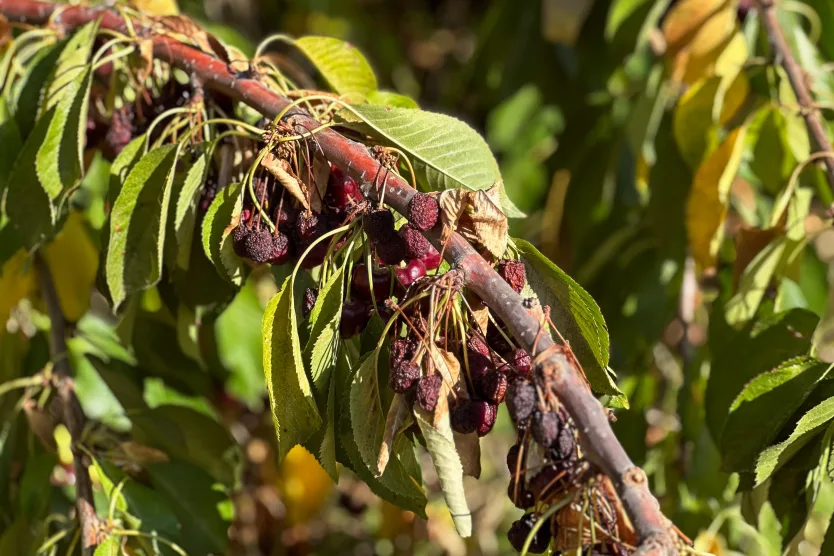
The cherries are rotting on the trees in Ian Chandler’s orchards. Branch after branch hang heavy with fruit the Oregon farmer calls “mummified” — dark, shriveled and unappetizing.
They should have been picked a couple of weeks ago to tempt shoppers at markets and stores, or processed to garnish Shirley Temple mocktails, shiny and fat, promising bursts of sweetness.
The lost harvest has hit almost a quarter of Chandler’s 125 acres of cherry trees — not because of bad weather, disease or blight, just because there was no one to pick the fruit.
“What you’re going to see is a bunch of fat, happy raccoons this winter,” Chandler said ruefully, standing amid his still burdened trees. “Unfortunately, we weren’t able to harvest these.”
He said he’s built up a loyal seasonal workforce for his Wasco County operation called CE Farm Management, about 90 minutes from Portland, with the same people coming year after year and staying in touch with birth announcements and Christmas cards in between. But this year half of them did not arrive, and many of his neighbors were scrambling for pickers too. All told, Chandler said he will lose $250,000-$300,000 of revenue, left to rot on the trees.
“It’s lost revenue for the operation, which is one thing, but it’s also lost revenue for the workers that would have been able to pick them had they been here,” he said.
“The beginning of the season, it coincided, unfortunately, with a lot of really strong immigration enforcement down in southern California, where our workforce comes from, and that had a chilling effect on people wanting to move.”
Chandler’s pickers are mostly Latinos who follow the harvests in the west and northwest. But with raids by Immigration and Customs Enforcement on cities and workplaces and detentions and even deportations ensnaring many with no criminal records, he has seen a dramatic drop-off in labor this year.
It’s a situation that’s being repeated across the nation as crops ripen for harvest. The US Department of Agriculture estimates 42% of hired crop farmworkers are undocumented immigrants, with no authorization to work. Another 26% are immigrants who have become citizens or permanent residents.
Since April, 1.4 million people have dropped out of the US labor force — 802,000 of whom were foreign-born, according to the Bureau of Labor Statistics. Farmworkers are not tracked in the official monthly jobs reports, but analysts agree immigration policy is having an impact generally across the nation.
The issue has come to the attention of President Donald Trump, who promised help for the agricultural sector in a Tuesday morning phone interview with CNBC. “I take care of the farmers. I love the farmers. They’re a very important part of this country, and we don’t want to do anything to hurt the farmers,” he said.
Vice President JD Vance has said his preferred solution is automation. But Chandler’s farm won’t be mechanized — he believes cherries are best harvested by hand, preferably an experienced one to not rip off next year’s crop that’s already showing as buds. He does hire locally, but he says Oregonians, whether they are students on summer break or adults looking for full-time employment, only last in non-picking positions, like scanning buckets of produce or driving a tractor.
“I worked in high school in the cherry industry back in the 90s and then got back into this industry back in 2011 until current. You do not find people who are normally born here in the United States, unless they’re children of immigrants who are already doing this work, who want to work in this kind of industry,” he said. “It just doesn’t exist.”
Nevertheless, everyone hired by Chandler provides identification and work authorization so he does not know who may be in the country illegally.
“We’ve had relationships with these workers for years,” he said. “You talk to a family, you get a good relationship with them, they recommend more family members, and that’s how you build up your workforce. You could have all the children born in the United States, but if mom’s still trying to work through the immigration system, and has an issue, the whole family might say, ‘Look, we’re not going to risk it, because we don’t want mom to get picked up, so we’re going to stay down in California.’ So, then we lose our workforce.”
One of those absent from Oregon farms this year is a woman who told us to call her Lisa. She has permission to work through the Deferred Action for Childhood Arrivals (DACA) program, but asked her actual name not be used for fear it might hamper her DACA renewal. Her three young children are all US citizens, but she worries about her mother and stepfather who have lived in the US for decades as undocumented workers and so she stayed in California.
“My parents are agriculture workers and seasonal workers, so every summer they will migrate to the state of Oregon to work the cherry season,” she said, adding that she and the children would often join them. “But this year, we decided to stay home just to be safe.”
While Chandler pointed out the financial loss he and his workers will suffer this season, Lisa highlighted the impact on small farmers like Chandler. And both said the federal government will also lose out.
“There is no shady under-the-table stuff. It’s all above board,” Chandler said, noting the deductions he made from each worker’s check to pay federal and local taxes and make contributions to Medicare and Social Security. “There seems to be a big disconnect when (opponents say,) ‘There’s this shadow economy of undocumented people being paid in certain ways.’ No, everything is above board. Everybody shows documentation to work.”
Lisa said about $150 was automatically deducted from her paycheck of some $900, and she thought the same was true for her parents even though they cannot file for a tax refund or use Medicare or Social Security, both of which they pay into.
The tax argument was raised by Trump too in his CNBC interview. “We’re going to be coming out with rules and regulations. I mean, you’ll see a farmer with the same person working for him for 20 years. The person’s even paying taxes and other things,” Trump said, drawing a distinction between hard-working undocumented immigrants who work on farms and those who commit violent crimes.
 Coast Contact