The Impact of Technology on Blue Collar Workers

We are about to select a new American president in a world that is rapidly becoming more technically advanced than anyone could have imagined in the year 2000. Remember that as the year many of us were concerned that clocks would stop, power grid systems might fail, and commercial aircraft might fall from the sky. Of course none of that happened. What has happened is the rapid advance of technology and a globally connected society. Thomas Friedman’s “The World is Flat” (Published April 5, 2005) was not only a recognition of a changing world economy but the need for America to look forward and plan for the new economy.

Take just one new technology, autonomous (self driving) cars and trucks, that is predicted to be launched by the year 2020 to 2025 and consider the impact and you will understand that no one – no president of the United States – can stop the impact on the public in either the United States or other countries.

Don’t Tell The Teamsters: But Driverless Trucks Are Already Here.  Driverless trucks are operating in an Australian mine. When those trucks arrive in America the Teamsters will fight with everything they have to stop those autonomous trucks. Feather bedding will be a prominent part of their strategy. There are currently 900,000 active working Teamsters in the United States and Canada. There are approximately 3.5 million professional truck drivers in the United States, according to estimates by the American Trucking Association.

What will all those families that rely on those truck driving jobs do when they are replaced by self driving trucks? As a nation we have not looked forward. We have looked back.  Technology’s impact on the trucking industry is simply one example of the changing work environment.

Donald Trump promises to bring back the jobs that have been lost due to out sourcing. It is not clear what will motivate the return of jobs other than tariffs that could start a trade war.

Hillary Clinton says she will propose investing in infrastructure, manufacturing, research and technology, clean energy, and small businesses. The costly $787 billion spending bill that President Barack Obama signed into law soon after taking office had little effect. It was argued that it was insufficient.
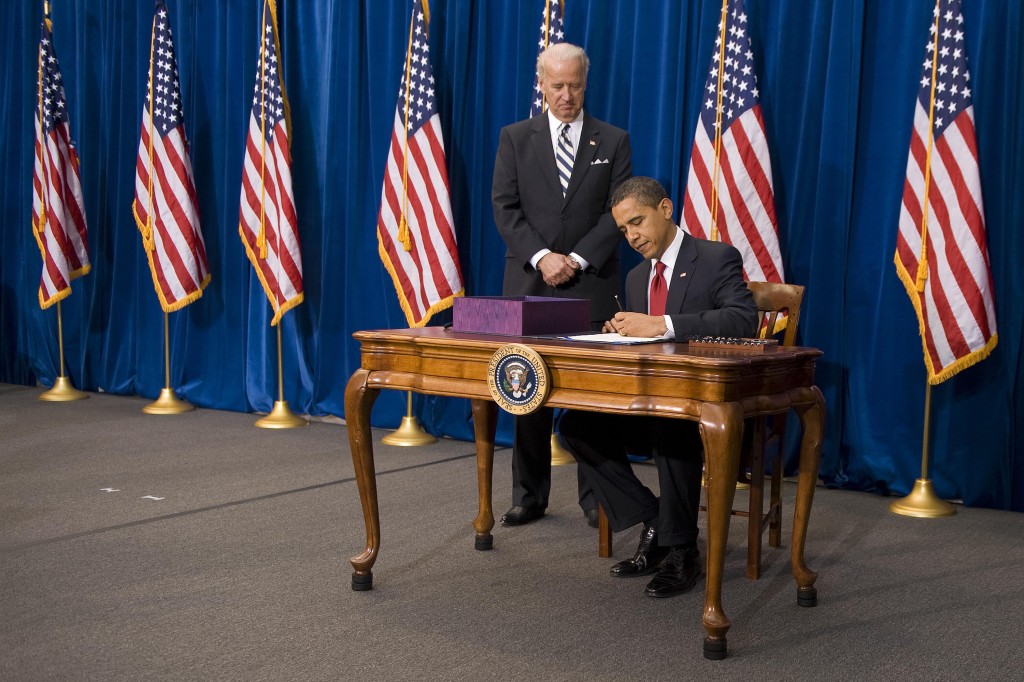
obama-signs-the-american-recovery-and-reinvestment-act-of-2009

In all of the Trump and Clinton ideas there is no consideration of the future.
Technological Unemployment

From Wikipedia: “Perhaps the earliest example of a scholar discussing the phenomena of technological unemployment occurs with Aristotle, who speculated in Book One of Politics that if machines could become sufficiently advanced, there would be no more need for human labour.”

It has been reported repeatedly that Queen Elizabeth I of England refused to grant a patent for a weaving machine because it would put the hand weavers out of work. She was correct. It did.

I was talking with an acquaintance about the effects of AI (artificial intelligence) and IT (information technology) on the work environment and the elimination of many jobs. A touch plate at a fast food ordering counter could replace an order taker. So could many other jobs.

One job I held for 7½ years was a scheduling supervisor in a factory. I had decided to quit after about four years. The work was tedious and very stressful. It took me the next 3½ years to find work that would pay more and appeared to offer a chance of advancement. I was responsible for all the production schedules and work orders in the factory. If something went wrong in the middle of the night, the night foreman called me. Today that job would be done more accurately by a computer generated program that could accomplish my 40 plus hour weekly job in minutes.

My father was a structural engineer. He retired just as computers were beginning to be used to calculate stress analysis. His calculation tool was a slide rule. He was a mathematical genius. Today those calculations can be more accurately accomplished using a computer that would provide the results in minutes not hours. The drafting of the structure can now be provided by a computer driven drafting machine rather than a draftsman.

Perhaps the order taker at the fast food counter will still have a job preparing the order. Perhaps the mathematical genius will be working on a program in Silicon Valley. One thing is certain. All jobs that can be mechanized and/or computer driven will result in fewer jobs.

I rarely take my car to a repair garage because they too have been fitted with longer lasting components. Thanks to a well-made furnace and plumbing in my house the need for service maintenance is reduced. That means there is no growing need for service industry workers.

I have yet to hear anyone, neither politician, corporate leader, nor social engineer, explain how even the brightest people will care for their families when the number of jobs is in decline.

We have a serious societal challenge and no answers. Joel Kotkin and other commentators have observed the issue. Now what?

Newsweek -Final print edition is December 31, 2012

Newsweek to cease print edition after 80 years

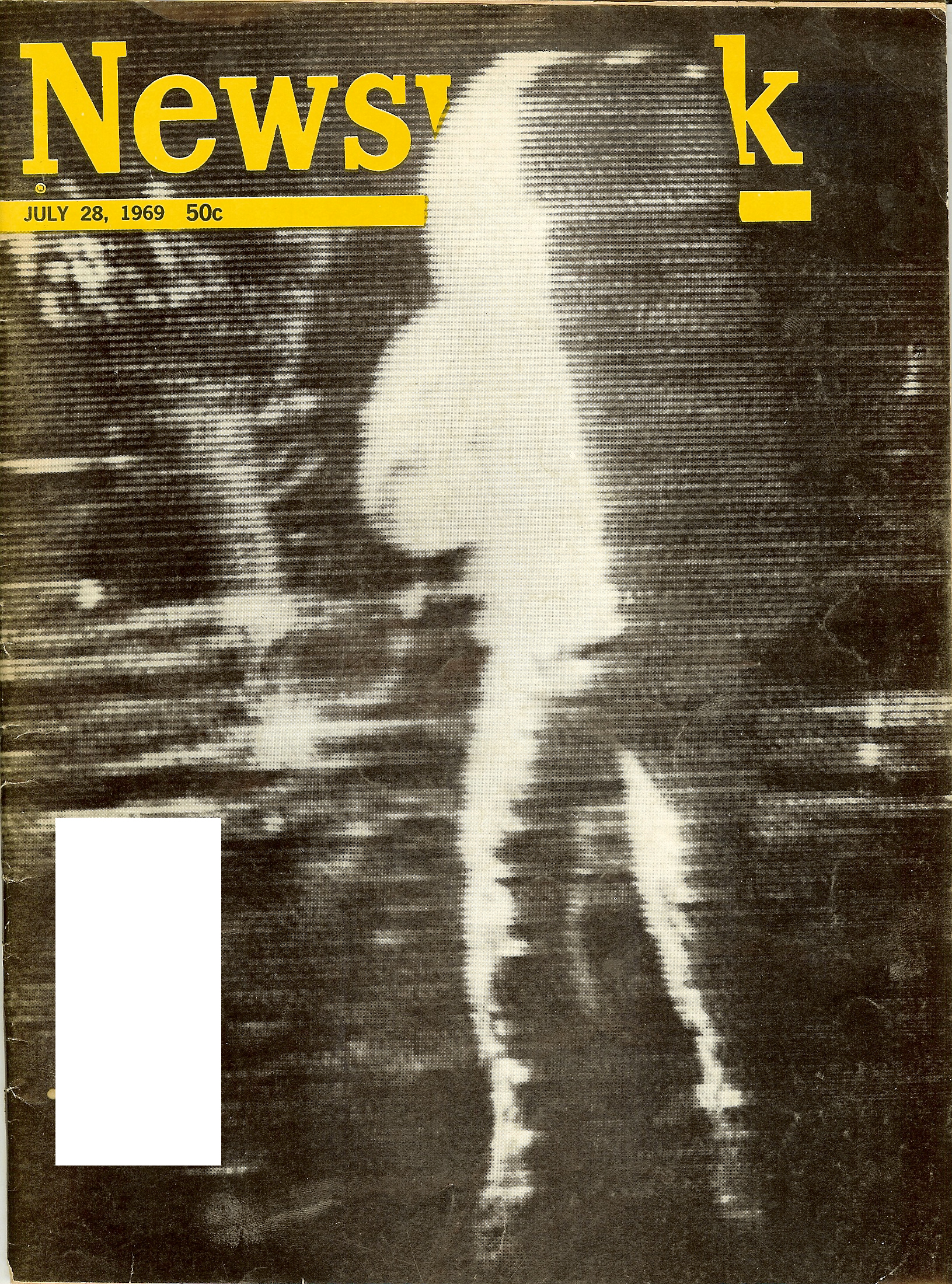
I don’t remember precisely when I started reading Newsweek but I do have the July 28, 1969 edition with a transmitted photo of the walk on the Moon.   I considered the magazine the alternate to the too conservative Time.  The magazine has provided worthwhile insight to the world’s problems.

Just a few years ago a commentator in BusinessWeek forecasted the end of much of the print media.  That was just before McGraw-Hill sold that money losing weekly to Bloomberg.  So none of this is a surprise.

I myself have been evaluating the myriad of tablet computers this past week.

Goodbye old friend!!

Creative Destruction

The capitalist system is also the system of Creative Destruction.  It is industrial evolution driven by the rise of new innovations and the downfall of old technologies.  Kodak’s demise is a perfect example.  Kodak developed the first digital camera and then buried the development to protect its very existence.

Excerpt from Why Nations Fail by Daron Acemoglu and James Robinson

in 1589 William Lee, an Englishman, had perfected a knitting machine and presented it to Queen Elizabeth for a patent.  She refused to grant Lee a patent, instead observing, “Thou aimest high, Master Lee. Consider thou what the invention could do to my poor subjects. It would assuredly bring to them ruin by depriving them of employment, thus making them beggars.” Crushed, Lee moved to France to try his luck there; when he failed there, too, he returned to England, where he asked James I (1603-1625), Elizabeth’s successor, for a patent. James I also refused, on the same grounds as Elizabeth.

Both feared that the mechanization of stocking production would be politically destabilizing. It would throw people out of work, create unemployment and political instability, and threaten royal power. The stocking frame was an innovation that promised huge productivity increases, but it also promised Creative Destruction.

I don’t know the solution.  I do know that there aren’t many blacksmiths or candle makers anymore.

‘all robot’ Manufacturing

May 13, 2012 – LOS ANGELES (MarketWatch) — Japan’s Canon Inc. (JP:7751)(US:CAJ) plans to fully automate its digital-camera production by 2015, becoming the first camera maker to swap out all its workers in favor of robots, the Nikkei business daily reported Monday without citing sources. Canon, the world’s No. 1 digital-camera maker by virtue of an approximately 20% global market share, plans to keep employees displaced by the robots by engaging them in production-control jobs or at “new divisions in growth fields,” the report said. The plants involved in the first phase of the move are located within Japan, but if the fully automated lines are successful, Canon will duplicate the move at three overseas facilities, the report said.

This topic brings up the question of employing the world in an era of automation.  Automobiles were welded by hand held machines but today they are fully automated.


Cisco’s commercial on CNN shows a fully automated factory.  There are no humans to be seen.  One robot breaks down and another says “I can fix that.”  It does and all the machines resume functioning.

So what will people be doing in this new high tech world?  I have not read a solution to that question.

The Tech impact has Just Begun

When my son had his car stolen, my daughter called to say she learned about it on his Facebook page.

No one doubts that technology has impacted our way of life. Computers, television have morphed into computers, cell phones have become smart phones, tablet computers are replacing lap top computers, and music is now downloaded rather than played on CDs or records (what are records?).

Despite all the new stuff, electronic retail has seen a continuous downward trend over the last few years.  First it was Circuit City that once was the largest chain of electronic stores in the nation and now Best Buy seems to be following with the closing of 50 stores by the end of this year.  Six (revised to 7)in California, six in Illinois, and the balance in Minnesota (revised to 17 states and Puerto Rico).

This really is the impact of technology.  Borders Books is gone and Barnes and Noble is barely hanging on.  All these businesses are impacted by the internet.  It’s the place I made two purchases this month from Amazon.  One was a new camera (tech product) and the other was sugar bowl (that is a blow to all retail).  Banking? On line.

What is the message?  Retail will never be the same.

What about jobs?  Many of us will be working from home.

Betty White may be correct when she said, “Facebook is a big waste of time.”  Just don’t tell the millions of people who use it as a primary means of communication.