‘2023 Was A Miraculous Year’

Nobel laureate Paul Krugman on Friday took exception to comments made by Republican presidential primary candidate Nikki Haley.

Haley offered a bleak take on the economy in a campaign speech in her home state of South Carolina on Wednesday. Criticizing her GOP rival Donald Trump for throwing a temper tantrum, Haley said, “He [Trump] didn’t talk about the American people once he talked about revenge. He didn’t talk about the fact that we’ve got an economy in shambles and an inflation that’s run out of control.”

Sharing excerpts of Haley’s comments from OK Magazine on X, Krugman said the economy grew 3% and core inflation was back at 2%. Haley repeated those claims on her Meet the Press interview on the Sunday January 28 program.

Krugman also said the six-month annualized rate of the core price consumption expenditure index should be considered as a more accurate inflation measure than the core annual inflation rate.

“Using annual core CPI puts you way behind the curve, for 2 reasons. First, annual: even core CPI was 4.6 in the first half of 2023, 3.2 in the second half. Second, known lags in official shelter prices lagging far behind market rents,” he said.

“So annual CPI creates a spurious impression of stubborn inflation, with a difficult last mile to cover.”

He observed that shelter receives a lower weight in the calculation of price consumption expenditure.

“The inflation battle is over. Now we need to worry that lagged effects of rate hikes will tip us into an unnecessary recession,” the economist said.
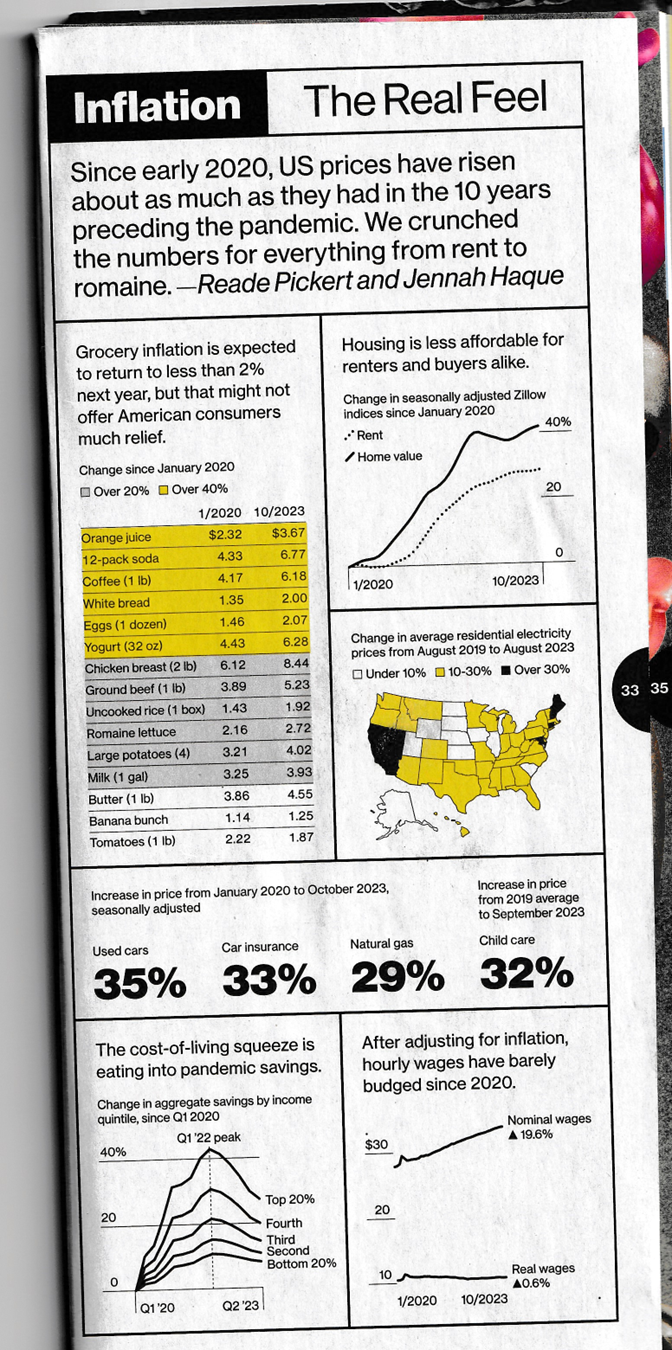
Inflation is Real

It’s the economy stupid” was a phrase coined by James Carville in 1992, when he was advising Bill Clinton in his successful run for the White House. And it is still true today.

The Biden administration may want you to believe that inflation is not real but they are telling you a lie. This report from the latest Bloomberg Business Week provides the facts. In my own personal life my Quaker Oats Apple and Cinnamon now provides 8 packets down from 10 in a box. My shaving cream is now in a 7 ounce container down from 10 ounces. Next year’s inflation rate of an expected 2% won’t be bringing prices down.

Unintended Consequences

The lower income tax rates passed into law this past December seemed like a wonderful idea.  Who can object to bonuses and higher take home pay?

The U.S. stock market indexes fell sharply today (Friday, February 2, 2018) as investors digested a stronger-than-expected jobs report that stoked inflation fears.  “The details of this jobs report, especially the numbers behind the wage growth suggest that companies are competing for workers and the shortage of skilled workers is pushing up wages. The trend in inflation is ticking higher and the big question is whether the incoming Fed, which is more hawkish, will allow the economy run hotter in the short term or tighten aggressively,” said Quincy Krosby, chief market strategist, at Prudential Financial.


Investopedia: A government or economy often defines full employment as any rate of unemployment below a defined number. If, for example, a country sets full employment at a 5% unemployment rate, any level of unemployment below 5% is considered acceptable. Full employment, once attained, often results in an inflationary period. The inflation is a result of workers having more disposable income, which would drive prices upward.


The short term benefit of lower income tax rates are obvious.  It results in a bigger paycheck for almost all workers.  However, with America’s unemployment rate at 4.1% for the past four months and below 5% since November 2016 the shortage of workers along with lower corporate taxes could easily result in a horrible surge in inflation.

Many of us saw the consequences of high inflation.  In 1974 and again 1979 to 1981 we experienced inflation as high as 14.7% in a single month.  We spent using a credit card knowing that the repayment would be in cheap dollars.  Buying a home meant paying an inflated interest rate on the mortgage.  We refinanced when the rate fell.

 I have read nothing about economist’s concerns of higher inflation.  The Federal Reserve Board did not raise rates at last Wednesday’s meeting. They left its benchmark interest rate unchanged in a range of 1.25 percent to 1.5 percent, a relatively low level that the Fed said would help support continued job growth and stronger inflation.


Wow! Is the Fed correct or are stock market investors correct?  When you are working you can demand a pay raise to compensate for inflation but if you are retired inflation can destroy your retirement plans.  Roaring inflation will also destroy the party in power in Washington.

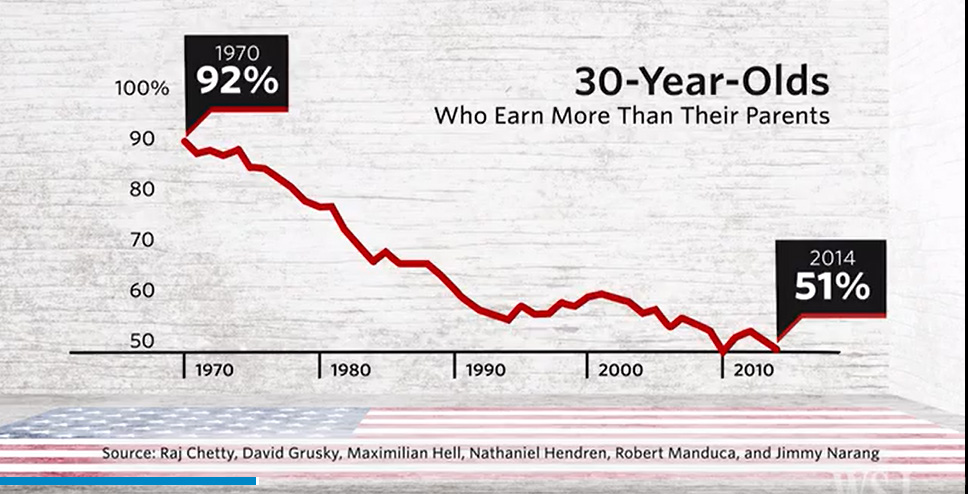
Barely Half of 30-Year-Olds Earn More Than Their Parents

Sorry, Young People: You Probably Won’t Make as Much Your Parents Did

As wages stagnate in the middle class, it becomes hard to reverse this trend

From a report in the Wall Street Journal dated December 8, 2016.   Barely half of 30-year-olds earn more than their parents did at a similar age, a research team found, an enormous decline from the early 1970s when the incomes of nearly all offspring outpaced their parents. Even rapid economic growth won’t do much to reverse the trend.

30-year-olds-earning-less-than-their-parents

Wage stagnation has taken heavy toll since 1970s

“My parents thought that one thing about America is that their kids could do better than they were able to do,” said Raj Chetty, a prominent Stanford University economist who emigrated from India at age 9 and is part of the research team. “That was important in my parents’ decision to come here.”

What’s more, even if President-elect Donald Trump fulfills his promises of rapid economic growth, the trend won’t be reversed significantly. Even if income levels grew 3.8%, the percentage of 30-year-olds who out-earn their parents would bump up to just 62%, the Wall Street Journal reports.

The study was conducted by economists and sociologists at Stanford, Harvard and the University of California. They used tax and census data to compare the earnings of 30-year-olds starting in 1970 to that of their parents.

What the report does not do is explain why wages are stagnant. I will give you my take on this horrible reality. I did earn more than my parents but only because of inflation.

When I married in 1969 my salary was $10,000 per year. According to the United States bureau of Labor Statistics your income today, based upon the CPI Inflation Calculator, that salary equates to $65,866.  My father never earned that inflation adjusted salary.

There have been many reasons for the stagnant salaries.  Three come to mind almost immediately. 

First management earned ten to twenty times the average income of most employees in the earlier parts of the 20th century.  Today management earns 200 to 300 times the average income of most employees.

Second many jobs have been outsourced other countries.  That has resulted in more potential employees seeking the remaining jobs.  Thus with more people looking for work employers can push down the pay they have to offer.

Third, many jobs have been automated thanks to artificial intelligence (AI), and computerization.   Have you seen the inside of an auto manufacturing facility?  Automation has eliminated many jobs from welding to painting.  Warehouses are now so automated that less material handlers are needed.  Office workers, I am one of them, now have computers that perform many of the manually performed functions that were done using typewriters and spreadsheets. That too reduced manpower needs. Less manpower translates to an oversupply of workers and that translates to lower pay. It is all about supply and demand.

It is unlikely that any government of any political party will change this trend.  I hope I am wrong.

Raising the Minimum Wage is No Solution

Remember when cars cost $3,500 and a house cost $30,000?  Inflation raised your pay, the cost of that car, and houses are still just as unaffordable.

Over my many working years I have benefited from the increased minimum wage rates as well as the union won rate increases.  I have always been part of the administrative staff and always on a salary.  Some were weekly rates, some were monthly rates, and there was once even an annual salary.  I receive no overtime pay but my high pay rate is supposedly offset by better pay than the hourly employees.  Not true.

Huffington Post reports that 13 States Will Raise Their Minimum Wage For The New Year It seems like a good idea.  After all who could argue with the idea of increasing the pay for those least paid who clearly are in a world of hurt?  Many need food stamps and housing subsidies to survive.

Those salaried jobs of mine have not brought me to wealth.  So I can relate to the poorest paid.

The problem for me is that a pay hike for everyone still leaves the poorest paid at the bottom of the pyramid. Now they face proportionately higher cost for rent, food, and the other necessities of life.  They will be no better off than they had been before the pay increase.  Inflation will destroy their gains.

San Francisco is a city with a minimum rate of $10.55 per hour. The new rate in January will be $10.74.  The cost of living in San Francisco is 164% of the national average.  How has the high minimum rate helped the lowest paid workers?  It hasn’t!

Is there a solution?  I know of none.