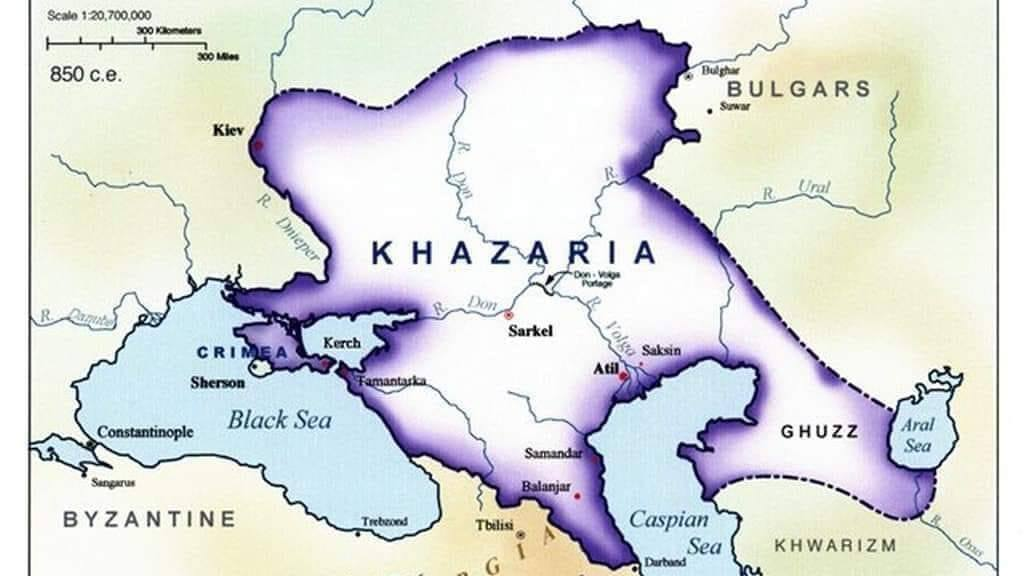
Khazaria the Thirteenth Tribe

The question is why are there so many Jews in Ukraine, today’s southern Russia, Poland, and Germany?

The Thirteenth Tribe is a 1976 book by Arthur Koestler[1] advocating the Khazar hypothesis of Ashkenazi ancestry, the thesis that Ashkenazi Jews are not descended from the historical Israelites of antiquity, but from Khazars, a Turkic people. Koestler hypothesized that the Khazars (who converted to Judaism in the 8th century) migrated westwards into Eastern Europe in the 12th and 13th centuries when the Khazar Empire was collapsing.

Koestler used previous works by Douglas Morton DunlopRaphael Patai and Abraham Polak as sources. His stated intent was to make antisemitism disappear by disproving its racial basis.

Popular reviews of the book were mixed, academic critiques of its research were generally negative, and Koestler biographers David Cesarani and Michael Scammell panned it. In 2018, the New York Times described the book as “widely discredited.”[2] Neither was it effective in disproving antisemitism, as antisemites merely adapted it — like prior work on the hypothesis — to argue the illegitimacy of present-day Jews.

The Khazar Khaganate was a powerful and influential Turkic state that existed between the 7th and 10th centuries. Located primarily in the northern Caucasus and western steppes of modern-day southern Russia, the Khazar Khaganate controlled vast territories, including parts of the Volga River, the Crimea, and the Caspian Sea region.


Key Points about the Khazar Khaganate:
1. Origins: The Khazars were a semi-nomadic Turkic people who emerged as a political force following the collapse of the Western Turkic Khaganate in the mid-600s. They eventually established their own state, with a ruling class known as the Khaganate.
2. Religion: One of the most unique aspects of the Khazar Khaganate was the ruling elite’s conversion to Judaism sometime in the 8th or 9th century. The exact reasons for this conversion remain debated, but it set the Khazars apart from their Christian and Muslim neighbors, such as the Byzantine Empire and the Caliphates.
3. Trade and Economy: The Khazars were known for their significant role in the Silk Road trade network, controlling key trade routes between Europe, the Middle East, and Central Asia. Their capital, Atil, on the Volga River, was a major commercial hub.
4. Diplomatic Relations: The Khazar Khaganate maintained a strategic diplomatic balance between the Byzantine Empire and the Muslim Caliphates, often serving as a buffer state between the two. They also had interactions with the emerging Kievan Rus and other Slavic states.
5. Military Power: The Khazars had a strong military and often engaged in warfare with their neighbors. They were known for employing a mix of cavalry and mercenary forces, and their military might helped them maintain control over their vast territory.
6. Decline and Fall: The Khazar Khaganate began to weaken in the 10th century due to internal strife, economic pressure, and attacks from external forces. One key factor in their decline was the rise of the Kievan Rus, which defeated the Khazars in a series of campaigns, culminating in the destruction of Atil around 965 AD. By the early 11th century, the Khazar state had largely disintegrated.
7. Legacy: The Khazars are often remembered for their unique religious identity and their role in medieval trade and diplomacy. Their influence extended over a wide area, and they are considered a key player in the history of the Eurasian steppes.
The Khazar Khaganate holds a special place in history for its blend of Turkic nomadic culture, religious diversity, and strategic political positioning. 

History of Israel Palestinian Wars

If you believe that the latest cease fire in Gaza you need to think about the history of Israel’s fight for survival.

When the UN voted to partition the British Mandate on
November 29, 1947, Palestinian Arabs, with the help
from Arab states, launched attacks against Israel
to seize the entire Mandate. On May 14, 1948, Israel
declared independence and was immediately invaded
by the armies of five Arab nations: Egypt, Syria,
Transjordan, Lebanon, and Iraq. The newly formed
Israeli Defense Force (IDF) managed to prevail after
fifteen months of war.

THE SIX-DAY WAR (1967)
Israel was forced to defend itself when Syria, Egypt,
Jordan, and Iraq intensified their attacks and Egypt
illegally blocked Israel’s access to international waters
and expelled UN peacekeeping forces. Four Arab
countries mobilized more than 250,000 troops in
preparation for a full-scale invasion. Israel preempted
the invasion in a defensive war and managed to
capture the West Bank from Jordan; Gaza and
the Sinai Peninsula from Egypt; and the Golan
Heights from Syria

An infographic depicting the timeline of conflict in Gaza.

The focus of the RAND study was on the five-year period between the end of Operation Cast Lead in 2009 and the end of Operation Protective Edge in August 2014.

Dec. 27, 2008 – Israel launches a 22-day military offensive in Gaza after Palestinians fire rockets at the southern Israeli town of Sderot. About 1,400 Palestinians and 13 Israelis are reported killed before a ceasefire is agreed.

The Israel Defense Forces, or IDF, launched a ground invasion of the Gaza strip on Aug. 7, 2014, with the goal of destroying Hamas’ widespread network of underground tunnels that were being used to stow rockets.

In 2018 on May 29, Gaza’s Hamas rulers said they had agreed to a cease-fire with Israel to end the largest flare-up of violence between the two sides since a 2014 war.

Egypt mediated a ceasefire between Israel and Hamas, which came into effect on 21 May 2021, ending 11 days of fighting in which both sides claimed victory.

October 7, 2023 Hamas attacks Israel and Israel is at war with Hamas again.

When will this end?

My guess is NEVER!

President Joe Biden has a Problem

I previously predicted that Joe Biden will not run for re-election. My reasons revolved around the economy.  Today young people are opposed to America’s support of Israel.  

The turmoil we’re seeing on campuses today brings back memories of the widespread student protests of 1968 — a comparison that won’t be lost given that the Democratic National Convention this year will take place in Chicago. The 1968 Democratic Party convention was also held in Chicago.

On March 31, 1968, following the New Hampshire primary and Robert Kennedy’s entry into the election, the president made a televised speech to the nation and said that he was suspending all bombing of North Vietnam in favor of peace talks.

After concluding his speech, Johnson announced,

“With America’s sons in the fields far away, with America’s future under challenge right here at home, with our hopes and the world’s hopes for peace in the balance every day, I do not believe that I should devote an hour or a day of my time to any personal partisan causes or to any duties, other than the awesome duties of this office — the presidency of your country. Accordingly, I shall not seek, and I will not accept, the nomination of my party for another term as your President.”

After President Lyndon Johnson announced that he would not run for reelection, the party nominated his vice president, Hubert Humphrey. But Humphrey’s moment of coronation quickly turned into a moment of chaos. As Chicago police, unleashed by Mayor Richard Daley, confronted anti-Vietnam War protesters with tear gas and batons on the streets outside the convention, the televised images of violence greatly harmed Humphrey’s prospects in November.

President Joe Biden knows this history. The anti-war protests in the 1960s went on for years. Now, it remains unclear whether the protests — which are not yet nearly as large in scale or scope as were the anti-Vietnam protests — will continue to intensify or start to dissipate, especially as school lets out for the summer months. And in one recent Harvard Kennedy poll surveying young people between the ages of 18 and 29 in March, the findings showed the Israel/Palestine conflict ranked second-lowest in importance, coming in below gun violence as well as bread-and-butter issues such as inflation, health care and housing.

Will Biden’s belief that a Trump victory mean the end of the American democracy continue his run for re-election?  I hope so when Trump says he will be a dictator on day one.

Top Democrat Schumer calls for new elections in Israel, saying Netanyahu is an obstacle to peace

WASHINGTON (AP) — Senate Majority Leader Chuck Schumer on Thursday called on Israel to hold new elections, saying he believes Israeli Prime Minister Benjamin Netanyahu has “lost his way” and is an obstacle to peace in the region amid a growing humanitarian crisis in Gaza.

Schumer, the first Jewish majority leader in the Senate and the highest-ranking Jewish official in the U.S., strongly criticized Netanyahu in a 40-minute speech Thursday morning on the Senate floor. Schumer said the prime minister has put himself in a coalition of far-right extremists and “as a result, he has been too willing to tolerate the civilian toll in Gaza, which is pushing support for Israel worldwide to historic lows.”

“Israel cannot survive if it becomes a pariah,” Schumer said.

The problem is that Israel’s “religious right” hold the view that they have a divine right to all of Gaza. Some of those people have blocked the roads to stop the delivery of food and medical supplies to Palestinians.

Do You Oppose Jewish Genocide? ‘It Depends’ Is Not the Right Answer

Opinion by James D. Zirin

Of all universities, the Ivy League colleges of Harvard, Penn and MIT should know better. It’s very simple: Advocacy of genocide is abhorrent, dehumanizing; it instills fear and distress. It has no place on a college campus, or anywhere else in our society. It has no pedagogical value. It is murder, nihilism.

Just before I went into the Army, a lawyer friend, who had served, counseled me to give an evasive non-answer to any question I was asked: “Depends on the tactics and the terrain.”

So it is perhaps not surprising that a lawyer thought “Depends on the context” was the perfect answer for three university presidents (one of whom is now an ex-president) testifying before Congress if asked whether calls for the genocide of Jews on campus constituted bullying or harassment.

Context? What a dreadful word to use in the context of genocide. What is the context it would depend on — Auschwitz, Dachau, the pogroms of Russia in the 19th century, or the Jews’ convenience over 2,000 years as victims of dehumanizing oppression. And let’s not forget the 1,400 victims of Hamas’ Oct. 7 attack on Israel — women raped and murdered, babies slaughtered, men butchered in barbarous ways on another day that will live in bloody infamy.  

At all of these universities, I am certain, burning a cross or erecting a gallows in front of a dormitory housing Black students — both forms of symbolic speech — would constitute bullying or harassment. I’m equally certain that statements targeting LGBTQ+ students would constitute bullying or harassment. 

Interestingly enough, Harvard President Claudine Gay was dean of the university’s Faculty of Arts and Sciences on May 25, 2020, when George Floyd was murdered on the faraway streets of Minneapolis. She published a statement, declaring that “We have been here before, too many times,” that “the headlines stir an acute sense of vulnerability,” and that “we are confronted again by old hatreds and the enduring legacies of anti-black racism and inequality.” She said she feared for her teenage son and suggested she felt personally threatened by Floyd’s death. The tragic event, she wrote, illustrated “the brutality of racist violence in this country” and gave her an “acute sense of vulnerability.”

In nothing which Gay said last week before Congress did she show any understanding or empathy that Jewish students or their parents might have felt similarly vulnerable after Harvard condoned calls for the genocide of Jews.

The question put to the university presidents by Rep. Elise Stefanik (R-N.Y.) was not all that difficult. The three scholars likely would not have had such a hard time responding if it had been based on race, gender or sexual orientation. If asked whether the burning of crosses has any place on a university campus, rest assured that the answer would not have been “It depends.”

Jewish students should be treated no differently — and certainly no worse — than others. But the ideal outcome is not to coddle Jewish students or make them another overly protected class. It would be much better for these elite schools to reconsider many of their current practices. They ought to set consistent guidelines on free speech and enforce those. They ought to refrain from partisan statements on national and international issues, which are beyond their scope of responsibility.

Historian Niall Ferguson — among other things, a senior fellow at Harvard’s Belfer Center — has it right in a piece he recently wrote in The Free Press. Ferguson argues that the answers given by the troika of university presidents may have been technically correct under the First Amendment but constituted the “treason of the intellectuals.” 

“The lesson of German history for American academia should by now be clear,” Ferguson writes. “In Germany, to use the legalistic language of 2023, ‘speech crossed into conduct.’ The ‘final solution of the Jewish question’ began as speech — to be precise, it began as lectures and monographs and scholarly articles. It began in the songs of student fraternities. With extraordinary speed after 1933, however, it crossed into conduct: first, systematic pseudo-legal discrimination and ultimately, a program of technocratic genocide.”

Germany and France both have more robust approaches to hate speech and incitement to genocide that have much to recommend them. But they’re flatly inconsistent with the way the Supreme Court has interpreted the First Amendment. There is obviously much to think about but, as far as fear of harm goes, violence or the threat of imminent violence obviously is not protected speech. So anyone who commits violence violence, or launches an imminent threat of violence, is breaching university rules.

But is this enough to nip genocidal ideation in the bud? Are the crazies among us more or less likely to become violent if they’re forbidden from engaging in speech about it? I’m not sure. 

Perhaps university authorities are more likely to identify dangerous people in their communities if they’re allowed to speak their minds — otherwise, an attack comes without warning. But is it feasible for universities to identify the potentially violent students on campus after they have expressed odious views, put them in a digital dossier, and keep them under artificial intelligence until they attack a Jew heading to class?

One professor I know at Penn explained it this way: 

“Oh, I fully agree with no threatening/no taunting/no cross burning. And all of those are prohibited by the Penn speech code. The issue is what to do about a call for genocide at a protest — someone chants ‘Kill all the —.’ I think that contributes nothing to discourse and has no place in a university community, and I would try to teach students norms of civility and respect. But I wouldn’t expel them for saying it, in part because I do think usually the best answer to bad speech is good speech, but more because I worry about giving university administrators the task of deciding who’s calling for genocide. In the Israel-Hamas conflict, for instance, each side accuses the other of genocidal goals, so supporting either side will be called endorsement of genocide. And I just don’t feel like student disciplinary proceedings are the place to decide who’s right about that. Administrators have a very hard time being neutral.”

Right. But can they be neutral about murder? And should university administrators take political positions at all? As Justice Jackson put it in his concurring opinion in Terniniello v. Chicago, “if the Court does not temper its doctrinaire logic with a little practical wisdom, it will convert the constitutional Bill of Rights into a suicide pact.”

Keeping students safe is of paramount importance. So I would forbid anyone on a college campus to advocate the murder of anyone. 

James D. Zirin, author and legal analyst, is a former federal prosecutor in New York’s Southern District. He is also the host of the public television talk show and podcast, “Conversations with Jim Zirin.”

Hatred of Jews has Reached a New High

It’s called anti-Semitism.

Harvard President Apologizes for Congressional Testimony on Antisemitism. The president, Claudine Gay, told the campus newspaper that she “should have had the presence of mind” to answer differently.

The presidents of leading Ivy League universities seem to be in support of on campus groups calling for a genocide against all Jews.

The exchanges involving Congresswoman Elise Stefanik, Dr. Gay and two other university leaders, Elizabeth Magill of the University of Pennsylvania and Sally Kornbluth of M.I.T., have thrown three of the country’s most influential colleges into turmoil. On Thursday, a House committee opened an investigation into “the learning environments” on all three campuses, and Senator Kirsten Gillibrand, Democrat of New York, said the three presidents should leave their posts.

When the hate reaches a fevers pitch there is one place American Jews can go and feel safe. Israel. That is the reason that even Jews who believe Israel attacks on Gaza are too much still support that country.

Why there is No Peace between Israelis and Palestinians

This posting is motivated by the United Nations Security Council condemnation of Israel’s decision to build new housing in Israel occupied West Bank.

The story is old but people reading this blog need to understand how Israelis and Palestinians have come to this sorry place in history.  This is not a complete history of all the wars fought between Arabs and Israel. Nor is there any reference to Hamas and Hezbollah in this discussion, who are both sworn enemies of Israel.

  • When the state of Israel was created by an action of the United Nations in 1948 the Arab population in that area refused to recognize the creation of a Jewish state. Immediately after Israel declared itself a state the surrounding nations attacked.  Arabs lost that war.
  • In 1967 the Arab nations surrounding Israel gathered armies on the borders of Israel in preparation to invade. Those countries were Syria, Jordan, and Egypt.  The Israelis actually started the war before the Arab countries attacked.  Israel won that war driving the Syrians out of the immediately adjoining area, pushing the Jordanians to the east of the Jordan River and taking all of the Sinai Peninsula from Egypt and occupying all the land of Egypt to the Suez Canal.  In the process Israel also occupied parts of southern Lebanon.
  • Israel reached an agreement with Egypt to withdraw from all of the land they had won in the 1967 War in exchange for Egyptian recognition of the State of Israel. The EgyptIsrael Peace Treaty was signed in Washington, D.C., United States on 26 March 1979, following the 1978 Camp David Accords.
  • The Jordan-Israel Peace Treaty was signed on October 26, 1994, at the southern border crossing of Wadi ‘Araba. The treaty guaranteed Jordan the restoration of its occupied land (approximately 380 square kilometers), as well as an equitable share of water from the Yarmouk and Jordan rivers. Moreover, the treaty defined Jordan’s western borders clearly and conclusively for the first time.
  • Israel remains in control of what was part of Jordan, the area west of the Jordan River, and Gaza, a small strip of land along the Mediterranean Sea that had previously been controlled by Egypt, and the Golan Heights that were previously part of Syria.
  • Israel withdrew its settlements in Gaza in 2005. That amounted to about 8,500 people being relocated in the hopes of bringing some peace to that area. Repeated missile attacks from Gaza into Israel’s pre-1967 territory has resulted in repeated bombing of the area by the Israeli Defense forces.  The most recent bombing occurred in 2014.
  • Efforts to create a two state solution between Israel and the occupied Arab territories have been unsuccessful primarily because the leadership of the Palestinians refuse to recognize Israel’s right to exist.
  • Israelis take the position that the spoils of war is they get to decide what happens in the areas they occupy. Thus building Jewish communities in areas that are primarily Palestinians is a fair consequence of the wars they have won.  The rest of the world through the United Nations disagrees.
  • Neither Israelis nor Palestinians trust their opponents to honor their words.

Hatred makes a peace agreement an unlikely outcome in the next few years.  New leadership for both Israel and the Palestinians is the only hope for a settlement and permanent peace.

Happy New Year

David Bancroft

Bernie Sanders: If you don’t like Israel don’t ask me for money!

Mr. Sanders:

You continually send me e-mails asking me to send you money so that you can be elected to be the President of the United States.

I am Jewish and I fear for the safety and future of Jews in the world, especially when Iran is launching missiles – dedicating to the eradication of the State of Israel.

I will not vote for you because I believe that you do not know the difference between good and evil.  You have spokespeople, like Linda Sarsour, who decry the State of Israel and liken it to white supremacists and say that it is an apartheid state.

 After the Germans, Arabs and Japanese conspired to conquer the world and wipe out every Jew in the world in World War 2, the world (at the U.N.) voted to divide Palestine into Arab-land and Jew-land (this was after Great Britain gave 80% of Palestine to Jordan in 1922).

Israel agreed to accept the “partition” plan and the Arabs refused, claiming that they wanted 100% of the land – that the Jews could live in the Mediterranean.  After the war of 1948, the borders were fixed; except that the Arabs again refused to honor those borders or acknowledge that the Jews had any right to live anywhere.

In 1967, the Arabs launched another offensive against Israel.  Israel won that war too.   Israel ended up with more territory.  They gave most of the “gains” back to Egypt in order to make peace with Egypt.

They offered to give the “West Bank” back to Jordan to make peace, but Jordan refused to take it – because Jordan hates the Palestinians (the Jordanians have kept the Palestinians in camps for the past 60 years – rather than accept them as Jordanian citizens).

Israel kept, accepted and made citizens of the Israeli Arabs.  I’m sure that you know that 20% of Israelis are Arabs …. and 20% of Israeli medical students are Arabs.  Did you know that the new assistant head of the Police is an Arab (named yesterday)?

Your outrageous lying statement that the Israelis overreacted in the Gaza conflict is immoral.  No fighting army (against Hamas terrorists who use human shields and launch missiles from schools and mosques) has EVER acted with such restraint and morality as the Israeli’s.

Shame on you Bernie that you cannot tell good from bad; morality from evil.  You are turning your back on the only democracy in the Middle East.  You are turning your back on the country that is the nicest and best place for Palestinians to live (Syria, Lebanon and Jordan have them locked up in camps).  You support those whose motto is “From the River to the Sea” (meaning that ALL of Israel should be Arab … and the Jews should live in the Sea).  You just don’t understand the real world.  You have bought into Arab propaganda and turned against the only Jewish country in the world.

written by Michael Waterman, teacher at Temple Beth Am in Los Angeles

Obama versus Netanyahu

Obama versus Netanyahu

“If there is one lesson American Jews will learn from Israel’s election, it’s this:  they’re not us.

Israel is not New York. Or LA. Or Chicago or Boston or Miami or Philadelphia. It is a Jewish “community” unlike any in America.”

Those are the opening words by Rob Eshman in today’s Jewish Journal.

We just don’t appreciate the perceptions of Israelis. They live under the constant threat of war with their neighbors. They live in fear of their lives. No one in the United States lives with those kinds of fears. Many American Zionists will evolve in their view of Israel. The reason is that Americans favor the idea of a two state solution to the Israel-Palestinian problem.

I suspect that the ongoing enmity between President Obama and Prime Minister Netanyahu is the result of the prime minister’s refusal to negotiate a two state solution. In other words Netanyahu told Obama his one state position years ago. He only just told the world two days ago.

Netanyahu and his American supporters may still change the course of the Iran nuclear negotiations. Those Americans who favor supporting Israel in all situations no matter what that country does will work their will through Congress. There is no doubt that Israel’s path will be unpleasant over the next two years.

Israelis are a resourceful people. They will find a way to have their way.

David Bancroft

Benjamin Netenyahu Speaks to the United States Congress

My theory is that Speaker of the House John Boehner invited Benjamin Netenyahu to speak to Congress is an effort on the part of the GOP to prove to Jewish voters that the Republican Party is the party that supports Israel.  It’s not that their votes will change an election.  The GOP would like to attract more Jewish donors.

I believe Benjamin Netenyahu really does fear for the existence of Israel.  His intention is to go where ever he must to obtain the support for what he believes are Israel’s needs.