You will be Happier without Jewish Food

If you are not Jewish all this may be meaningless to you. All the Jewish people I know only eat these delicacies on special occasions. Jewish people eat at BJ’s, McDonald’s, KFC, and all the places you know. The exception being the Bagels.

Latkes A pancake-like structure, not to be confused with anything a first-class health restaurant would put out. In a latke the oil remains inside the pancake. It is made with potatoes, onions, eggs and matzo meal. Latkes can be eaten with applesauce but COULD also be used to comb your hair, shine your shoes or lubricate your automobile. There is a rumor that in the time of the Maccabees, they lit a latke by mistake and it burned for eight days. What is certain is that you will have heartburn for the same amount of time. It tastes GREAT but will stop your heart if the grease gets cold.

Note: Eggs are not necessary since the potatoes will bind the pancake when they cook. Also it is not necessary to fry it in much oil. Use Pam or the like or a Teflon pan.
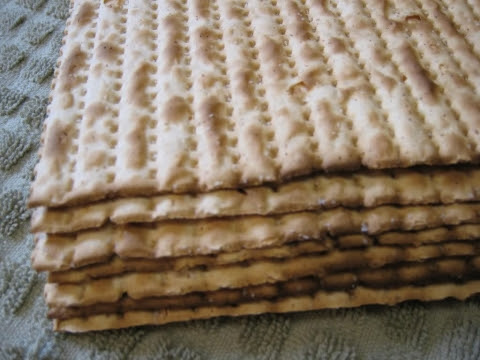
Matzoh Israel ‘s punishment for escaping slavery. It consists of a simple mix of flour and water – no eggs or flavor at all. When made especially well, it could actually taste like a cardboard box recycled from the Tel Aviv city dump. Its redeeming value is that it does fill you up and stays with you for a long time–sometimes far too long–and you are advised to eat lots of prunes with it. If the prunes do not work, try castor oil, or even gun powder as a last resort before a surgeon has to mine it out.

For eight days every year religious Jews must eat matzoh.  No bread. It is part of the Passover tradition that will start on the evening of April 10, 2017.

Eggs are not necessary and the constipation can be avoided by eating whole wheat matzos.


Kasha Varnishkes  One of the little-known “delicacies” that is even more difficult to pronounce than it is to cook. It has nothing to do with varnish, but is basically a mixture of buckwheat and bowtie noodles (not macaroni). Why bowties? Many sages in the Old Testament discussed this and agreed that an ancient Jewish mother must have decided, ‘Son, you can’t come to the table without a tie or, god forbid, place your elbow on the table.” If Mamma said ‘bowties,’ you better believe that’s what the family used, even if they had to invent them on the spot.
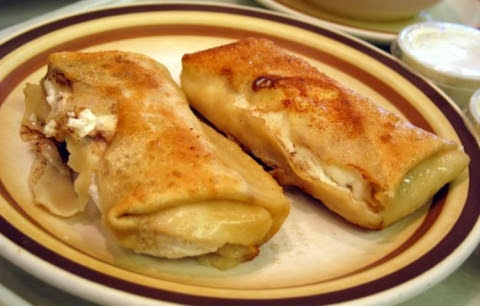
 

Blintzes  Not to be confused with the German war machine’s ‘blintzkreig.’ Can you imagine the Jerusalem Post in ’39 with huge headlines announcing: ‘Germans drop tons of cheese and blueberry blintzes on Poland. Shortage of sour cream expected’? Basically, this is the Jewish answer to Crepe Suzettes. They are actually offered on the menu at the local International House of Pancakes, but no one there knows what the hell they are. In ignorant bliss, they often serve them frozen from the blintz factory. No modern woman will take time to make them if she can find a grocery store selling frozen ones (assuming she can find someone in that store who knows where they are kept). 
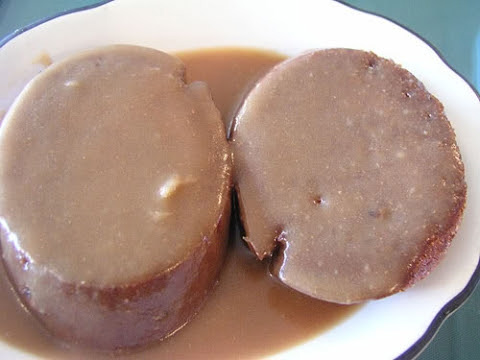
 

Kishke You know from Scottish Haggis? Well, this it ain’t. Remember what I say if you should go to the Highlands . You do not want to eat Haggis, no matter how much Scotch you’ve downed. In the old days they would take an intestine and stuff it to make kishkewe use parchment paper or plastic (made in China). And what do you stuff it with? Carrots, celery, onions, flour, and spices. The skill is not to cook it alone, but to add it to the cholent (see below) and let it simmer for 24 hours until there is no chance whatsoever that there is any nutritional value left. The gravy can be purchased in bulk at any southern Bisquitville drive-thru.
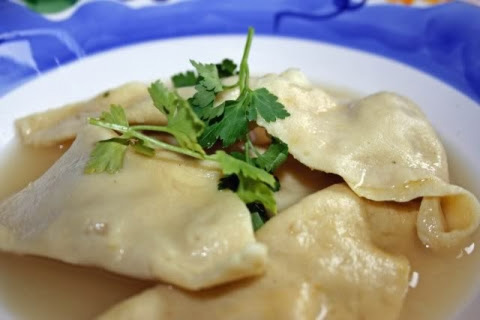
 

Kreplach They sound worse than they taste. There is a rabbinical debate on their origins. One Rabbi claims they began when a Chinese fortune cookie fell into the chicken soup. Another claims they started in an Italian restaurant, where the owner yelled at the chef, ‘Disa pasta tastes like-a krep!’ Either way it can be soft, hard, or soggy, and the amount of meat inside depends on whether it is your mother or your mother-in-law who cooked it. Tastes best if made in a Manhatten deli where they serve the soup by the barrel-load.
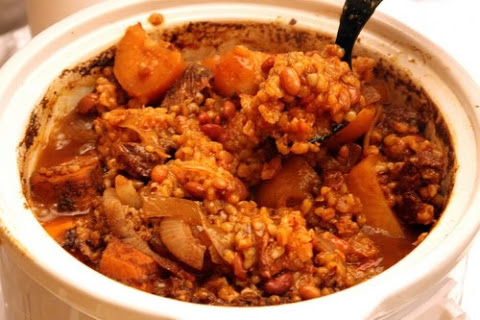
 

Cholent This combination of noxious gases had been the secret weapon of Jews for centuries. The unique combination of beans, barley, potatoes, and bones or meat is meant to stick to your ribs and anything else it comes into contact with. Precursor of Superglue. At a fancy Mexican restaurant (kosher, of course) I once heard this comment from a youngster who had just had his first taste of Mexican refried beans: ‘What, they serve leftover cholent here too?” A Jewish American Princess once came up with something original for her guests (her first and probably last cooking attempt at the age of 25). She made cholent burgers for night supper. The guests never came back. The dogs ate the burgers but later threw up and had to be taken by ambulance to the pet emergency room.
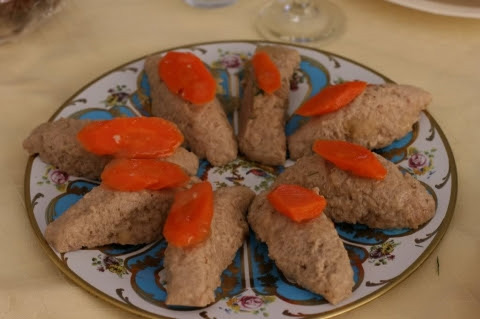


Gefilte Fish A few years ago, an Israeli politician had problems with the filter in his fish pond and a few of his fish got rather stuck and mangled. His son (5 years old at the time) looked at them and asked, “Is that why we call it ‘ge-filtered fish?” Originally it was a carp stuffed with a minced fish and vegetable mixture. it usually is comprised of small fish balls eaten with horseradish (pronounced ‘chrain’ to rhyme with ‘insane,’ which you have to be to inflict it on your innards) and is judged on its relative strength in bringing tears to your eyes at 100 paces. The VERY NAME OF THIS DISH FRIGHTENS FULLY GROWN AND SOPHISTICATED GENTILES and they actually run when it is merely mentioned.


Bagels How can we finish without the quintessential Jewish defense weapon, the bagel? Like most foods there are legends surrounding the bagel, although I don’t know any other than it was first discovered when unsugared donuts accidentally petrified. There have been persistent rumors that the inventors of the bagel were the Norwegians who couldn’t get anyone to buy smoked salmon (Lox). Think about it: Can you picture yourself eating smoked salmon or trout on white bread? Rye? A cracker? Naaa! The Israel Defense Forces research lab looked for something hard and almost indigestible which could take the spread of cream cheese and which doesn’t take up too much room in desert-maneuvers ration kits. And why the hole? The truth is that many philosophers believe the hole is the essence and the dough is only there to indicate where the hole is placed.

Some say the wheat bagel is less constipating.  I love onion bagels.  I am especially fond of the bagels from Western Bagel.

David Bancroft

Brisket is not the same as Corned Beef!

If you are not Jewish, I cannot even begin to explain it to you.

This goes back 2 generations, 3 if you are over 50. It also explains why many Jewish men died in their early 60’s with a non-functional cardiovascular system and looked like today’s men at 89.

Before we start, there are some variations in ingredients because of the various types of Jewish taste (Polack, Litvack, Deutch and Gallicianer). Sephardic is for another time.

Just as we Jews have six seasons of the year (winter, spring, summer, autumn, the slack season, and the busy season), we all focus on a main ingredient which, unfortunately and undeservedly, has disappeared from our diet. I’m talking, of course, about SCHMALTZ (chicken fat).


SCHMALTZ has, for centuries, been the prime ingredient in almost every Jewish dish, and I feel it’s time to revive it to its rightful place in our homes. (I have plans to distribute it in a green glass Gucci bottle with a label clearly saying: “low fat, no cholesterol, Newman’s Choice, extra virgin SCHMALTZ.” (It can’t miss!) Then there are grebenes – pieces of chicken skin, deep fried in SCHMALTZ, onions and salt until crispy brown (Jewish bacon). This makes a great appetizer for the next cardiologist’s convention.

There’s also a nice chicken fricassee (stew) using the heart, gorgle (neck) pipick (gizzard – a great delicacy, given to the favorite child), a fleegle (wing) or two, some ayelech (little premature eggs) and other various chicken innards, in a broth of SCHMALTZ, water, paprika, etc. We also have knishes (filled dough) and the eternal question, “Will that be liver, beef or potatoes, or all three?”

Other time-tested favorites are kishkeh, and its poor cousin, helzel (chicken or goose neck). Kishkeh is the gut of the cow, bought by the foot at the Kosher butcher. It is turned inside out, scalded and scraped. One end is sewn up and a mixture of flour, SCHMALTZ, onions, eggs, salt, pepper, etc., is spooned into the open end and squished down until it is full. The other end is sewn and the whole thing is boiled. Often, after boiling, it is browned in the oven so the skin becomes crispy. Yummy!

My personal all-time favorite is watching my Zaida (grandpa) munch on boiled chicken feet.

For our next course we always had chicken soup with pieces of yellow-white, rubbery chicken skin floating in a greasy sea of lokshen (noodles), farfel (broken bits of matzah), tzibbeles (onions), mondlech (soup nuts), kneidlach (dumplings), kasha (groats), kliskelech and marech (marrow bones) . The main course, as I recall, was either boiled chicken, flanken, kackletten, hockfleish (chopped meat), and sometimes rib steaks, which were served either well done, burned or cremated. Occasionally we had barbecued liver done to a burned and hardened perfection in our own coal furnace.

Since we couldn’t have milk with our meat meals, beverages consisted of cheap soda (Kik, Dominion Dry, seltzer in the spritz bottles). In Philadelphia it was usually Franks Black Cherry Wishniak (vishnik).

Growing up Jewish

If you are Jewish, and grew up in city with a large Jewish population, the following will invoke heartfelt memories.

The Yiddish word for today is PULKES (PUHL-kees). Translation: THIGHS.
Please note: this word has been traced back to the language of one of the original Tribes of Israel, the Cellulites.

The only good advice that your Jewish mother gave you was: “Go! You might meet somebody!”

You grew up thinking it was normal for someone to shout “Are you okay?” through the bathroom door when you were in there longer than 3 minutes.

Your family dog responded to commands in Yiddish.

Every Saturday morning your father went to the neighbourhood deli (called an “appetitizing store”) for whitefish salad, whitefish “chubs”, lox (nova if you were rich!), herring, corned beef, roast beef, cole slaw, potato salad, a 1/2-dozen huge barrel pickles which you reached into the brine for, a dozen assorted bagels, cream cheese and rye bread (sliced while he waited). All of which would be strictly off-limits until Sunday morning.

Every Sunday afternoon was spent visiting your grandparents and/or other relatives.

You experienced the phenomenon of 50 people fitting into a 10-foot-wide dining room hitting each other with plastic plates trying to get to a deli tray.

You had at least one female relative who penciled on eyebrows which were always asymmetrical.


You thought pasta was stuff used exclusively for Kugel and kasha with bowties.

You were as tall as your grandmother by the age of seven.

You were as tall as your grandfather by age seven and a half.

You never knew anyone whose last name didn’t end in one of 5 standard suffixes (berg, baum, man, stein and witz).

You were surprised to discover that wine doesn’t always taste like cranberry sauce.

You can look at gefilte fish and not turn green.

When your mother smacked you really hard, she continued to make you feel bad for hurting her hand.

You can understand Yiddish but you can’t speak it.

You know how to pronounce numerous Yiddish words and use them
correctly in context, yet you don’t know exactly what they mean.
Kaynahurra.

You’re still angry at your parents for not speaking both Yiddish and English to you when you were a baby.

You have at least one ancestor who is somehow related to your spouse’s ancestor.

You thought speaking loud was normal.

You considered your Bar or Bat Mitzvah a “Get Out of Hebrew School Free” card.

You think eating half a jar of dill pickles is a wholesome snack.

You’re compelled to mention your grandmother’s “steel cannonballs” upon seeing fluffy matzo balls served at restaurants.

You buy 3 shopping bags worth of hot bagels on every trip to Stamford Hill or Edgware and carefully shlep them home like glassware. (Or, if you live near Chigwell, Manchester or another Jewish city hub, you drive 2 or 3 hours just to buy a dozen “real” bagels.)  Western Bagel and Brent’s in the San Fernando Valley. Factor’s  or Canter’s deli in West L.A.

Your mother or grandmother took personal pride when a Jew was noted for some accomplishment (showbiz, medicine, politics, etc.) and was ashamed and embarrassed when a Jew was accused of a crime as if they were relatives.

You thought only non-Jews went to sleep away colleges. Jews went to city schools… unless they had scholarships or made an Ivy League school.

And finally, you knew that Sunday night and the night after any Jewish holiday was designated for Chinese food.

Zei gezunt!!

Original author unknown.

P.S. Corned beef is a salt-cured beef product. In the United States and Canada, corned beef typically comes in two forms, a cut of beef (usually brisket, but sometimes round or silverside) cured or pickled in a seasoned brine, and canned (or ‘tinned,’ in British English) (cooked).  It’s not an exclusively Jewish dish.  As an example Corned beef and Cabbage is an Irish favorite. 

Stay Well, David Bancroft

Smoked Salmon (Lox) Emergency

For those of you less informed people, Lox is the Jewish name for smoked salmon.  I do not know the origin of the word Lox.  I do know that a bagel topped with cream cheese and Lox is a heavenly dish.

On our recent trip to Paris (this past August) we did not go to the Moulin Rouge (way to expensive to watch the can-can).  One young lady on the tour, who did go to the show, complained the next day that they served raw smoked salmon for dinner.  I informed her that smoked salmon is raw and is very expensive.  By the pound smoked salmon costs at least $20.00 USD in Los Angeles.

Now a serious smoked salmon (Lox) emergency has befallen us all.  The AP reports “Smoked salmon tainted with salmonella bacteria has sickened hundreds of people in the Netherlands and the United States, sparking a major recall, health authorities said Tuesday.”

What will Lox cost at Jerry’s Famous Deli or Brent’s with this recall?  I won’t be surprised if the cost rises to $50.00 USD a pound.