Cities Grow or Die

Updated May 22, 2015 because of data reported in the Los Angeles Daily News.

Chicago, Detroit, Philadelphia, and Baltimore are examples of large cities that are dying.  They all have one common issue. A lack of jobs.  Cities that are thriving are growing and they all have one common reason.  New jobs.  Los Angeles grew in population by 136,243 people since the last census says the U.S. Census Bureau.  That is a growth of just the city and does not include surrounding towns such as Long Beach which have all seen similar or greater population increases.

I live near the very end of the northwest part of Los Angeles. The nearby boulevard ends about 2 miles west of my home. Despite that fact the traffic is busy all of the time. It is obviously crowded during rush hours. Simply put, we have run out of space. The land beyond the end of the city has been set aside as protected land to preserve open space with the idea of establishing a wildlife park to protect both animals and native habitat.

The question is how do we provide housing for the growing population? The answer is more apartments and condominiums. With that conclusion in mind the city has decided to permit that kind of construction. Cities do not remain static. They either grow or shrink. The growth is into the suburbs, more high rise buildings, or a combination. Spread of the Los Angeles area is a fact and is probably known throughout the world. The travel times has become nightmares for some people driving as long as two hours to get to work. Finally the city has become wiser and now has started permitting the dreaded high rise housing. Many in our city are continuing to fight this kind of construction.

Thus we have arrived at a time when many new proposals are being submitted to neighborhood councils and the city council for approval. In my area:

  •  Two part with phase 1 for the construction of a 7-story, 193,000 sqft building to house 170 apartments including 13 live-work units and 5,700 sqft restaurant. There will also be parking for 258 cars and 196 bikes.  The 2nd phase is for the construction of 166,000 sqft commercial office building with 10,000 sqft for restaurant and retail space. There will also be parking for 490 cars and 254 bikes. The office buildings being replaced are modern two story structures.
  •  A 707 unit apartment complex that was the home of Panavision manufacturing consisting of a one story building and parking lot.
  •  A 300 unit apartment complex most likely replacing one or two story office buildings.
  •  A 4,000 multifamily unit development on the former Rocketdyne facility that is expected take 10 years to complete. That project is in the design phase and has not been released for public scrutiny. The information released to date says that the buildings will vary in height from 6 to 18 stories high.
  • The former Catalina Yachts manufacturing site will be converted into 600 units.

That is a total of 5,777 housing units which more than likely means an additional 11,000 people and their cars added to already congested boulevards. To make the additional housing more palatable new nearby shopping centers and business offices will provide jobs.

Westfield Village #3

You don’t like it? Some alternative places to live are Fresno, California and Medford, Oregon. Those are two nice communities that are not faced with large growth but do offer a pleasant climate and many of the benefits of larger cities. 

Military-Industrial Complex Equals Jobs

The 223rd and final C-17 cargo plane was delivered to the Air Force last week. The plane was manufactured at Boeing (the old Douglas Aircraft facility) in Long Beach, California.  That’s the last airplane manufacturing facility in Southern California.  The plant will be closed by 2015 and will result in the loss of 3,000 jobs.

Here is the problem. While Boeing cited sequestration, the Pentagon has made it clear for several years that it didn’t require more C-17s. However, lawmakers pushed through more orders to preserve jobs.

As reported in Businessweek, October 29, 2009, “Every year since 2006, the Pentagon has said that it has enough C-17s. And every year, Congress overrules the military and authorizes funds for additional planes. In October the Senate approved $2.5 billion in the 2010 budget for 10 more C-17s, which would bring the fleet to 215.”

The United States has created high paying jobs by ordering complex technology and other aerospace/biotech products from American companies.  To a great extent the military-industrial complex has been the driver of jobs.

We give $1.3 billion of aid to Egypt in the form of military hardware.  We even gave Russia $126 million in aid in 2010.

 Top Recipients of U.S. Military Aid, FY2010

Country $ U.S.   millions
Afghanistan

6,800.3

Israel

 2,799.5

Egypt

 1,301.9

Iraq

 1,006.0

Pakistan

 913.9

Jordan

 303.8

Somalia

 204.0

Colombia

 185.8

Russia

126.8

Sudan

104.9

Mexico

96.0

Poland

 55.6

Is this the only way we can provide our citizens with good jobs?

Companies that Benefit from War

A Review of an Aug 28, 2013 post. Look at all the money those war material manufacturers will be making. Is this Obama’s job stimulus program? Green is for m-o-n-e-y.


It was no surprise that the stock market dropped yesterday.  A 1.59% drop in one day on the S&P 500.  After all the threat of the United States at war in Syria could have an additional impact on our country.  Most likely it will impact every country as the cost of oil and other commodities increases.

Then today the stock markets in the United   States have risen by .3%.  How can that be? Why would the stock market rise when the threat of war is still so prominent?

MSN Money seems to have the answer. “Sales for the world’s 100 largest arms producers amounted to $411 billion in 2010, according to the Stockholm International Peace Research Institute. That was up 1% from the year before, a modest rise that was held in check by the drawdown of foreign forces in Iraq.”

The top ten listed below.

United Technologies

  • Arms sales in 2010 $11.4 billion

L-3 Communication

  • Arms sales in 2010 $13.1 billion

Finmeccanica

  •  Arms sales in 2010 $14.4 billion

EADS

  •  Arms sales in 2010 $16.4 billion

Raytheon

Tomahawk_300px_Block_IV_cruise_missile_-crop

Arms sales in 2010 $23 billion.

  • Raytheon’s web site says, “The combat-proven Tomahawk is the world’s  most capable cruise missile and is ideally suited for critical long-range, precision-strike missions against high-value with minimal collateral damage.”
  • Arms sales as percent of total revenue: 91%.
  • Total Number of Employees: 72,400.

 General Dynamics

  • Arms sales in 2010 $23.9 billion

Northrop Grumman

  • Arms sales in 2010 $28.2 billion

Boeing

  • Arms sales in 2010 $31.4 billion

BAE Systems

  • Arms sales in 2010 $32.9 billion

Lockheed Martin

  • Arms sales in 2010 $35.7 billion
  • Among Lockheed’s major products are the Trident missile and the F-16 and F-22 fighter jets.
  • Arms sales as percent of total revenue: 78%

Is this the impact of the Military–industrial complex?

Los Angeles Needs to Grow Up

Major cities throughout the world are noted for their skyscrapers.  Los Angeles lacks that distinctive architectural image.

The tallest building in Los Angeles today is the 73-story U.S. Bank Tower, which rises 1,018 feet (310 m) in Downtown Los Angeles and was completed in 1989.  Among the next nine tallest buildings none are more than 858 feet (262m) tall.  They are 52 to 55 stories high.  Among that group of ten the last one was completed in 1992.  Among the 34 buildings that are at least 400 feet (122 m) tall two were completed in this century and the rest were primarily completed in the 60’s, 70, and 80’s.

LA-tallest-building-in-the-west-to-be-built-in-downtown

Korean Air’s $1-billion hotel skyscraper. Rendering of the 73-story Wilshire Grand hotel and office building to be constructed in downtown Los Angeles. (AC Martin Partners)

Cities either grow or shrink. Los Angeles has filled its land space with low rise structures. If we are to grow it must be up. When you add the new Korean Air 73 story building to new high rise developments in Hollywood and elsewhere you know the city is in growth mode. These new structures will be magnets for more new business. Most of us want to be part of a growing economy.

LA-millennium-hollywood-2 tower project

A proposal for two skyscrapers that would flank the Capitol Records tower in Hollywood gained the approval of the city’s planning department Tuesday despite push-back from dozens of disgruntled residents.

An artist’s rendering of the project near the Capitol Records building in Hollywood. (Handel Architects)

Those who continuously fight against tall buildings, public transportation and other elements of large metropolises are dreaming of another time when land was plentiful and the idea of big city life was something that only those east of the Mississippi could appreciate.  Los Angeles has the second highest population in the nation.  Metropolitan Los Angeles encompasses more than 10 million people.  It’s time we started acting like a very big city.

Los Angeles – Long Beach Harbors Resume Operations

Work resumed today, Wednesday, at the nation’s busiest port complex after a crippling strike was settled, ending an eight-day walk-off that affected thousands of jobs and billions of dollars in cargo.

Is everybody Happy?  Today the answer is YES but the future is looking bleak for these import facilities.  This is a serious situation for the 10,000 dock workers.

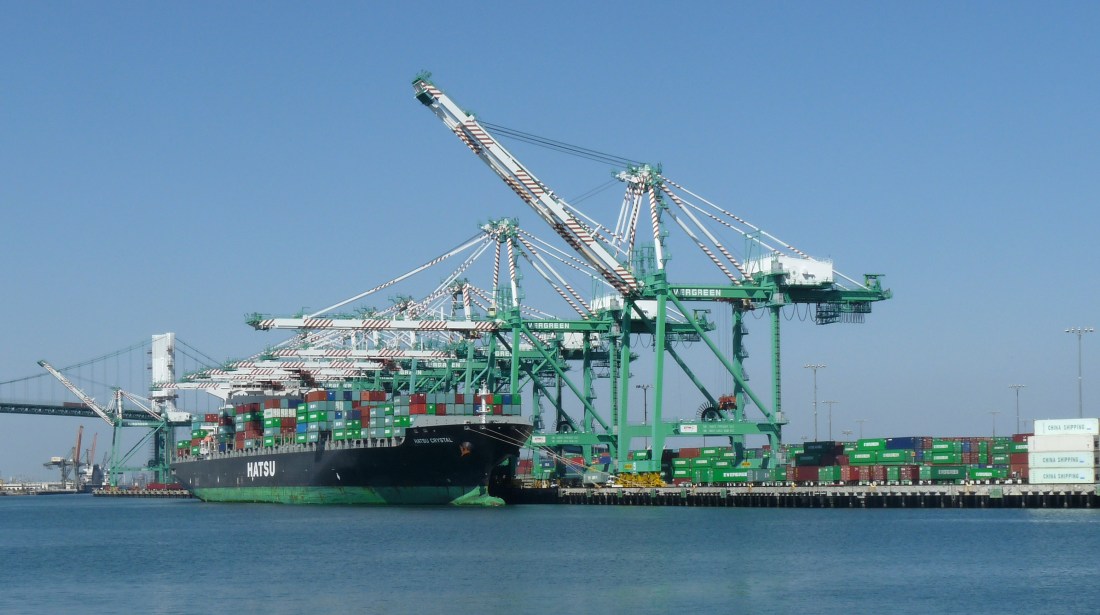
Los Angeles Cargo Terminal

Los Angles cargo terminal, photo taken on April 29, 2011 at 2:30PM . 1/50 second at f7.1 using Panasonic DMC FZ28 camera.  The sky was that blue and cloud free.  The sea was that blue.  Hey, It’s Los Angeles! 

The immediate effect was the redirection of ships to other ports.  One of those ports is Ensenada, Mexico. Ensenada is in Baja California lying 125 kilometers (78 mi) south of San Diego on the Baja   California Peninsula.  With a population of more than 279,000 people a major part of its economy depends upon tourism.  It also has a deep water port for commercial shipping that received more than 3 million metric tons of freight in 2010.  When cargo is unloaded in Ensenada it is not done using unionized workers.  Truckers are not unionized. When the goods are transported into the USA there are no tariffs thanks to NAFTA.  So why won’t some shipping companies continue to use Ensenada rather than the Los Angeles area ports now that the ships have been diverted?

Currently Hyundai makes shipboard cargo containers and truck trailers at its nearby Tijuana plant, and two other Korean conglomerates–Samsung and Daewoo–make TVs and other electronic products at plants in Tijuana and San Luis Rio Colorado near Yuma, Arizona.  Daewoo and Samsung have announced plans to expand their manufacturing operations in Baja California, and Hyundai has told the Mexican delegation that it is mulling the possibility of building a steel plant in Mexico.

I am guessing that ever more business will not be returning to the California ports.

There is another more serious threat to the Los Angeles-Long Beach port facilities. The Panama Canal Overhaul.  When completed some of the largest ships in the world will be able to traverse the canal.  The canal’s new set of locks will allow a ship with a 160-foot beam to pass with ease.  The current canal can accommodate only ships that are no more than 106 feet wide and 965 fee long.  Some of the largest ships in this category, with containers stacked seven-deep on their decks, look like they’re barely able to squeeze through today’s locks.  Currently vessels traversing the canal can carry a maximum of 5,000 20-foot containers.  With the new locks completed the canal will be able to handle ships three football fields long that hold 13,000 containers.

The result of the enlarged canal locks will mean ships from China, Japan and other Asian nations can more easily set their destination on the Atlantic and Gulf costs of the United States.  When those Panama Canal improvements have been completed who will be shipping their cargo to California?

Vice Presidential Debate

It was a Draw!

Vice President Joe Biden did what he does so well.  He was the attack dog.  Congressman Paul Ryan was the calmer deliberate speaker who adequately supported Mitt Romney.

The differences between the parties could not have been more stark.  Both men offered some inaccurate information and both offered some accurate info.

I suspect Joe Biden’s eye rolling and silly grins were all intentional and well practiced.  Even after giving a serious response to Raddatz or Ryan he returned to those big smiles and surprised facial expressions.

Martha Raddatz was an excellent moderator.  She wins the award for performing an outstanding job in a difficult situation.

For those of us who are undecided the decision is yet to be made. Too little time was spent on the job of creating jobs in America.  Biden skipped the topic and Ryan restated the Romney contention that their election will result in 12 million jobs being created in the next four years.  How exactly will that be done?  Biden or Raddatz should have asked Ryan that question.    

 My recent purchase was two beautifully tailored shirts that were made in China.  That is the country that also makes iPhones, Dell computers, and other more expensive high tech devices.

Perhaps the next debate will provide some further reason to vote for one of these candidates.

Why I believe Mitt Romney Will Win the Election

Are Americans stupid or just plain desperate?

I have never voted for a Republican for president.  I could not discern the differences between Richard Nixon and Hubert Humphrey in the first time I voted.  I was correct in saying there was little to differentiate the two.  Nixon imposed price controls on the economy and that was a decidedly Democratic Party kind of regulation.  Richard Nixon supported a national health care plan that the Democrats refused to support.

Now we have Mitt Romney promising to “create 12 million new jobs over the next four years.”  He won’t tell us how that will be done.  Without the details his words are meaningless.   However, Americans are desperate for a recovery so they will buy his promise.

Americans vote for the person who can offer us the promise we want to hear.  Proof? “Hope and Change” but no details enabled Barack Obama to win the election four years ago.

Despite the poll trends, I believe Romney will win. It will be mostly about those jobs and the economy. He won’t win CA, NY, IL or MA. He will win a majority in the battleground states.

The result will be that four years from now we will vote for the Democratic challenger.

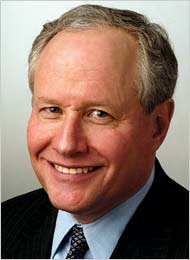
Bill Kristol, Fox News Pundit, Questions Tax Cut for the Wealthy

Back in 2001 and 2003 President George W. Bush pushed his income tax reduction laws through Congress.  The theory behind those tax reductions was the government was running a surplus and the economy needed a boost.  What was the result?  Higher net income for business and the loss of American jobs to China, India, and other nations.  The result is that business leaders tell the American people we are no longer a manufacturing society, we are now a service society.   Those services translate to lower paying jobs for the middle class.  What middle class?  Those jobs are the jobs of the poor!

Even Bill Kristol is now questioning the idea of even lower taxes for business.

By Igor Volsky of Think Progress on Aug 11, 2012 at 3:42 pm

Bill Kristol, who had predicted that Mitt Romney would name Paul Ryan as his vice presidential running-mate, expressed some concern Saturday morning that Republicans may have a hard time defending the GOP budget, which disproportionately cuts taxes for the rich.

“It’s the tax cuts for the wealthy, where Republicans have not done a particularly good job of defending it and I think you’ll see Democratic attacks focus on that side of the equation,” he said. The Wall Street Journal’s Stephen Moore agreed, but noted, “who’s better to defend those policies that Paul is, I mean he knows this stuff better than anyone.”

Paul Ryan’s infamous budget — which Romney embraced — replaces “the current tax structure with two brackets — 25 percent and 10 percent — and cut the top rate from 35 percent.” Federal tax collections would fall “by about $4.5 trillion over the next decade” as a result. To avoid increasing the national debt, the budget proposes massive cuts in social programs and “special-interest loopholes and tax shelters that litter the code.”

 But 62 percent of the savings would come from programs that benefit the lower- and middle-classes, who would also experience a tax increase. That’s because while Ryan “would extend the Bush tax cuts, which are due to expire at the end of this year, he would not extend President Obama’s tax cuts for those with the lowest incomes, which will expire at the same time.” Households “earning more than $1 million a year, meanwhile, could see a net tax cut of about $300,000 annually.”

Decline of Manufacturing Jobs in America

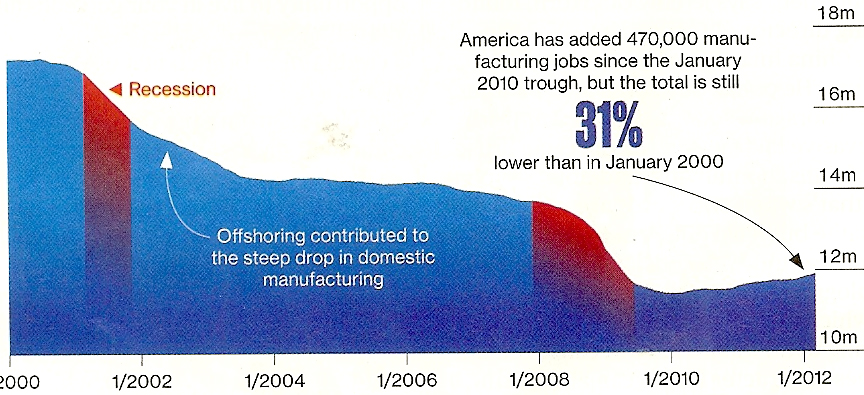
 The Long Goodbye: Number of U.S. Manufacturing Jobs

The graph was in Businessweek April 16-April 22, 2012.  It tells the story of the continuing loss of manufacturing jobs in the United States.  Those that believe that America will become a “service society” are in a dream world.  No nation thrives on services alone.  Actually we are already outsourcing many services to Asian countries.  Dell Computer, Citi Bank, Hewlett Packard, and the Los Angeles Times are just FOUR of the many companies that have out sourced their customer service.

Notice that this graph reflects what many of us already knew.  Decline in manufacturing has been a decades old event.

Things are Getting Better?

The unemployment rate decreased .1% last month. That sounds good but the cause was more people giving up on searching for a job.  There weren’t even enough jobs created last month to keep up with increased population. 

Today’s Bureau of Labor Statistics report included the following statement. “The number of long-term unemployed (those jobless for 27 weeks and over)was essentially unchanged at 5.3 million in March. These individuals accounted for 42.5 percent of the unemployed. Since April 2010, the number of long-term unemployed has fallen by 1.4 million.”

There is the problem that neither President Obama nor Mitt Romney has addressed. American industry doesn’t need most of those long term unemployed. The reason is that technology and the export of American jobs has reduced the numbers of people required in the United States.

The president’s job plan does include the following proposals
– A $4,000 tax credit to employers for hiring long-term unemployed workers.
– Prohibiting employers from discriminating against unemployed workers when hiring.
Nice gestures that do not answer the question of who will hire these un-needed people?

I have found nothing in Mitt Romney’s proposals that even suggest any solutions. His focus is on “free market.” My question is, where were the free markets under George W. Bush when the economy was in free fall?

My solution is higher tariffs on all imported products. Neither Obama nor Romney agree with that solution.  They don’t have a solution!