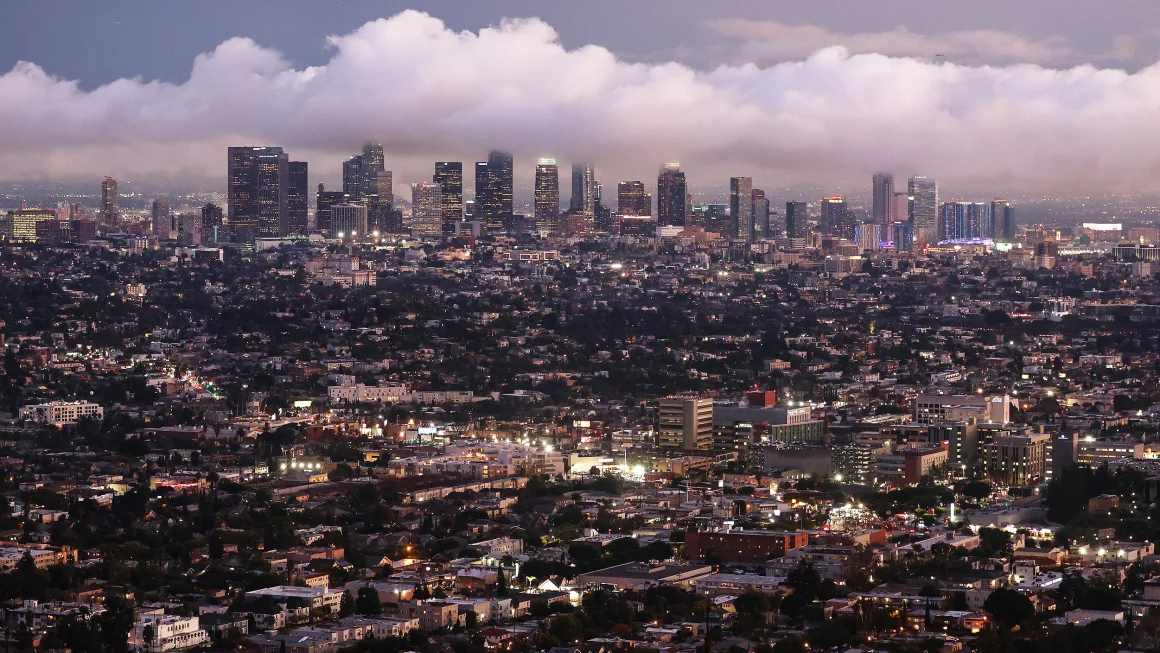
The downtown skyline of Los Angeles, California as seen on January 22, 2024 Mario Tama/Getty Images/File
US cities on the West Coast and Hawaii occupied five of the top 10 most unaffordable places, according to the annual Demographic International Housing Affordability report, which has been tracking house prices for 20 years.
Perhaps unsurprisingly, the most expensive US cities to buy home are in California, where San Jose, Los Angeles, San Francisco and San Diego have all made the top 10.
Top 10 “impossibly unaffordable” cities
Hong Kong
Sydney
Vancouver
San Jose, California
Los Angeles
Honolulu
Melbourne
San Francisco/Adelaide
San Diego
Toronto
I am living in a house in Los Angeles that I bought over 40 years ago. So I am old and now the Los Angeles Department of water and Power just sent me a notice that my monthly bill will increase by 31% effective July 1.
I now take my wife food shopping and the usual weekly bill is about $150. Happily I do not drive my car great distances because the cost of gas is now about $4.50 per gallon.
Should I move to Nevada or Arizona? A cousin of mine moved to the Phoenix area this past summer.
When we visited Toronto Canada for the first time in 2009 we were astonished by the number of high rise buildings under construction throughout the city. Walking on Yonge Street there were signs announcing plans for more sky scrapers to be built within the coming year or two. When we visited Toronto again in 2017 the construction of new sky scrapers had not diminished.
Yonge Street Toronto
There is a high rise (skyscraper) construction boom under way in many major cities all over North America.
The Comcast Development Center in Philadelphia is adding a 1,121-foot-tall building to that city’s skyline.
Chicago is adding the Vista Tower. It is an 1,186-foot tall luxury hotel and condo tower. There is actually 50 high rises of 100 feet or more under construction in Chicago.
After 1992, when the California Plaza was built there were no new skyscrapers in Los Angeles until 2003. That new high-rise was just a 35 story building. Then starting in 2009 there has been a resurgence in high-rise construction throughout Los Angeles. The Wilshire Grand was just completed last year as the tallest building west of the Mississippi. It is about to be eclipsed by another high-rise at 1107 feet.
77-story planned Bunker Hill tower drawn into a photo of the area
The first phase of a massive redevelopment of the old Boston Garden site will ultimately add 1.87 million square feet of shops, restaurants, offices, hotel rooms, and residences and is set to finish sometime this year. Eventually, the joint project between developers Boston Properties and Delaware North will include a 38-story residential tower, 21-story office tower, as well as new transit connections and outdoor space.
There 14 high-rises under construction in San Francisco right now. The Salesforce Tower will be that city’s new tallest building beating the famous TransAmerica Tower.
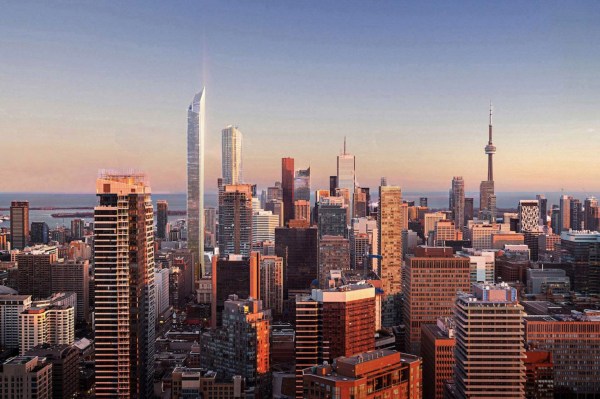
Meanwhile Toronto Canada is trying its very best to be second to New York City with traffic, subways and over 60 high rises over 500 feet. Most of them are jammed into their downtown area. The tallest is 978 feet. A 1,043 foot tall 85 floor building is under construction now an even taller 98 story building is awaiting approval of their city council.
Artist conception – Tallest building tower “Yonge Street Living” is proposed for downtown Toronto
Most of these projects are a combination of offices, hotels, stores, and residences. Living closer to the center of the city means less commuting. That translates to less traffic on our congested roads and easier access to museums, entertainment centers, and hospitals. Add to that is we like living in busy cosmopolitan cities. The proof is the tourism to NYC, Las Vegas, and downtown San Francisco.
I have lived in Los Angeles most of my life. My family moved here when I was nine years old. We came here from Philadelphia in 1948.
As a boy, in those less sophisticated times, I rode the city on trolleys and buses without any fear. It helped me to develop a little independence at a young age. Of course living in middle class family I never missed a meal and never worried about homelessness.
As a young man I had access to a car that enabled me to drive where ever I wanted.
I have been to Hollywood, Santa Monica, Beverly Hills and downtown so many times I lost count decades ago.
You are invited to visit it whenever you are curious about the second largest city in the U.S.A. I will be writing about the good and the bad. Included will be lots of photos mostly taken by me.
Photo taken from Griffith Park Observatory parking lot looking west. Hollywood is in the foreground and the tall buildings are in Westwood (home of UCLA). Photo taken with a Panasonic DMC-FZ28 camera.
HOLLYWOOD has produced plenty of films about underdogs rising to claim the limelight. Now Los Angeles is experiencing its own real-life Cinderella story, as the area’s technology scene has been transformed from backwater to boomtown in just a few years. Hordes of venture capitalists from northern California, once long dismissive of their southern neighbour, now regularly commute in search of deals in a less heavily hunted spot than the Bay Area. In 2016 the city’s startups received around $3bn in funding, around six times more than in 2012, according to CB Insights, a research firm.
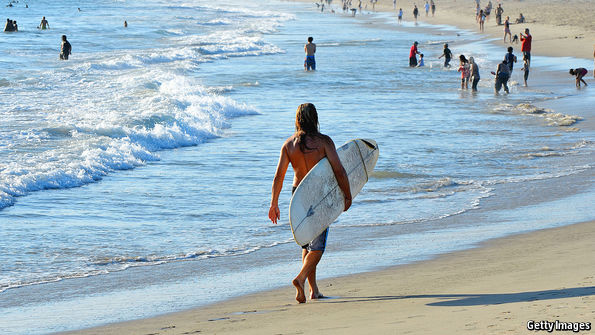
Evan Spiegel went to Stanford University in the heart of Silicon Valley, but he wanted to live and work close to the sea. So he based his new company one block from the Pacific in Venice Beach, which is better known in Los Angeles for its silicone-enhanced bodies than the silicon chips that gave the Valley its name. Mr Spiegel’s firm, Snap, is best known for its ephemeral Snapchat social-media messages and is now valued at a whopping $18bn. Other successful technology firms are thriving nearby, including Dollar Shave Club, an e-commerce firm recently sold to Unilever for $1bn; Ring, a “smart” doorbell company, and Riot Games, maker of “League of Legends”, a popular online multiplayer contest.
Los Angeles is now the third-most-prominent outpost for startups in America, after San Francisco and New York. It has several advantages, including good universities, warm weather, a relaxed culture, proximity to San Francisco and much lower costs. Michael Schneider, the boss of Service, a customer-relations startup, reckons he would need to have raised at least 40% more money if based in San Francisco, “just to pay for the same space and people”.
Although Los Angeles has fewer experienced engineers, those that are there tend to be more loyal, not least because there are fewer firms out to poach them. Startups can convince people to move. Ophir Tanz of GumGum, an advertising startup, says he has recruited several employees looking for a more balanced life away from cities like New York and San Francisco.
Los Angeles may at last be getting the attention it deserves. “The original monetisation of the internet was created here, not Silicon Valley,” says Mark Suster, a venture capitalist with Upfront Ventures, referring to pioneers such as Applied Semantics, bought by Google. But for Los Angeles to establish itself as an enduring place for startups, it needs Snapchat to continue to thrive and go public, which could happen as soon as next year.
Once upon a time there was a very smart man named Henry Huntington, nephew of Collis Huntington who built the Southern Pacific Railroad, who believed that Los Angeles would grow into a very widespread city. He conceived an electric railroad that would connect all of the area. That year was 1901. Along with his financial partner, banker Isaias W. Hellman, he proceeded with his dream. The electric car system, called the Red Car, stretched from Newport Beach to the south, San Bernardino and Riverside to the east, and the northern parts of the San Fernando Valley. The system was shut down in 1961. Its demise was caused by the belief that the Los Angeles area would be better served by the car. Large-scale land acquisition for new freeway construction began in earnest in 1951.
About 10 years ago Los Angeles County created a 1½ mile long replica of the old Red Car in the San Pedro area near other tourist attractions just for fun. It cost millions to build and maintain but only collected $460,000 in revenue. Now it too will be shut down.
These are my photos taken with a Panasonic FZ150 camera.
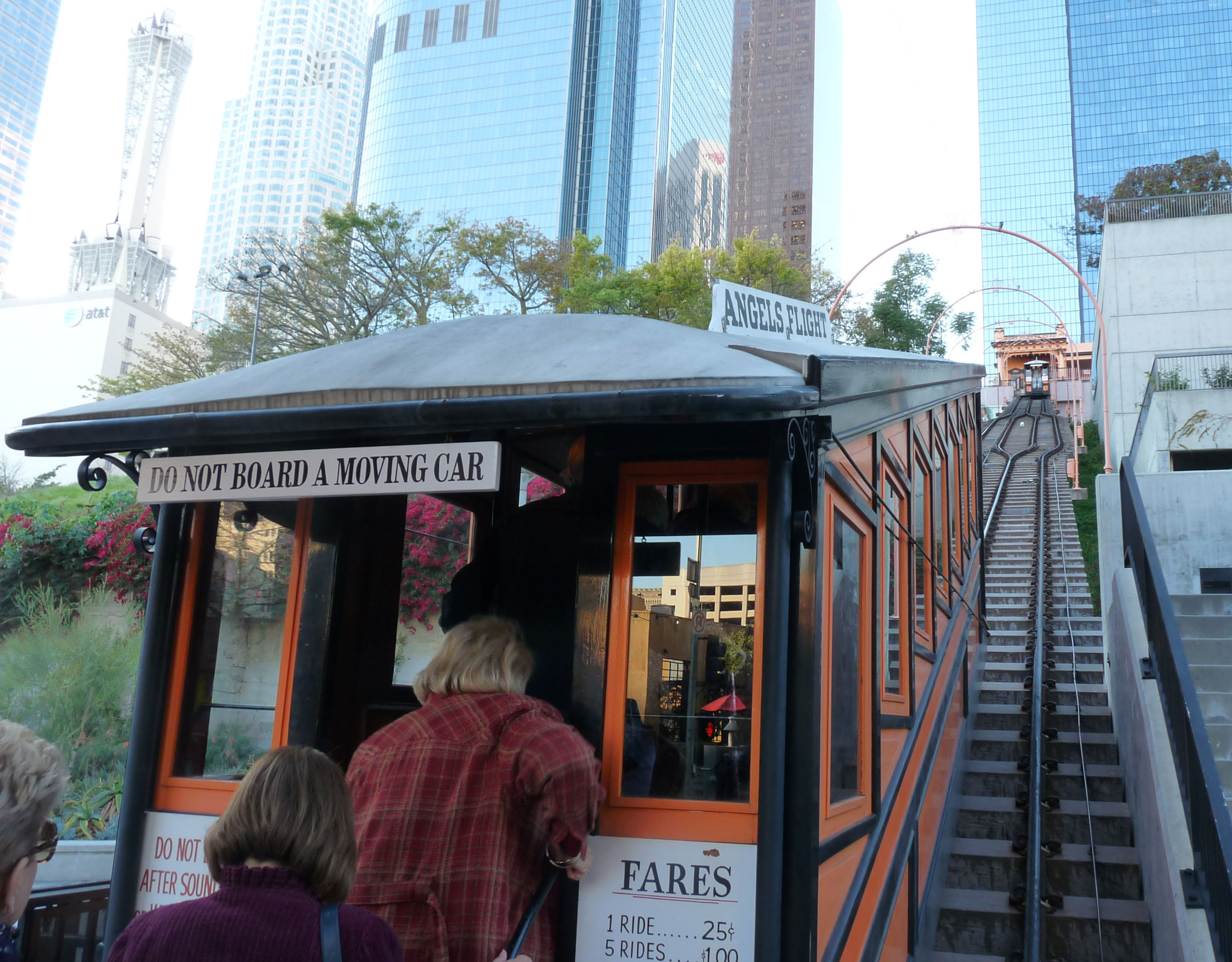
There used to be a funicular in downtown Los Angeles but that too has been shut down.
Angel’s Flight
Interestingly the Los Angeles new light rail and subway system that won’t be complete for another 20 to 30 years is being built along and near the paths of Huntington’s Pacific Electric. They also want to build a loop trolley line in the downtown area.
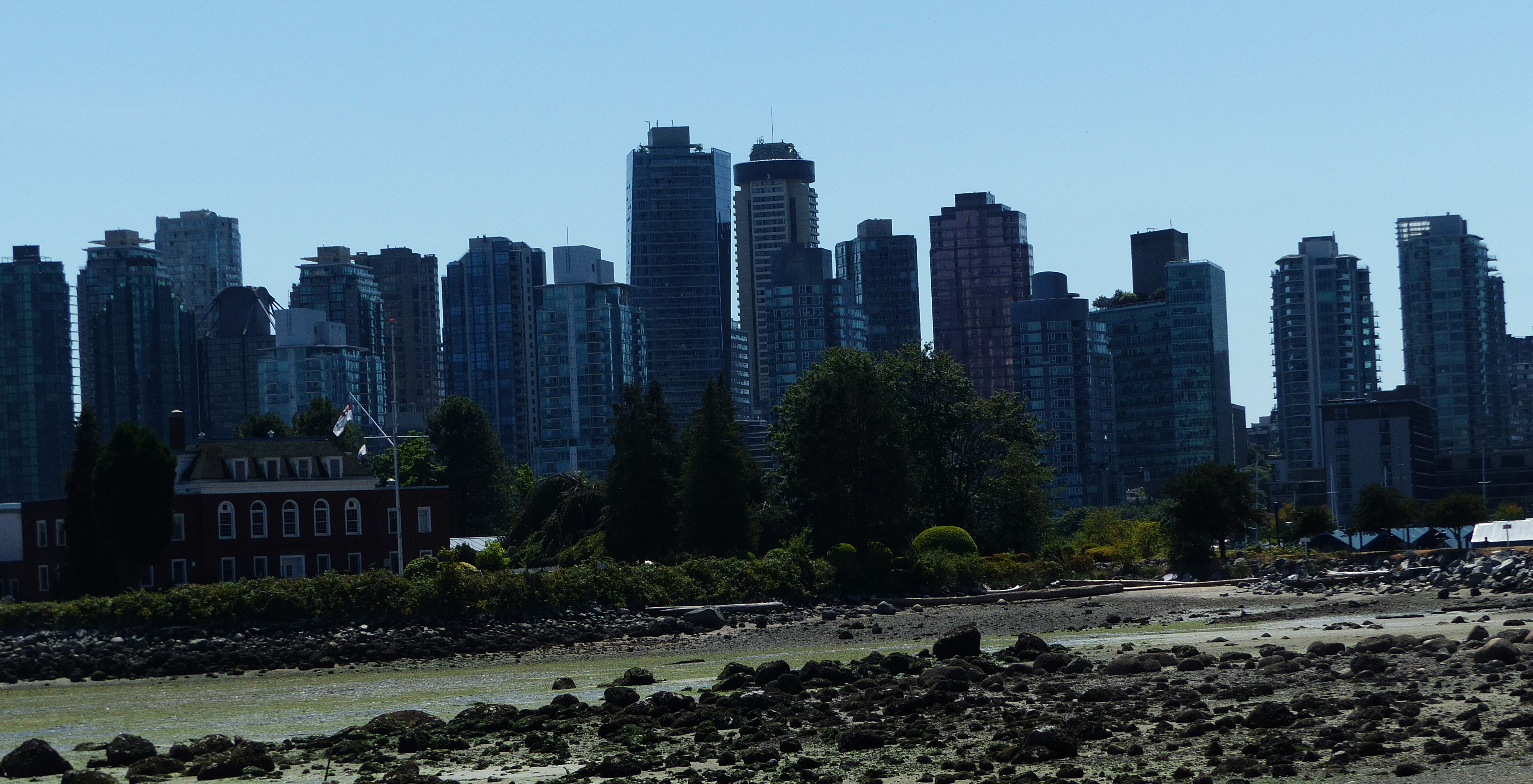
Just this past July 22 we returned from a trip that included five days in Vancouver, British Columbia, Canada. While there we rode one of the Hop On Hop Off city tours. The guide was obviously quite knowledgeable about the city. It is a city of many very attractive 20 to 30 story high buildings. She informed us that the cost of the apartments in those buildings started at $1 million (Canadian). Although the Canadian dollar is currently about 30 cents lower in value than the American dollar it has been almost identical during the past few years. So the cost of living in Vancouver is high.
Meanwhile here in California the cost of homes has been equally as high. The median home price value in San Francisco is over $1 million reports Zillow. They say it’s a 12.7% increase during the past year and predicts even higher prices in the coming five years.
Down here in Los Angeles Home sales reached a nine-year high in July, prices climbed 5.5% from a year earlier, according a report out Tuesday from CoreLogic a company that tracks home prices throughout southern California. The Los Angeles Timesreports that Zillow says “Los Angeles and Orange County are the least affordable housing market in the country.”
Interestingly Portland, Oregon is the city that has experienced the least impact of the inflated home prices with median home prices of about $327,000. However not to be out done their prices have also risen over 10% in the past year.
However as the price of homes has risen the average family income has not risen by comparable amounts. In Portland, Oregon median family income was $55,571 in 2013. In Los Angeles that number was $48,466. Using the old standard of qualifying to buy a home 2½ to 3 to times your family annual income that calculates to a home costing $150,000. No wonder so many young adults are still living with their parents.
What is causing inflated home prices? Googling that question shows lots of analysis but no answers. Here is my take.
Most cities have run out of space for new building. That translates into more high rise housing. Those kinds of structures are expensive to build. Those buildings are townhouse/condominiums translate into expensive homes. Even Los Angeles, a city known for single family homes, has turned to more apartment housing because travel times have become too long (a 1½ hour drive to the airport or to work has become the norm). Average families simply cannot afford that style of housing so they move to the outer edge of the city. That’s where I live.
Thousands of people from other nations have been buying homes in the United States and Canada because it is a safe place to invest their money. That demand has driven up the price of American and Canadian homes. There have been a series of news items and opinion pieces in the Los Angeles Times that have pointed to this growing trend. 47% of Vancouver is now populated by Asians. The San Gabriel Valley area of metropolitan Los Angeles has experienced a growing Asian population to the point that many long time residents have voiced their concern about the changing demographics. Those voices made their way into the newspaper.
http://www.bankrate.com says, “International homebuyers have been pouring billions of dollars into the U.S. housing market as they take advantage of lower home prices and a weaker dollar.” “When buying a home in the United States, foreign buyers often pay cash because it’s a much easier, quicker process, says real estate agent Baro Shalizi of Shalizi Real Estate, in Santa Fe, N.M.” When an elderly acquaintance of mine sold his home for more than $700,000 the buyer paid for it in cash. That all cash offer made the sale easy and eliminated all other offers.
Now cities are confronted with the question of providing decent housing for young families that have median incomes. Without the needed homes there is an impact on the buying habits of those families. They will live with their families. That translates to reduced purchases of refrigerators, lawn mowers, and everything else that homeowners buy.
There will be one of three consequences or perhaps some combination. 1) Government does nothing and young families double up to buy a home or continuing living with parents. 2) There will be subsidized housing for the median income families. 3) More people living farther from the big cities in order to buy a home and that results in more commuters.
City officials closed 7th Street in front of the MacArthur Park-area landmark as crowds lined up for what is known as the deli’s No. 19, its most popular sandwich. Normally, it sells for $15.20.
After the Kings took Game 5 Friday night in a thrilling double overtime win, after the New York Rangers went home, after the cup was kissed and the red carpet removed from the ice, there was still the matter of the pastrami sandwich.
LAPD Chief Charlie Beck and New York City Police Commissioner William J. Bratton (a former LAPD police chief) bet a pastrami sandwich that their home team would win the Stanley Cup. At stake was bragging rights over which city’s hockey team was better – and which city’s pastrami.
On Saturday morning, Bratton signaled his intent to honor the bet. He tweeted a photo of Katz’s Deli in New York and tagged Beck’s Twitter account.
“Do you take your pastrami sandwich with or without mustard? Congrats!” Bratton tweeted.
Beck’s response, after telling Bratton he was looking forward to having lunch again soon, was to tweet a picture of L.A.’s most-revered pastrami sandwich, the Number 19 at Langer’s Deli.
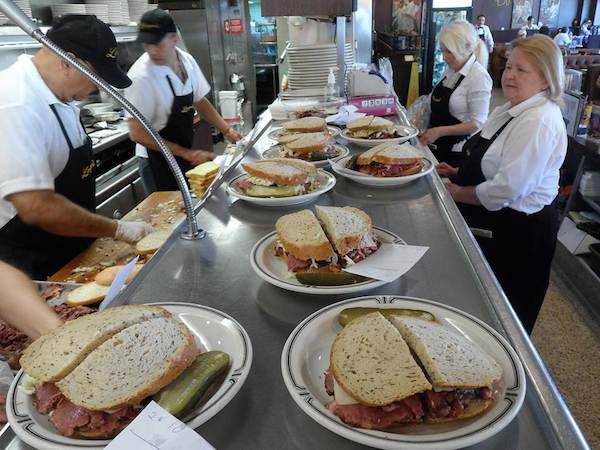
The sandwich – tender, hand-sliced pastrami, cool Russian dressing, crisp cole slaw and Swiss cheese between two slices of pillow-soft, crunchy-crusted twice-baked rye bread – is a favorite of the Los Angeles Police Department.
New York City loves it too – the New Yorker magazine once called Langer’s Number 19 “the finest hot pastrami sandwich in the world.” Even Bratton admitted the corned beef at Langer’s was better than any in New York.
“Hold the mustard please, slaw inside, just like @LangersDeli #19,” Beck tweeted along with the picture.
Bratton isn’t the only New York official who will have to make good on his bet. New York Gov. Andrew Cuomo has to send Gov. Jerry Brown a basket of buffalo wings, Italian sausage and oysters from Long Island. Brown had wagered a book of California history and lightly salted organic brown rice cakes.
New York City Mayor Bill De Blasio has agreed to sing Randy Newman’s “I Love LA” on “The Jimmy Kimmel Show,” a relief for those who hoped to avoid listening to Mayor Eric Garcetti sing “New York, New York” on the same show.
The answer is simple. Our elected officials take no chances. Their primary objective is re-election.The majority of electorate doesn’t care who holds office as long as it is a Democrat. Thus the city and county continue down the same beaten path. I am not alone in my opinion.
The mayor started his administration with a bang by discharging department heads that did not meet his performance expectations. More here.
Year by year, Los Angeles, which “once was a beacon of innovation and opportunity to the world” has become a city of despair. Poverty now dominates all other issues. A lack of decent jobs, poor schools, and overwhelming congestion are a daily fact of life.
Early in 2013 Los Angeles City Council President Herb Wesson asked Mickey Kantor to establish an independent, private commission to study and report on fiscal stability and job growth in Los Angeles. (Former) Mayor Antonio Villaraigosa also endorsed the establishment of the Commission.”
Following is part of the initial report. A link at the bottom of this post takes you to a PDF for the complete report.
A TIME FOR TRUTH
Los Angeles is barely treading water while the rest of the world is moving forward. We risk falling further behind in adapting to the realities of the 21st century and becoming a City in decline.
For too many years we have failed to cultivate and build on our human and economic strengths, while evading the hard choices concerning local government and municipal finance presented by this new century. Like the hapless Mr. Micawber in Dickens’ “David Copperfield,” our wishful response to continued economic decline and impending fiscal crisis has become a habitual: “Something, my dear Copperfield, will turn up.”
The City where the future once came to happen has been living in the past and leaving tomorrow to sort itself out.
As a consequence, Los Angeles is sinking into a future in which it no longer can provide the public services to which our people’s taxes entitle them and where the promises made to public employees about a decent and secure retirement simply cannot be kept.
City revenues are in long-term stagnation and expenses are climbing.
I am exhausted by government mismanagement. It’s not about Obamacare. It’s about foolish spending at the state and local levels.
Here in California the EDD (Employment Development Department), that is the department that pays unemployment insurance, they decided to implement a new computerized check paying system. California paid Deloitte Consulting $62 million to develop EDD’s new computer system. An estimated 148,000 people have experienced delays of up to four weeks in receiving their payments due to computer glitches.
The Los Angeles DWP implemented a new billing system in October of this year. Thousands of people received bills that were double their normal charges. Some received bills one half their normal charges. When those receiving incorrect overcharges refused to pay they were threatened with shutoff notices.
A retired DWP construction worker volunteered his retirement benefit to me, $6,000 per month. Stunned, I said nothing. The DWP has a powerful union.
Meanwhile Chicago officials, as they often do, turned to borrowing to relieve the financial pressure. This time they used taxable bonds with high interest rates, making the ultimate price tag even bigger. A $12 million bill related to disabled parking will be paid off in 2039 for at least $30 million. The Chicago Tribune found that the mayor’s boasting of tough choices amounts to selling taxable bonds to cover day-to-day expenses. Long after he is gone the bill for retirement benefits will come due. With a declining population (in the 1950s it was 3.5 million people, today the population is 2.5 million) this city may be the next Detroit.





 Coast Contact