Republican Party Stands Opposed to Social Welfare

Social Welfare is the various social services provided by a state for the benefit of its citizens.

In the United States the range of services includes Social Security (a program that guarantees a stipend to all senior citizens), Medicare (a program that provides health care to all senior citizens), minimal support for those unable to earn a living (usually referred to as welfare), and unemployment benefits (for those who lost their jobs through no fault of their own). Those are the primary programs that American residents are entitled to when there is a need.

In every instance those programs have been opposed by the G.O.P. In every instance those programs were instituted when a Democrat held the office of President of the United States.

The current chairman of the House Budget Committee, Republican Congressman Paul Ryan has sustained the Republican view on social welfare programs with the following words copied from his web site.

The current Medicare program attempts to do two things to make sure that all seniors have secure, affordable health insurance that works. First, recognizing that seniors need extra protection when it comes to health coverage, it pools risk among all seniors to ensure that they enjoy secure access to care.

Second, Medicare subsidizes coverage for seniors to ensure that coverage is affordable. Affordability is a critical goal, but the subsidy structure of Medicare is fundamentally broken and drives costs in the wrong direction. The open-ended, blank-check nature of the Medicare subsidy drives health-care inflation at an astonishing pace, threatens the solvency of this critical program, and creates inexcusable levels of waste in the system.

Ryan’s solution:
Beginning in 2024, for those workers born in 1959 or later, Medicare would offer them a choice of private plans competing alongside the traditional fee-for-service option on a new Medicare Exchange. Medicare would provide a premium-support payment either to pay for or to offset the premium of the plan chosen by the senior.

The Medicare Exchange would provide seniors a competitive marketplace in which they could choose a plan the same way members of Congress and federal employees do. Every plan, including the traditional fee-for-service option, would participate in an annual bidding process to determine the federal contribution seniors would receive to purchase coverage. Health-care plans would compete for the right to serve Medicare beneficiaries.

What Ryan calls “the president’s partisan health-care law” is an appointed government board like the FCC, the FDA, the FAA, and dozens of other appointed boards. He favors the unelected bureaucrats in privately owned insurance companies that answer to private enterprise. His view is those government bureaucrats aren’t as reliable to private company bureaucrats.

Ryan goes on to say The President’s partisan health-care law creates an unaccountable board of 15 unelected bureaucrats—the Independent Payment Advisory Board—empowered to cut Medicare in ways that will result in denied care and restricted access for seniors. The bureaucrat imposed cuts threaten critical care for current seniors and fail to strengthen Medicare for future generations.

So is it the blank-check nature of Medicare or 15 unelected bureaucrats that will be threatening current seniors? Ryan has covered both possibilities in his contradictory analysis.

The point is that Republicans are trying their very best to end Medicare, Social Security, and all other social welfare programs. They offer no substitutes. Their obsession with free market principles is the view of the rich who say they have no responsibility for the less well off.

There are many other reasons to oppose Republicans but that will be addressed on another day.
Medicare for Everyone

Even before the annual enrollment period for Medicare had started (October 15) I was receiving the start of insurance company campaigns for my enrollment.  Since then the volume of mailings has become an avalanche.  This has caused me to ask: Are there significant profits to be made in Medicare enrollments?

The answer appears to be YES.  AARP’s single largest revenue source is royalties from United Health Care Group.  This is no surprise.  I receive solicitations from AARP to join United Health Care every single month of the year.  34% of their revenue comes from United Health Care.  In 2011, the AARP generated $458 million in royalty fees from so-called “Medigap” plans.  Read more about AARP’s special treatment at this forbes.com link.

Other companies solciting my enrollment include: Blue Cross, Blue Shield, SCAN, Aetna, and Humana.

This campaign leads me to the conclusion that Medicare for all would be a real solution to affordable health care for everyone.

Social Security Now Called ‘Federal Benefit Payment’

Have you noticed, your Social Security check is now referred to as a “Federal Benefit Payment”? It’s not accurate!

Not only did we all contribute to Social Security but our employers did too. It totaled 15% of our income before taxes.

If you averaged $30K per year over your working life, that’s close to $180,000 invested in Social Security.

If you calculate the future value of your monthly investment in social security ($375/month, including both your and your employer’s contributions) at a meager 1% interest rate compounded monthly, after 40 years of  working you’d have more than $1.3+ million dollars saved. This is your personal investment.

Upon retirement, if you took out only 3% per year, you’d receive $39,318 per year, or $3,277 per month.

That’s almost three times more than today’s average Social Security benefit of $1,230 per month, according to the Social Security Administration (Google it – it’s a fact). And your retirement fund would last more than 33 years (until you’re 98 if you retire at age 65)!

I can only imagine how much better most average-income people could live in retirement if our government had just invested our money in low-risk interest-earning accounts. Instead, the folks in Washington pulled off a bigger Ponzi scheme than Bernie Madoff ever did.

They took our money and used it elsewhere. They “forgot” that it was OUR money they were taking.

They didn’t have a referendum to ask us if we wanted to lend the money to them.

And they didn’t pay interest on the debt they assumed. And recently, they’ve told us that the money won’t support us for very much longer.

But is it our fault they misused our investments? And now, to add insult to injury, they’re calling it a “benefit,” as if we never worked to earn every penny of it.

Just because they “borrowed” the money, doesn’t mean that our investments were a charity!

Let’s take a stand.

We have earned our right to Social Security and Medicare. Demand that our legislators bring some sense into our government – Find a way to keep Social Security and Medicare going, for the sake of that 92% of our population who need it.

Then call it what it is: Our Earned Retirement Income. 99% of people won’t forward this.

Will you?

What will happen when Medicare runs out of money?

This news item in the Toronto Star, a large daily newspaper in Toronto, Canada poses a question that could easily be faced in the United States.  The questions:

  • Will America let people die who have little chance of recovery? 
  • Who will pay the bill?  Medicare? Medicaide? Private funds?
      Dying woman outlives her 90 days of home care so CCAC cuts her services

Published on Saturday September 29, 2012

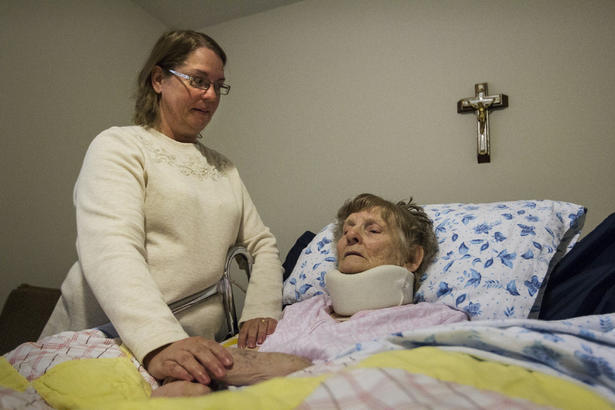
When Doris Landry was discharged from hospital with a life expectancy of one to two months, she entered the “Home First” program.

Offered by the Central Community Care Access Centre, the program provided a caseworker, personal support workers for eight hours every day, and medical equipment including a special bed, an oxygen machine, a wheelchair and a lift, so Landry could live her final days in the comfort of her niece’s home.

Her niece Charlene Dunlevy took care of her the other 16 hours of the day. “She’s good to me,” Landry says.

The only problem is a bittersweet one: Because Landry survived beyond the program’s 90 day funding period, she now faces reductions in care and uncertainty about the medical equipment.

Landry has cervical spinal stenosis and extensive nerve damage and lives with her niece in Lisle, Ontario, outside of Alliston. Lying in bed, she can manage a small squeeze of her hands, and with effort, a little movement in her arm.

Because of her condition, the bones in Landry’s neck are getting tighter, pinching her nerves. She is losing the power and sensation in her extremities, her voice is becoming weaker. She has difficulty swallowing, chokes often, and has problems breathing. She can’t move her limbs.

“I want to get out of bed,” she says as the air hums on its way through the special mattress. “The doctors tell me, ‘You’ll never get up again.’”

Home First is meant to divert elderly patients from long term care facilities after they are discharged from the hospital following an “acute episode.” The idea is that at-home support can eventually be lessened after the patient improves, or, it will give families 90 days to decide to transition into another form of care, like a long-term care home, which Landry does not want to do. Central CCAC has offered the program since 2009, and 1,713 clients have gone through it. The average 60-day stay (many transition out before 90 days) costs the ministry $10,500.

Born the fourth youngest in a family of seventeen children on Christmas Eve 1927 in New Brunswick, Landry is the last of her siblings. She is lucid, and on her good days, spunky and bright, with nails painted pink by a caring personal service worker. She wants to sit in the gliding rocking chair at the bedside, but she can’t get there. Her condition is terminal — but it is difficult to predict how much longer she will live. Her doctor says there is a prognosis of death in the next few months.

When the 90-day deadline was looming in August, Dunlevy says she was told that the bed would not be removed, but later she was informed all the equipment would have to go, and support would be reduced to three hours a day.

Dunlevy was told she could rent equipment and hire personal support workers. But the family can’t afford either option.

“I’m glad she didn’t die in three months. I hope she has many years to come,” Dunlevy said.

When reached by the Star on Friday, Cathy Szabo, the chief executive officer of Central CCAC, said that after 90 days, clients can stay at home, but the government does not fund the same level of service — legislation and regulations dictate that the CCAC can only provide up to 21 hours of care a week.

She said Landry could remain in the home with reduced care supplemented by hospice and other community organizations. She said equipment from volunteer services has been offered to the family, but if the needs exceed that, Landry could choose a long term care facility. She also noted that if Landry deteriorates, “we will restore service levels.”

Szabo said there was no intent to remove the hospital bed although “we did have conversations with them about how to secure additional equipment going forward in the future.”

She said to remove a hospital bed from a person who came into the program in her final stages of life but has now stabilized would be “cruel and mean.”

“We’re not about that. We aren’t going to take out the bed until there is another plan, if there is another plan for that bed,” she said.

Szabo said her staff had reported that certain equipment wasn’t in use, and that was the equipment that was going to be removed so other patients could use it.

“That is what we offered to take out of the home.”

The family says that isn’t the case — sure, they are not able to put Landry in the wheelchair on some days if she isn’t feeling well, but they try to get her out of her bed as much as they can and need the equipment to do that.

“I would give it to someone if we weren’t using it,” Dunlevy said.

They say the only equipment that has been offered is a medical bed from a local resident. While they are grateful, the mattress does not have air circulation like the CCAC bed and Dunlevy is worried Landry will have bedsores from “head to toe” because of her extremely limited movement.

When asked if the additional equipment was scheduled to be removed, Szabo said, “Not as far as I know.”

“We do need the family to work with us to help us get the right plan and care for the patient, if this lady stays at this same level for two years — and someone else does need the bed, and they just say, ‘No we’re not going to work with you guys we’re not going to make any plans with you,’ that is a very difficult situation. We only have a certain amount of money every year for medical supplies and equipment and that means somebody is on a wait-list for the bed,” Szabo said.

Landry’s palliative care doctor Monique Moreau, sent a request for “ongoing services” to the CCAC in August, and wrote a letter to local health authorities and health minister Deb Matthews on September 13, stressing that staying at home was the best option for Landry and the province’s finances.

Moreau did not get any response — and an email she sent on Monday to the CCAC went unacknowledged. On Friday, after the Star contacted the CCAC about the situation, Moreau received a phone call.

Moreau was told that Landry and her niece misunderstood about the removal of the equipment.

“I don’t think two people can misunderstand that much,” she said.

Moreau was told a case manager was going to visit the family on Monday to review the situation. Moreau believes that supplementary care from volunteers from a hospice will not be enough because those services only offer companionship.

Dunlevy, who works through a temp agency, has stopped working to care for her aunt. Now that service is being reduced further, she cannot return to work.

“I won’t have a choice, I can’t leave her alone. They’re putting us in a predicament,” she said. “I don’t know how we’re going to survive, but we will.”

Moreau, a former board member of the Central LHIN, understands the financial strain on the province.

“It’s not like we’re going to save the health care system a whole lot of money, unless the niece keeps her at home and quits her job and pays for everything,” she said.

Dunlevy says she understands that the CCAC’s hands are “probably tied because they don’t have the money,” but feels that the ministry needs to consider this problem.

Dunlevy and Landry are worried about the uncertainty ahead. For now, Landry can only lie in bed and wait, looking at the small Virgin Mary statue atop the television set.

“Pray for me,” she says. “I’m praying, but she doesn’t do too much.”