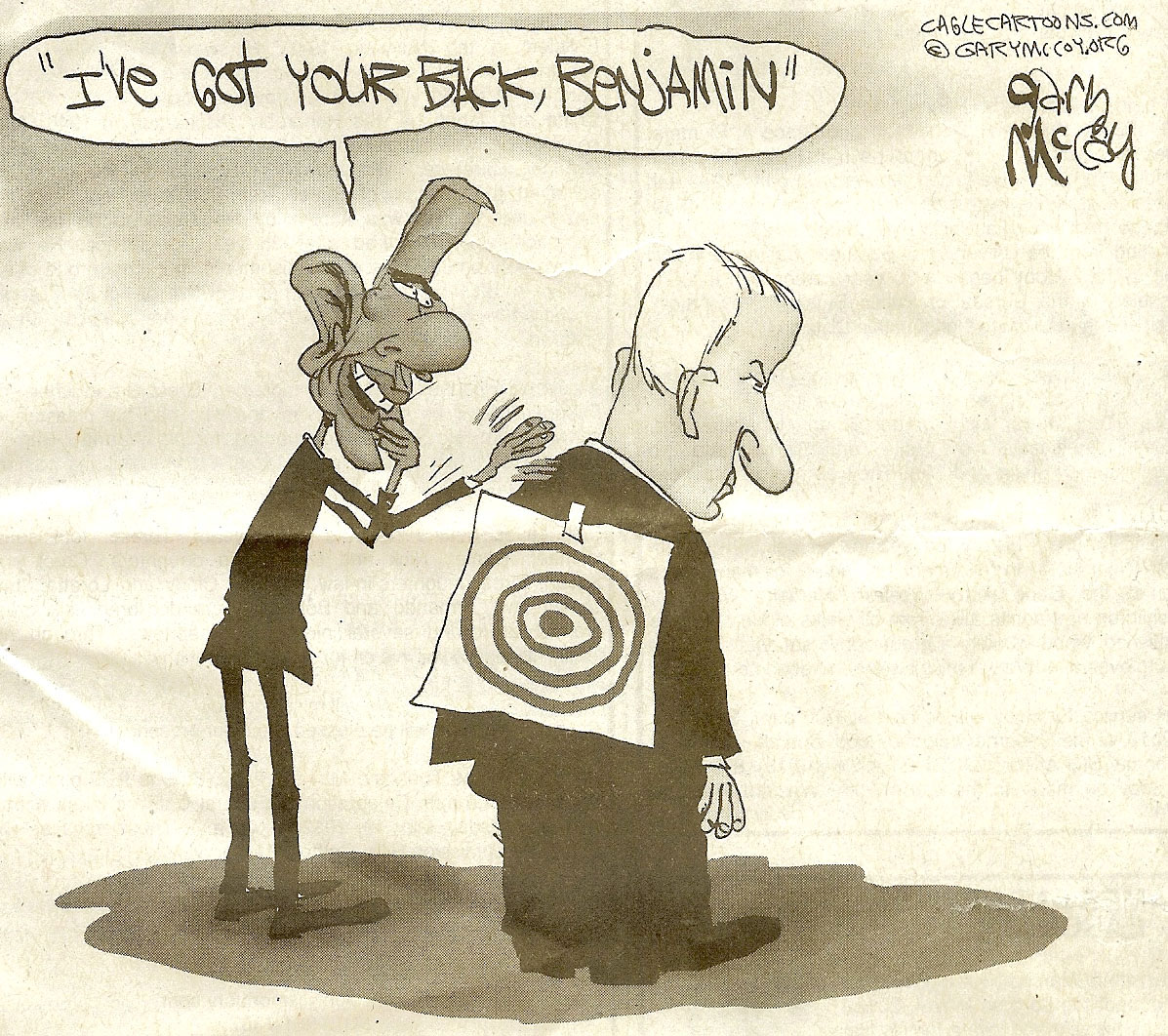
An important commentary by Charles Krauthammer . If he is correct, Netanyahu has sent a message to Obama.
David Bancroft
—
IN May 1967, in brazen violation of previous truce agreements, Egypt ordered U.N. peacekeepers out of the Sinai, marched 120,000 troops to the Israeli border, blockaded Eilat (Israel’s southern outlet to the world’s oceans), abruptly signed a military pact With Jordan and, together with Syria, pledged war for the final destruction of Israel.
May 1967 was Israel’s most fearful, desperate month. The country was surrounded and alone. Previous great-power guarantees proved worthless. A plan to test the blockade with a Western flotilla failed for lack of participants. Time was running out. Forced to protect against invasion by mass mobilization – and with a military consisting overwhelmingly of civilian reservists – life ground to a halt. The country was dying.
On June 5, Israel launched a pre-emptive strike on the Egyptian air force, then proceeded to lightning victories· on three fronts. The Six-Day War is legend, but less remembered is that on June 1, the nationalist opposition (Menachem Begin’s Likud precursor) was for the first time ever brought into the government, creating an emergency national-unity coalition.
Everyone understood why. You do not undertake a supremely risky pre-emptive war without the full participation of a broad coalition representing a national consensus.
Forty-five years later, in the middle of the night ·of May 7-8, 2012, Prime Minister Benjamin Netanyahu shocked his country by bringing the main opposition party, Kadima, into a national unity government. Shockking because just hours earlier, the Knesset was expediting a bill to call early elections in September.
Why did the high-flying Netanyahu call off elections he was sure to win(
Because for Israelis today, it is May 1967. “The dread is not quite as acute: The mood is not despair, just foreboding. Time is running out, but not quite as fast. War is not four days away, but it looms. Israelis today face the greatest threat to their existence – ‘apocalyptic .mullahs publicly pledged to Israel’s annihilation acquiring nuclear weapons – since May 1967. The world is again telling Israelis to do nothing as it looks for a way out. But if such a way is not found – as in 1967 – Israelis know they will once again have to defend themselves, by themselves.
Such a fateful decision demands a national consensus. By creating the largest coalition in nearly three decades, Netanyahu is establishing the political premise for a pre-emptive strike, should it come to that. The new government commands an astonishing 94 Knesset seats out of 120, described by one Israeli columnist as a “hundred tons of solid concrete.”
So much for the recent media hype about some great domestic resistance to Netanyahu’s hard line on Iran. Two notable retired intelligence figures were widely covered here for coming out against him. Little noted was that one had been passed over by Netanyahu to be the head of Mossad, while the other had been fired by Netanyahu as Mossad chief (hence the job opening). For centrist Kadima·(it pulled Israel out of Gaza) to join a Likud-led coalition whose defense minister is a former Labor prime minister (who once offered half of Jerusalem to Yasser Arafat) is the’ very definition of national unity – and refutes the popular “Israel is divided” meme, “Everyone is saying the same thing,” explained one Knesset member, “though there may be a difference of tone.”
To be sure, Netanyahu and Kadima’s Shaul Mofaz offered more prosaic reasons for their merger: national service laws, a new election law and negotiations with the Palestinians. But Netanyahu, the first Likud prime minister to recognize Palestinian statehood, did hot need Kadima for him to enter peace talks .. For two years he’s been waiting for Mahmoud Abbas to show up at the table. Abbas hasn’t. And won’t. Nothing will change on that front.
What does change is Israel’s position vis-a-vis Iran. The wall-to-wall coalition demonstrates Israel’s political readiness to attack, if necessary. (Its military readiness is not in doubt.)
Those counseling Israeli submission, resignation or just endless patience can no longer dismiss Israel’s tough stance as the work of irredeemable right-wingers. Not with a government now representing 78 percent of the country.
Netanyahu forfeited September elections that would have given him four more years in power. He chose instead to form a: national coalition that guarantees 18 months of stability – 18 months during which, if the world does not act to stop Iran, Israel will.
And it will not be the work of one man, one party or one ideological faction. As in 1967, it will be the work of a nation.
Charles Krauthammer is a columnist for the Washington Post. Readers may contact him via email atletters@!charleskrauthammer.com.

 Coast Contact