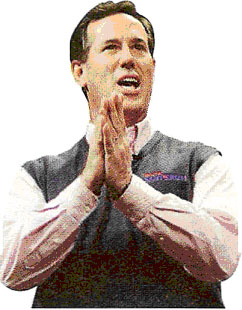
Rick Santorum is Pulling the GOP Too Far to the Right

   He is a sincere man who is clearly outside the mainstream of American opinion on the place of religion in our society.  He wants religion to participate in government and direct everyone’s behavior.  He couldn’t be more wrong. The First Amendment to the Constitution specifically says that “Congress shall make no law respecting an establishment of religion, or prohibiting the free exercise thereof.”  Those are the very first words of that amendment.

From The Week magazine

Rick Santorum may be leading Mitt Romney in the polls, said Jennifer Rubin in WashingtonPost.com, but the sweater­vested Pennsylvanian reminded us this week of why the GOP would “get slaughtered with Santorum as the nominee.”

 In a speech on President Obama’s energy policy, the devout Catholic veered off into an attack on Obama’s “phony theol­ogy” that, he later explained, “elevates the earth above man.” Then Santorum set off a fresh controversy by saying he opposes free prenatal testing for pregnant women because it can lead to abortions of fetuses with birth defects. With Santorum heading the Republican ticket this November, one GOP senator moaned this week, “we’d lose 35 states,” and the House of Representatives, too. Santorum’s social conservatism would be less problematic if he weren’t so abrasive, said David Kuhn in ReaIClearPolitics.com. But he has compared the battle to defeat President Obama to the struggle against Hitler in World War II, and this week, a tape surfaced of Santorum telling a crowd in 2008 that “Satan has his sights on the United States of America.” This fire-and-brimstone rhetoric is clearly helping Santorum with the social conservatives who vote in GOP primaries, but it’s a major turnoff to “the independent voters who elect American presidents.”

 Santorum’s appeal to these voters is not hard to understand, said Harold Meyerson in The Washington Post. His worldview “summons the ghosts of religious and patriarchal orders that once regulated much of working-class life,” for which many conservatives are deeply nostalgic.

But Americans also value personal freedom, said Conor Friedersdorf in TheAtlantic.com. Are voters really going to hand the presidency to a man who wants to criminalize abortion even in the case of incest and rape, opposes contraception even for married couples, and famously equated homosexuality with “man-on­dog” sex? Republican presidential candidates don’t have to be Ron Paul libertarians, said Philip Klein in WashingtonExaminer.com, but Santorum seems “actively hostile” to the idea that people have a right to make their own moral decisions. Nominating a smug scold who wants to “lecture Americans about their sex lives” would “ensure a Democratic rout in November.”

 “Santorum’s style of social conservatism is deeply American,” said Rich Lowry in National Review, despite what “the media and political elite” would have you believe. He walks the walk, as the father of seven children, including one with a serious birth defect that often leads other couples to choose abortion. His “pas­sionate intensity” plays very well with blue-collar voters, many of whom share Santorum’s belief that issues of family and culture are inextricably bound up with “the struggles of the working class.”

Santorum should probably avoid “the weeds of theological debate,” said William McGurn in The Wall Street Journal. He should also stop criticizing contraception. But the core of his appeal is that he’s a “conviction politician,” and even those who might not share all his views “are hungry for a nominee who does not bend with the wind.” Perhaps so, said David Weigel in Slate.com. But even Santorum now realizes that as a front-runner, he needs to tone down the harsh rhetoric. “Santorum 2.0” is saying that gays should be “treated with respect,” and noting that as a senator, he voted for two international aid programs that provided contraception. His problem is that, as the 2008 “Satan” speech illustrates, Santorum 1.0 has left a mother lode of extremist positions and off-the-wall statements for the media and his opponents to mine. And the digging “has only just begun.”
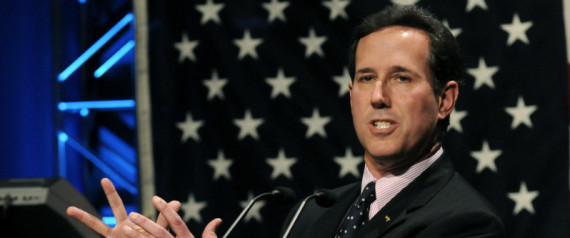
A Chance to “throw up”

Rick Santorum was a guest on “This Week with George Stephanopoulos” this past Sunday.  If he was trying to make headlines he certainly was a success.  Following are the transcripts of the two parts of the interview that are truly nauseating.

It’s the things that make me want to throw up.

ON EDUCATION

STEPHANOPOULOS: Let me get back to education. We were talking about that at the top of this interview. You had — you talked about President Obama and education yesterday. I want to show what you said.

(BEGIN VIDEO CLIP)

SANTORUM: President Obama once said he wants everybody in Americato go to college. What a snob.

(LAUGHTER)

SANTORUM: You’re good, decent men and women who go out and work hard every day and put their skills to tests that aren’t taught by some liberal college professor.

(END VIDEO CLIP)

STEPHANOPOULOS: Now getting to college has been part of the American dream for generations, Senator. Why does articulating an aspiration make the president a snob?

SANTORUM: I think because there are lot of people in this country that have no desire or no aspiration to go to college, because they have a different set of skills and desires and dreams that don’t include college.

And there are other — there’s technical schools, there’s additional training, vocational training. There’s skills and apprenticeships. There’s all sorts of things that people can do to upgrade their skills to be very productive and —

(CROSSTALK)

SANTORUM: — and build their community.

STEPHANOPOULOS: All he said was he wants, quote, “every American to commit to at least one year or more of higher education or career training.” In your interview with Glenn Beck this week, you seemed to go further. You said I understand why Barack Obama wants to send every kid to college, because they are indoctrination mills. What did that mean?

SANTORUM: Well, of course. I mean, you look at the colleges and universities, George. This is not – this is not something that’s new for most Americans, is how liberal our colleges and universities are and how many children in fact are – look, I’ve gone through it. I went through it at Penn State. You talk to most kids who go to college who are conservatives, and you are singled out, you are ridiculed, you are – I can tell you personally, I know that, you know, we – I went through a process where I was docked for my conservative views. This is sort of a regular routine (ph). You know the statistic that at least I was familiar with from a few years ago — I don’t know if it still holds true but I suspect it may even be worse – that 62 percent of kids who enter college with some sort of faith commitment leave without it.

STEPHANOPOULOS: But Senator, when you put all this together—

SANTORUM: This is not a neutral setting.

STEPHANOPOULOS: — it makes it sound like you think there is something wrong with encouraging college education.

ON RELIGIOUS FREEDOM

STEPHANOPOULOS: You have also spoken out about the issue of religion in politics, and early in the campaign, you talked about John F. Kennedy’s famous speech to the Baptist ministers in Houston back in 1960. Here is what you had to say.

(BEGIN VIDEO CLIP)

SANTORUM: Earlier (ph) in my political career, I had the opportunity to read the speech, and I almost threw up. You should read the speech.

(END VIDEO CLIP)

STEPHANOPOULOS: That speech has been read, as you know, by millions of Americans. Its themes were echoed in part by Mitt Romney in the last campaign. Why did it make you throw up?

SANTORUM: Because the first line, first substantive line in the speech says, “I believe in America where the separation of church and state is absolute.” I don’t believe in an America where the separation of church and state is absolute. The idea that the church can have no influence or no involvement in the operation of the state is absolutely antithetical to the objectives and vision of our country.

This is the First Amendment. The First Amendment says the free exercise of religion. That means bringing everybody, people of faith and no faith, into the public square. Kennedy for the first time articulated the vision saying, no, faith is not allowed in the public square. I will keep it separate. Go on and read the speech. I will have nothing to do with faith. I won’t consult with people of faith. It was an absolutist doctrine that was abhorrent (ph) at the time of 1960. And I went down to Houston,Texas 50 years almost to the day, and gave a speech and talked about how important it is for everybody to feel welcome in the public square. People of faith, people of no faith, and be able to bring their ideas, to bring their passions into the public square and have it out. James Madison—

STEPHANOPOULOS: You think you wanted to throw up?

(CROSSTALK)

SANTORUM: — the perfect remedy. Well, yes, absolutely, to say that people of faith have no role in the public square? You bet that makes you throw up. What kind of country do we live that says only people of non-faith can come into the public square and make their case? That makes me throw up and it should make every American who is seen from the president, someone who is now trying to tell people of faith that you will do what the government says, we are going to impose our values on you, not that you can’t come to the public square and argue against it, but now we’re going to turn around and say we’re going to impose our values from the government on people of faith, which of course is the next logical step when people of faith, at least according to John Kennedy, have no role in the public square.

– 

My grand parents (both sets) were proud of the fact that they had one child from their families that graduated from college.  They were my mom and dad.

As to religion there is nothing in the First Amendment that says government should bring “everybody, people of faith and no faith, into the public square.”