New York Times Editorial Board
Feb. 13, 2025, 5:03 a.m. ET
The U.S. Constitution established three branches of government, designed to balance power — and serve as checks on one another. That constitutional order suddenly appears more vulnerable than it has in generations. President Trump is trying to expand his authority beyond the bounds of the law while reducing the ability of the other branches to check his excesses. It’s worth remembering why undoing this system of governance would be so dangerous to American democracy and why it’s vital that Congress, the courts and the public resist such an outcome.
Among legal scholars, the term “constitutional crisis” usually refers to a conflict among the branches of government that cannot be resolved through the rules set out in the Constitution and the system of checks and balances at its heart.
Say, a president who openly disregards the 22nd Amendment’s two-term limit and asserts a right to remain in office indefinitely.
But there’s no need to get ahead of ourselves. Right now, in February 2025, only weeks into President Trump’s second term, he and his top associates are stress-testing the Constitution, and the nation, to a degree not seen since the Civil War.
A partial list would include flouting the express requirements of multiple federal laws, as though Congress were an advisory board and not a coequal branch of government. It would include feeding entire agencies into the “wood chipper” (their words), an intentionally gory metaphor for the firing of thousands of civil servants without the legally mandated congressional approval. It would include giving an unelected “special government employee” access to the private financial information of millions of Americans, in violation of the law. And it would include issuing an executive order that purports to erase one of the foundational provisions of the Constitution on Mr. Trump’s say-so.
There is also reason to fear that powers that solely rest with the president, and therefore don’t raise direct constitutional concerns, are being abused in ways that weaken the constitutional order. His mass pardon of Jan. 6 rioters, for instance, is technically legal, but it both celebrates and gives license to anyone who wishes to engage in violence to keep Mr. Trump in power.
Any one of these acts sets off major alarms. Taken as a whole, they are a frontal assault on the laws and norms that underpin American government — by the very people who are meant to execute the law.
So are we in a constitutional crisis yet?
The most useful way to answer that question is to focus less on discrete events and more on the process, in which one branch pushes the limits of its authority and then the others push back. When those in power understand that their first obligation is to the Constitution and the American people, this process can be normal, even healthy.
When they don’t — well, that’s what we are watching play out.
Voters gave Mr. Trump a Republican-controlled Congress, and those lawmakers are within their right to try to pass the president’s agenda through the legislative process. That doesn’t relieve either chamber of its constitutional responsibility to the American people to serve as a check on the power of the president.
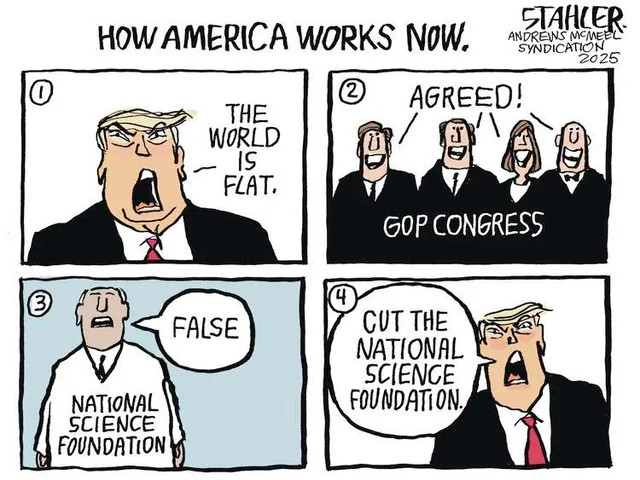
With virtually no exception, Republican leaders in Congress have made clear through their inaction that as long as they and Mr. Trump hold power — until January 2027, at least — they will stay out of his way. One reason, however, that Mr. Trump is using executive orders so often is that many of his plans would find resistance from Congress because of the Republicans’ slim majorities and the Senate’s 60-vote filibuster threshold.
While it may seem that the Republican leaders in Congress are free to abdicate their power to the president if they choose, that is not the case. As the sole branch granted lawmaking authority, they can repeal a law only by passing another one — not by failing to complain when a president chooses not to follow the ones he doesn’t like. That ensures that every law passed has the support of a majority of members elected to represent this diverse, divided country.
The United States Agency for International Development, for example, is funded through the congressional appropriations process. Would the current Congress vote to cut that funding? Perhaps. But at the very least, the House speaker and Senate majority leader should be putting the question up for a vote.
And Congress plays another important role: When the president or his administration is believed to have broken the law, it’s up to Congress to investigate and, when appropriate, use its censure powers. There is no sign that lawmakers plan to hold Mr. Trump accountable in this manner.
The willingness of Republican congressional leadership to watch passively as its own rights and responsibilities as a coequal branch of government are undermined leaves only one other branch actively checking the excesses of this overreaching presidency: the federal courts, where nearly all intragovernmental disputes eventually wind up.
The courts exist to define the bounds of the Constitution and the laws and to tell the other branches when they have strayed past those bounds. They also tend to slow everything down — frustrating, perhaps, for those who are impatient to wield their power or who wish to see justice done quickly — but that deliberation is essential to the rule of law and due process. So far, the federal courts have done their job, blocking several of Mr. Trump’s more brazenly illegal moves, including his executive order ending the 14th Amendment’s guarantee of birthright citizenship. He has already refused to comply at least once: A Rhode Island judge ruled on Monday that the president has defied a federal court order to release billions of dollars in federal grants. This is a dangerous trial balloon that Mr. Trump is daring someone to pop.
It’s fine for presidents to disagree, even strongly, with court rulings. That’s part of America’s evolving constitutional conversation, and it can lead to important changes. But the way to handle such disagreements is through the appeals process or passing legislation or even an amendment. “That’s how the rule of law works,” one federal judge said last week in blocking Mr. Trump’s birthright citizenship order.
In short, change needs to happen through the established channels of litigation in, and obedience to, the courts. Chief Justice John Roberts emphasized this last December, when he warned of the dangers of disobeying court rulings. “Every administration suffers defeats in the court system,” he wrote, but until recently people didn’t dare ignore decisions they didn’t like. Now we live with “the specter of open disregard for federal court rulings.”
He did not name Mr. Trump, but it was clear whom he was talking about. Of course, Chief Justice Roberts and his colleagues made their jobs harder with their 2024 decision in Trump v. United States, which granted astonishingly broad presidential immunity — a decision that emboldened Mr. Trump and his allies to see how far he can expand his powers without resistance.
Some may argue that defying a lower court order is not as serious as defying a final ruling of the Supreme Court. The complication is that the judiciary depends on the executive branch to enforce its orders. When the executive branch is the defendant, as it is in these cases, and refuses to follow a court order, who can compel it to do so? This is the predicament Mr. Trump and his allies have put the nation in.
However it may play out, the refusal to obey a Supreme Court ruling — from which there is no appeal — would be the moment that America’s constitutional order completely fails. That is a clear red line separating countries that operate under the rule of law from those that do not. If he crosses it, Mr. Trump will have created the precise scenario the nation’s founders fought a war and established an entirely new government to avoid. And if that happens, no part of society can remain silent.
There is disagreement among even legal scholars about whether the country is all the way to a constitutional crisis yet. Regardless, the statements from the White House and the unwillingness of Republican leaders in Congress to even consider acting as a check should be taken as a flashing warning sign. If we have learned anything from the past decade of living with Donald Trump, it’s that when he tells you about what he will do with power, believe him.

 Coast Contact