Sad Destruction of U.S. Economy by Madman

The U.S. unemployment rate rose to 4.2% in March 2025, the highest level since November and slightly above market expectations of 4.1%.

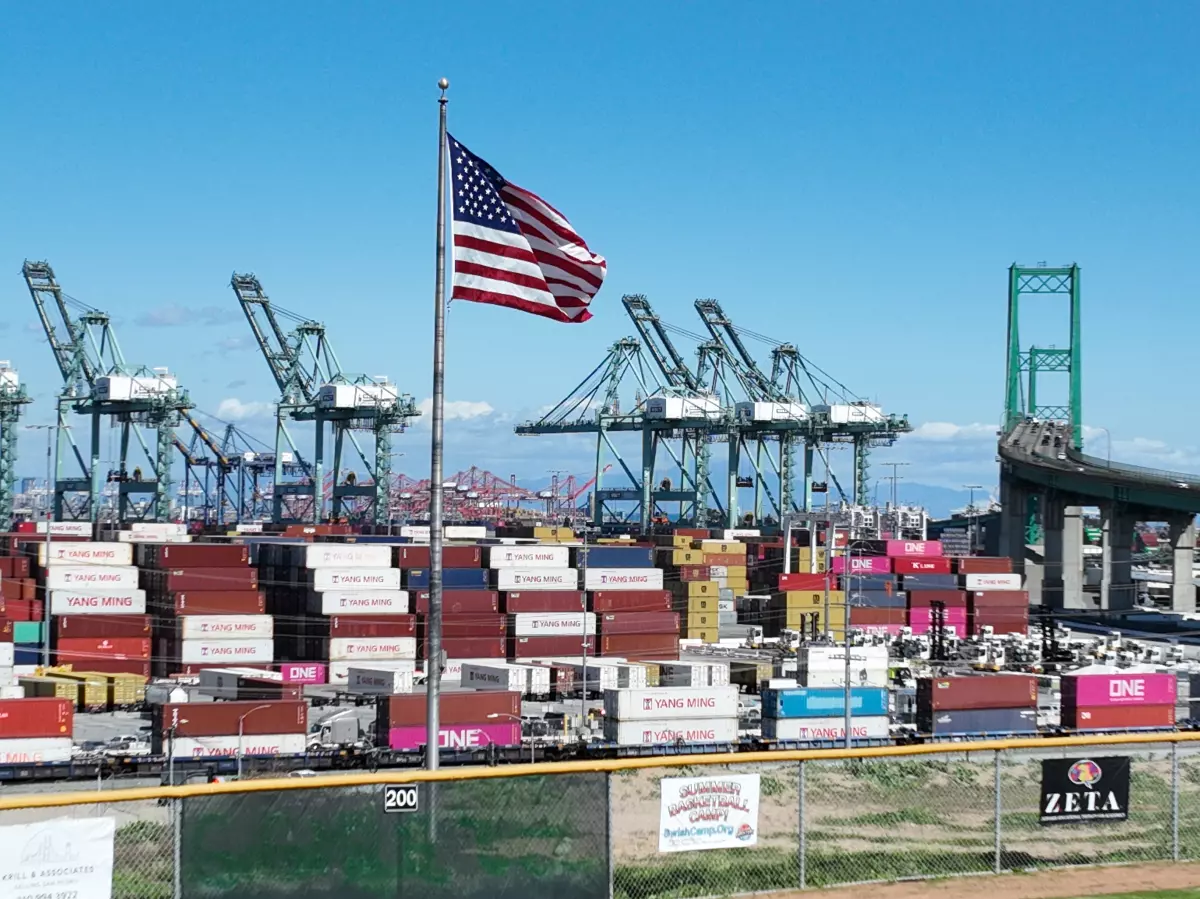
The Port of Los Angeles alone supports 136,000 jobs in the city. The combined Port of Los Angeles and Port of Long Beach support 186,000 jobs in the Los Angeles/Long Beach area. 

California Gov. Gavin Newsom on Wednesday announced a lawsuit contesting President Trump’s executive authority to enact international tariffs without congressional support, which he likened to the commander-in-chief taking a “wrecking ball” to America’s global reputation.

The legal action argues that the International Emergency Economic Powers Act that Trump cited to impose tariffs does not grant the president the ability to unilaterally adopt tariffs on goods imported to the U.S. The suit from California is the first challenge from any state against Trump’s trade policy.

California’s legal case rests on an argument that the International Emergency Economic Powers Act, which specifies the actions the president can take if he declares a national emergency in response to a foreign national security, foreign policy or economic threat, does not give Trump the authority to enact tariffs.

“The reality is the U.S. Constitution gives Congress the power of the purse,” Bonta said. “It’s Congress’ responsibility to set and collect taxes, duties and excises, including, yes, tariffs, not the president’s. Congress hasn’t authorized these tariffs, much less authorized imposing tariffs only to increase them, then pause them, then imminently reinstate them on a whim, causing our nation and the global economy whiplash. Trump is attempting to override Congress and steamroll the separation of powers.”

The tariffs appear to be on weak legal ground, given the president’s decision to rely on the International Emergency Economic Powers Act, said Stratos Pahis, associate professor of law and co-director of Block Center for the Study of International Business Law at Brooklyn Law School.

Donald Trump, an unsuccessful business man, with a high approval rating by the public, is destroying America’s economy and the G.O.P. is bowing to his wishes.

The question is where the people needed for all those manufacturing jobs come from?

Canadian snowbirds love Palm Springs. But Trump is making them say: Sorry! We’re leaving

By Hailey Branson-Potts, Staff Writer for Los Angeles Times

This is an abridged article.

Since his reelection in November, Trump has upended the typically friendly relationship between the U.S. and its northern neighbor. He has mocked Canada by calling it America’s “51st state” and repeatedly referred to former Prime Minister Justin Trudeau as “governor.” And he has threatened to use “economic force” to annex the country, whose population of 40 million is about the same as California’s.

Trump in February invoked emergency powers to justify stiff new tariffs on Canadian imports, arguing in an executive order that the trafficking of illegal drugs — namely, fentanyl — across the northern border constituted a dire threat to American security.

After Trump’s separate 25% tariff on imported automobiles went into effect last week, Canadian Prime Minister Mark Carney, who called the levies a “direct attack” on his country, slapped a 25% retaliatory levy on vehicles imported from the United States.

In Palm Springs, the snowbirds who were already here before Trump took office are leaving for the season. The question is: Will they return?

Two Canadian airlines this spring ended their seasonal service to and from Palm Springs International Airport earlier than initially planned, airport spokesman Jake Ingrassia said in a statement to The Times.

“Flair Airlines and WestJet have slightly shortened their seasonal service to Vancouver and Winnipeg, respectively,” Ingrassia said. “The airlines have advised the airport that these adjustments are in response to the current operating environment and shifts in demand.”

Kenny Cassady, director of business development for Acme House Co., which manages vacation rental properties in Palm Springs, said Canadians often book stays of one to three months a full year in advance, returning to the same properties annually.

“But when it comes to rebooking for next year? They’re just declining,” said Cassady, who also is a board member for Visit Greater Palm Springs, a tourism marketing agency for the Coachella Valley.

Trump’s Destruction of the Country’s Economy

Tariffs Are a Self-Inflicted Economic Catastrophe that will make America hated by most of the world. Russia and its allies are loving this.

Dow drops over 1,400 as US stocks lead worldwide sell-off after Trump’s tariffs ignite

Financial markets around the world are reeling Thursday following President Donald Trump’s latest and most severe set of tariffs, and the U.S. stock market is taking the worst of it so far.

The S&P 500 was down 4% in midday trading, more than other major stock markets, and at its bottom in the morning was on track for its worst day since COVID struck in 2020. The Dow Jones Industrial Average was down 1,412 points, or 3.3%, as of 11:50 a.m. Eastern time, and the Nasdaq composite was 5.1% lower.

 In President Donald Trump’s first term, apparel and footwear makers shifted manufacturing out of China to avoid tariffs. Now they’re being pummeled as Trump targets the same nations they moved to. 

A tariff of 46% on goods from Vietnam is particularly painful for companies such as Nike Inc., Adidas AG and Lululemon Athletica Inc., which produce significant amounts of merchandise in the country. Levies of 49% on Cambodia and more than 30% on Indonesia and Thailand are also problematic. Trump says the tariffs will push companies to relocate manufacturing to the US. 

America’s biggest trading partners promised retaliation for President Donald Trump’s massive tariff announcement. The first major response has come in — from Canada.

Canadian Prime Minister Mark Carney said that Canada will levy a 25% counter-tariff on vehicles imported from the United States that are not compliant with the United States-Mexico-Canada Agreement (USMCA) in response to US tariffs on Canadian vehicles and auto parts that went into effect today.

“As I told President Trump during our call last week, Canada will respond to the US auto tariffs, and today, I’m announcing that the Government of Canada will be responding by matching the US approach with 25% tariffs on all vehicles imported from the United States that are not compliant with CUSMA, our North American Free Trade Agreement,” Carney told reporters in Ottawa, using the Canadian acronym for the USMCA.

The prime minister said there were no talks scheduled between him and Trump, but he would talk to the US president again “if appropriate.” Carney also said Canada’s counter-tariffs would not affect auto parts.

Though Carney said Canada still considers the US an ally in defense and security, his country “must be looking elsewhere to expand our trade, to build our economy and to protect our sovereignty.”

Where will all this end? Look for a World Wide RECESSION.

Buy Canadian movement starts to take a sizable bite out of U.S. business

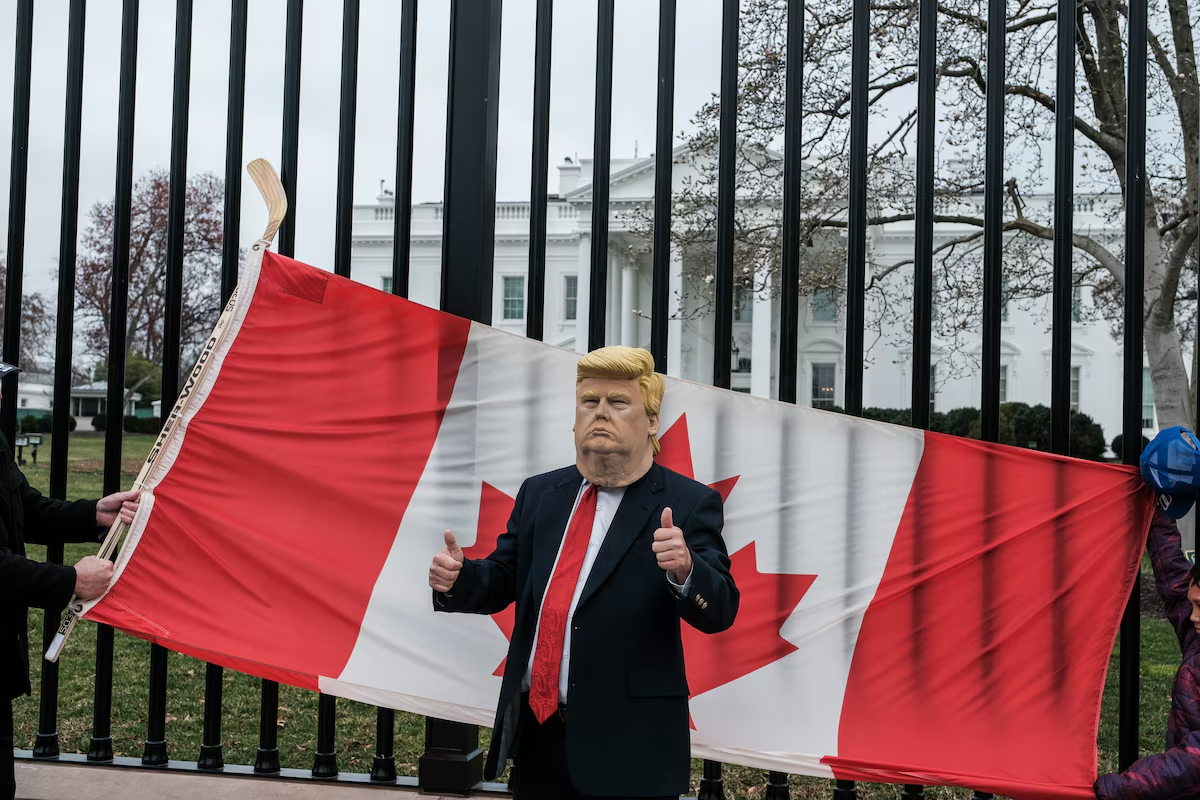
A man dressed as U.S. President Donald Trump poses for a photo near the White House in Washington on March 13. MICHAEL A. MCCOY/The New York Times News Service

The surge in patriotism among Canadian shoppers, fuelled by trade tensions with the United States, is already leaving a sizable mark on American business, early data from a variety of industries suggests.

U.S. tour operators are reporting booking declines of as much as 85 per cent, while American distilleries are losing major deals. Meanwhile, Canadian grocers are posting a bump in domestic product sales of up to 10 per cent.

Donald Trump’s jabs about annexation, along with a 25-per-cent levy on steel and aluminum from Canada and the U.S. President’s threats of a 25-per-cent tariff on most Canadian imports have prompted a rallying cry to “Buy Canadian” across this country.

While consumer boycotts – combined with government policy actions – are causing trouble south of the border, concerns are bubbling up about the toll on Canadian businesses, too.

“To use some of the words I hear from tour company members of the National Tour Association, the drop-off is ‘astronomical’ when speaking about Canadians booking group travel to the United States,” said Catherine Prather, president of the Kentucky-based organization, which specializes in group tours.

The exchange rate and fluctuating trade policies have had a “resounding effect” on Canadians’ travel cancellations, she said. But tour operators shared that the rhetoric about making Canada the 51st state is “perhaps even worse,” and in many cases, has been the “deciding factor” for customers.

Traffic across some major border crossings in tourism states such as New York has dropped by 12 per cent in the first two weeks of February alone, said Corey Fram, director at the Thousand Islands International Tourism Council. He cited data provided to him by the Bridge and Tunnel Operators Association for border crossings on the Thousand Islands Bridge between Alexandria Bay, N.Y., and southeastern Ontario.

Statistics Canada data also show that Canadian automobile trips to the U.S. are plummeting. About 1.2 million return trips were made into Canada by Canadians in February – a 23-per-cent drop from that period a year ago.

The U.S. Travel Association warned in February that even a 10 per cent drop in Canadian visitors would lead to more than $2.1-billion in spending losses and a threat to 14,000 jobs.

The Buy Canadian movement is also hitting the grocery aisles. Per Bank, CEO of Canada’s largest food retailer, Loblaw Cos. Ltd., said in February that the company saw about a 10-per-cent uptick in sales for Canadian products in preceding weeks.

Pierre Cléroux, vice-president of research and chief economist at the Business Development Bank of Canada, told The Globe and Mail that if every Canadian household redirected $25 a week from foreign products to Canadian ones, it would boost GDP by 0.7 per cent and create 60,000 jobs.

According to his modelling, if Canadians also cut international travel by 10 per cent and spent that money domestically, the combined effect would raise GDP by 1 per cent and create 74,000 jobs.

Another U.S. industry reeling from the “Buy Canadian” movement and its manifestation in public policy – including provincial moves to take American booze off the shelves – is American distilling.

Canada is a critical market for U.S. spirits, making up “a little over 31 per cent of all U.S. exports” of distilled spirits in 2024, said Stephen Gould, a Colorado-based alcohol trade consultant at Consulting Alchemist Ltd and former distillery owner.

In addition to bourbon, Canada is a crucial market for U.S. whisky and other spirits as well as wine and beer. Bartenders, waitstaff and retail clerks in the U.S. are among those who will face significant layoffs if trade tensions continue, said Mr. Gould.

“The American industry is suffering,” he said.

Victor Yarbrough, co-founder of Brough Brothers,Kentucky’s first Black-owned distillery, said his company was “deeply disappointed” after losing a lucrative deal to sell its bourbon to New Brunswick Liquor due to trade tensions. The deal was projected to increase company sales by 2.55 per cent in 2025.

“Canada’s a large export market for us,” said Mr. Yarbrough. “Let’s figure out ways to move forward and amicably.”

Abridged article from the Canadian Globe and Mail.

Trump Versus Canada

Donald Trump wants to annex Canada and Greenland. To accomplish that goal without an invasion he is using tariffs. Trump doesn’t want to use the military to obtain his objectives. Vladimir Putin’s effort to annex Ukraine using his military is a message that Trump should not use military force to reach his objectives. 

Mr. Trump followed through on a threat at midnight Wednesday to slap 25-per-cent tariffs on aluminum and steel from all countries including Canada, Mexico, South Korea, Australia and Europe. The 27-nation European block joined Canada with retaliatory tariffs of US$28-billion on American goods.

“These tariffs are completely unjustified, unfair and unreasonable,” Canada Finance Minister Dominic LeBlanc told a news conference on Wednesday, warning U.S. protectionist measures will hurt American and Canadian consumers.

U.S. Commerce Secretary Howard Lutnick said the tariffs put in place Wednesday will stay in effect until there is a strong U.S. aluminum and steel industry. That is not a likely scenario.

Ontario premier Mr. Ford on Monday announced a 25-per-cent surcharge on electricity exports to three U.S. states, but suspended it Tuesday after a call with the Commerce Secretary. The Premier said Mr. Lutnick “extended an olive branch” to start a conversation about the future of the United States-Mexico-Canada Agreement.

Canadian Foreign Affairs Minister Mélanie Joly said she’ll once again told Mr. Rubio that Canadians are fed up with Mr. Trump’s call for the annexation of Canada. “Everything that has to do with the 51st state rhetoric is unacceptable,” she said.

The President also defended his whipsaw approach to tariffs, after weeks of threats followed by retreats – and then new rounds of levies.

“It’s called flexibility,” he said. “It’s not called inconsistency.”

Will the American congress assert itself? The authoritarian has control for now.

The Largest U.S. Trade Deficit Is With China

Why is President Donald Trump imposing tariffs on China?

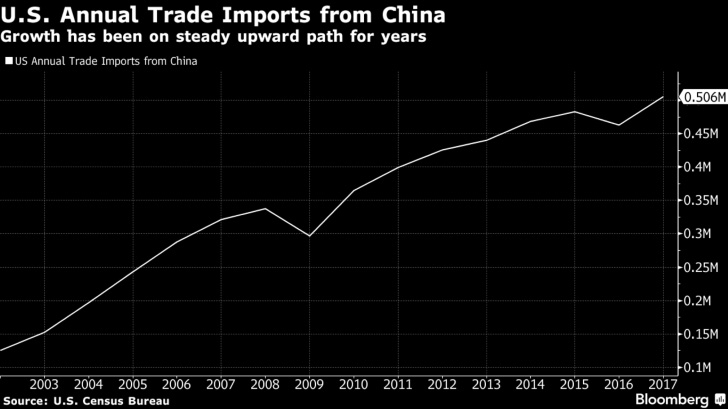
More than 65 percent of the U.S. trade deficit in goods was with China. The $375 billion deficit with China was created by $506 billion in imports. The main Chinese imports are consumer electronics, clothing, and machinery.

America only exported $130 billion in goods to China.

As this graph indicates this is not a new phenomenon. It goes back to the late 1900s.

China currently assembles the majority of Apple’s iPhones in its Shenzen, China, location by Foxconn. That company maintains factories in countries across the world, including Thailand, Malaysia, the Czech Republic, South Korea, Singapore, and the Philippines. A second company, Pegatron, is a relatively recent addition to the iPhone assembly process also in China.

High End clothing brands we all lust after really have to work hard to minimize the production costs while keeping their products “luxurious” and “high end”. China is their go to manufacturing location. Who are they?
1. PRADA
2. COACH
3. ARMANI
4. BURBERRY
5. MULBERRY
6. MARC JACOBS
7. D&G

Chinese factories manufacture winter coats, gloves, mittens and hats for consumers around the world. These factories also produce maternity clothes and infant clothes as well as wedding dresses and tuxedos. Underwear, T-shirts and slips are among the items exported from China to consumers around the world. Sports caps are also produced in China as are belts and bras.

Luggage, machinery, and furniture are also made in China.

The consequence of the outsourcing of all that manufacturing has resulted in a major loss of good paying blue collar jobs in America.

Trump is correct when he points out that both political parties stood by and did nothing as the jobs left the country.

We couldn’t stop the outsourcing but our government did nothing to train people in new jobs that are needed in the 21st century.

While Trump has accurately identified the problem he does not appear to understand the needed solution. His solution of applying tariffs will only harm the American economy by raising the cost of consumer goods.

Article I of the US Constitution vests the power to set tariffs in Congress. The president has the power to impose tariffs at his discretion only because Congress has passed laws granting him that power. If Republicans in Congress think Trump has a bunch of dumb, destructive ideas about trade, they could pass new laws that strip him of that power.

Congress is in total grid lock. They won’t do anything to counter the new tariffs.

We are headed for a trade war. The last time that happened was 1930. Smoot-Hawley Tariff Act, formally United States Tariff Act of 1930, also called Hawley-Smoot Tariff Act, U.S. legislation (June 17, 1930) that raised import duties to protect American businesses and farmers, adding considerable strain to the international economic climate of the Great Depression.

Wall Street bankers are not given to grovelling. But in June 1930 Thomas Lamont, a partner at J.P. Morgan, came close. “I almost went down on my knees to beg Herbert Hoover to veto the asinine Hawley-Smoot Tariff,” he recalled. “That Act intensified nationalism all over the world.”