Columnist reflects the specter of losing his landline

By DENNIS MCCARTHY, Los Angeles Daily News

PUBLISHED: February 16, 2024 at 4:33 p.m. | UPDATED: February 16, 2024 at 4:34 p.m.

When they came for my typewriter and replaced it with a word processor, I grumbled but said nothing.

When they took away my vinyl LPs and replaced them with CDs, I begrudgingly put my Sinatra albums in storage and bought his discs.

When bookstores began closing, I built more shelves in my home and started my own bookstore.

Now, AT&T wants to take away my landline, and I say enough, already! Keep your hands off Ma Bell.

Her rotary phones were our lifelines — our memories of when you could stay in touch with the world with a phone, a newspaper and Walter Cronkite.

Today, I’m paying AT&T and Verizon nearly $400 a month to stay in touch, and I don’t have a clue of what’s going on.

In case you missed it, AT&T wants out of the old copper wire business that delivers landline access to around 25% of the households in California that still have landlines and a cell phone. It drops to around 15% with landlines only.

With the speed and technology AT&T possesses, you’d think they’d have texted me with the news, but they chose good, old, reliable snail mail to let me know. How’s that for a shot of irony?

It’s asking the California Public Utilities Commission for a release from its obligation to provide landline phone service in a large portion if its service territory in the state. My portion.

If approved, AT&T will give us land liners six months before it cuts the copper wires and we have to move to a private, unregulated carrier to keep our landline. If no alternative voice services are available, it will hang on until there are.

Not so fast, though. I kind of like the government keeping an eye on my phone bills. It keeps an eye on everything else for me.

I still have an old rotary phone I keep at the end of my desk for personal therapy. The number’s University 6-3230.

Whenever I’m feeling down or stressed out, I stick my forefinger in one of the 10 holes — digits 1 through 9, and zero — on the rotary dial, and give her a whirl, cradling the receiver between my chin and shoulder, like I used to.

That familiar clicking noise when you turn the rotary dial is a glass of chocolate milk and Oreo cookies to me. I’m back in the old neighborhood calling my high school buddies and old girlfriends in my mind.

Ma Bell hung from our kitchen wall and sat on a side table in the living room in the 1950s when two-thirds of American households had at least one rotary phone, thanks to that old copper wiring it now wants to cut.

Ma couldn’t fit in our pocket or do all the things smart phones can do now, but somehow we made do.

Calendars told us what day it was and watches told us the time. Newspapers, TV and radio news kept us in the loop.

Ma couldn’t check our messages or text our friends for lunch, but she gave us great reception and that’s all we were asking for. She never died in the middle of a call.

By the 1970s, push buttons began replacing rotary dials, and that therapeutic clicking sound was gone forever. By the 80s, most rotary phones were being phased out as Ma Bell sang her swan song in 1984.

Today, when my cell phone rings in my house, it’s a mad dash to the window in my den where I get the only good reception in the place and don’t lose the call.

When my landline rings, I take my time walking over to answer it. It never loses a call.

Before the California Public Utilities Commission makes a decision in April on AT&T’s request, it’s asking for public comments.

Comments may be posted on a CPUC link: tinyurl.com/yvp6fb7n

Also, the California Public Utilities Commission is holding two in-person public forms — Feb. 22 in Ukiah, and March 14 in Indio.

One virtual meeting to be held at 2 and 6 p.m. March 19. Information about these meetings and other information on the issue on the CPUC page here: tinyurl.com/yx9sv9zw

For more information on the issue of AT&T’s request to be relieved of its “Carrier of Last Resort” obligations in certain areas of California go online to: https://www.cpuc.ca.gov/attcolr

Or, better yet, give them a call on your landline at 866-849-8390.

For Ma Bell.

Is it Greed or Simply Evolution?

Scrooge McDuckGreed: a selfish and excessive desire for more of something (as money) than is needed. That is the Merriam-Webster definition.

When I was a boy reading comic books there was a character in the Donald Duck series named Scrooge McDuck. He loved money and the cartoon showed him rolling in dollar bills and dancing on the money. That was a characterization of some people in this world. Was that greed?

The stock market continues to hit new highs every several months. The S&P 500 reached another new high on Friday, February 13, 2015. Apple Computer shares are at or near their highest level ever. Most people do not own enough stocks to feel a significant impact. The wealthy, whose source of income is the stock market, are the beneficiaries of this situation.

Meanwhile BBC.com and Fareed Zakaria GPS reports the findings of Oxfam, an anti-poverty group, that the combined wealth of the world’s richest 1% will overtake that of the other 99% of the world’s population by 2016. Furthermore the richest 80 people in the world have collected the same amount of wealth as the bottom 3.5 million people-$1.9 Trillion.

There are two facts that are slowly destroying the middle class and causing even greater harm to blue collar laboring classes.

  1. Without government involvement jobs are performed at the lowest pay rate which moves jobs to the poorest countries.
  2. Technology enables employers to replace workers performing repetitive work with a machine.

These are not new facts. Queen Elizabeth I (queen of England 1558–1603) denied a patent for the first knitting machine in 1589. It was denied because of her concern for the security of the kingdom’s many hand knitters.

Robots install rivets on a 2015 Ford F-150

Paul Wiseman of the Associated Press posted an article titled “Robots replacing workers at a faster pace”. The report was replicated by many news media outlets including ABC, Fox Business, etc. The article said “A new report says that cheaper, better robots will replace human workers in the world’s factories at a faster pace over the next decade, pushing labor costs down 16 percent.” The mechanization has impacted only 10% of the possible uses for robots. 90% of the changeover is still in the future.

Recently two public parking lots I had occasion to use had no pay clerk at the exit. The system was automated. Soon there will be no one to take your order at McDonald’s.

I could go on with more examples of lost jobs thanks to technology or replacing middle income workers with low paid workers but you already understand the point I am making.

The question to candidates for the next president of the United States is what will you do to change the obvious decline in the income of the majority of Americans? You ought to ask your congressional representative and senators that same question.

America’s Dying Industries

Shoe Manufacturing

This comes as no surprise.  Still it hurts to see these numbers.  As you read each of these items you know the reason for the decline in business.  This was published on Huffington Post.  The reasons are as follows:

  1. The photofinishing decline was the result of the digital camera era and the sharing of photos on internet web sites.
  2. The high cost of labor now makes appliance repair more expensive than buying a new item.
  3. Advertising revenue has declined at most newspaper and magazine publications thanks to the internet and smartphones.
  4. Manufacturing of consumer products is now cheaper in most other nations of the world.

Photofinishing

Revenue decline 2002 to 2012  -70%.  $15.509 million to $897 million

Recordable Media Manufacturing

Revenue decline 2002 to 2012  -53.6%.  $4.144 billion to $3.311 billion

Money Market and Other Banking

Revenue decline 2002 to 2012  -51.2%.  Industry revenue in 2012 $834 million

DVD, Game and Video Rentals

Revenue decline 2002 to 2012  -49.6%.  Industry revenue in 2012 $5.894 billion

Newspaper Publishing

Revenue decline 2002 to 2012  -48.1%.  Industry revenue in 2012 $29.302 billion

– Women’s/Girls’ Apparel Manufacturing

Revenue decline 2002 to 2012  -57.7%.  Industry revenue in 2012 $8.603 billion

Costume/Team Uniform Manufacturing

Revenue decline 2002 to 2012  -49.9%.  Industry revenue in 2012 $986 million

Appliance Repair

Revenue decline 2002 to 2012  -44.5%.  Industry revenue in 2012 $3.684 billion

Hardware Manufacturing

Revenue decline 2002 to 2012  -44.5%.  Industry revenue in 2012 $7.484 billion

Shoe/Footwear Manufacturing

Revenue decline 2002 to 2012  -39.6%.  Industry revenue in 2012 $1.712 billion

Impact of Technology on the U.S. Economy

If only businesses would start re-hiring all those people who lost their jobs in the Great Recession everything would be as it was.  It won’t happen like that!  Globalization and technology have changed everything.

The Mobile World Congress is a show of the latest cell phone and tablet technologies.  It will occur February 24 to February 28 in Barcelona, Spain.  The facility used is a new state of the art convention centre called Fira Gran Via consisting of eight halls.  With over 1,500 exhibits, it is a reminiscent of CES and Comdex that have been held at the Las Vegas Convention CenterThis is a wake-up call that the United States is not necessarily the center for new technologies.

  Fira Gran Via, Barcelona Spain

  The Gran Via Convention Centre

 Fira Gran Via mwc_carousel_networking gardens_final                                                                                


No business will hire employees in the western world when the job can be done for far less in developing countries.  Workers in China, Mexico, and elsewhere are willing to work for $1USD an hour.  Workers in the United States, Canada, U.K., Germany and other industrialized nations cannot pay their bills on that rate of pay.

Businesses of all types try to solve their employment needs by looking for automated equipment rather than hiring.  The benefit is lower cost for services rendered where ever labor is needed.

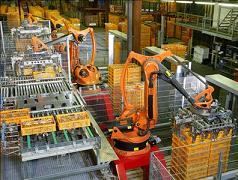
  factory-robots

From cars to bread, robots dominate modern production

On-line Digital Camera Review owner/editor Jeff Keller, “The smartphone became the preferred photo tool for many.”  The web site closed down effective December 31, 2012.

Newsweek’s final print publication mailed out on December 24, 2012.  The final issue is dated December 31, 2012.  The cause was a decline in advertising revenue.  The magazine’s owner will attempt a digital version that will be available only to subscribers.

Borders bookstores have closed.  Barnes and Noble stores are closing too.  E-readers are this year’s sought after device.  Barnes and Noble’s Nook is one of those readers.

Modern manufacturing isn’t based on human labour; it’s based on the robot. Still, most people cannot grasp the breadth of automation in factories. We still picture plants full of human workers toiling to make our cars and furniture, just as we imagine our meat comes from animals in a barn. The truth is much more awe-inspiring, perhaps even frightening. The factories of today have some human workers, but huge portions of assembly lines are 100% mechanized. The US Bureau of Labor Statistics expects automotive jobs to decline 18% by 2018 despite expected increases in production. Robots eliminate the need for more workers.

What is the United States doing to sustain its lead in technology and grow its economy?  Arguing about gun control, immigration, and government debt.

Apple Needs to Take Bold Action

Apple is done, say teens

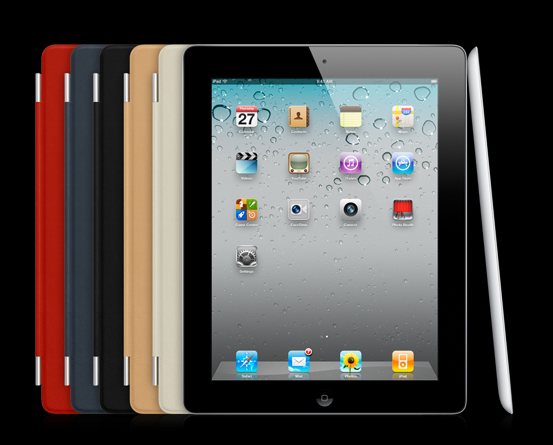
iPad

                                                                                                                       We know this company for the Mac computer, iPod, iPhone, and iPad.  All were leaders in technology.

Many people do not believe that Apple (AAPL) will be a leading innovator now that Steve Jobs has passed away.  There are flaws in that thinking.  Steve Jobs lead the company through some serious mistakes and the company did thrive despite those events.  Those bad decisions did impact company earnings and Apple’s reputation.  Some examples below.

Sticking with AT&T as an exclusive partner for too long

If only Jobs had pulled the plug on Apple’s exclusive relationship one year earlier, the U.S. smartphone landscape might be radically different. Motorola released the first DROID phone for Verizon at the end of 2009. It was the first Android phone that we remember seeing in the wild. It was Verizon’s answer to the iPhone.

Emailing an iPhone 4 customer to say, “Just avoid holding it in that way,” was a mistake

Apple had its sterling reputation severely tarnished by Antennagate. The iPhone 4 became synonymous with dropped calls and signal problems. (Sneer if you want, but when we’d pull out the new iPhone a lot of people would ask us if we could even use it to make phone calls.)

Tim Cook, CEO of Apple, needs to go Bold.   That translates to taking on some new ideas for new products and extraordinary improvements for existing products.  He can do it!  The question is: Will he do it?

Japan’s Technology is Impacting the World

Bloomberg Businessweek sells advertising that looks like its columns.  Companies and countries use this methodology to promote their business friendly atmosphere.  The sections are clearly marked as “advertising section.”  In one edition the United Arab Emirates bought pages that promoted the business opportunities in those nations.  The information was presented in a format that leads readers to believe the articles were being presented by the magazine.  The font sizes and the presentations give the appearance that they are indeed being presented by the magazine publisher.

In the October 22, 2012 edition there was a 13 page presentation that was sponsored by Japanese companies.  It is impressive and informative.  It makes me realize how far other counties have developed compared to the United   States.  The article is long but is worth your time.  I was especially impressed by the fact that a Japanese company is updating the British railway system.  Another has developed quick set up homes for people who have been displaced by natural disasters (think the homes damaged by Hurricane Sandy).

Following is very abridged version of the article with significant statements in bold text.

A new market for Japanese rail technology is the U.K., the original home of railways. Hitachi Ltd. has formed a consortium with a British company to supply a total of nearly 600 high-speed rail carriages, and the supporting maintenance infrastructure, starting delivery in 2017. The Hitachi Super Express trains will be manu­factured in a newly built factory in the north of England. The total value of the project. including the maintenance and repair centers to be constructed throughout the U.K., is estimated at between ¥400-¥500 billion ($5.1-$6.3 billion).

These new trains will replace the U.K.’s aging Intercity fleet on the East Coast Main Lines and the Great Western Main Lines. The lightweight construction of the trains (between 15 and 40 percent weight reduction per seat) lowers energy consumption of the bi­mode units, and this light weight also helps reduce the travel time for the growing number of passengers on the routes where these trains will be operated.

High-speed shelters

Following the Great East Japan Earthquake, over 340,000 people were displaced, with most taking refuge in emergency shelters, such as school gymnasiums, until more permanent housing could be arrangec for them. The lack of privacy for extended periods (blankets or tempo­rary cardboard partitions were often the only divisions between family groups) caused severe additional emotional stress to many survivors.

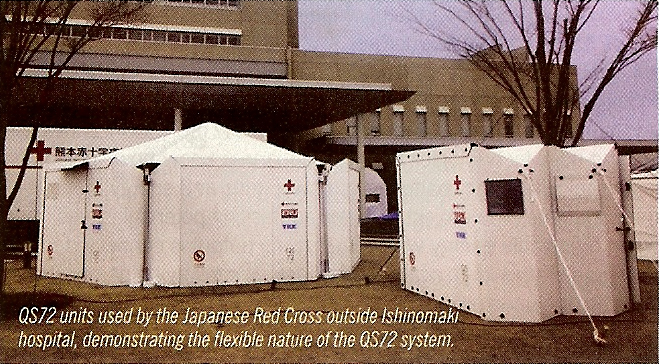
Photo was scanned from Businessweek

Accordingly, a need was perceived for lightweight flexible structures that can be quickly transported and erected to provide such spaces. Enter the QS72 from Daiichikensetsu Ltd., with “QS” standing for “Quick Space” and “72” representing the number of hours within which such components can be deployed to provide floors, walls and roofs for meeting rooms, emergency clinics, toilets and other areas, in the time when disaster survivors are at their most vulnerable psychologically.

Constructed of polypropylene, the system requires only a few people and no tools to assemble. Using a lightweight construction method providing thermal insulation, the units can be linked together in a variety of ways to serve various needs of a displaced community. The basic construction recalls the principles of origami in the way the different parts fold and unfold to create the spaces. A single unit can temporarily accommodate a small family until more permanent accommodations can be arranged and constructed. Following this, the unit can be combined with others and reused as a community space, for example, or a store or medical center. Indeed, following the March 2011 quake, 100 units were donated to the Japanese Red Cross, and used as general purpose structures in lshinomaki, supplementing the existing hospital facilities.

Keeping in touch during disasters

A key issue following a disaster is the effective dissemination of information. Making use of one of the best IT infrastructures in the world, the Japanese government has developed Disaster Guide­lines and Action Plan for IT, with a twopronged emphasis on the preservation of life and the well-being of the survivors.

First, the safety of inhabitants of the affected area, and the status of emergency services, is confirmed. Following this immediate response, the system changes to provide information to survivors about vital infrastructure elements (utilities, communications and transportation). The rapid growth of smartphone use in Japan al­lows for rapid and easy sharing of information. Already, earthquake early-warning systems are incorporated into the cellular network, and internet sites designed for smartphones are planned that will allow parents to check on the safety of their children at school, as well as to use the newly developed J-anpi system to check on others’ safety and reassure friends and family of their own.

Lessons learned from the March 11 disaster that have been incorporated into the plan include the use of alternative channels (websites, email and social network services) beyond the usual emergency number. These channels can also disseminate information, using cloud services to ensure continuity of service, and supplement radio and TV broad­casts. The Prime Minister’s Office also operates a Twitter account, allowing the government to “push” up-to-the-minute information to millions of smartphone users.

In the event of future disasters, Japan hopes to save lives, and to improve the lives of survivors through such implementations of technology, and to share these techniques and technologies with other nations. – H.A.

Tablet Computers are the New “Must have” Device

This blog is still written using MS Word and I still love my 19″ desktop computer. That is not likely to change.

There were e-readers before the iPad but Apple made tablets the new ‘need to have” category.  Suddenly Amazon’s Kindle and Barnes & Noble’s Nook had taken on new value.  Actually the iPad did both of those devices a favor.  They spurred them to improve the quality and capabilities.

We saw some Europeans in San   Diego last summer (2011) with their tablets.  I realized they knew where the restaurants were located and could obtain other worthwhile info you were on vacation.  Dragging a 17” laptop to London and Paris this past summer was no fun.  It’s old and slow too and that made it even more unpleasant.

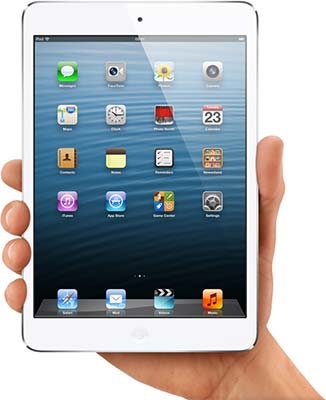
When Microsoft announced their new Surface tablet this past August I knew I would have to consider this new connection to the world.  Now Apple has announced their new iPad Mini that does not include a mini price tag.

Many potential iPad buyers may have been contemplating the purchase during this coming Christmas buying season. They might now buy the Mini to save some money.  Apple will have diverted buyers and that means less profit.  From a shareholder viewpoint this decision will impact the bottom line.

The challenge for me is to determine the size and capabilities that will fulfill my immediate needs and what future needs I might have.

Surface by Microsoft coming October 26

I can hardly wait!  As a dedicated PC user, I have been disappointed by the offerings of the primary PC manufacturers.

Apple’s iPad tablet computer is reported to hold 70% of market share.  None of the competitors have been able to come even close to making a dent in Apple’s dominance.  H-P has dropped out of the market entirely and Dell offers a tablet but I do not know anyone with the unit.

Thus the entry of the Surface by Microsoft might bring on even more sales and a significant migration from the laptop format.  To add extra spice it is rumored that a low cost 7 inch version may be offered at $199.  That could be the reason that Apple is reportedly introducing its own 7” iPad.

On our recent trip to Europe I did see a few people carrying tablet computers.  The really are too big to use as a camera.  However, for finding your way around New York, London, Paris, Rome, etc. they would be a great benefit.  Of course they will be an easy way to update your blog.

Manufacturing in the U.S.A.

Can manufacturing thrive in the United   States? Consider the cost of labor in China, Mexico, Indonesia, and Vietnam.  Hourly rates are 50 cents USD to $1.00 USD.  My contention is that even with lowered income taxes those other countries will continue to provide products that cannot be put together in the USA at competitive costs.

However, PC World has run this article that indicated there is a possibility the USA can still compete.

By Karen Haslam, Macworld-U.K.    Jun 30, 2012  1:15 pm

Apple’s been criticized in the past for not manufacturing its products in the U.S., and has given a number of excuses when pressed on the matter. However, Google has now proven that high-tech goods can be produced in the U.S., the company’s new Nexus Q is “Designed and Manufactured in the USA” according to the inscription on the device.

There are a number of reasons why Apple manufacturers products in factories in China and other Far East countries, not only are workers cheaper, but overseas factories offer more flexibility, diligence and industrial skills. A report has also claimed that Apple has to manufacturer the iPad in China in order to get access to rare earth materials.

When asked why Apple isn’t manufacturing the iPhone in the US, Apple’s late-CEO Steve Jobs told U.S. President Barack Obama in February 2011: “Those jobs aren’t coming back,” complaining that there is a massive skills shortage in the US prohibiting the manufacturer of such goods there.

Google’s Andy Rubin said that the company had made a conscious effort to test the possibility of manufacturing in the U.S. with this product: “We’ve been absent for so long,” he said, referring to manufacturing not happening in the U.S., and added: “We decided, ‘Why don’t we try it and see what happens?'”

The report in the New York Times notes that consumer electronics manufacturers will be closely watching this case, to see if it disproves the accepted wisdom that consumer electronics products can no longer be made in the United States.

However, Google’s device has a high price than similar devices manufactured outside of the country, notes the report. The report also notes that Google is not disclosing details about where components of the device were manufactured.

Photography is Ever Evolving


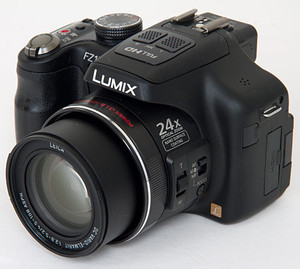
As good as the Panasonic Lumix DMC-FZ28 camera is, there is always room for improvement.  Thus I have purchased a Panasonic Lumix DMC-FZ150.

This will most likely be the last camera I will buy.  It has all the features of the FZ28 but has a somewhat longer lens, much faster shooting burst speed (12 fps), a faster focusing system, and my favorite Photo Style option (STANDARD / VIVID (Brilliant effect with high saturation and contrast.) / NATURAL (Soft effect with low contrast.) / MONOCHROME / SCENERY (An effect appropriate for scenes with vivid blue skies and greens) / PORTRAIT (An effect appropriate for portrait picture with a healthy and beautiful skin tone.) There are many other addtional features too numerous to list here.

The advanced manual is 202 pages long.  No wonder they chose to provide it in an Adobe reader format.

I bought the camera with a 30 day return privilege and that time has now passed.

Two problems with the camera are:

1. Like the FZ28 indoor pictures has a yellowish cast that is apparent when there is no outdoor sunlight.  The issue seems eliminated by using a polarizing filter.  Note the camera will take 52mm threaded filters without an adadpter.

2. The camera is bulkier than the FZ28 and weighs 18.62 ounces.  The FZ28 weighs 14.71 ounces.  You definitely will notice the difference.  My compensation is using a wider cloth neck strap rather than the supplied leather strap.

Although they have seen the camera sold out at most locations it appears they have discontinued manufacture of this model.  My guess is they want to add a longer zoom and connectivity to the internet in their next iteration.