Next week, for the third time in eight years, Donald Trump will be nominated as the Republican Party’s candidate for president of the United States. A once great political party now serves the interests of one man, a man as demonstrably unsuited for the office of president as any to run in the long history of the Republic, a man whose values, temperament, ideas and language are directly opposed to so much of what has made this country great.
It is a chilling choice against this national moment. For more than two decades, large majorities of Americans have said they are dissatisfied with the direction of the country, and the post-Covid era of stubborn inflation, high interest rates, social division and political stagnation has left many voters even more frustrated and despondent.
The Republican Party once pursued electoral power in service to solutions for such problems, to building “the shining city on a hill,” as Ronald Reagan liked to say. Its vision of the United States — embodied in principled public servants like George H.W. Bush, John McCain and Mitt Romney — was rooted in the values of freedom, sacrifice, individual responsibility and the common good. The party’s conception of those values was reflected in its longstanding conservative policy agenda, and today many Republicans set aside their concerns about Mr. Trump because of his positions on immigration, trade and taxes. But the stakes of this election are not fundamentally about policy disagreements. The stakes are more foundational: what qualities matter most in America’s president and commander in chief.
Mr. Trump has shown a character unworthy of the responsibilities of the presidency. He has demonstrated an utter lack of respect for the Constitution, the rule of law and the American people. Instead of a cogent vision for the country’s future, Mr. Trump is animated by a thirst for political power: to use the levers of government to advance his interests, satisfy his impulses and exact retribution against those who he thinks have wronged him.
He is, quite simply, unfit to lead.
The Democrats are rightly engaged in their own debate about whether President Biden is the right person to carry the party’s nomination into the election, given widespread concerns among voters about his age-related fitness. This debate is so intense because of legitimate concerns that Mr. Trump may present a danger to the country, its strength, security and national character — and that a compelling Democratic alternative is the only thing that would prevent his return to power. It is a national tragedy that the Republicans have failed to have a similar debate about the manifest moral and temperamental unfitness of their standard-bearer, instead setting aside their longstanding values, closing ranks and choosing to overlook what those who worked most closely with the former president have described as his systematic dishonesty, corruption, cruelty and incompetence.
That task now falls to the American people. We urge voters to see the dangers of a second Trump term clearly and to reject it. The stakes and significance of the presidency demand a person who has essential qualities and values to earn our trust, and on each one, Donald Trump fails.
If I were a relative or close confidant of President Biden, I’m pretty sure I’d give him a hug, thank him for his service, and tell him to seriously consider walking away.
I’d tell him that after a life of service, he can pass the torch with pride, with dignity, and with grace.
Someone probably should have done this months ago, out of love or duty, and out of the concern that Biden’s health is likely to get worse in coming years.
But we’re not very good at this sort of thing — at summoning the courage it takes to confront a loved one or a boss who’s in decline and being totally honest about it. To be courteous but firm. I had trouble telling my own father it was time to give up driving. He resisted, unaware of or unwilling to accept the reality of his obvious shakiness behind the wheel, and unwilling to surrender his keys or his pride.
By many accounts, people close to Biden have been aware of a decline but have not pressed him to step aside. The New York Times reported on Tuesday that in “the weeks and months” before last Thursday’s presidential debate, “several current and former officials and others who encountered him behind closed doors noticed that he increasingly appeared confused or listless, or would lose the thread of conversations.” There are also reports that people are encouraging him to keep going.
There are some analogies to California‘s Sen. Dianne Feinstein, who died last year at the age of 90 after more than 30 years in office. If there was any inner-circle effort to persuade her to leave the Senate due to her obvious cognitive and physical decline, that effort failed. She died in office after announcing she would not run again.
In some cases, stepping aside is the right thing to do.
This might sound odd to those who’ve followed my Golden State column over the last 28 months. One of my driving principles has been to stand firm against the notion that we’re incapable of contributing as we age, or that our value diminishes.
In recent columns, I’ve been pointing out, with the help of experts, that you can’t diagnose dementia from afar, though many people have tried to do so in Biden’s case, especially after his debate performance.
I’ve also written that whatever the cause of his foggy gaze and occasional meandering phrase (the medical possibilities are numerous), Biden seemed lost and unsteady. He may still have some gas in the tank, but time is working against him. A year from now, or two, or three or four, how will he be?
The world population is aging rapidly, and more people are staying on the job longer — and while the benefits are many, the risks are real. Bodies and minds break down. It’s OK, when they do, to punch out and move on.
Since the debate, I’ve been thinking about something USC gerontology professor Caroline Cicero said to me last year, when I wrote about whether Biden or Feinstein should step aside.
“I’m very concerned about ageism in the workplace, but I’m also concerned about people who think they have to work forever,” said Cicero. “Giving people permission to retire is something I think we need to do.”
She picked up on that line of thinking this week.
“In recent decades, society has told us that we can have it all. In a battle against ageism, we tell people they can work as long as they want,” she said. “In a battle to prove ourselves, we tell ourselves we can beat normal slowdowns that come with the passage of time.”
But most of us can’t.
Mick Jagger and Paul McCartney, each north of 80, are still holding a tune, and Warren Buffett, at 93, seems to be doing OK. But that’s the thing about aging, as I‘ve said before: You can be old at 60 and young at 85.
Biden has obvious strengths, chief among them experience, wisdom, decency, civility and the empathy that comes with crushing loss. It may be that those in his inner circle, knowing what he’s made of, can’t bring themselves to question his strength and resolve, even in the face of obvious decline. Sure, his family knows him better than we do, but maybe they can’t see what we see from afar.
Some of you might be wondering, right about now, that if I’m all about frank discussions on knowing when it’s time to go, then how come I’m not bringing the Trump family into this.
I would, but their task is even harder than the Biden family’s. What would be the point of saying to a convicted felon who continues to insist he won the 2020 election, “Hey Pop, the fact-checkers are still recovering from the workout you gave them in the last debate”? It takes a bit of humility to see the truth about yourself, and when you begin listing the qualities that define Donald Trump, humility and truth do not make the cut.
iden may be having trouble seeing himself as anything other than what he is now — a public servant at the top of the flow chart. You can’t be president of the United States without a healthy ego, and in jobs that people are passionate about — that become their very identity — they often can’t imagine what or who else they could be in retirement, provided they can afford to retire, which many cannot.
These people may not be able to imagine that anyone waiting in the wings is as up to the task as they are, and perhaps that’s part of Biden’s calculation. If he takes the next exit, who would take his place? And is there enough time for Vice President Kamala Harris or any of the other potential last-minute candidates to find traction?
It never should have come to this.
The late Supreme Court Justice Ruth Bader Ginsburg comes to mind as Exhibit A for lessons on the price of stubbornly holding on. She refused to surrender her position as her health faded, and women’s reproductive rights suffered a blow as a result.
“I see it with entrepreneurs who created a business and have hard time letting go,” said Helen Dennis, who started a support group called Renewment — combining the words “renewal” and “retirement” — 25 years ago for successful women who had trouble imagining the next versions of themselves. The group now includes “teachers, nurses, doctors, several attorneys,” all of them leaning on each other as they learn “how to navigate the next chapter.”
Work is not life, and life is not work, USC’s Cicero once said to me. That must be a foreign concept to a sitting president, but I’m thinking of former President Jimmy Carter as one of the best examples of those who have found ways to contribute after leaving office. He took up a hammer and went to work for Habitat for Humanity — and he won the Nobel Peace Prize for working on peaceful solutions to world conflicts.
“People often fear retirement because they don’t want to be labeled as old, invisible or unimportant,” Cicero said. And many of those who are “addicted to routine don’t know how they will spend their time without the rigors of a work schedule,” she added — but that “does not mean they need to keep working to have a satisfying later life.”
Biden, after his debate stumble, was quickly back on the stump, telling supporters that when you’re knocked down, you get back up and keep fighting.
But Father Time, as they say, is the one who’s undefeated.
I’d remind Biden that the country and the world have problems neither he nor Trump can fix, and that if he’s reelected he will be subjected to four more years of unrelenting judgments about his fitness to hold office.
I’d tell him that, at 81, when you’re knocked down, you’ve earned a rest.
It is time for President Joe Biden to step aside now so that the Democratic Party can select a candidate that can win in November.
On CNN ‘That was painful’: Van Jones reacts to Biden’s debate performance. Joe Biden’s scratchy voice at the start of the debate made me think this man is not well. Sadly Joe Biden came across as an old man who means well but as an old man who cannot communicate clearly and perhaps can’t think clearly.
When then-special counsel Robert Hur released his February report on President Biden’s handling of classified material, Hur assessed that a jury wouldn’t be likely to convict Mr. Biden because he’d be seen as a “well-meaning, elderly man with a poor memory.” That single line in the 345-page report delighted Republicans and infuriated the president and his allies, even though Hur cleared the president of criminal wrongdoing.
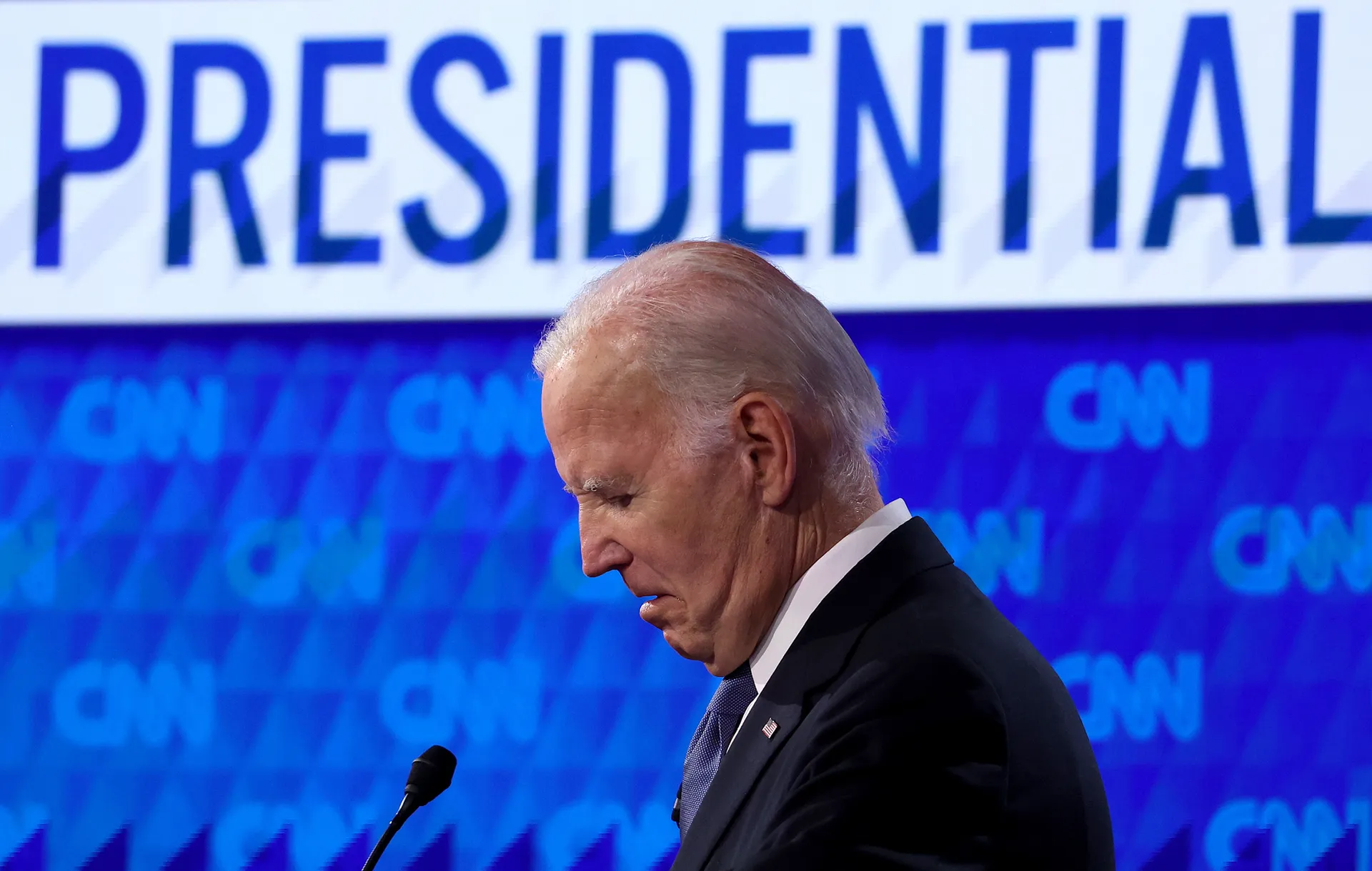
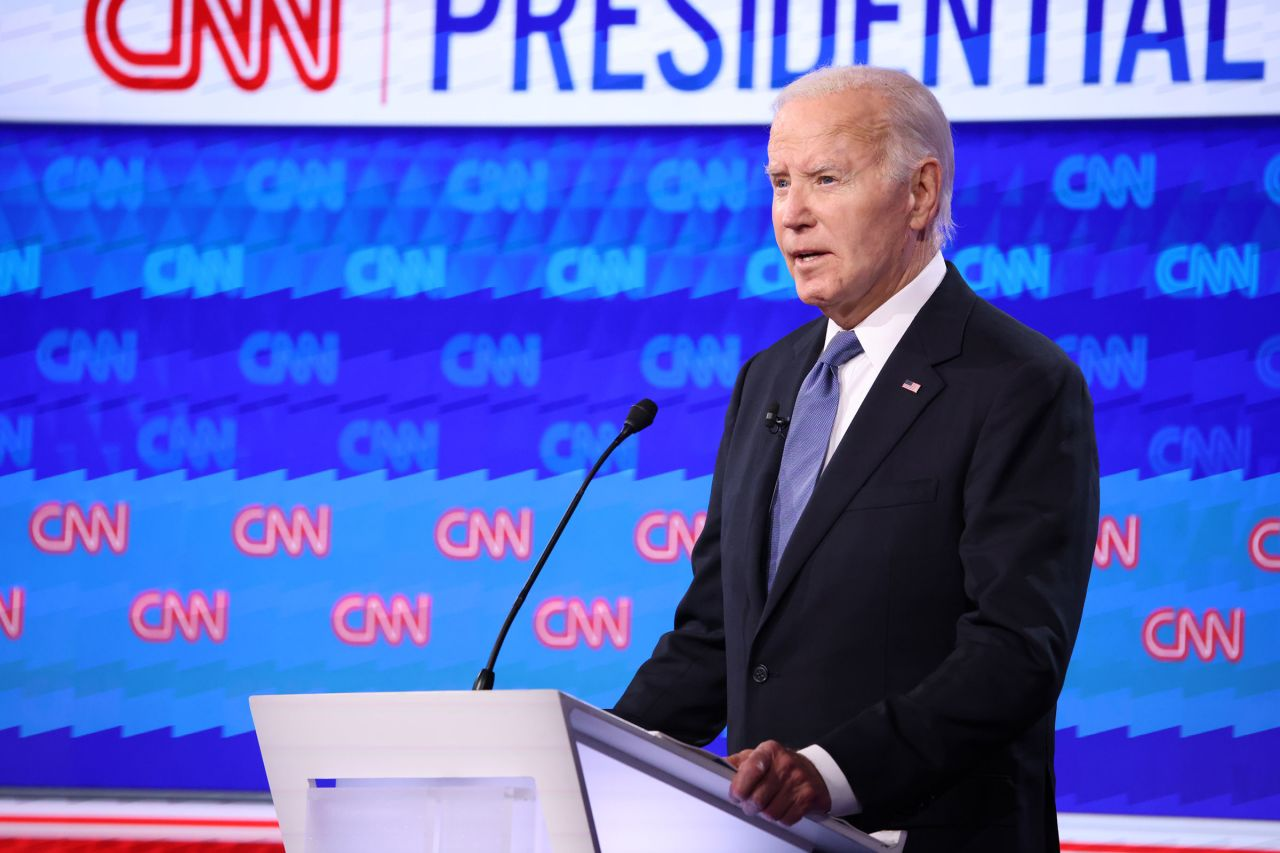
Democrats are despairing over President Joe Biden’s debate performance Thursday night, a showing so halting some even privately raised questions about whether he should remain the party’s nominee.
Biden appeared onstage with a soft, halting voice and an open-mouthed, staring look. He struggled to finish thoughts at points, and ceded ground on issues like abortion where Democrats have an edge.
It took just minutes for Democrats to realize how bad it was becoming.
“Biden looks and sounds terrible. He’s incoherent,” one Democrat who spent time working in the Biden administration said.
“Horrific,” said another Democratic operative.
And one Democrat who’s worked on campaigns up and down the ballot said simply: “We are f***ed.”
The looming question as the debate came to a close was almost existential: Should someone else top the Democratic ticket?
“It’s hard to argue that Biden should be our nominee,” said an operative who’s worked on campaigns at all levels for over a decade.
This debate was historic for many reasons, but not least because it is taking place before each man is formally nominated at their respective conventions. The Democratic National Convention is set to convene August 19 in Chicago.
Democrats have spent much of the past year handwringing about Biden’s chances of beating Trump in an election many view as an existential one that will decide the very survival of American democracy. But Biden himself was determined to be the one to take on Trump, at one point even saying directly: “If Trump wasn’t running, I’m not sure I’d be running.”
No serious Democratic challengers stepped up to run against Biden, and at this point in the campaign he’d have to decide to step aside if Democrats were to pick another nominee. If Biden did withdraw, the Democratic nomination would be decided on the floor.
Democrats were even talking about who it might be instead: “If I was Gavin (Newsom) or Gretchen (Whitmer), I’d be making calls tonight,” one said.
It’s time for President Joe Biden to move to Leisure World.
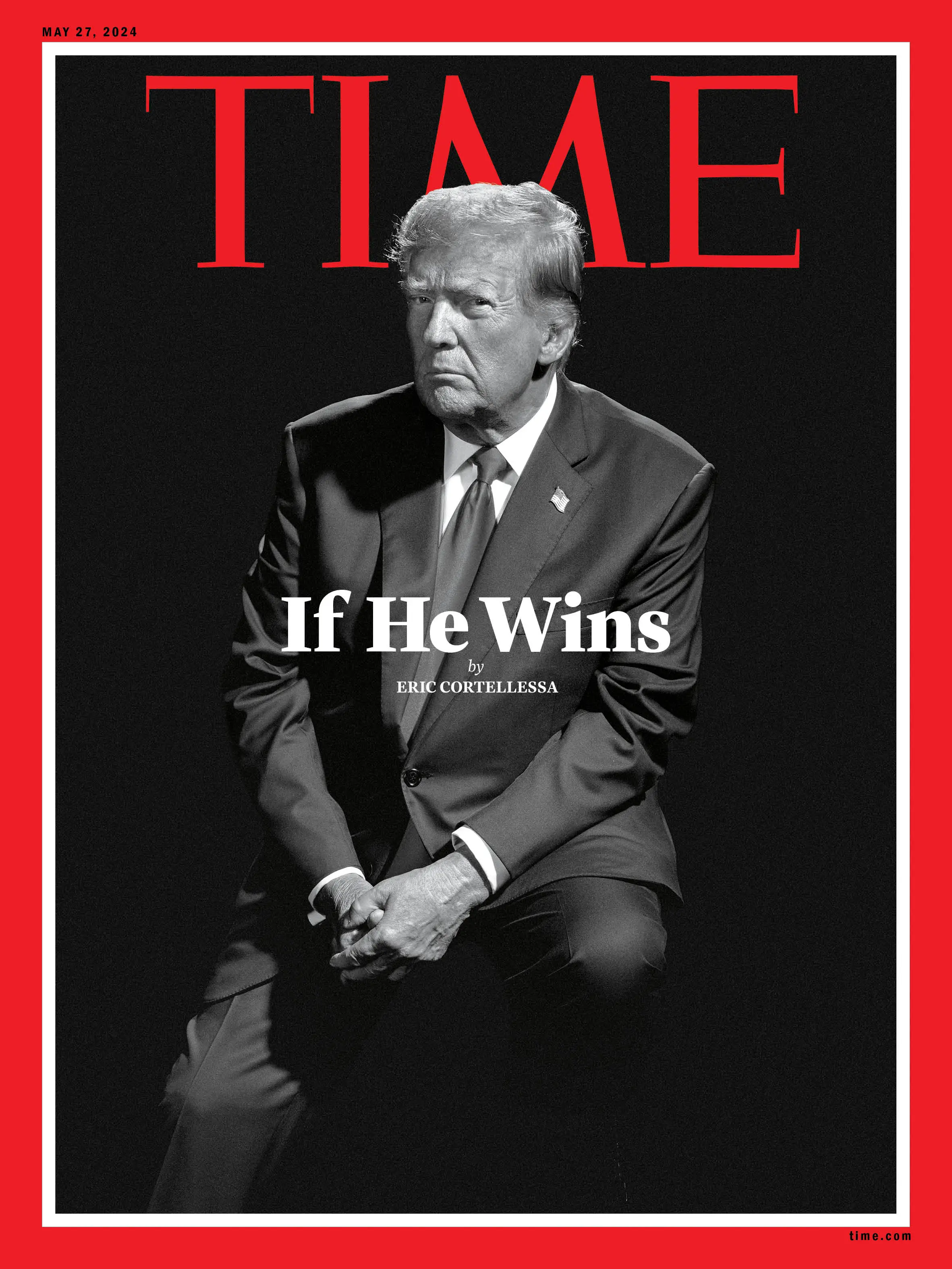
This article appears in the May 27, 2024 Time magazine
In exclusive interviews, the former President lays out a second-term agenda that would reshape America and its role in the world.
Donald Trump thinks he’s identified a crucial mistake of his first term: He was too nice.
We’ve been talking for more than an hour on April 12 at his fever-dream palace in Palm Beach. Aides lurk around the perimeter of a gilded dining room overlooking the manicured lawn. When one nudges me to wrap up the interview, I bring up the many former Cabinet officials who refuse to endorse Trump this time. Some have publicly warned that he poses a danger to the Republic. Why should voters trust you, I ask, when some of the people who observed you most closely do not?
As always, Trump punches back, denigrating his former top advisers. But beneath the typical torrent of invective, there is a larger lesson he has taken away. “I let them quit because I have a heart. I don’t want to embarrass anybody,” Trump says. “I don’t think I’ll do that again. From now on, I’ll fire.”
Six months from the 2024 presidential election, Trump is better positioned to win the White House than at any point in either of his previous campaigns. He leads Joe Biden by slim margins in most polls, including in several of the seven swing states likely to determine the outcome. But I had not come to ask about the election, the disgrace that followed the last one, or how he has become the first former—and perhaps future—American President to face a criminal trial. I wanted to know what Trump would do if he wins a second term, to hear his vision for the nation, in his own words.
What emerged in two interviews with Trump, and conversations with more than a dozen of his closest advisers and confidants, were the outlines of an imperial presidency that would reshape America and its role in the world. To carry out a deportation operation designed to remove more than 11 million people from the country, Trump told me, he would be willing to build migrant detention camps and deploy the U.S. military, both at the border and inland. He would let red states monitor women’s pregnancies and prosecute those who violate abortion bans. He would, at his personal discretion, withhold funds appropriated by Congress, according to top advisers. He would be willing to fire a U.S. Attorney who doesn’t carry out his order to prosecute someone, breaking with a tradition of independent law enforcement that dates from America’s founding. He is weighing pardons for every one of his supporters accused of attacking the U.S. Capitol on Jan. 6, 2021, more than 800 of whom have pleaded guilty or been convicted by a jury. He might not come to the aid of an attacked ally in Europe or Asia if he felt that country wasn’t paying enough for its own defense. He would gut the U.S. civil service, deploy the National Guard to American cities as he sees fit, close the White House pandemic-preparedness office, and staff his Administration with acolytes who back his false assertion that the 2020 election was stolen.
Trump remains the same guy, with the same goals and grievances. But in person, if anything, he appears more assertive and confident. “When I first got to Washington, I knew very few people,” he says. “I had to rely on people.” Now he is in charge. The arranged marriage with the timorous Republican Party stalwarts is over; the old guard is vanquished, and the people who remain are his people. Trump would enter a second term backed by a slew of policy shops staffed by loyalists who have drawn up detailed plans in service of his agenda, which would concentrate the powers of the state in the hands of a man whose appetite for power appears all but insatiable. “I don’t think it’s a big mystery what his agenda would be,” says his close adviser Kellyanne Conway. “But I think people will be surprised at the alacrity with which he will take action.”
The courts, the Constitution, and a Congress of unknown composition would all have a say in whether Trump’s objectives come to pass. The machinery of Washington has a range of defenses: leaks to a free press, whistle-blower protections, the oversight of inspectors general. The same deficiencies of temperament and judgment that hindered him in the past remain present. If he wins, Trump would be a lame duck—contrary to the suggestions of some supporters, he tells TIME he would not seek to overturn or ignore the Constitution’s prohibition on a third term. Public opinion would also be a powerful check. Amid a popular outcry, Trump was forced to scale back some of his most draconian first-term initiatives, including the policy of separating migrant families. As George Orwell wrote in 1945, the ability of governments to carry out their designs “depends on the general temper in the country.”
Every election is billed as a national turning point. This time that rings true. To supporters, the prospect of Trump 2.0, unconstrained and backed by a disciplined movement of true believers, offers revolutionary promise. To much of the rest of the nation and the world, it represents an alarming risk. A second Trump term could bring “the end of our democracy,” says presidential historian Douglas Brinkley, “and the birth of a new kind of authoritarian presidential order.”
Trump steps onto the patio at Mar-a-Lago near dusk. The well-heeled crowd eating Wagyu steaks and grilled branzino pauses to applaud as he takes his seat. On this gorgeous evening, the club is a MAGA mecca. Billionaire donor Steve Wynn is here. So is Speaker of the House Mike Johnson, who is dining with the former President after a joint press conference proposing legislation to prevent noncitizens from voting. Their voting in federal elections is already illegal, and extremely rare, but remains a Trumpian fixation that the embattled Speaker appeared happy to co-sign in exchange for the political cover that standing with Trump provides.
At the moment, though, Trump’s attention is elsewhere. With an index finger, he swipes through an iPad on the table to curate the restaurant’s soundtrack. The playlist veers from Sinead O’Connor to James Brown to The Phantom of the Opera. And there’s a uniquely Trump choice: a rendition of “The Star-Spangled Banner” sung by a choir of defendants imprisoned for attacking the U.S. Capitol on Jan. 6, interspersed with a recording of Trump reciting the Pledge of Allegiance. This has become a staple of his rallies, converting the ultimate symbol of national unity into a weapon of factional devotion.
The spectacle picks up where his first term left off. The events of Jan. 6, during which a pro-Trump mob attacked the center of American democracy in an effort to subvert the peaceful transfer of power, was a profound stain on his legacy. Trump has sought to recast an insurrectionist riot as an act of patriotism. “I call them the J-6 patriots,” he says. When I ask whether he would consider pardoning every one of them, he says, “Yes, absolutely.” As Trump faces dozens of felony charges, including for election interference, conspiracy to defraud the United States, willful retention of national-security secrets, and falsifying business records to conceal hush-money payments, he has tried to turn legal peril into a badge of honor.
In a second term, Trump’s influence on American democracy would extend far beyond pardoning powers. Allies are laying the groundwork to restructure the presidency in line with a doctrine called the unitary executive theory, which holds that many of the constraints imposed on the White House by legislators and the courts should be swept away in favor of a more powerful Commander in Chief.
Nowhere would that power be more momentous than at the Department of Justice. Since the nation’s earliest days, Presidents have generally kept a respectful distance from Senate-confirmed law-enforcement officials to avoid exploiting for personal ends their enormous ability to curtail Americans’ freedoms. But Trump, burned in his first term by multiple investigations directed by his own appointees, is ever more vocal about imposing his will directly on the department and its far-flung investigators and prosecutors.
Nowhere would that power be more momentous than at the Department of Justice. Since the nation’s earliest days, Presidents have generally kept a respectful distance from Senate-confirmed law-enforcement officials to avoid exploiting for personal ends their enormous ability to curtail Americans’ freedoms. But Trump, burned in his first term by multiple investigations directed by his own appointees, is ever more vocal about imposing his will directly on the department and its far-flung investigators and prosecutors.
Such moves would be potentially catastrophic for the credibility of American law enforcement, scholars and former Justice Department leaders from both parties say. “If he ordered an improper prosecution, I would expect any respectable U.S. Attorney to say no,” says Michael McConnell, a former U.S. appellate judge appointed by President George W. Bush. “If the President fired the U.S. Attorney, it would be an enormous firestorm.” McConnell, now a Stanford law professor, says the dismissal could have a cascading effect similar to the Saturday Night Massacre, when President Richard Nixon ordered top DOJ officials to remove the special counsel investigating Watergate. Presidents have the constitutional right to fire U.S. Attorneys, and typically replace their predecessors’ appointees upon taking office. But discharging one specifically for refusing a President’s order would be all but unprecedented.
Trump’s radical designs for presidential power would be felt throughout the country. A main focus is the southern border. Trump says he plans to sign orders to reinstall many of the same policies from his first term, such as the Remain in Mexico program, which requires that non-Mexican asylum seekers be sent south of the border until their court dates, and Title 42, which allows border officials to expel migrants without letting them apply for asylum. Advisers say he plans to cite record border crossings and fentanyl- and child-trafficking as justification for reimposing the emergency measures. He would direct federal funding to resume construction of the border wall, likely by allocating money from the military budget without congressional approval. The capstone of this program, advisers say, would be a massive deportation operation that would target millions of people. Trump made similar pledges in his first term, but says he plans to be more aggressive in a second. “People need to be deported,” says Tom Homan, a top Trump adviser and former acting head of Immigration and Customs Enforcement. “No one should be off the table.”
For an operation of that scale, Trump says he would rely mostly on the National Guard to round up and remove undocumented migrants throughout the country. “If they weren’t able to, then I’d use [other parts of] the military,” he says. When I ask if that means he would override the Posse Comitatus Act—an 1878 law that prohibits the use of military force on civilians—Trump seems unmoved by the weight of the statute. “Well, these aren’t civilians,” he says. “These are people that aren’t legally in our country.” He would also seek help from local police and says he would deny funding for jurisdictions that decline to adopt his policies. “There’s a possibility that some won’t want to participate,” Trump says, “and they won’t partake in the riches.”
As President, Trump nominated three Supreme Court Justices who voted to overturn Roe v. Wade, and he claims credit for his role in ending a constitutional right to an abortion. At the same time, he has sought to defuse a potent campaign issue for the Democrats by saying he wouldn’t sign a federal ban. In our interview at Mar-a-Lago, he declines to commit to vetoing any additional federal restrictions if they came to his desk. More than 20 states now have full or partial abortion bans, and Trump says those policies should be left to the states to do what they want, including monitoring women’s pregnancies. “I think they might do that,” he says. When I ask whether he would be comfortable with states prosecuting women for having abortions beyond the point the laws permit, he says, “It’s irrelevant whether I’m comfortable or not. It’s totally irrelevant, because the states are going to make those decisions.” President Biden has said he would fight state anti-abortion measures in court and with regulation.
Trump’s allies don’t plan to be passive on abortion if he returns to power. The Heritage Foundation has called for enforcement of a 19th century statute that would outlaw the mailing of abortion pills. The Republican Study Committee (RSC), which includes more than 80% of the House GOP conference, included in its 2025 budget proposal the Life at Conception Act, which says the right to life extends to “the moment of fertilization.” I ask Trump if he would veto that bill if it came to his desk. “I don’t have to do anything about vetoes,” Trump says, “because we now have it back in the states.”
Presidents typically have a narrow window to pass major legislation. Trump’s team is eyeing two bills to kick off a second term: a border-security and immigration package, and an extension of his 2017 tax cuts. Many of the latter’s provisions expire early in 2025: the tax cuts on individual income brackets, 100% business expensing, the doubling of the estate-tax deduction. Trump is planning to intensify his protectionist agenda, telling me he’s considering a tariff of more than 10% on all imports, and perhaps even a 100% tariff on some Chinese goods. Trump says the tariffs will liberate the U.S. economy from being at the mercy of foreign manufacturing and spur an industrial renaissance in the U.S. When I point out that independent analysts estimate Trump’s first term tariffs on thousands of products, including steel and aluminum, solar panels, and washing machines, may have cost the U.S. $316 billion and more than 300,000 jobs, by one account, he dismisses these experts out of hand. His advisers argue that the average yearly inflation rate in his first term—under 2%—is evidence that his tariffs won’t raise prices.
Since leaving office, Trump has tried to engineer a caucus of the compliant, clearing primary fields in Senate and House races. His hope is that GOP majorities replete with MAGA diehards could rubber-stamp his legislative agenda and nominees. Representative Jim Banks of Indiana, a former RSC chairman and the GOP nominee for the state’s open Senate seat, recalls an August 2022 RSC planning meeting with Trump at his residence in Bedminster, N.J. As the group arrived, Banks recalls, news broke that Mar-a-Lago had been raided by the FBI. Banks was sure the meeting would be canceled. Moments later, Trump walked through the doors, defiant and pledging to run again. “I need allies there when I’m elected,” Banks recalls Trump saying. The difference in a second Trump term, Banks says now, “is he’s going to have the backup in Congress that he didn’t have before.”
From former Vice President Pence to Bill Barr, former Attorney General these are quotations worth readings.
“Anyone who puts himself over the Constitution should never be president of the United States . . . President Trump demanded that I Choose between him and the Constitution.”
Mike Pence, Vice President
.
“He putshimself beforecountry. Hisactions areall about himand not aboutthe country.”
Mark Esper, Secretary of Defense
.
“THE DEPTHS OFHIS DISHONESTY ISJUST ASTOUNDING. TO ME … HE ISHE MOST FLAWEDPERSON I HAVE EVERMET IN MY LIFE.”
John Kelly, Secretary ofHomeland and WhiteHouse Chief of Staff
.
“His understandingOf global events, hisunderstanding of globalhistory, his understandingof U.S. history wasreally limited.”
Rex Tillerson, Secretary of State
.
“He will alwaysput his owninterests, andgratifying his own ego,ahead of everything else, including the country’s interests.”
Bill Barr, Attorney General
.
“President Trump and other officialshave repeatedly compromisedour principles in pursuit of partisanadvantage and personal gain.”
H. R. McMaster, National Security Adviser
.
“Trump has this impressionthat foreign leaders, especiallyadversaries, hold him in highregard, that he got a goodrelationship with Xi Jinping,Vladimir Putin, Kim Jong Un.In fact, the exact opposite istrue. I have been in those roomswith him when he’s met withthose leaders. I believe theythink he is a laughing fool.”
John Bolton, National Security Adviser
.
“THE PRESIDENTHAS VERY LITTLEUNDERSTANDINGOF WHAT IT MEANSTO BE IN THEMILITARY, TOFIGHT ETHICALLYOR TO BE GOVERNEDBY A UNIFORMSET OF RULES ANDPRACTICES.”
 Coast Contact