“Fast Track” is the Fast Elimination of American Jobs

The Los Angeles Times argues that the ‘fast track’ bill on trade makes sense in a June 10, 2015 editorial. Pointing out that “The nation’s five metropolitan areas with the largest agricultural exports are all in California.” That is clearly a reason to support more free trade agreements that will help farmers sell their crops.   However the consequence of selling those crops overseas is higher food costs for Americans.

The United States is a consumer driven economy. That is an established fact. This country has a history of making everything from cars to bed sheets. I just walked through a Macy’s department store and looked at three men’s shirts made by well known manufacturers. All three were made in other countries: Indonesia, Bangladesh, and Chile. Recently purchased towels were made in India, carving knives made in Switzerland, and a desk chair made in China. We all know that consumer tech products are made in Asia. Where does that leave the blue collar, former middle class, Americans? Unemployed! The last thing the United States needs is another free trade agreement.

Update June 13, 2015 – from my congressman:

Brad Sherman

Dear Friend,

I voted NO on the Fast Track Trade Bill this afternoon. The House stood up for American workers and voted down the package that gives the President “Fast Track” authority that would force into place job killing legislation such as the Trans-Pacific-Partnership.

Washington’s trade policy in the past few decades has failed the American middle. For far too long, we have seen the U.S. export jobs rather than products. We can no longer afford to continue on this path. We must abandon these failed, so-called “free trade” policies of the past and take a new direction that creates more jobs here at home in America. We need balanced trade. That is why I have opposed NAFTA, CAFTA, MFN for China, and a host of bad trade deals we have adopted over the last 20 years.

Thank you very much for contacting me and sharing your views, I hope to hear from you further in the future.

Sincerely,

$1.6t

How much did the United States spend on the wars, counter terrorism operations, reconstruction, diplomacy, and medical care for wounded veterans since September 11, 2001? $1.6 trillion according to a congressional authorized office. Most of that money includes $686 billion on Operation enduring Freedom (Afghanistan) and another $815 billion on Operation Iraqi Freedom (Iraq).

What do we have to show for our efforts? Iraq is in a state of collapse and Afghanistan is teetering towards collapse. ISIS (or ISIL) is on the rise having taken control of eastern Syria and Northwestern Iraq. al-Qaeda is on the rise in Yemen and Libya.

If there is a strategy to defeat al-Qaeda and ISIS it has not been revealed to the press and so the citizens of the United States have no knowledge.

The United States had provided a significant amount of military hardware to Egypt, Jordan, Saudi Arabia, and other Gulf nations but they seem to prefer keeping it all parked in their garages. Perhaps the killing of a Jordanian pilot will motivate countries in that region to step up to the plate and actively participate, but given their historical behavior this seems like an unlikely occurrence.

The Arab nations will hope that the United States will send in more troops and equipment to stop their enemies. Given America’s exhaustion over wars that did not result in defeat of Jihadi terrorist groups it is unlikely that there will be another wave of American ground troops.

The only event that is likely to cause a major re-engagement of America in the Middle East is a direct attack on the United States.

A Super Power Proves Its Strength

U.S. Secretary of State John Kerry Makes a Fool of Himself and the United States

This video has an indistinct sound track

The White House imposed asset freezes on seven Russian officials, including Putin’s close ally Valentina Matvienko, who is speaker of the upper house of parliament, and Vladislav Surkov, one of Putin’s top ideological aides. The Treasury Department also targeted Yanukovych, Crimean leader Sergei Aksyonov and two other top figures.

The EU’s foreign ministers slapped travel bans and asset freezes against 21 officials from Russia and Ukraine.

Somehow I don’t think that’s much of a problem. Not from the least threatening Secretary of State in American history. Hillary Clinton was more threatening in her sleep than John Kerry is after four cups of coffee and three Belgian snubs.

But still John “Unbelievably small strike” Kerry took the time out to reassure Vlad that America was not threatening him.

John Kerry, “We hope President Putin will recognize that none of what we’re saying is meant as a threat. It’s not meant as a – in a personal way. It is meant as a matter of respect for the international multilateral structure that we have lived by since World War II and for the standards of behavior about annexation, about secession, about independence and how countries come about it.”

“So we very much hope that President Putin will hear that we are not trying to challenge Russia’s rights or interests, it’s interest in protecting its people, its interests in its strategic position, its port agreement. None of those things are being threatened here. They can all be respected even as the integrity of Ukraine is respected, and we would hope that President Putin would see that there is a better way to address those concerns that he has that are legitimate, and we hope he will make that decision.”

Those are the words of the Secretary of State (Secretary of Foreign Affairs) of the one claimed super power in the world.  The United States apologizes to Russia for taking a minimal action.  It’s an action so small that no one will notice that it happened.

Is it any wonder that the world holds contempt for the United States?

The Richest 1% Own Nearly Half of all Global Wealth

By David Lazarus, Los Angeles Times, October 11, 2013

David Lazarus, Los Angeles Times

The richest 1% own nearly half of all global wealth.

Let’s get our heads around that. Only a tiny fraction of the roughly 7 billion people in the world accounts for 46% of the estimated $241 trillion in money, prop­erty and other material resources available.

The richest 10%, mean­while, can claim 86% of global wealth, leaving 90% of the world’s population to divvy up whatever’s left.

These extraordinary figures were included in a report this week from Credit Suisse Research Institute. It found that the gravy train is chugging along, but with relatively few passengers.

Former Labor Secretary Robert Reich has been sounding the alarm over wealth inequality for years. He’s at the center of a recent documentary, “Inequality for All,” which explains the problem in frightening detail.

“When so much of the purchasing power, so much of the economic gain, goes to the very top,” Reich told me, “there’s simply not enough purchasing power in the rest of the economy.”

That has profound impli­cations. In the United States, consumer spending accounts for about 70% of all economic activity. If most consumers are getting by with less, the inevitable outcome is that they’ll have fewer dollars to pump into the economy.

Reich noted that wealth inequality was greatest in this country in 1928 and 2007. In both years, the top 1% represented about a quarter of total income.

And shortly thereafter, in 1929 and again in 2008, the U.S. economy tanked, drag­ging down the rest of the world with it.

Other nations, Reich said, have taken steps to address wealth inequality. They’ve invested more in infrastructure and educa­tion in an effort to create more economic opportuni­ties throughout the social spectrum.

The United States, for its part, has been content to let the problem grow.

“We are far more unequal than any other advanced society in the world, and we are surging toward greater and greater inequality,” Reich said.

The Credit Suisse report bears that out. Average adult wealth in Switzerland is $513,000, the world’s high­est, followed by Australia ($403,000), Norway ($380,000) and Luxembourg ($315,000).
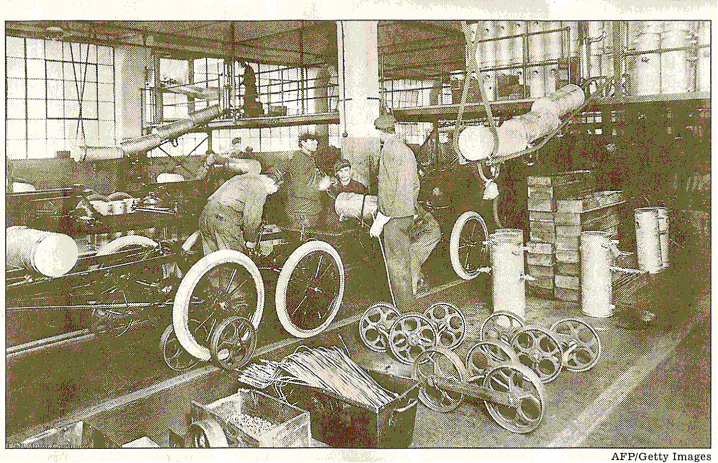
Ford Factory - 1913

IN 1914, HENRY FORD more than doubled factory workers’ minimum pay so they could afford to buy Ford cars. Above is the Highland   Park plant in 1913.

——————————————————————————————————

Average adult wealth in the United States is $301,000, but that number is heavily skewed by the fact that this country has, by far, the greatest number of “ultra-high net worth” indi­viduals, with personal as­sets exceeding $50 million.

According to the report, the United States accounts for 46% of all such super­wealthy people worldwide. Coming in a distant second is China, which boasts 6% of the world’s super rich.

Being successful, obvi­ously’ isn’t a bad thing. There’s much to be said for the whole land-of-opportu­nity idea, in which people are rewarded for a job well done.

But that’s not what’s actually happening. The rich are gaming the system so they can accumulate a greater share of wealth to the detriment of others.

They do this by using their financial (and hence political) clout to reduce their share of taxes, thus placing a greater burden on the rest of society to fund government programs and the public sector’s investment in economic growth.

The top marginal tax rate for much of the 1920s was 25%. It was 35% in 2007. At both times, wealth in­equality was at record levels.

Compare that with the 1950s when, under then­ President Dwight Eisen­hower, a Republican, the top marginal tax rate was 91%. Were the upper classes barely scraping by with such an onerous tax load?

Hardly. This period was one of the most prosperous in American history. Not coincidentally, wealth in­equality was at a low as almost everyone shared in the economy’s and the country’s good fortune.

In contemporary terms, job creators were paying much higher taxes than working stiffs, and – guess what? – there were still plenty of jobs being created.

“I’m sure the rich in the 1950s would have preferred a 10% tax rate,” said Gregory Clark, an economist at UC Davis. “But there’s no em­pirical evidence that taxing the rich slows down eco­nomic growth.”

Just the opposite. Since consumer spending is re­quired for growth, placing more money in the hands of consumers would seem crucial to fueling economic expansion, which, it goes without saying, has the ancillary benefit of helping the rich get richer.

Henry Ford recognized this. In 1914, he more than doubled factory workers’ minimum pay to $5 a day ($1l7 in today’s dollars). In part, this was to halt costly employee turnover. But it was also to provide workers with enough cash to buy the cars they were making.

“It is our belief that social justice begins at home,” said James Couzens, Ford’s treasurer at the time. “We want those who have helped us to produce this great institution and are helping to maintain it to share our prosperity.

“We want them to have present profits and future prospects,” he said. “Believ­ing as we do that a division of our earnings between capital and labor is unequal, we have sought a plan of relief suitable for our busi­ness.”

U. S. chief executives made an average of$12.3 million last year, or 354 times what the average rank-and-fIle worker pulled down, according to the AFL-CIO. Thirty years ago, the average CEO was paid 42 times what ordinary workers received.

The Credit Suisse report shows that the number of millionaires worldwide has risen by almost 2 million since the middle of last year. There are now about 99,000 individuals worth more than $50 million apiece.

Yet two-thirds of all other adults have assets worth less than $10,000. Put another way, two-thirds of all adults worldwide repre­sent no more than 3% of global wealth.

Credit Suisse forecasts that global wealth will rise almost 40% over the next five years. That’s the good news.

The bad news is that you, and billions of other hard­working people, will see little if any of those gains.