Selena Gomez marries Benny Blanco: ‘My wife in real life’
SANTA BARBARA, Calif. (AP) — Selena Gomez has married music producer and songwriter Benny Blanco, announcing the news in an Instagram post showing the couple kissing and embracing on a lawn.
“My wife in real life,” Blanco responded to the post Saturday by the Grammy- and Emmy-nominated performer. Gomez wore a white halter bridal dress with floral flourishes, and Blanco wore a tuxedo and bow tie, both custom-made by Ralph Lauren.
Paparazzi had snapped photos of a massive outdoor tent and other preparations in the Santa Barbara area.
Friends in the entertainment industry and brands she’s linked to responded with heart emoji and congratulations. “Our Mabel is MARRIED,” said the account of her “Only Murders in the Building” series, and her Rare Beauty line of cosmetics posted: “so happy for you two.” Best wishes were also sent by Camila Cabello, Amy Schumer and others.
Blanco, 37, and Gomez, 33, met about a decade ago and got engaged at the end of last year. They worked together on the 2019 song “I Can’t Get Enough,” which also featured J Balvin and Tainy.
Among the songs he’s credited on as a writer and producer: Katy Perry’s “Teenage Dream,” “Circus” by Britney Spears and Maroon 5’s “Moves Like Jagger.”
Gomez, whose hits include “Calm Down,” “Good for You,” ’’Same Old Love” and “Come & Get It,” has been in the spotlight since she was a child. She appeared on “Barney and Friends” before breaking through as a teen star on the Disney Channel’s “Wizards of Waverly Place.”
She earned awards nominations in recent years for her ongoing role alongside Martin Short and Steve Martin in Hulu’s “Only Murders in the Building.” Gomez has a massive audience on social media with 417 million Instagram followers, the most for any woman on the platform.
The question is why are there so many Jews in Ukraine, today’s southern Russia, Poland, and Germany?
The Thirteenth Tribe is a 1976 book by Arthur Koestler[1] advocating the Khazar hypothesis of Ashkenazi ancestry, the thesis that Ashkenazi Jews are not descended from the historical Israelites of antiquity, but from Khazars, a Turkic people. Koestler hypothesized that the Khazars (who converted to Judaism in the 8th century) migrated westwards into Eastern Europe in the 12th and 13th centuries when the Khazar Empire was collapsing.
Popular reviews of the book were mixed, academic critiques of its research were generally negative, and Koestler biographers David Cesarani and Michael Scammell panned it. In 2018, the New York Times described the book as “widely discredited.”[2] Neither was it effective in disproving antisemitism, as antisemites merely adapted it — like prior work on the hypothesis — to argue the illegitimacy of present-day Jews.
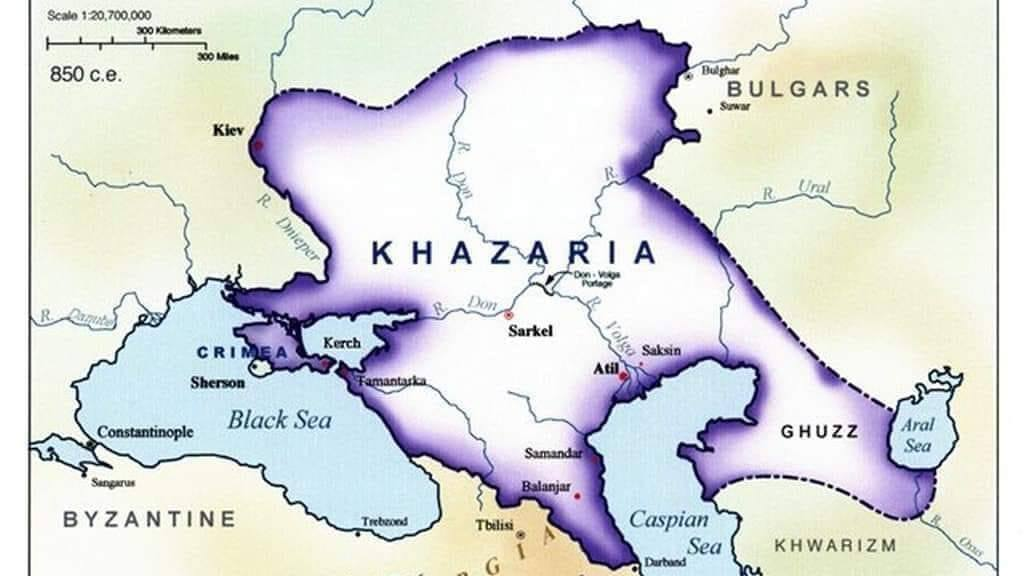
The Khazar Khaganate was a powerful and influential Turkic state that existed between the 7th and 10th centuries. Located primarily in the northern Caucasus and western steppes of modern-day southern Russia, the Khazar Khaganate controlled vast territories, including parts of the Volga River, the Crimea, and the Caspian Sea region.
Key Points about the Khazar Khaganate: 1. Origins: The Khazars were a semi-nomadic Turkic people who emerged as a political force following the collapse of the Western Turkic Khaganate in the mid-600s. They eventually established their own state, with a ruling class known as the Khaganate. 2. Religion: One of the most unique aspects of the Khazar Khaganate was the ruling elite’s conversion to Judaism sometime in the 8th or 9th century. The exact reasons for this conversion remain debated, but it set the Khazars apart from their Christian and Muslim neighbors, such as the Byzantine Empire and the Caliphates. 3. Trade and Economy: The Khazars were known for their significant role in the Silk Road trade network, controlling key trade routes between Europe, the Middle East, and Central Asia. Their capital, Atil, on the Volga River, was a major commercial hub. 4. Diplomatic Relations: The Khazar Khaganate maintained a strategic diplomatic balance between the Byzantine Empire and the Muslim Caliphates, often serving as a buffer state between the two. They also had interactions with the emerging Kievan Rus and other Slavic states. 5. Military Power: The Khazars had a strong military and often engaged in warfare with their neighbors. They were known for employing a mix of cavalry and mercenary forces, and their military might helped them maintain control over their vast territory. 6. Decline and Fall: The Khazar Khaganate began to weaken in the 10th century due to internal strife, economic pressure, and attacks from external forces. One key factor in their decline was the rise of the Kievan Rus, which defeated the Khazars in a series of campaigns, culminating in the destruction of Atil around 965 AD. By the early 11th century, the Khazar state had largely disintegrated. 7. Legacy: The Khazars are often remembered for their unique religious identity and their role in medieval trade and diplomacy. Their influence extended over a wide area, and they are considered a key player in the history of the Eurasian steppes. The Khazar Khaganate holds a special place in history for its blend of Turkic nomadic culture, religious diversity, and strategic political positioning.
This is the practice of taking someone else’s work or ideas and passing them off as one’s own.
Copying large pieces of text from a source without citing that source. Taking passages from multiple sources, piecing them together, and turning in the work as your own. Copying from a source but changing a few words and phrases to disguise plagiarism.
As a boy in high school I lacked the knowledge to write anything consequential and copied from books. It was plagiarism and I knew it. The teacher of that class knew it too but at least she knew I had done the research and I was given a passing grade on my report.
As an adult I give credit to the author of what I have copied.
Claudine Gay is stepping down as the president of Harvard University. Her decision was the result of her plagiarism. As Tom Nichols writes in The Atlantic Daily: “Despite the results of an investigation commissioned by the Harvard Corporation last month that found cases only of “inadequate” citation, new charges about her work include episodes of what most scholars would recognize as academic misconduct, including plagiarism. Experts consulted by CNN consider the recent excerpts to be plagiarism.” Why Ms. Gay did not provide citation for other’s work we will never know.
We have all had a lesson in stealing the works of others.

 Coast Contact