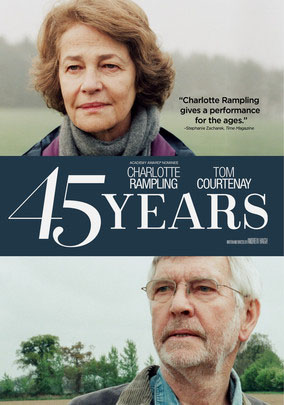
“45 Years” was Oscar Nominated in 2016

We, my wife and I, usually watch a recent movie once a week unless we are out on a Saturday night. We read the Netflix DVD jacket and no other information before the movie.

Charlotte Rampling was nominated for best actress in 2016 for the role of Kate Mercer. All nominated movies are part of my list of must see movies.

The description reads: “Geoff and Kate Mercer’s plans for a 45th anniversary party are upset by some unexpected news: A body found in the Swiss Alps has been identified as Geoff’s long-ago love Katya, who perished in an accident 50 years earlier.”

We are guessing this will be a mystery. Instead it is a well-acted but slow moving story about a happily married couple about to celebrate their 45th anniversary who are troubled over the death of Geoff’s long forgotten love.

I won’t reveal the story line or the ending. I will say that like many English movies the best and most intriguing part of the movie is the last 15 minutes.

It did remind me of my old girl friend who said No to my proposal.  I had not met my wife then.  We are married 48 years.

On a five star scale the movie is about a 2½. If the movie is to be graded on acting alone it is 4.

Natural Born Citizen

Those of you who worry about Democrats versus Republicans — relax. Here is our real
problem:

Indiana University:

In an Indiana University classroom, they were discussing the qualifications to be President of the United States. It was pretty simple. “The candidate must be a natural born citizen of at least 35 years of age.”

However, one girl in the class immediately started in on how unfair it was of the requirement to be a natural born citizen.

In short, her opinion was that this requirement prevented many capable individuals from becoming president. The class was taking it in and letting her rant, and not many jaws hit the floor when she wrapped up her argument by stating, “What makes a natural born citizen any more qualified to lead this country than one born by C-section?”

Yep, these are the same 18-22 year-olds that are now voting in our elections!

They breed, and they walk among us. Lord, we may need more help than we realized!!

Crown Prince Frederick Hoepnick Laugh Montage Meets Donald Trump

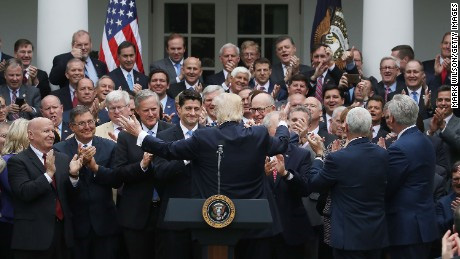
Watching Donald Trump coaxing his followers to cheer his success in passing the AHCA (American Health Care Act) was in my mind really funny. That’s what they do when a television show has a live audience. An applause sign flashes to motivate that audience. Likewise there is a sign that tells audience members to laugh.

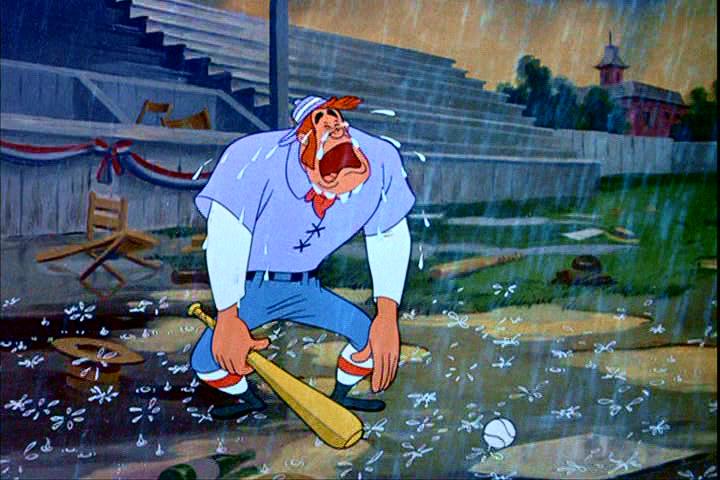
The entire spectacle reminded me of the movie “The Great Race.” Jack Lemon plays two parts in that movie. One as Crown Prince Frederick Hoepnick of the tiny kingdom of Pottsdorf.  In the first part of this movie clip the crown prince wants his court to applaud at his every move.  Donald Trump reminded me of that crown prince.

It’s called entertainment.

  That’s all folks!  


First Air Conditioning in a Car

The Goldberg Brothers – The Inventors of the Automobile Air Conditioner.

Here’s a little fact for automotive buffs, or just to dazzle your friends.

The four Goldberg brothers, Lowell, Norman, Hiram, and Maxwell, invented and developed the first automobile air-conditioner. On July 17, 1946 , the temperature in Detroit was 97 F degrees.

The four brothers walked into old man Henry Ford’s office and sweet-talked his secretary into telling him that four gentlemen were there with the most exciting innovation in the auto industry since the electric starter.

Henry was curious and invited them into his office.

They refused and instead asked that he come out to the parking lot to their car.

They persuaded him to get into the car, which was about 130 F degrees inside, turned on the air conditioner, and cooled the car off almost immediately.

The old man got very excited and invited them back to the office, where he offered them $3 million for the patent.

The brothers refused, saying they would settle for $2 million, but they wanted the recognition by having a label, ‘The Goldberg Air-Conditioner,’ on the dashboard of each car in which it was installed.

There was no way that Oldman Ford was going to put the Goldberg’s name on two million Fords.

They haggled back and forth for about two hours and finally agreed on $4 million and that just their first names would be shown.

And so to this day, all Ford air conditioners show —

Lo, Norm, Hi, and Max — on the controls.

Remember Slow Food?

Someone asked the other day, ‘What was your favorite fast food when you were growing up?’
‘We didn’t have fast food when I was growing up,’

I informed him.

‘All the food was slow.’

‘C’mon, seriously. Where did you eat?’

“It was a place called ‘at
Home,” I explained. !

‘Mom cooked every day and when Dad got home from work, we sat down together at the dining room table, and if I didn’t like what she put on my plate I was allowed to sit there until I did like it.’

By this time, the kid was laughing so hard I was afraid he was going to suffer serious internal damage, so I didn’t tell him the part about how I had to have permission to leave the table.

But here are some other things I would have told him about my childhood if I figured his system could have handled it :

Some parents NEVER owned their own house, never wore Levi’s, never set foot on a golf course, never traveled out of the country or had a credit card.

In their later years they had something called a revolving charge card. The card was good only at Sears Roebuck. Or maybe it was Sears & Roebuck.
Either way, there is no Roebuck anymore. Maybe he died.

My parents never drove me to soccer practice. This was mostly because we never had heard of soccer.

I had a bicycle that weighed probably 50 pounds, and only had one speed, (slow)
We didn’t have a television in our house until I was 11.

It was, of course, black and white, and the station went off the air at midnight, after playing the national anthem and a poem about God; it came back on the air at about 6 a.m. And there was usually a locally produced news and farm show on, featuring local people.

I was 19 before I tasted my first pizza, it was called ‘pizza pie.’ When I bit into it, I burned the roof of my mouth and the cheese slid off, swung down, plastered itself against my chin and burned that, too. It’s still the best pizza I ever had.

I never had a telephone in my room. The only phone in the house was in the living room and it was on a party line. Before you could dial, you had to listen and make sure some people you didn’t know weren’t already using the line.

Pizzas were not delivered to our home. But milk was.

All newspapers were delivered by boys and all boys delivered newspapers–my brother delivered a newspaper, six days a week. It cost 7 cents a paper, of which he got to keep 2 cents. He had to get up at 6 AM every morning.

On Saturday, he had to collect the 42 cents from his customers. His favorite customers were the ones who gave him 50 cents and told him to keep the change. His least favorite customers were the ones who seemed to never be home on collection day.

Movie stars kissed with their mouths shut. At least, they did in the movies. There were no movie ratings because all movies were responsibly produced for everyone to enjoy viewing, without profanity or violence or most anything offensive.

If you grew up in a generation before there was fast food, you may want to share some of these memories with your children or grandchildren

Just don’t blame me if they bust a gut laughing.

Growing up isn’t what it used to be, is it?

Donnie in the Room

This entertaining piece from The Weekly Sift.  You will laugh. Read it to the end!

(with apologies to Ernest Lawrence Thayer)
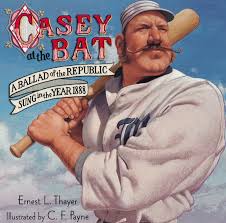
The outlook wasn’t brilliant for Republicans that day.
They’d promised for six years that they’d repeal the ACA.
But when the caucus gathered, and they looked from man to man
They knew that not a one of them had ever had a plan.

“I’d counted on a veto,” said a rep from Tennessee.
“The blame Obama always took would fall on Hillary.
Then Pennsylvania went for Trump, and Michigan the same.
And now we run the government, we can’t just play a game.”

A colleague from Wyoming was equally concerned.
Shaking his head sadly, he stated what he’d learned.
“My hopes from the beginning always had one little flaw.
I’d pictured making speeches, never thought I’d write a law.”

Neither had the others, though they often said they would.
They knew what programs shouldn’t do, but not the things they should.

Then said a man from Texas, “We’ll never have success.
We got so used to saying No, we’ll never get to Yes.”

“I know,” said Ryan hopefully, “that’s sometimes how it feels.
But Donnie wrote the book about the art of making deals.
I know agreement’s hard to find, and deadlines closely loom.
But we can still succeed if we get Donnie in the room.”

Oh Donnie! Clever Donnie! How everyone agreed.
The plan that he campaigned on was just the one they’d need.
It ended it all the mandates! It set the markets free!
And still it covered everyone, from sea to shining sea!

“It offers better treatment,” noted one committee chair.
“And cheaper,” said another, “I know cause I was there.
You should have heard the cheering. I thought the roof would fall.
And Mexico will pay for it! No, wait, that was the wall.”

But just how would he do it? That wasn’t in their notes.
It wasn’t in the speeches that he made while seeking votes.
It wasn’t on his website, and they recognized with gloom.
They’d never reproduce it without Donnie in the room.

So Ryan checked the White House, but Donnie was away.
He wasn’t in Trump Tower, and he hadn’t been all day.
Ivanka took his message, “Call me when you can.
We can’t repeal ObamaCare without your TrumpCare plan.”

When the President returned his call, he sounded tired and mean,
As he contemplated bogey from the bunker on fifteen.
“Write whatever bill you want. I really couldn’t tell.
Content doesn’t matter, Paul. It’s all in how you sell.”

“But what about the plan you had, the one in the campaign?”
“I only planned to have a plan, that’s no cause to complain.
Grasp this opportunity, and you’ll know what to do.
I sold all the voters, now you get to come through!”

So Ryan then picked up his pen, and wrote a plan so good
It didn’t do a single thing that Donnie said it would.
And as the caucus read it, they all wanted to vote No,
Both from the left, and from the right, and from the CBO.

The Speaker counted noses, and he always came up short.
And for the ones who criticized, he had no good retort.
But Ryan still was smiling as he sorted hateful mail.
For Donnie, clever Donnie, would soon complete the sale.

Trump was back in Washington with all his awesome charm.
He flattered and he compromised and twisted by the arm.
“Those whip counts are fake news,” he said, “we’ve got the votes and more.
Everyone will back me when we take it to the floor.”

Oh, somewhere in a favored land, the people get their way,
And illness leads to treatment, even if you cannot pay.
And somewhere leaders pass the law that makes their promise real.

But there’s mourning in the caucus, Donnie could not close the deal.
1984

1984 is a book written in 1948.

The dystopian novel has experienced another surge in sales that has resulted in the printing an additional 75,000 copies this year.  As of January 25, 2017 according to Nielsen BookScan, which measures most but not all book sales in the United States, “1984” sold 47,000 copies in print since Election Day in November. That is up from 36,000 copies over the same period the prior year. 

Here is a summary of the story:

George Orwell wrote 1984 in 1948. The novel is set in 1984 – Orwell’s near future and our recent past-but the novel is still relevant today, due to its depiction of a totalitarian government and its themes of using media manipulation and advanced technology to control people.

The movies do not do the book too well. I have seen both a read the book.

The book is on Amazon’s Best Seller list this year. You don’t have to wonder why. Consider “alternate facts” and “fake news” in the real world. The similarities between the book and the world of Donald Trump are too frightening.

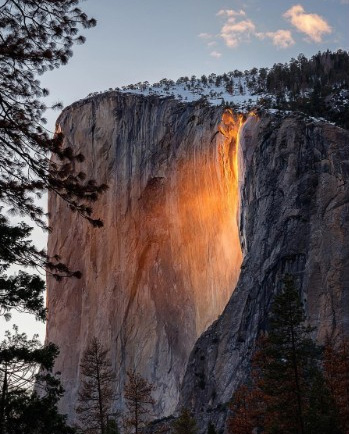
Firefall returns to Yosemite National Park

The last Firefall was on Thursday, January 25, 1968. Since it was winter, no crowd was present.  The cameras I owned in those days could not capture the image.  The Firefall was a daily event that occurred in Yosemite Valley.  Traffic stopped and so did everything else at 9 PM every night.  It took an hour for the traffic to clear.  It was a pollution problem for Yosemite National Park,

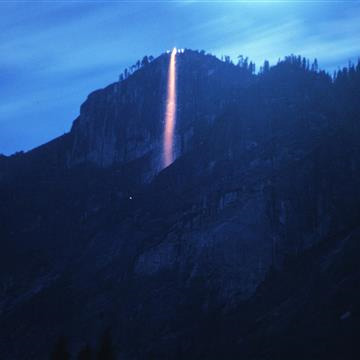
The Yosemite Firefall was a summer time event that began in 1872 and continued for almost a century, in which burning hot embers were spilled from the top of Glacier Point in Yosemite National Park to the valley 3,000 feet below. From a distance it appeared as a glowing waterfall. The owners of the Glacier Point Hotel conducted the firefall. History has it that David Curry, founder of Camp Curry, would stand at the base of the fall, and yell “Let the fire fall,” each night as a signal to start pushing the embers over.

firefall-photo-not-taken-by-me


Now to replicate the past artificial lighting has brought back the effect.  It is a challenge for photo hobbyists.  It is claimed that it is a natural phenomenon.

firefall-illuson-2017