The price to visit Disneyland and California Adventure is going up.
Disneyland and Disney California Adventure price increases are shown in this graphic from between 2000 and 2017.
ANAHEIM >> The price to visit Disneyland and Disney California Adventure – for either a day or with a year’s pass – is going up again.
Effective today, Sunday, it will cost $97 to go to one of the parks on Value days, the lowest-priced days of the year, up $2.
A visit on a Regular day will be $110, while a Peak day will cost $124, both up $5. Tickets are more on days when demand would be higher.
Parking is going to $20 from $18.
The price to visit Disneyland and Disney California Adventure – for either a day or with a year’s pass – is going up again. Effective this Sunday, it will cost $97 to go to one of the parks on Value days, the lowest-priced days of the year, up $2.
Since 2000, a single-day admission price to Disneyland has tripled on Peak days, with ticket prices going up at least once a year since 2002.
“Our pricing provides guests a range of options that allow us to better manage demand to maximize the guest experience and is reflective of the distinctly Disney offerings at all of our parks,” said Suzi Brown, a Disneyland spokeswoman.
Reaction to the announcement was swift on Saturday.
“Four hundred dollars for a family of 3 to get into the gate (on peak days),” said Tony Diamante, 57, of Temecula. “I can afford it, but this is a week’s pay for someone making $15 to $18 an hour, depending of course on taxes.”
James H. Carter II, 40 from Huntington Beach, who runs a podcast called Creepy Kingdom, said tourists will continue to pay.
“As a traveler, it doesn’t matter how much it cost. You booked the hotel, you flew down or drove down, an extra $10 is not really going to deter you,” he said. “It’s unfortunate for the consumer but Disney raising tickets a few dollars is not going to stop people from coming.”
Jay Valles, 31, of Whittier said he was a former annual pass holder but discontinued and stopped visiting the park last year because of price increases and overcrowding.
He said while Disneyland is still a better value compared to other live entertainment options, Disney needs to get rid of the monthly payment options for annual pass holders to really lessen the crowds at the park.
Disney officials said the monthly payment option that makes their annual passes more financially bearable will continue.
“If they really wanted to control demand, they would do away with monthly payments,” Valles said. “Also, a one day, one park ticket is still a good price compared to a concert ticket or a show on Broadway…[But] If the pricing was high and the crowds were moderate I would return to visit.”
Last year, in an effort to spread out the crowds, Disney introduced its three-level pricing. Some observers say the tiered pricing structure has worked, with less people flocking to the park, for example, on the highest-demand two-week period including Christmas and New Year’s Day.
Prices for some annual passes will go up, too.
The Southern California Select and Southern California passes will be $339 and $469, respectively, $10 increases. Both passes have blackout days. The monthly payment option remains.
The Deluxe pass, with some Saturday and peak-holiday-period blackout days, is getting boosted by $20 to $619. The prices for the higher-end passes will remain the same.
In 2015, Disneyland posted an all-time record with 18.2 million visitors, an increase of 1.5 million from the previous year, according to the Themed Entertainment Association, an industry group that tracks theme park attendance.
Meanwhile, neighboring Disney California Adventure also reached record attendance with 9.3 million visitors.
However, according to Walt Disney Co.’s latest fiscal report, overall recent attendance is down 5 percent but revenue is up at Disney’s domestic theme parks. The company does not publicly break that number down for individual parks, though.
But with the Guardians of the Galaxy attraction opening this summer at Disney California Adventure, and a “Star Wars” land at Disneyland expected to land in 2019, demand should continue to be high for the Anaheim theme parks.
BY THE NUMBERS
Here’s what it cost to enter Disneyland between 2000 and now:
• 2000: $41 and $43 (price went up twice)
• 2002: $45
• 2003: $47
• 2004: $49.75
• 2005: $53 and $56 (price went up twice)
• 2006: $59 and $63 (price went up twice)
• 2007: $66
• 2008: $69
• 2009: $72
• 2010: $76
• 2011: $80
• 2012: $87
• 2013: $92
• 2014: $96
• 2015: $99
• 2016: $95, $105, $119 (depending on the day)
• 2017: $97, $110, $124 (depending on the day)
Source: Orange County Register archives; Los Angeles Daily News
This was reported in the Los Angeles Times. $250-$450 for marquee events such as the gymnastics final and basketball gold-medal game. Less popular Olympic events, including preliminaries for rugby and shooting, would average about $34 a ticket. Golf preliminaries would be the cheapest event at an average of $13.12. Diving finals would cost $270 and beach volleyball finals would be $166. The overall average would be about $137 a ticket.
Clearly the Olympic games are for rich people. The rich want the city to underwrite the cost. With a 83% current occupancy rate at local hotels without any Olympics why do we need this? Of course NBC will benefit from the games and that is business. I hope Budapest or Paris wins the competition. We DO NOT need the Olympics in Los Angeles.
Mary Tyler Moore dead at 80. Since I was a fan you know that I too am old. First it was Debbie Reynolds and now Mary. I am just a little younger than both of them but not by much. I loved them both.
By Chris Barton, Contact Reporter for the Los Angeles Times
The news of the death of beloved actress Mary Tyler Moore sparked her fans and the entertainment industry to look back on her distinguished career, which spanned both TV and film.
She first made an unforgettable impression as Laura Petrie, the supportive wife of Rob Petrie, the comedy writer played by Dick Van Dyke in “The Dick Van Dyke Show,” which premiered in 1961 and ran for five seasons. But it was her portrayal of Mary Richards, the single career woman at the center of the iconic workplace comedy “The Mary Tyler Moore Show” that put a defining stamp on TV comedy in the 1970s.
The series was so adored and Moore played Richards with such precise comedic flair and charisma that she and her character almost seemed inseparable, an element that may have affected her subsequent follow-up CBS vehicles, the short-lived variety show “Mary” and “The Mary Tyler Moore Hour,” an awkward hybrid of variety show and sitcom.
Following those shows, she departed her genial TV comedy roots with 1980’s “Ordinary People.” A harrowing look at a wealthy family in tatters after the death of its oldest son, Moore shocked her fans and Hollywood with her revelatory performance as matriarch Beth Jarrett, a wife and mother disconnected from those closest to her. Richards’ icy portrayal was worlds away from her lovable TV personas.
Moore scored an Oscar nomination for best actress for “Ordinary People,” which marked the directorial debut of Robert Redford, and the film won several Oscars, including best picture. In a statement released on Wednesday, Redford recalled Moore’s “courage” in taking on the dark role, calling her performance “enormously powerful.”
Her dramatic triumphs continued that same year when she appeared on Broadway in the right-to-die drama “Whose Life Is It Anyway?” In a gender reversal from the original play, Moore portrayed a sculptor paralyzed after a car crash who argued to end her life. The play, which also starred James Naughton, earned Moore a special honor at that year’s Tony Awards, which she also co-hosted.
Moore returned to television for much of the ‘80s and ‘90s, mostly in a string of generally unheralded TV movies. But she again scored a career highlight with her scene-stealing turn in David O. Russell’s 1996 family comedy “Flirting With Disaster.”
In a movie loaded with absurdist turns by Alan Alda, Lily Tomlin and Josh Brolin, Moore was a standout as the domineering adoptive mother of Ben Stiller’s Mel Coplin, who is attempting to learn his roots. In a role that found Moore memorably flashing her daughter-in-law (Patricia Arquette) to testify as to the importance of a good bra.
The 2000s found Moore appearing in guest roles on a number of comedies, including “The Ellen Show,” “King of the Hill” and “That 70s Show,” where she appeared in a multi-episode arc as a tightly wound TV host. Most recently, she reunited with her “Mary Tyler Moore Show” costar Betty White on the TV Land series “Hot in Cleveland” appearing in the premiere of the show’s second season in 2011 and again in 2013.
This is a very funny and entertaining letter to Donald Trump. It was printed in the Los Angeles Timeson January 19, 2017.
By Ariel Dorfman
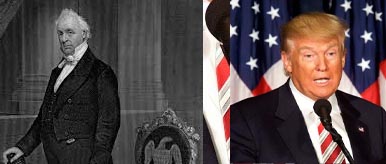
Sir: How long have I waited for your advent, prayed for someone like you to come along? All these years, since my death in 1868, I have watched each election cycle, hoping that finally my savior would appear, a man — heaven forbid it should be a woman! — who would rescue me from my status as the worst president in the annals of the United States.
Limited as your knowledge of our past may be, surely you are aware that I have been blamed for the secession of the Southern states in 1861, just as my term was ending. Unfairly faulted for the Civil War that ensued, I am now relieved to know that the presidency will soon be in the hands of someone who will, I am certain, go down in history as a leader who most bitterly divided the nation and wreaked havoc with the foundations of our democracy.
I am excited, indeed, about your chances of outshining me. If you persist in your campaign to drill, extract and pollute, if you enable the climate deniers and help to overheat our spacious skies, you will have led us, not to the brink of a conflagration that killed a mere million, but to a more substantial achievement of worldwide significance: taking the whole of humanity to the brink of extinction. That is a record that will considerably exceed my own lapses and make me seem a paragon of wisdom to future citizens (at least, those who survive).
As to the peoples’ daily lives, you are likely to far surpass the harm I have wrought there as well. Many families cursed my name as they received news of their maimed or dead kin, but many more will curse yours when their well-being deteriorates as you assault the country’s healthcare system.
Regarding corruption, I am also hopeful you will outstrip me. My offenses (accused of bribery, extortion and abuse of power by a congressional committee) will be deemed petty compared to those that loom for you, guaranteeing an administration rife, at all levels, with sleaze and conflicts of interest. But do not tarry over your manifest financial or ethical dilemmas. I managed to avoid impeachment and so will you, given your proven ability to convince your supporters that facts do not matter. Would that such talents had been bestowed upon me, and oh that television and social media had been invented in my day. I could have blamed Mexico for our Civil War.
Could you address two other matters? The first is abortion. It was during my presidency, in 1859, that the American Medical Assn. urged the criminalization of women who terminated their pregnancies, and you have the chance to revert our laws and customs to that pristine moment when the gentle sex recognized that their bodies belonged to their menfolk. And then Cuba. I tried in vain to buy that island from Spain and then favored invading it. You can complete my dream. Extend the reach of our empire into the Caribbean and beyond, intervene vigorously in the affairs of enemy and allied nations. Pay special attention to China, where I made the mistake of being only marginally involved in the Second Opium War. I am sure you will do better when you engage the Chinese in the First Asian Trade War.
I am not alone in urging you to stubbornly follow your instincts. Other deceased presidents also entertain high expectations for your reign. Richard Nixon wishes that your slurs and insults would make people forget his own foul language, and he eagerly anticipates manifold Trumpgates that will make Watergate seem small potatoes. Warren G. Harding is certain that your outrages will go far beyond the Teapot Dome scandal, which fraudulently favored the oil companies. And Herbert Hoover, reviled for ignoring the oncoming Great Depression, is confident you will be even more obtuse, and when you precipitate a worse economic catastrophe his actions will thus appear less disastrous. He expects you will also best him in union-busting and the massive deportation of immigrants.
Presidents who occupy the top tier of favorite leaders, including several Founding Fathers, have reproached me for appealing to what they call the worst angels of your nature. They are preparing a collective message counseling moderation and praying that you are not further deranged by the power of your high office.
Franklin Roosevelt believes that informing you that he regrets the internment of Americans of Japanese origin will discourage you from a roundup of Muslim Americans. Harry Truman, haunted by the ghosts of Hiroshima, would press you to abolish nuclear weapons instead of starting a devastating arms race. Dwight Eisenhower intends to reiterate his warning against the military-industrial complex — so naïve, our Ike, unable to realize that representatives of those powers are about to be blatantly ensconced in your Cabinet. And Mr. Lincoln, whose party you have terribly transmogrified, trusts that if he were to whisper daily guidance in your ear, the Republic might, once more, be saved.
I have no doubt that you will not heed him or any other meddling altruist.
After all, I send these words of encouragement inspired by your own example. You have taught me that it is better to bolster one’s image in the Presidential Celebrity Sweepstakes than to sacrifice oneself for the good of the country.
And so, farewell, until the moment you join the former presidents on the other side of death, when I will be delighted to steer you to the very bottom of the heap, where I have languished for a century and a half. What a pleasure finally to be able to look down upon someone who has done damage to the United States in ways unimaginable to me in my most desolate dreams.
With my sincere thanks for all your efforts to rescue me from the nethermost abyss and from the title worst of the worst, I am, sir, your humble servant,
James Buchanan
Ariel Dorfman’s latest book is the memoir “Feeding on Dreams.” He and his wife divide their time between Chile and North Carolina, where he is emeritus professor of literature at Duke University.
In ancient Israel , it came to pass that a trader by the name of Abraham Com took unto himself a healthy young wife by the name of Dorothy (Dot for short). Dot Com was a comely woman, large of breast, broad of shoulder and long of leg. Indeed, she was often called Amazon Dot Com.
And she said unto Abraham, her husband, “Why dost thou travel so far from town to town with thy goods when thou canst trade without ever leaving thy tent?”
And Abraham did look at her as though she were several saddle bags short of a camel load, but simply said, “How, dear?”
And Dot replied, “I will place drums in all the towns and drums in between to send messages saying what you have for sale, and they will reply telling you who hath the best price. The sale can be made on the drums and delivery made by Uriah’s Pony Stable (UPS).”
Abraham thought long and decided he would let Dot have her way with the drums. And the drums rang out and were an immediate success. Abraham sold all the goods he had at the top price, without ever having to move from his tent.
To prevent neighboring countries from overhearing what the drums were saying, Dot devised a system that only she and the drummers knew. It was known as Must Send Drum Over Sound (MSDOS), and she also developed a language to transmit ideas and pictures – Hebrew to The People (HTTP).
And the young men did take to Dot Com’s trading as doth the greedy horsefly take to camel dung. They were called Nomadic Ecclesiastical Rich Dominican Sybarites, or NERDS. And lo, the land was so feverish with joy at the new riches and the deafening sound of drums that no one noticed that the real riches were going to that enterprising drum dealer, Brother William of Gates, who bought off every drum maker in the land. Indeed he did insist on drums to be made that would work only with Brother Gates’ drumheads and drumsticks.
And Dot did say, “Oh, Abraham, what we have started is being taken over by others.” And Abraham looked out over the Bay of Ezekiel , or eBay as it came to be known. He said, “We need a name that reflects what we are.”
And Dot replied, “Young Ambitious Hebrew Owner Operators.”
YAHOO,” said Abraham. And because it was Dot’s idea, they named it YAHOO Dot Com.
Abraham’s cousin, Joshua, being the young Gregarious Energetic Educated Kid (GEEK) that he was, soon started using Dot’s drums to locate things around the countryside.
It soon became known as God’s Own Official Guide to Locating Everything (GOOGLE).
That is how it all began. And that’s the truth. I would not make up this stuff.
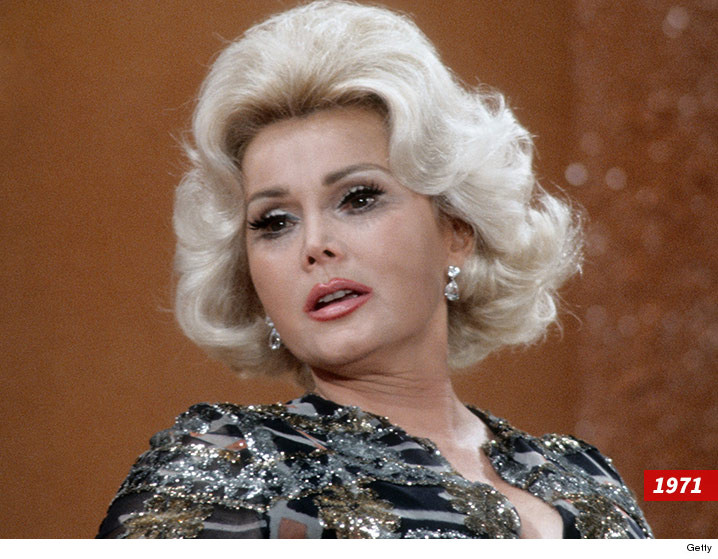
The best known of three glamorous sisters from Hungary, actress Zsa Zsa Gabor pioneered a modern version of celebrity — she was famous for being famous. She started as a beauty contest winner in Hungary. Now dead at age 99.
With the advent of television shows, Gabor became a frequent guest as early as the 1950s, charming audiences with her fractured English and slightly risqué jokes.
Her nine marriages and reputation for shaving years off her age made her a pop-culture punch line. When entertainer Bob Hope joked, “You can calculate Zsa Zsa Gabor’s age by the rings on her fingers,” it only added to her fame.
Among her husbands were Conrad Hilton (famous for the hotel chain), and actor George Sanders. Her ninth husband who she married in 1986 is Prince Fredrick von Anhalt who bought his title.
To Gabor everyone everyone was “dahlink,” an endearment the endeared the vernacular of mid 20th century and is still used by many today. She was fun!
In the 1950s, the American economy was booming, the suburbs were sprawling, and automobiles took on newfound importance. At the same time, inventions, pop culture, and technological innovations touched our lives in new ways, from the Space Race and the credit card to the Barbie doll and beyond. With jet planes and research rockets soaring above us, not even the sky was the limit anymore. Few objects of any sort embodied the spirit, the extravagance, and the confidence of 1950s America as well as the concept, or “idea,” cars displayed at the country’s auto shows and, in some cases, on its roads. Designers and engineers experimented with wild styling, clever features, and new solutions to old problems, some of which worked and some of which didn’t. The Jet Age was upon us, and the carmakers were not about to let us forget it. And so you don’t forget them, here is a collection of what we consider to be the greatest concept cars of the decade.
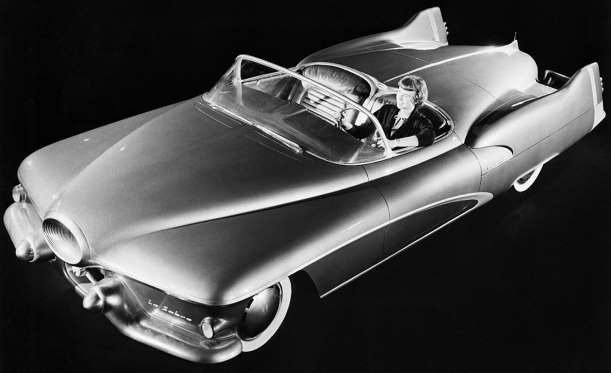
1951 GM LeSabre
No company put out more captivating concept cars in the 1950s than General Motors, in large part thanks to GM design boss Harley Earl, who dazzled the world in 1951 with the GM LeSabre. The LeSabre (a name not yet associated with Buick) captured the dawning Jet Age from every angle, starting with the protuberant center grille that concealed twin headlamps. Its distinct, fuselage-like upper body contours flowed all the way to its afterburner-like center taillamp, all flanked by low and wide fenders and tailfins sprouting from its outboard flanks. The latter theme continued to define the era. The LeSabre was a runner, too, powered by a 335-hp aluminum supercharged V-8 with a rear-mounted automatic transaxle. But unlike most concept cars that followed, the LeSabre was no trailer queen: Earl used it as his everyday ride for a few years, ultimately putting 45,000 miles on it. Strong public reaction to the LeSabre helped convince GM to include concept cars in its famous Motorama traveling car shows of the 1950s.
1956 Oldsmobile Golden Rocket
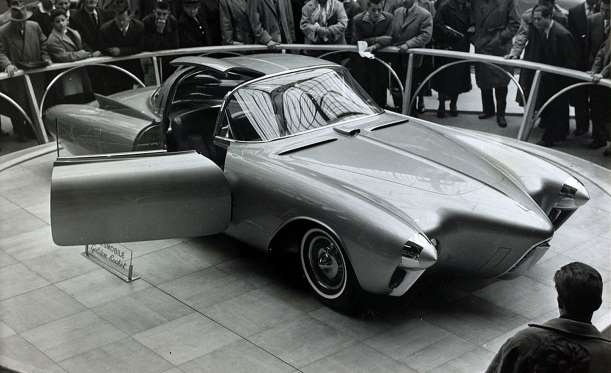
Oldsmobile was a powerhouse in the 1950s, and its shark-nosed Golden Rocket concept, which made the rounds as part of 1956’s General Motors Motorama, showed how ambitious the brand was. Decidedly sporty, if a little strange-looking with its round headlamps tucked between the skinny grille and high-set, missile-like fenders, the fiberglass-bodied Golden Rocket could have outaccelerated a Corvette at the time, thanks to its 275-hp V-8 and lithe 2500-pound curb weight. Sadly, few of its nifty styling features made production, save for the wraparound split-rear-window treatment, which appeared on the 1963 Corvette. As fast as it was, its luxury features were equally interesting, including a power-tilting steering column, seats that automatically raised and swiveled out when the doors opened, and twin roof panels that tilted upward to facilitate ingress and egress, adding even more drama to arrival.
1954 Lincoln Futura
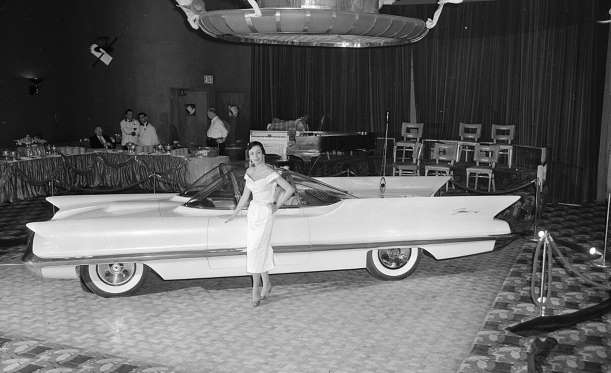
Italian coachbuilder Ghia kept busy in the 1950s and built the gorgeous Lincoln Futura in 1954 for display at the 1955 Chicago auto show. The Futura’s furrowed brow was the most consequential styling element as far as Lincoln was concerned, but the car itself became a cultural icon more than a decade later when, in 1966, it was given a batlike face, fluted fins, and black-and-orange paint, becoming—you guessed it—the Batmobile for the Batman series. Fifty years later, it remains one of the most famous and beloved automobiles in history, selling at auction in 2013 for $4.6 million.
1953, 1954, and 1955 Alfa Romeo B.A.T. Cars
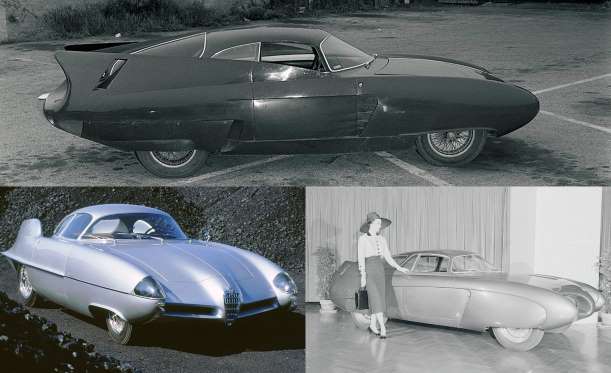
Concept cars weren’t just an American thing. In the early 1950s, Alfa Romeo commissioned its fellow Italians at the Bertone design house to assist its aerodynamic research efforts. The collaboration resulted in three amazing B.A.T. (Berlinetta Aerodinamica Tecnica) concept cars: B.A.T. 5, B.A.T. 7, and B.A.T. 9. No relation to Bruce Wayne’s favored ride, Alfa’s trio appeared in successive order at the 1953, 1954, and 1955 Turin auto shows brandishing tapered greenhouses, curved fins, and fenders that were covered in smooth bodywork. Each car looked more producible than the one before it, but they were never built for customers. They did, however, help Alfa Romeo gain a better understanding of aerodynamics, with the best one claiming a heroically low 0.19 drag coefficient, a figure achieved only by the GM EV1 and the Volkswagen XL1 in modern times.
1955 Ford Mystere
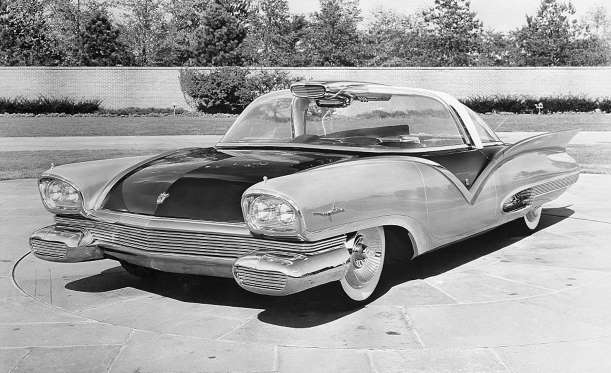
With its one-piece glass roof, forward-thrusting front fenders, and dual afterburner taillamps, the Ford Mystere could hail from no other time than the 1950s. The Mystere’s four passengers would enter and exit through the rear-hinged swing-up canopy, with the overhead scoop providing much-needed ventilation considering how much sunshine the cabin would get (and that there was no way to open the glass). Intended for a gas-turbine engine mounted in the back, the Mystere is said to have arrived at the 1956 Chicago auto show unable to move under its own power. It also supposedly had a radio telephone between the front seats and an aircraft-like “throw over” steering system that could be moved for operation from either front seat.
1956–1957 Chrysler Dart/Diablo
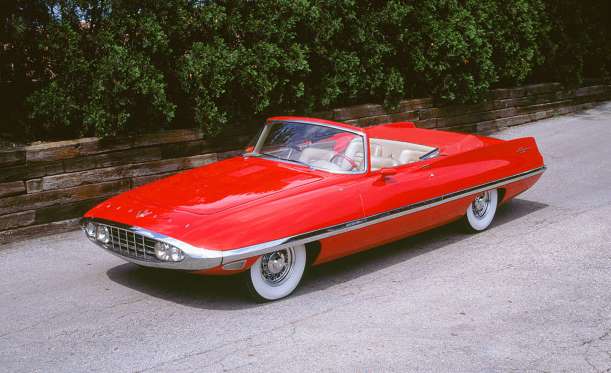
Of the numerous Chrysler/Ghia collaborations of the 1950s, the 1956 Dart/Diablo was arguably the greatest. This concept was built on the chassis of a 1956 Chrysler 300 and was originally dubbed the Dart, featuring a low, ovoid, horizontal grille rendered in chrome that streaked all the way down its clean, unadorned body sides. With its smooth body and inset wheels, the Dart was extremely aerodynamic, so gigantic fins were used for stability as well as style. It originally featured a trick, if unreliable, retractable hardtop that slid back in three positions—sunroof, landau, and fully retracted—but in 1957 it was sent back to Ghia, where the elaborate roof was swapped for a more conventional ragtop and the tailfins were shaved down to more relatable proportions. Thus equipped and renamed the Dart Diablo, the nearly 21-foot-long show car was shown to the public at the 1958 Chicago auto show. In 2013, it sold at auction for a cool $1.4 million.
Many have theorized that Christopher Columbus was a Jew. The basis for that is the fact that the Spanish Inquisition was in process in 1492. The theory goes that Columbus and his crew were Jews escaping the Inquisition. There is no proof to support that idea. The following article may be factual or not. My daughter does have a Jewish friend whose family did emigrate from Jamaica to the United States.
Some Jews turned to piracy as a way to fight against Spain and Portugal, the hosts of the brutal Inquisition.
Jewish pirates? It’s not a joke. Turns out, some of the most well-known and respected buccaneers in previous centuries were Jews. These captains were not the dreaded pirates of popular imagination; many worked in the employ of Britain, the Netherlands, and other maritime powers, protecting those nations’ coasts and seas.
While many of the details of these captains’ lives are mysterious, historians have pieced together some details of their lives, giving us a glimpse into the little-known world of Jewish pirates. Here are eight interesting facts about Jews and piracy.
Abraham Henriques Cohen and the World’s Biggest Heist
Abraham Henriques Cohen started life as a secret Jew living under the Inquisition in his native Portugal. One of the most prominent merchants in Lisbon, he was discovered to be a practicing Jew in 1605 and publicly tortured, along with 150 other hidden Jews. This experience apparently led Cohen to decide to work against Spain and Portugal, the hosts of the brutal Inquisition.
After escaping to Amsterdam, Cohen seemingly became a secret agent for the Dutch navy, and made his way to the New World, settling in Jamaica, which was then a haven for Jews. He worked on behalf of the Netherlands to attack Spanish ships and frustrate Spain’s colonial designs in the New World.
Cohen teamed up with one of the most feared pirates of the time, Sir Henry Morgan, with the tacit backing of both the Dutch and British governments. In 1628, along with Dutch folk hero Admiral Piet Pieterszoon Hein, Cohen captured a Spanish treasure fleet off the coast of Cuba. The ships were carrying gold and silver worth 11,509,524 guilders, around $1 billion today. It was the largest theft in the history of the Spanish fleet.
Cohen gave up piracy in old age when Sir Henry Morgan became Lieutenant Governor of Jamaica, and pardoned his longtime friend. The two lived out their days in Jamaica, their pirate ways behind them for good.
Jean Laffite, War Hero and Pirate
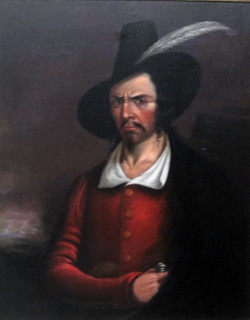
One of the most fabled and swashbuckling pirates of all time, Jean Laffite, was born in France in about 1780. He later wrote that his grandparents were Jews who were tortured by the Inquisition. This sparked a lifelong disdain for Spain in young Jean, and inspired him to turn to piracy to attack Spanish holdings in the New World where the Inquisition held sway.
Moving to the French colony of New Orleans, Jean Laffite and his brother Pierre founded a blacksmith shop, but they had a second secret profession as well: they held commissions from the Republic of Cartagena (in modern day Colombia) to intercept Spanish boats. They carried on this secret activity from a secluded colony in Barataria Bay, off the coast of New Orleans.
During the War of 1812, Laffite warned American troops of British invasion plans. He offered the help of his pirate gang to Gen. Andrew Jackson in the defense of New Orleans in exchange for a pardon for their pirate activities. Gen. Jackson agreed and Laffite’s gang fought with distinction. Jackson later called Laffite “one of the ablest men” of the Battle of New Orleans.
A few years later, in 1817, Laffite once again turned to piracy, taking nearly a thousand followers with him to the site of present-day Galveston, Texas. Until his death in about 1825, Jean Laffite remained one of the most feared pirates of the “Spanish Main,” the eastern coast of Spain’s holdings in the New World.
“Brotherhood of the Black Flag” and Buried Treasure
Sudel Deul, a 16th Century Jewish physician, was an early explorer of the Americas and is credited with introducing the potato to Europeans. His son Subatol found fame in a very different route: becoming one of the most feared pirates in the world.
Subatol formed an alliance with another son of a famous explorer who’d also turned to piracy: Henry Drake, son of the great British explorer Sir Francis Drake. Together the two buccaneers formed the “Brotherhood of the Black Flag”, leading a band of pirates in attacking Spanish ships off the coast of present-day Chile. It is said that the duo buried 6,000 pounds of Spanish gold and an even greater amount of silver near the Guayacan harbor in present-day Chile. No one has found the buried treasure yet, though seekers have discovered documents written partly in Hebrew, possibly written by Subatol.
Pirate Gravestones in a Jewish Cemetery
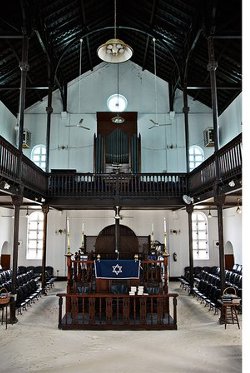
jamaicas-sole-synagogue
The island nation of Jamaica was once crawling with pirates; it seems that some of these were Jews. Seven gravestones in the old Hunt’s Bay Cemetery in Kingston bear unusual markings above Hebrew writing can be seen the familiar skull and crossbones of the pirate insignia. Similarly marked graves have also been found in Bridgeport, in the Bahamas, and in the old Jewish cemetery of Curacao.
Those buried in Hunts Bay were carried across the Cagway Bay from Port Royal, once called the Wickedest City in the World. These seven Jewish denizens might have helped contribute to that fearsome reputation with their pirate activities.
The Pirate Rabbi
Although Samuel Pallache trained as a rabbi in the late 1500s in Fez, Morocco, he preferred the seafaring life, eventually working as a privateer for both the Dutch government and for the Sultan of Barbary, in Morocco. Pallache negotiated one of the very first treaties between European and Middle Eastern nations: the 1610 agreement guaranteeing peace between the Netherlands and Morocco.
In 1614, Morocco and Spain were at war, and Pallache led a small Moroccan fleet that captured Spanish ships. Arrested by the Spanish ambassador, Pallache was tried for piracy. A letter to Dudley Carleton, British ambassador to Venice at the time, described the dashing Jewish buccaneer: “Here is a Jew Pirate arrested that brought three prizes of Spaniards into Plymouth . . . he shall likely pass out of here well enough for he has league and license under the King’s hand for his free egress and regress which was not believed until he made proof of it.”
Indeed, Pallache was eventually acquitted of piracy and set free. When he died in 1616, he was given a hero’s funeral. Every member of Amsterdam’s Jewish community marched in his funeral procession and they were joined by city elders and Prince Maurice of Nassau.
The “Great Jew”
Sinan Reis and his family fled the Spanish Inquisition in the early 1500s, settling in the city of Smyrna, in what is today Izmir, Turkey. There, Sinan became the right-hand man of one of the most famed pirates of all time, Hayreddin Barbarossa, who eventually became a sultan and commander in the Ottoman navy. The two sailed under a flag bearing a six-sided star, much like the Jewish Star of David.
The pair’s greatest victory came in 1538, in the Battle of Preveza, off the coast of Greece, when Ottoman forces led by Reis and Barbarossa defeated a flotilla of armed ships from Christian countries assembled by Pope Paul III, ensuring Ottoman dominance on the Mediterranean for generations to come. Sinan’s great bravery in that battle earned him the sobriquet “The Great Jew” from his Spanish enemies. The Ottoman Empire rewarded him by appointing him Supreme Naval Commander.
At the end of his life, Barbarossa dictated his memoirs to Sinan Reis, who created five hand-written volumes that are exhibited today in the Topkapi Palace in Istanbul and in the Istanbul University Library.
Israel Connections in the Caribbean
The Jewish homeland was never far from the thoughts of some Jewish seafarers. Yaakov Koriel worked as a buccaneer in the Caribbean in the early 1600s, until he changed his ways, moved to Israel, and studied Torah and Kabbalah in the Israeli city of Safed. He’d buried in that city, near the grave of his the famous Rabbi Isaac Luria, whose works he studied.
Another Jewish seafarer in the Caribbean, David Abrabanel, shared his name with a famous rabbi, Isaac Abrabanel. After his family was murdered in South America in the early 1700s, David adopted the nickname “Captain Davis” and sailed with British privateers. He eventually commanded his own ship, which he named The Jerusalem.
Israelis Fighting Pirates Today
The days of Jewish pirates on the high seas is over. Today instead, Israeli security teams are world leaders in opposing piracy and protecting cargo and passenger ships from modern-day pirates.
One such Israeli anti-piracy company, Mano International Security, gained international attention in 2009, when its Israeli guards fought off a daring attempt by Somali pirates to take over the Italian cruise ship Melody, which was sailing within a few hundred miles of the pirate-infested coast of Somalia with 1,500 passengers and crew on board. According to ship captain Ciro Pinto, Israeli guards fired shots over the heads of the bandits, eventually scaring them off.
“It was the first time we have encountered resistance” one of the Somali pirates was quoted as saying after the attack. “The guys acted exactly according to the regulations and I’m proud of them” Mano Nik, the company owner said.