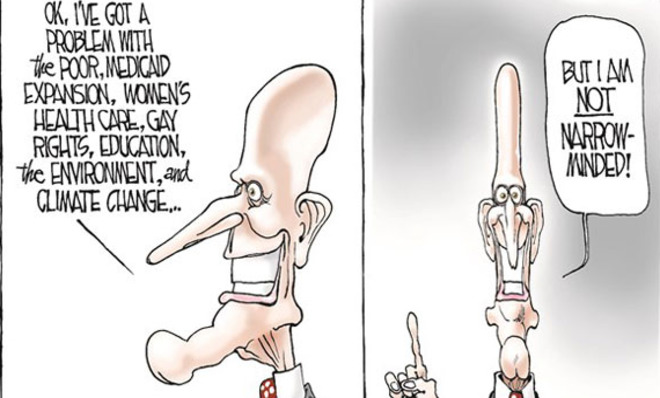
From The Week Magazine

From The Week Magazine
This is all about the money spent on state propositions. Does more money spent translate to an outcome that is contrary to the public interest?
To see the updated revised list that indicates current total contributions you can go to California Fair Political Practices Commission.
I have posted my position on each.
Proposition 1 – AB1471 Water Quality, Supply and Infrastructure Improvement Act of 2014
Supporting
Corrected
Opposing
No committee opposing this ballot measure raised enough money to reach the reporting threshold for this list.
Notice who is supporting this bond issue. It’s the engineers, carpenters, iron workers, and construction trade groups. Why? This bond issue will provide lots of money for the construction industry. Will any of the money spent create one more drop of water? NO!
Over $13 Billion has been spent on water bonds since the year 2000. How was that money spent? This is more money that will be wasted.
Vote NO.
Proposition 2 – State Reserve Policy
No data posted by California Fair Political Practices Commission.
The argument against this proposal is that it may deny schools the support they need.
I am voting YES.
Proposition 45 – Approval of Healthcare Insurance Rate Changes. Initiative Statute
Supporting
| Consumer Watchdog Campaign – Yes on 45 and 46, a coalition of consumer advocates, attorneys and nurses | $1,243,529 |
| California Nurses Association | $1,000,000 |
| Consumer Watchdog | $235,000 |
| Wylie A. Aitken and Affliliated Entity Wylie A. Aitken Law Corporation | $100,000 |
| Strumwasser & Woocher | $50,000 |
| Lieff, Cabraser, Heimann & Bernstein, LLP | $50,000 |
| Milstein, Adelman, Kreger LLP | $25,000 |
| Adler Law a Professional Corporation | $25,000 |
| Cotchett, Pitre & McCarthy, LLP | $25,000 |
| Paul Goldenberg | $25,000 |
| CA Federation of Teachers COPE/Prop Ballot Measure Committee | $25,000 |
| Shernoff Bidart Echeverria Bentley, LLP | $25,000 |
| Yes on Prop. 46, Your Neighbors for Patient Safety, a coalition of consumer attorneys and patient safety advocates | $25,000 |
| Total from top contributors | $2,853,529 |
Opposing
| Kaiser Foundation Health Plan, Inc. | $14,716,574 |
| Wellpoint, Inc. and affiliated entities | $12,896,224 |
| Blue Shield of California | $9,819,424 |
| Health Net, Inc. | $261,224 |
| UnitedHealthCare Insurance Company | $156,224 |
| California Association of Health Plans | $60,000 |
| California Association of Health Plans PAC | $10,000 |
| California Hospitals Committee on Issues | $10,000 |
| Total from top contributors | $37,929,670 |
Every other type of insurance has regulated rates in California. Thirty five other states also regulate health insurance rates.
Vote YES.
Proposition 46 – Drug and Alcohol Testing of Doctors. Medical Negligence Lawsuits. Initiative Statute
Supporting
| Consumer Attorneys of California and its sponsored committees: Consumer Attorneys Issues PAC, ID 842149; Consumer Attorneys Initiative Defense PAC, ID 1275672 | $1,183,000 |
| Robinson Calcagnie Robinson Davis, Inc. | $250,000 |
| Cotchett, Pitre & McCarthy, LLP | $150,000 |
| Bisnar/Chase Personal Injury Attorneys, LLP | $125,000 |
| Panish, Shea & Boyle, LLP | $125,000 |
| Casey, Gerry, Schenk, Francavilla, Blatt & Penfield, LLP | $115,000 |
| Shernoff, Bidart, Echeverria, Bentley, LLP | $115,000 |
| Bruce G. Fagel, A Law Corporation | $110,000 |
| Law Offices of Walkup, Melodia, Kelly & Schoenberger | $100,000 |
| Kazan, McClain, Satterley, Lyons, Greenwood & Oberman | $100,000 |
| Lieff Cabraser Heimann & Berstein, LLP | $100,000 |
| Total from top contributors | $2,473,000 |
Opposing
| Cooperative of American Physicians IE Committee | $10,161,489 |
| The Doctors Company | $10,001,200 |
| Norcal Mutual Insurance Company | $10,000,000 |
| California Medical Association Physicians’ Issues Committee | $5,212,026 |
| Kaiser Foundation Health Plan, Inc., and The Hospitals | $5,000,000 |
| Medical Insurance Exchange of California, Including Aggregated Contributions | $5,000,000 |
| California Association of Hospitals & Health Systems | $2,500,000 |
| California Hospitals Committee on Issues | $2,500,000 |
| California Dental Association | $2,052,709 |
| The Dentists Insurance Company | $1,620,000 |
| Total from top contributors | $54,047,424 |
Wow! $2 Million being spent to support this proposition. $54 Million being spent to oppose this proposition. I had no idea that drug and alcohol abuse is a major issue among doctors. As to medical negligence, incompetence is prevalent. As I understand the current law the limit to reimbursements is $250,000. I once went to a dentist who seemed to be drunk. He was part of a dental group. I requested another dentist. There must be a problem if so much money is being spent.
Vote YES.
Proposition 47 – Criminal Sentences. Misdemeanor Penalties. Initiative Statute
Supporting
| Open Society Policy Center | $1,210,112 |
| Hughes, B. Wayne | $750,000 |
| Atlantic Advocacy Fund | $600,000 |
| Munger, Molly | $325,448 |
| Hastings, Reed | $246,664 |
| Phillips, Steven C. | $125,000 |
| Parker, Sean | $100,000 |
| Drug Policy Action | $100,000 |
| Delaney, M. Quinn | $100,000 |
| California Federation of Teachers, AFT, AFL-CIO COPE Prop/Ballot | $50,000 |
| Total from top contributors | $3,607,224 |
Opposing
No committee opposing this ballot measure raised enough money to reach the reporting threshold for this list.
United States Senator and member of the Democratic party, Dianne Feinstein, came out against Proposition 47 in a column featured in the Los Angeles Daily News. Feinstein said she found the proposition to be dangerous, especially the way it classifies at-risk individuals.
I have been a supporter of eliminating laws that penalize people who use drugs. Petty theft should not be a felony because we are short jail space.
I respect the senator’s opinion. I was going to vote yes but now am on the fence.
Proposition 48 – Referendum to Overturn Indian Gaming Compacts
Supporting
No committee opposing this ballot measure raised enough money to reach the reporting threshold for this list.
Opposing
| Table Mountain Rancheria | $3,528,099 |
| Brigade Capital Management, LLC through affiliated entities | $2,666,780 |
| Riva Ridge Recovery Fund LLC | $226,232 |
| DG Capital Management, LLC and affiliated entites | $113,258 |
| United Auburn Indian Community of the Auburn Rancheria | $100,000 |
| Chukchansi Economic Development Authority | $25,000 |
| Club One Casino, Inc. | $15,000 |
| Total from top contributors | $6,674,369 |
This is something that I do not have enough knowledge to accurately judge.
The governor supports this change in the law. The argument is that this law will create jobs. Casinos are closing in Atlantic City. Isn’t it mostly the poor who waste their money in casinos? Over $6 Million to oppose this proposition should be a message. Probably those in this business don’t want any more competition. Indian tribes have benefited from their casinos.
I am voting NO because the idea was to provide Indians with an income source. More competition will harm that source.
Are there any poor members of congress? How do you define rich?
The Washington Post listed the top 50 members. The poorest in the group has assets totaling over $6 million.
This data was complied by Roll Call (http://www.rollcall.com) based on reports that members must file.
The ten richest:
The ten poorest:
While these members appear to be in the most dire straits on paper, an alternative calculation would peg the seven members who report having no assets as the poorest. These seven members are: Democrats Kyrsten Sinema of Arizona, Gwen Moore of Wisconsin, John Conyers Jr. of Michigan and Gregory W. Meeks of New York, and Republicans Rick Crawford of Arkansas, Duncan Hunter of California and Louie Gohmert of Texas. These members do not have enough liabilities to drop into the 10 poorest, but their net worths range from -$15,000 (Sinema) to -$610,000 (Gohmert).
Democrat Debbie Stabenow of Michigan is the poorest member of the Senate, with a net worth of -$585,000. Fellow Democrat Mark Pryor of Arkansas is the senator with the smallest amount of assets; he has a bank account worth $1,000 to $15,000 and one for his children worth less than $1,000.

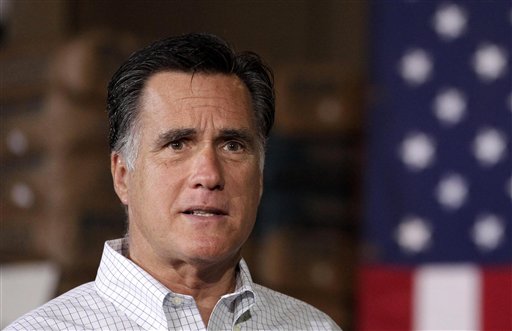
Hillary Clinton appeared in Iowa this past week and used the words “I’m back!” Mitt Romney appeared on Fox News Sunday. Neither has said they are running for president. Are they doing these reappearances just for fun? It’s unlikely.
Both of them had their chance to run for president and both lost. Why would we want to consider the loser as our next president? Richard Nixon proved that it can be done. Of course look at how his presidency turned out.
AOL conducted a poll of their readers and the results should be a message to both of them. Who would you pick for president in 2016? The choices Romney, Clinton, or Anyone else. The results should be the message. 61% chose Anyone else.
“In a match up between Hillary and Satan himself, I would have to go with Satan,” said Stacy Marston reports AOL.
Despite those cutting words it is obvious that Mrs. Clinton is planning another run for president. No one of consequence is likely to challenge her in the Democratic Party. Sorry Bernie Sanders.
With no clear front runner in the GOP, Mitt Romney is an odds on favorite in my view.
The question is who wants re-runs?
I believe both of them consider themselves able candidates for president. Are we likely to have a choice of “the lesser of two evils.” I fear the answer is yes.
It appears that many Americans have given up on the electoral system. Grid lock in Washington makes us all wonder “what’s the use?” I too am reaching that point. We just don’t have an alternate.
Written by Courtney McKinney in the Huffington Post. She just wants to be an American. I totally agree.
—
I don’t like being called African-American.
I’ve always been pretty fond of being an American. I come from a military family from Texas — patriotism is required. My appearance is not straight forward, black or white, so people often ask me what I am. Sometimes they ask for my ethnicity, sometimes they ask for my race, but sometimes they ask about my “nationality.” My nationality is simple and very straight-forward. I am an American.
I have an American passport. I was born here, and I’ve lived here for my whole life, just like my grandparent’s grandparents. Something interesting yet predictable happens when I respond that I am simply “American.” People are not content with that answer, because it does not give the full rundown of the information they seek. What they are asking for is a deeper explanation. Within my definition of myself they seek an answer to the question of what part of America I belong in, which part of America’s history my veins flow from. Being a citizen of America has always meant different things for different people, and deep down we all know that.
Native American. Isn’t that redundant? Qualifying the people who were here first. Apparently it is not length of time a person’s bloodline has on this land that makes an American, because then we would all have to agree that the only true “Americans” are the native population. So who is American? Who can say, in response to an inquiry about their ethnicity, that they are simply “American,” and people accept their answer?
“America” as we now know it began with the Declaration of Independence. We have a constitution, we have amendments and laws, all created for the advancement of the country of Americans. When those foundational structures were created they were made for a particular group of people — white, anglo-saxon, land-owning men. Over the years the pool expanded a bit, but the general aesthetic of the “American” maintained its potency. The blonde-haired blue-eyed beauty queens and the Barbies that circulate around the globe embody the imagined American ideal. The overwhelmingly white faces we see leading our country, and police forces, the faces we see in movies, in magazines, and on TV — they are the American ideal. They are the ones at the table, creating the structures, the companies, and laws. The founders of this country were white men, and their families and their descendants are understood to be the “Americans.” Never mind a majority of “African-Americans” (black people in America whose ancestors were slaves) are partially descended from white slave-owning men.
That is why certain (usually hyphenated) citizens of America do not feel protected by the laws of their own land. That is why sometimes it feels like there are many different Americas existing on the same large piece of land — some living comfortably and some living in what feels like a war zone, or an occupation.
I desire to claim my complete and comprehensive Americanness. I am American. I have the history of this country’s conception mapped out in my bloodlines. I am American. Some of my ancestors were born here and knew no other land, some of my ancestors journeyed here from Europe, and some of my ancestors were brought here from Africa. I don’t know the complete stories of any of their lives, but I know their stories merge to create mine. One that is very specifically American.
Asian-Americans are American. Hispanic-Americans are American. African-Americans are American. By hyphenating groups we create a subset that relegates certain Americans to a second tier of citizenship that we all internalize whether we want to or not. Being labeled African-American feels like a disavowal of everythingthat I am as well as the singular thing that I am — American.
I am ready to drop the hyphens. I am German-American, Irish-American, French-American, Native-American, and African-American. All of those hyphens make up who I am; who I am is the melting pot we learned about in school but have yet to fully conceptualize. I am what happens in a land of immigrants. I am the embodiment of the American experiment, and I am okay with that as long as I can call myself what I am. The push-back for “reclaiming America” or going back to “the good ole days” is a push back for something that never was. America has never been a happy place for everyone living in it, but the more of America a person can claim, the better America is for them.
It’s time to reclaim Americanness as inclusive rather than exclusive, as a nationality we wear proudly no matter the color of our skin. The founding fathers started this experiment, now we have to carry it out. African slaves built this country, the Irish built this country, Native Americans built this country, the Chinese built this country, the English built this country — we’ve all played our part, so why not let all of us have our name, no hyphens asked? It doesn’t make sense to have a country with a hyphenated majority. This is America, and I am simply American.
Israel has the right to defend itself, by itself, from the continued campaign of terror being waged by Hamas. The moral bankruptcy of Hamas, its lack of concern for civilians or international law (on Thursday, the UN said it had found rockets hidden in one of its Gaza schools), its indiscriminate rocket launches that it hopes will cause civilian casualties, its refusal to recognize the very existence of Israel gives Israel absolute right to defend itself.
Margaret Wente wrote the following commentary in the Canadian Globe and Mail newspaper
Human shields are Hamas’s PR
Published Tuesday, Jul. 15 2014, 7:00 AM EDT
Last updated Tuesday, Jul. 15 2014, 7:00 AM EDT
It’s hard to figure out why Hamas would launch a missile attack against Israel. They can’t possibly win. Their missiles are useless, and seldom hit anything before the Israelis blow them up. If they wanted to, they could crush Hamas like a bug.
What Hamas does get is good PR. The visuals are golden: fleeing civilians, injured kids, apartment buildings bombed to rubble. So are the lopsided statistics – hundreds of Palestinians dead but zero Israelis. European press coverage has been overwhelmingly sympathetic to the Palestinians. In the Guardian, one commentator called the conflict “as perverse as Mike Tyson punching a toddler.”
There’s another difference between the two sides. Israel doesn’t want to shed civilian blood. Hamas needs it – especially from its own civilians. That’s one reason why it puts rocket launchers and ammunition dumps in mosques and homes in crowded neighbourhoods. That’s why it told people not to leave northern Gaza this weekend after Israel warned it was going to bomb.
Even Palestinian Authority president Mahmoud Abbas has called out Hamas. “We are the losing side, and every minute there are more and more unnecessary deaths,” Mr. Abbas said in an interview on Lebanese television. “I don’t like trading in Palestinian blood.” (In response, Hamas called him a criminal.)
Israel tries to minimize civilian deaths by warning people in advance of a strike, either with a telephone call or a harmless missile (known as a “knock on the roof”). These tactics don’t always work. A few days ago, the IDF mistakenly bombed a home for the disabled, whose residents were unable to flee despite the warning. Advance warnings also fail because instead of running away from the scene, some people rush to it. They hope their presence might deter an attack. Either it works or they become martyrs.
Earlier this month, the IDF targeted a compound in Khan Younis that was allegedly a headquarters for leading Hamas bad guys. They made a phone call warning noncombatants to get out. They also sent a knock-knock missile. But instead of leaving, people rushed in and headed to the roof to form a human shield. Eight noncombatants died, including several children. The IDF called it a “tragic mistake,” noting that by the time the people were spotted on the roof, the missile was already in the air.
Hamas openly encourages civilians to act as human shields. Here’s what Hamas spokesman Sami Abu Zuhri had to say recently on Al-Aqsa TV (via the Middle East Media Research Institute): “This attests to the character of our noble, jihad-fighting people, who defend their rights and their homes with their bare chests and their blood … We in Hamas call upon our people to adopt this policy in order to protect the Palestinian homes.”
The willingness to sacrifice Palestinian children has served Hamas well. Rights groups have condemned the advanced-warning efforts as just another version of collective punishment. “There is no way that firing a missile at a civilian home can constitute an effective ‘warning,’ ” said Amnesty International’s Philip Luther. United Nations High Commissioner for Human Rights Navi Pillay says there is “serious doubt” that Israel is complying with international human-rights law.
In the greater bloodbath that has engulfed the Middle East, this doesn’t add up to much. It will probably be over soon, and things will quiet down until next time. And there will be a next time – the younger generation of Israelis isn’t all that interested in peace. Nor are the kids on the other side. As one boy said on Palestinian TV, “We love the resistance. We want to die as martyrs. Long live the martyrs.”
David Bancroft
I have always voted for the Democratic Party presidential candidate so this commentary was an unpleasant task.
It is not unusual to believe the current president of the United States is incompetent. I cannot recall one that received my appreciation while he held office. Presidents usually receive their lowest approval numbers in the last two or three years of their second term. So perhaps it is not unexpected that I too do not approve of Barack Obama’s presidency.
The difference is that I believe he will be listed as one of America’s worst presidents. The honor for worst, in my opinion, is Jimmy Carter. The reasons  be addressed in another column.
President Obama came to office when the country was in economic collapse. It was not his fault. We have the Bush administration to thank for that horror. Banks were on the verge of bankruptcy, many large companies were experiencing rapid declines in sales that were jeopardizing their very existence, unemployment was at 7.2% and falling, home foreclosures were massive, etc.
What did the president do? He proposed the American Recovery and Reinvestment Act, his $800 billion stimulus bill for a $14.57 trillion economy. Was that enough? I don’t think so. Many economists said the stimulus should have been twice his proposal. The money was to be spent on “shovel ready projects.” There just weren’t very many of those projects immediately available. Although the administration claims that law created jobs the reality is the unemployment rate continued dropping through October 2009 to a rate of 10.1%. That rate did not decline to 9.5% until June 2010.
In the meantime the administration pushed his health care law (Affordable Care Act: AKA Obama Care) that has yet to prove its value in any significant way. That was the wrong focus. The introduction of that new program was a disaster. It is his signature program and yet it was not given the attention needed to accomplish a near perfect launch.
In other domestic issues he has been late to the table. Veteran’s Administration, gun regulation, domestic spying, immigration, and massive outsourcing of jobs are the issues that come to mind.
In foreign affairs the president has pulled back from every situation in the world. From drawing a red line in Syria, to a too fast draw down of troops in Iraq the president has not considered the unintended consequences of his decisions. Today Islamic terrorists are threatening Iraq, Syria, and many African nations. Now we are faced with thousands of children entering our country from Central America. He didn’t see the issue of thousands of children entering the country until the situation has become overwhelming? How can that be?
What we have here is a reactive presidency rather than a proactive presidency . The president reacts to situations. CNN and FOX seem to know what is happening before the president. He does not initiate attention to an issue.
Americans want their president to initiate the steps to resolve issues even before the public is aware. This is not a characteristic that can be evaluated until a person is holding the office of POTUS.
Barack Obama was the wrong choice for president. Sadly the Republicans did not offer Americans a good alternative. Perhaps this column should have been titled “America’s Broken Political System.”
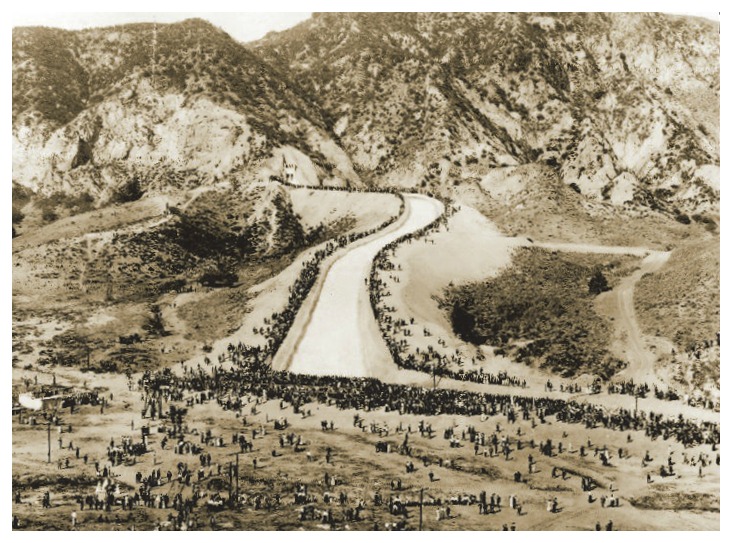
40,000 people observed the opening of the aqueduct into the San Fernando Valley
The latest water bond proposal calls for $7.5 billion that would allocate $2 billion for surface and groundwater storage projects, $850 million for Delta levees and habitat restoration, and $1 billion for groundwater cleanup. If this sounds familiar you are not mistaken. We have spent billions of dollars doing the very same thing. None of those projects has resulted in more available water.
On December 9, 2012 George Skelton, Los Angeles Times commentator/reporter, wrote “The truth is that no matter what the size of the bond issue no additional water will come to Los Angeles nor will there be any additional water for agriculture. The reality is that Californians will have to face water rationing. However, construction companies will benefit from this giant expenditure. I wonder how much money will be donated to campaign re-elections.”
I conducted my own on line research on California water bonds and found the following bonds approved.
Proposition 13. In March 2000, California voters approved Proposition 13 (2000 Water Bond), which authorizes the State of California to sell $1.97 billion in general obligation bonds to support safe drinking, water quality, flood protection and water reliability projects throughout the State.
Proposition 40.In March 2002, California voters approved Proposition 40, a $2.6 billion state bond measure for conservation, neighbourhood parks, and coastline and watershed protection. Proposition 40 was the largest conservation bond measure ever approved in California.
Proposition 50.In November 2002, the $3.4 billion water bond measure, the largest in California history, was approved by voters. It provides $825 million in funding for CALFED for a variety of programs, including surface water storage studies, water conveyance facilities, levee improvements, water supply reliability projects, ecosystem restoration, watershed programs, conservation and water recycling. More on Proposition 50 is available at http://www.water.ca.gov/grants- loans.
Proposition 84. In November 2006 California voters approved this measure that will fund water, flood control, natural resources, park and conservation projects by authorizing $5,388,000,000 in general obligation bonds. The bonds will be used to fund various projects aimed at (1) improving drinking and agricultural water quality and management; (2) preserving, restoring and increasing public access to rivers and beaches; (3) improving flood control. See details of the law at http://www.parks.ca.gov/pages/1008/files/prop 84 text.pdf.
My calculator says these propositions spent more than $13 billion. The cost to pay back those bonds with interest will most likely be double that amount.
California is up to its neck in commitments and needs. The recent claims that the state government has a surplus is incorrect. The surplus is only in terms of money needed to pay this year’s bills. We are drowning in future debt owed to retired teachers, retired state employees, and other bond commitments. Our infrastructure is falling apart.
Unless I hear some startling reason for this waste of tax dollars we should all vote NO to this give away.
I just finished watching Face The Nation. Peggy Noonan and Michael Gerson for the GOP. Dee Dee Myers and Todd Purdum for the Dems.
-No one explained how civil wars in the Middle East would impact the United States.
Actually Bob Schieffer did not ask the questions that might provide the answers to these questions. The discussion of these commentators told the viewer they have no answers.
Where is the accountability on Iraq?
Can someone explain to me why the media still solicit advice about the crisis in Iraq from Sen. John McCain (R-Ariz.)? Or Sen. Lindsey Graham (R-S.C.)? How many times does the Beltway hawk caucus get to be wrong before we recognize that maybe, just maybe, its members don’t know what they’re talking about?
Certainly Politico could have found someone with more credibility than Douglas Feith, former undersecretary of defense for policy in the George W. Bush administration and one of the architects of the Iraq war, to comment on how the White House might react to the Iraq war, to the rapidly deteriorating political situation in Iraq today. Certainly New York Times columnist David Brooks knows what folly it is to equate President Obama’s 2011 troop removal with Bush’s 2003 invasion, as he did during a discussion with me last Friday on NPR?
Just a reminder of what that 2003 invasion led to: Joseph Stiglitz and Linda Bilmes authoritatively priced Bush’s war at more than $3 trillion. About 320,000 U.S. veterans suffer from brain injury as a result of their service. Between 500,000 and 655,000 Iraqis died, as well as more than 4,000 U.S. military members.
Yet as Brooks’s words reveal, the prevailing mindset in today’s media is to treat the 2003 invasion as if its prosecution were an act of God — like Hurricane Katrina, an inevitability that could not have been avoided. Seen this way, policymakers can ignore the idiocy of the decision to invade in the first place and can instead direct all of their critical attention to how to deal with the aftermath. It’s almost as though the mainstream media have demoted themselves from a corps of physicians, eager and able to diagnose, prognosticate and prescribe, to one of EMTs, charged instead with triaging, cleaning and cauterizing a catastrophe without investigating its underlying cause.
Since so many liberal hawks reached the same conclusion as did Bush et al., this notion of the 2003 invasion’s inevitability can falsely seem to have some credence (which is, perhaps why, as Frank Rich points out in New York magazine, so many erstwhile hawks, especially so-called liberal ones, feel no need to acknowledge their erroneous judgments of a decade ago).
But if so many were wrong about Iraq in 2003, why are they still being invited (and trotting themselves out) on Sunday morning talk shows and op-ed pages as authorities on U.S.-Iraq policy? Where is the accountability for the politicians’ and pundits’ warmongering of 11 years ago? James Fallows — who was “right” on Iraq in a 2002 Atlantic cover story — tweeted Friday, “Working hypothesis: no one who stumped for original Iraq invasion gets to give ‘advice’ about disaster now. Or should get listened to.” Amen.
In the current cacophony of Washington, we must remember that there is no equivalence to be drawn between Bush’s 2003 decision to invade Iraq and Obama’s 2011 decision to withdraw U.S. troops. Bush’s invasion, after all, was not just a mistake. At best a fool’s errand, at worst a criminal act, this great blunder helped set the stage for Iraq’s chaos today. The increased sectarian violence stems not from the 2011 withdrawal; rather, it is the fruit of the 2003 invasion, subsequent occupation and much-vaunted “surge” of 2007–08.
McCain and Graham insist that airstrikes are the only way forward in today’s Iraq. But what we need now are not armchair warriors calling for military strikes or sending weapons. (As an aside, I will say that, should members of the neoconservative movement feel so motivated, we would wholeheartedly respect their decision to enlist in the Iraqi army.) Obama, himself “right” on Iraq during the war’s run-up, is also right today to resist calls for direct U.S. military action — including airstrikes — in Iraq. The U.S. misadventure in Iraq ended in 2011; we do not need another. Experience and history have (clearly) taught us that there is no military solution in Iraq. Only a political reconciliation can quell the unrest, and this requires more than bellicose calls for violence from 5,000 miles away. To find a solution, we must commit to regional and international diplomacy.
We learned in 2003 that when we move in with guns blazing, we tend to spark a lot more fires than we extinguish. In 2014, we cannot afford to learn this same lesson. Regardless of how many are too blind (or proud or foolish) to realize it, we need to write a new scenario for 2014, so that 11 years from now, we can look back and ponder how, this time, we did things right.
Read more from Katrina vanden Heuvel’s archive or follow her on Twitter.


