A Plan to Stop the Employment of Illegal Aliens

Actually this plan might be considered an invasion of privacy by some people but unless there is a better idea it will have to be implemented.  My wife and I both have passports.  To obtain those documents we supplied her birth certificate and my naturalization certificate.  Our pictures and birth dates appear on the documents.  Our Drivers licenses also have our thumb prints.  I do not consider this an invasion of privacy.   Securing the Mexican border is not a doable action.  The border is too long to guard and tunnels can be dug beneath.  Tunneling has already been discovered near San Ysidro (southern end of San Diego).  This article explaining the process appeared in the Wall Street Journal.

March 27, 2010

Lawmakers working to craft a new comprehensive immigration bill are proposing a new national biometric ID card that would be required of all U.S. workers. WSJ’s Laura Meckler explains the proposal and the objections from privacy advocates.

Under the potentially controversial plan still taking shape in the Senate, all legal U.S. workers, including citizens and immigrants, would be issued an ID card with embedded information, such as fingerprints, to tie the card to the worker.

The ID card plan is one of several steps advocates of an immigration overhaul are taking to address concerns that have defeated similar bills in the past.

The uphill effort to pass a bill is being led by Sens. Chuck Schumer (D., N.Y.) and Lindsey Graham (R., S.C.), who plan to meet with President Barack Obama as soon as this week to update him on their work. An administration official said the White House had no position on the biometric card.

“It’s the nub of solving the immigration dilemma politically speaking,” Mr. Schumer said in an interview. The card, he said, would directly answer concerns that after legislation is signed, another wave of illegal immigrants would arrive. “If you say they can’t get a job when they come here, you’ll stop it.”

The biggest objections to the biometric cards may come from privacy advocates, who fear they would become de facto national ID cards that enable the government to track citizens.

“It is fundamentally a massive invasion of people’s privacy,” said Chris Calabrese, legislative counsel for the American Civil Liberties Union. “We’re not only talking about fingerprinting every American, treating ordinary Americans like criminals in order to work. We’re also talking about a card that would quickly spread from work to voting to travel to pretty much every aspect of American life that requires identification.”

Mr. Graham says he respects those concerns but disagrees. “We’ve all got Social Security cards,” he said. “They’re just easily tampered with. Make them tamper-proof. That’s all I’m saying.”

U.S. employers now have the option of using an online system called E-Verify to check whether potential employees are in the U.S. legally. Many Republicans have pressed to make the system mandatory. But others, including Mr. Schumer, complain that the existing system is ineffective.

Last year, White House aides said they expected to push immigration legislation in 2010. But with health care and unemployment dominating his attention, the president has given little indication the issue is a priority.

Rather, Mr. Obama has said he wanted to see bipartisan support in Congress first. So far, Mr. Graham is the only Republican to voice interest publicly, and he wants at least one other GOP co-sponsor to launch the effort.

An immigration overhaul has long proven a complicated political task. The Latino community is pressing for action and will be angry if it is put off again. But many Americans oppose any measure that resembles amnesty for people who came here illegally.

Under the legislation envisioned by Messrs. Graham and Schumer, the estimated 10.8 million people living illegally in the U.S. would be offered a path to citizenship, though they would have to register, pay taxes, pay a fine and wait in line. A guest-worker program would let a set number of new foreigners come to the U.S. legally to work.

Most European countries require citizens and foreigners to carry ID cards. The U.K. had been a holdout, but in the early 2000s it considered national cards as a way to stop identify fraud, protect against terrorism and help stop illegal foreign workers. Amid worries about the cost and complaints that the cards infringe on personal privacy, the government said it would make them voluntary for British citizens. They are required for foreign workers and students, and so far about 130,000 cards have been issued.

Mr. Schumer first suggested a biometric-based employer-verification system last summer. Since then, the idea has gained currency and is now a centerpiece of the legislation being developed, aides said.

A person familiar with the legislative planning said the biometric data would likely be either fingerprints or a scan of the veins in the top of the hand. It would be required of all workers, including teenagers, but would be phased in, with current workers needing to obtain the card only when they next changed jobs, the person said.

The card requirement also would be phased in among employers, beginning with industries that typically rely on illegal-immigrant labor.

The U.S. Chamber of Commerce doesn’t have a position on the proposal, but it is concerned that employers would find it expensive and complicated to properly check the biometrics.

Mr. Schumer said employers would be able to buy a scanner to check the IDs for as much as $800. Small employers, he said, could take their applicants to a government office to like the Department of Motor Vehicles and have their hands scanned there.

—Alistair MacDonald contributed to this article.

Write to Laura Meckler at laura.meckler@wsj.com
Sending Illegal Aliens Home

The Arizona legislature sent the Republican governor, Jan Brewer, legislation making it a crime under state law to be in the country illegally.  She signed the law today.  It also requires local police officers to question people about their immigration status if there is reason to suspect they are illegal immigrants; allows lawsuits against government agencies that hinder enforcement of immigration laws; and makes it illegal to hire illegal immigrants for day labor or knowingly transport them.  Sanctuary cities are outlawed in the legislation.

Three problems immediately come to mind.

1. Illegal aliens living in Arizona will not call the police after a burglary or other criminal offense because they will fear being arrested.  Special Order 40 in Los Angeles was issued specifically to stop police from arresting suspected illegal aliens when dealing with crime issues.

2. This law could result in everyone wearing an arm band to identify their status similar to Nazi Germany banding Jews and other “undesirables”.

3. There will be racial profiling.  Anyone with a Hispanic/Latino surname, physical characteristics common to Mexicans, or an accent will be stopped and questioned.

I have to respect those Arizonans for having the courage of their convictions.  Has anyone seen this data regarding crime in Arizona that was compiled by someone in Michigan?  When the car washes have no employees and the care givers have all left will they still demand the imposition of this law?  If the law conforms to all Federal law it will not be overturned.

Despite the down sides, forcing illegal aliens back to their home countries is a good thing.  Most illegal aliens probably won’t go back to their native countries.  My question is how do you identify illegal aliens from Canada, eh? 

The Republican Party will pay a price for this law.

Here are two links that are worthy of considering from the Arizona Republic and from Freewheel Burning.

The Tea Party Just Wants To Save Money!

If H1N1 had become a pandemic and there was no vaccine would you understand that the government was just trying to save money?  Aid for an earthquake in California or a Hurricane like Katrina, sorry we need to save money!  Besides it’s none of our business says Uncle Sam.

Tea Party groups have two major arguments with the Federal government.  First, the Federal debt is so high that it will leave a burden for generations to come.  Many say that our grandchildren will be faced with the problem.  Second, the Federal government is intruding in our lives at an unacceptable level.  Government is trying to control our lives.  The control that government is trying to impose is far beyond what the Constitution allows.  I am not clear which is of greater concern.  While I agree with the concern, I am not convinced that most people understand the consequence of a reduced role for government.

I decided to list some of the many projects and departments that have been adopted by the Federal government.  Which ones would we really be willing to forego?

-The Interstate highway system was built with a combination of money from the Federal government and individual state governments.  Funds continue to be made available to maintain and upgrade that system.  The highways are not only for private passenger cars but are used by the trucking industry.  Here in Los Angeles the Long Beach Freeway is a primary route for moving goods from the ports to distribution centers.  Los Angeles/Long Beach ports are the largest in the nation.

-Social Security, Medicare, and Medicaid are the three most expensive and most used Federal programs.  I have not met a single person who is willing to surrender their benefits including the wealthy and the Republicans who bad mouth those programs.

-The Food and Drug Administration is a popular target of those wanting more attention to detail.  FDA officials were roundly criticized for not enforcing health standards at the Peanut Corporation of America in Georgia.  The slaughter of sick cattle and the occurrence of salmonella poisoning has brought complaints about the FDA’s lack of enforcement.  When drugs are not approved in a timely manner we attack the FDA but if a drug was approved that has caused death or injury we say that it’s the fault of FDA procedures.

-The Securities and Exchange Commission (SEC) is the much maligned department that we want to ensure that the financial industry is not cheating investors.  It’s done a poor job but what if there was no agency? There wasn’t one before 1934.  The main reason for the creation of the SEC was to regulate the stock market and prevent corporate abuses relating to the offering and sale of securities and corporate reporting.           

-The FAA (Federal Aviation Agency) is respected around the world.

– The National Highway Traffic Safety Administration (NHTSA) just fined Toyota $16 million.  The agency appears to be under manned.

 – U.S. Immigration and Customs Enforcement (ICE) is the largest investigative agency in the U.S. Department of Homeland Security (DHS).

– The FBI recently arrested Najibullah Zazi, 24, a Colorado airport shuttle driver who has admitted receiving weapons training from al-Qaida, played a direct role in an alleged terror plot, according to court documents released Sunday. Authorities have said they don’t know the timing or location of any planned attack.

So which agencies are you willing to close to save money?

Who Cares About the Facts?

If you have read it, it must be true.  Blogs spew extraordinary amounts of mis-information.  Of course, those with a political point of view are trying to sell everyone their beliefs and write things that they know full well are lies or near lies.  That is the folly of freedom of the press.    

Thus we have the short piece in Newsweek’s April 12, 2010 edition titled “INDIA IS ANNOYED BY THE U.S.”  The author, Sumit Ganguly, contends in red text “But the Obama administration, preoccupied with China and the Middle East, has left little room on its schedule for India.”  Perhaps Mr. Ganguly was on vacation while we all saw the State Dinner for the Indian Prime Minister on every news show.  If you will recall that was the dinner with the uninvited guests.  The dinner received significant coverage by almost every news outlet.

Then there is Debbie Poochigian, Fresno County California Supervisor, and most likely a Republican.  Her poorly researched commentary only reinforces my perception that people support a candidate just because the person is a member of their political party.  On the Fox and Hounds blog she contends that Senator Barbara Boxer does not adequately support job growth in California.    However the facts do not support her contentions.  To the contrary when President Obama signed the recent jobs bill the Chicago Tribune quoted Boxer with these words, “This is a great day. Today, a million American workers — including 100,000 in California — know their jobs are more secure because we have renewed the transportation bill through the end of the year.”  Further more Boxer voted for the continuation of the C-17 aircraft program even though Secretary of Defense, Robert Gates, wanted to kill the project.  5,000 jobs were saved in Long Beach California as a result of this congressional action.

Next Year in the White House: A Seder Tradition

REPAIRING A DAMAGED IMAGE

Although this really happened last year it was not an event that came to my attention.  I suspect this re-write on New York Times page A1 is a set up to “make nice” with American Jews.


  Pete Souza/White House

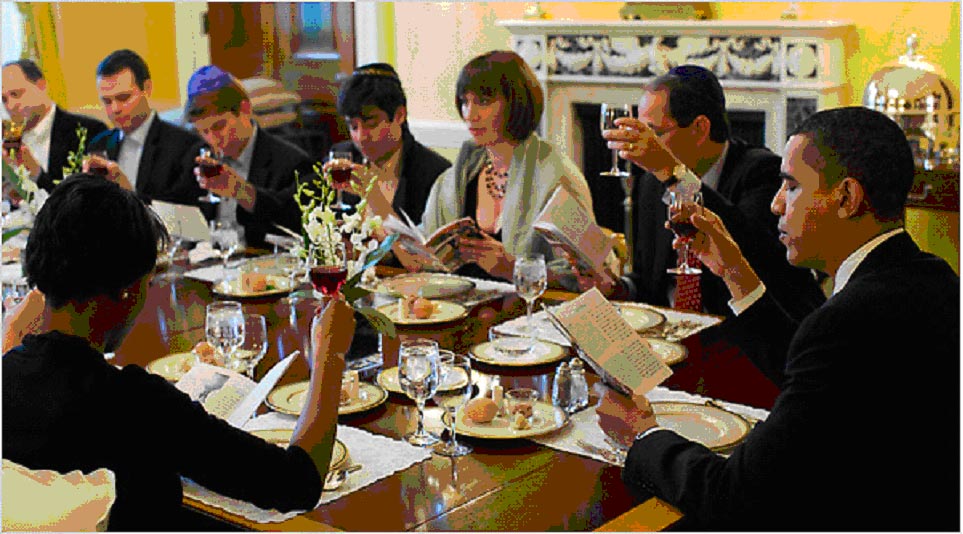
Last year’s Seder, a White House first, saw the Macaroon Security Standoff.
By JODI KANTOR
Published: March 26, 2010 in the NewYork Times
WASHINGTON — One evening in April 2008, three low-level staff members from the Obama presidential campaign — a baggage handler, a videographer and an advance man — gathered in the windowless basement of a Pennsylvania hotel for an improvised Passover Seder.
 
 Pete Souza/White House
Susan Sher, who is now Michelle Obama’s chief of staff, at the White House Seder last year.

The day had been long, the hour was late, and the young men had not been home in months. So they had cadged some matzo and Manischewitz wine, hoping to create some semblance of the holiday.

Suddenly they heard a familiar voice. “Hey, is this the Seder?” Barack Obama asked, entering the room.

So begins the story of the Obama Seder, now one of the newest, most intimate and least likely of White House traditions. When Passover begins at sunset on Monday evening, Mr. Obama and about 20 others will gather for a ritual that neither the rabbinic sages nor the founding fathers would recognize.

In the Old Family Dining Room, under sparkling chandeliers and portraits of former first ladies, the mostly Jewish and African-American guests will recite prayers and retell the biblical story of slavery and liberation, ending with the traditional declaration “Next year in Jerusalem.” (Never mind the current chill in the administration’s relationship with Israel.)

Top aides like David Axelrod and Valerie Jarrett will attend, but so will assistants like 24-year-old Herbie Ziskend. White House chefs will prepare Jewish participants’ family recipes, even rendering chicken fat — better known as schmaltz — for just the right matzo ball flavor.

If last year is any guide, Malia and Sasha Obama will take on the duties of Jewish children, asking four questions about the night’s purpose — along with a few of their own — and scrambling to find matzo hidden in the gleaming antique furniture.

That event was the first presidential Seder, and also probably “the first time in history that gefilte fish had been placed on White House dishware,” said Eric Lesser, the former baggage handler, who organizes each year’s ritual.

As in many Jewish households, the Obama Seder seems to take on new meaning each year, depending on what is happening in the world and in participants’ lives (for this group, the former is often the same as the latter).

The first one took place at the bleakest point of the campaign, the long prelude to the Pennsylvania primary, which was dominated by a furor over Mr. Obama’s former pastor. “We were in the desert, so to speak,” remembered Arun Chaudhary, then and now Mr. Obama’s videographer, who grew up attending Seders with his half-Jewish, half-Indian family.

No one led the proceedings; everyone took turns reading aloud. Mr. Obama had brought Reggie Love, his personal aide, Ms. Jarrett and Eric Whitaker, another close friend, all African-American. Jennifer Psaki, the traveling press secretary, and Samantha Tubman, a press assistant, filtered in. Neither had ever been to a Seder, but they knew the Exodus story, Ms. Psaki from Catholic school and Ms. Tubman from childhood Sundays at black churches.

They peppered the outnumbered Jews at the table with questions, which the young men sometimes struggled to answer. “We’re not exactly crack Hebrew scholars,” said Mr. Lesser, now an assistant to Mr. Axelrod.

Participants remember the evening as a rare moment of calm, an escape from the din of airplanes and rallies. As the tale of the Israelites unfolded, the campaign team half-jokingly identified with their plight — one day, they too would be free. At the close of the Seder, Mr. Obama added his own ending — “Next year in the White House!”

Indeed, the group, with a few additions, has now made the Seder an Executive Mansion tradition. (No one considered inviting prominent rabbis or other Jewish leaders; it is a private event.)

But maintaining the original humble feel has been easier said than done.

Ms. Tubman and Desirée Rogers, then the White House social secretary, tried to plan an informal meal last year, with little or even no wait staff required. White House ushers reacted with what seemed like polite horror. The president and the first lady simply do not serve themselves, they explained. The two sides negotiated a compromise: the gefilte fish would be preplated, the brisket passed family-style.

Then came what is now remembered as the Macaroon Security Standoff. At 6:30, with the Seder about to start, Neil Cohen, the husband of Michelle Obama’s friend and adviser Susan Sher, was stuck at the gate bearing flourless cookies he had brought from Chicago. They were kosher for Passover, but not kosher with the Secret Service, which does not allow food into the building.

Offering to help, the president walked to the North Portico and peered out the door, startling tourists. He volunteered to go all the way to the gates, but advisers stopped him, fearing that would cause a ruckus. Everyone seemed momentarily befuddled. Could the commander in chief not summon a plate of cookies to his table? Finally, Mr. Love ran outside to clear them.

Mr. Obama began the Seder by invoking the universality of the holiday’s themes of struggle and liberation. Malia and Sasha quickly found the hidden matzo and tucked it away again, so cleverly that Mr. Ziskend, the former advance man, needed 45 minutes to locate it. At the Seder’s close, the group opened a door and sang to the prophet Elijah.

In preparation for this year’s gathering, Mr. Lesser and others have again been collecting recipes from the guests, including matzo ball instructions from Patricia Winter, the mother of Melissa Winter, Mrs. Obama’s deputy chief of staff.

“We like soft (not hard) matzo balls,” Mrs. Winter warned in a note to the White House chefs, instructing them to buy mix but doctor it. Use three eggs, not two, she told them; substitute schmaltz for vegetable oil, and refrigerate them for a day before serving (but not in the soup).

The Seder originated with Jewish staff members on the campaign trail who could not go home, but now some celebrate at the White House by choice. Participants say their ties are practically familial now anyway. “Some of the most challenging experiences of our life we’ve shared together,” Ms. Jarrett said.

No one yet knows exactly what themes will emerge this year. Maybe “taking care of people who can’t take care of themselves and health care reform,” suggested Ms. Sher, now Mrs. Obama’s chief of staff.

The evening might also reflect a group that has settled into the White House and a staff more familiar with the new custom. Last week, Ms. Sher was leaving the East Wing when a guard stopped her.

“Hey, are you bringing macaroons again this year?” he asked.

A Richman’s Roadmap

Republican Congressman Paul Ryan of Wisconsin’s 1st District has an interesting web site titled The Roadmap Plan.  There was a very appealing article in Newsweek about Mr. Ryan and he has appeared on Hardball with Chris Matthews on MSNBC sounding like a very reasonable person.  If ever there was a likely candidate for Republican president it is Congressman Ryan.  The problem is he proposes changes to America that every wealthy person will love.  After you have read The Roadmap Plan you can read my rebuttal below. 

-Health Care

An interesting proposal but there is limited effort to control the actual cost of care.  That was President Obama’s number one priority and it was forgotten shortly after his push for health care reform.  Anthem Blue Cross raising rates as much as 39% in CA is a very loud message.  What is the solution to this issue?

-Medicare

I believe this program was established for those who could not afford private insurance.  If this revised program will leave people penniless when there is a major medical issue, it does not answer the needs of the elderly.  This is a matter of public policy.  Does society tell the elderly when you run out of money you will die because we do not want to pay your bills?

-Social Security

If the government will “guarantee that individuals will not lose a dollar they contribute to their accounts, even after inflation” that will not satisfy the payment rates currently provided to a retiree who lives 20 past his retirement date.

Where will the money come from to support current pay out rates?

-Tax Reforms

There is at least one aspect of this complicated program that I do understand.  “Eliminating taxes on interest, capital gains, and dividends” will be a great benefit to the wealthy.  People with earnings of million of dollars per year in pay will invest their money but won’t pay taxes on the investment income.  How nice for the millionaires of the country.  They will pay no taxes if their income is in the form of stock options and other non salary payments.

The frightening thing is that many Americans might buy Congressman Ryan’s ideas as the best roadmap for America.

Jobs, Jobs, Jobs

We are facing congressional failure.  It’s primarily the fault of the Democrats because they control both houses of Congress.  Instead of focusing on the number one problem in the country they focused on health care.  Of course health care is important but the first issue is money to pay the daily bills.

California has a civilian workforce of over 18 million people.  12.5% are unemployed.  According to state statistics employment in the manufacture of durable goods has declined by 9.6% in the past year.  The decline in non-durable goods employment has been 7.4%. 

Everywhere we look, we see that the goods we buy are manufactured in another country.  Services are no different.  Have you called Citibank, Earthlink, or Dell?  Help lines are provided in India or Philippines.  Pricewaterhouse Coopers has outsourced their data maintenance to India.

The highly respected Institute for Supply Management monthly report has been above 50% starting in August 2009.  A number of 50% or higher is supposed to indicate a growing economy.  While new orders have provided a positive situation for the companies, it has not translated into needed jobs.  ISM, the AMA, the U.S. Chamber of Commerce and other manufacturing associations need to work together by hiring lobbyists who will fight for laws rewarding American manufacturing and penalizing imported goods.

When you phone or email your congressman and senators you need to yell at them “Jobs. What are you doing to encourage job creation in this country?”

A Congressman Takes His Constituents for Granted

On February 20 I wrote this email letter to my congressman, Henry Waxman, using the contact on line service on his web site.

There are three really significant issues in America and this district today. 1) Jobs, 2) Banking Industry Controls, and 3) Health Insurance.  They should be addressed in that order. 

Jobs: How do you propose to re-build America’s employment when we have exported all our manufacturing and most of our service jobs to other countries?

Banking Industry Controls: Without the Glass-Steagall Act there is no protection from another financial meltdown.  When will we see the imposition of new controls? 

Health Insurance: You know what Anthem Blue Cross will be doing to their premiums. Rather than directing your efforts at covering the uninsured, what laws do you intend to support that will lower the cost of health insurance for those now covered? 

On March 5 I received a reply.  However rather than answering my questions a pre-written letter was sent with a modification in the last paragraph.  The letter reviewed all the legislation that has been enacted related to the recession and “steps toward long term deficit reduction with the enactment of Pay-As-You-Go (PAYGO) legislation, which requires that any new federal spending be paid for with spending cuts or revenue increases.”  

Finally in the last inserted paragraph, the writer responding to my inquiry wrote:

I am committed to doing all I can to promote employment, economic growth, and financial reforms.  I would welcome your further comments on this important effort and hope you will continue to stay in touch with me on issues of concern.

I am supposed to be happy with this foolishness.  I will not vote for Mr. Waxman’s re-election.

Democrats Against Democracy

This editorial speaks for itself.

from LA Daily News


Anti-democracy: Redistricting panel in cross hairs of legislators. Don’t let them kill it.

Updated: 02/26/2010 10:14:22 AM PST

CALIFORNIA voters are starting to make some moves to wrest control of their government away from entrenched interests and entrenched legislators. And now those threatened interests are fighting back.

That’s the only way you can look at the attempt to do away with the state’s new Citizens Redistricting Commission, which is drawing support from Democrats in California’s congressional delegation.

The Citizens Redistricting Commission is a result of the voters passing Proposition11, the Voters FIRST Act in the November 2008 general election. The commission is still being set up, but it clearly already has lawmakers worried.

U.S. House Speaker Nancy Pelosi, D-San Francisco, and 12 other Democratic Congress members have given at least $5,000 each to a campaign to scrap the redistricting committee before it does its work. And Assembly Speaker Karen Bass, D-Los Angeles, who will run for the seat held by retiring Rep. Diane Watson, chipped in $20,000.

The 14 legislators gave $160,000 in all to the so-called Financial Accountability in Redistricting Act, or FAIR Act, an initiative to repeal Prop. 11, which is currently in the signature-gathering phase.

If FAIR petitions get 694,354 valid signature by July 5, the act will land on the November ballot, endangering the voters’ 2008 decision to let citizens redraw Assembly, state Senate and Board of Equalization boundaries – instead of letting sitting Assembly members and senators draw their own boundaries to keep themselves and their parties in power.

There’s a reason lawmakers are willing to shell out so much money for this initiative, and it’s not about good government. They want to keep their jobs secure and know that a fair redrawing of the state’s political districts might endanger their re-election chances.

Our advice to readers is to thwart this well-funded attempt to override the voters by not signing any petition that includes this summary:

“Eliminates State Commission on Redistricting. Consolidates Authority for Redistricting with Elected Representatives. Initiative Constitutional Amendment and Statute.”

The last time legislators redrew their district boundaries, in 2001, they divvied up the state into safe districts for Democrats and Republicans – choosing their own voters instead of letting voters choose them.

Districts almost never change hands from one party to the other, which favors the most conservative Republicans and the most liberal Democrats in primaries because they don’t have to worry about the general election. This leaves the moderates – the people who might actually work together to solve California’s problems – out in the cold.

The result is a gridlocked Sacramento, where state lawmakers put more stock in ideological divisions than in solving problems or governing for the benefit of the entire state.

The citizens commission will help end that partisan gridlock, which is why it is the target of the FAIR act.

In California, it is Democrats who most fear redistricting the most. They hold most of the elected positions and therefore have the most to lose in redrawn districts. If Republicans held majorities, they would do the same thing.

That’s because, to most legislators, staying in office and keeping the party in control of seats has become more important than representing the people who gave them those seats in the first place.

And there is nothing good about that kind of government. 

Don’t Vote for a California Governor

This Fox and Hounds Daily offers a very interesting take on the California gubernatorial race.

Is ‘None of the Above’ the Smart Choice in the Governor’s Race?

Joe Mathews's picture

By Joe Mathews Journalist and Irvine senior fellow at the New America Foundation Fri, February 26th, 2010

If you think California governing system is badly broken, how should you vote in the governor’s race?

The likely nominees of each party, Jerry Brown and Meg Whitman, haven’t even bothered to offer an answer. (And for the record, Steve Poizner, despite being more specific about his policies than his rivals, has dodged this big question too).

Neither has spoken at any length about the state’s deep structural and constitutional problems, much less committed to addressing them.

At best, a vote for either Brown or Whitman is a wild guess. At worst, a vote for either is a waste of time. Without a mandate for broader change, the next governor, whether it’s Brown or Whitman, will be lucky to muddle through four years with more of the budget gimmicks and debt we’ve used for too long in California.

Is there a better option?

Well, leaving the ballot blank might be the better option.

A non-vote in the governor’s race isn’t a cop out. It’s a choice. In California, a “none of the above” vote has real weight.

How’s that? Because under the rules of California’s direct democracy, a non-vote for governor matters.

The qualification standards for initiatives and referendums are based on percentages of the number of votes cast for governor in the most recent election.

Thus, if fewer votes are cast in a governor’s race, it will take fewer signatures to qualify an initiative or referendum for the following four years. With lower signature requirements, the cost of qualifying initiatives drops.

So if you’re an advocate of a constitutional convention or some of the reforms offered by California Forward, you could give a boost to those efforts by not casting a vote in the governor’s race. Effectively, your non-vote would make it easier for those reformers – or others – to qualify their measures in the future. This could be an important boost for reformers, who have been unable to raise the big money needed to qualify measures this year.

Here’s a suggestion: someone in those reform movements should start making this point, and launch a campaign for “none of the above” in the governor’s race. Such an effort, if cleverly conceived, would be a lot cheaper than qualifying good government initiatives.

And if “none of the above” gained any steam, it could have more than just the long-term effect of making future reforms easier to qualify.

It might force Brown and Whitman to stop hiding the ball and start addressing the concerns of reform-minded voters right now.