After the Revolution

Pat Buchanan

After the Revolution

Sign-Up

“Democracy … arises out of the notion that those who are equal in any respect are equal in all respects,” said Aristotle.

But if the Philosopher disliked the form of government that arose out of the fallacy of human equality, the Founding Fathers detested it.

“A democracy is nothing more than mob rule,” said Thomas Jefferson, “where 51 percent of the people may take away the rights of the other 49.” James Madison agreed, “Democracy is the most vile form of government.” Their Federalist rivals concurred.

“Democracy,” said John Adams, “never lasts long. It soon wastes, exhausts and murders itself. There is never a democracy that did not commit suicide.”

“You people, sir, is a great beast,” Alexander Hamilton is said to have remarked. If he did not, it was not far from his view.

Said John Winthrop, the Pilgrim father whose vision of a “city on a hall” so inspired Ronald Reagan, “A democracy is … accounted the meanest and worst form of government.”

But did not the fathers create modernity’s first democracy?

No. They created “a republic, if you can keep it,” as Ben Franklin said, when asked in Philadelphia what kind of government they had given us. A constitutional republic, to protect and defend God-given rights that antedated the establishment of that government.

We used to know that. Growing up, we daily pledged allegiance “to the flag of the United States of America and to the Republic for which it stands,” not some democracy. As Walter Williams writes, Julia Ward Howe did not write the “Battle Hymn of the Democracy.”

Today, we are taught to worship what our fathers abhorred to such an extent that politicians and ideologues believe America was put on Earth to advance a worldwide revolution to ensure that all nations are democratic.

Only then, said George W. Bush, can America be secure.

The National Endowment for Democracy was established for this quintessentially neoconservative end and meddles endlessly in the internal affairs of nations in a fashion Americans would never tolerate.

The democratists are now celebrating the revolutions across the Islamic world in the same spirit, if in less exalted language, as William Wordsworth celebrated the French Revolution, “Bliss was it in that dawn to be alive/But to be young was very heaven!”

After 1789 ushered in Robespierre and Saint-Just, the Terror, the dictatorship and the Napoleonic wars, enthusiasm cooled. But with the Lenin-Trotsky revolution of 1917, Mao’s revolution of 1949, and Castro’s revolution of 1959, the exhilaration returned, only to see the bright hopes dashed again in blood and terror.

Last month, the Egyptian revolution enraptured us, with “pro-democracy” demonstrators effecting, through the agency of the Egyptian army, the overthrow of President Hosni Mubarak, a friend and ally for three decades.

In the exhilaration of their democratic triumph, some of the boys in Tahrir Square celebrated with serial sexual assaults on American journalist Lara Logan. A week after the triumph, returned Sheikh Yusuf al-Qaradawi addressed a crowd estimated at 1 million in Tahrir Square.

In January 2009, Qaradawi had declared that “throughout history, Allah has imposed upon the (Jews) people who would punish them for their corruption. The last punishment was carried out by Hitler. … Allah willing, the next time will be in the hand of the believers.”

“Qaradawi is very much in the mainstream of Egyptian society,” wrote the Christian Science Monitor.

In 2004, this centrist was apparently offered the leadership of the Muslim Brotherhood.

Today, we read that, liberated from Mubarak, Muslims set fire to a Christian church in Sol, south of Cairo, then attacked it with hammers.

When enraged Christians set up roadblocks in Cairo demanding the government rebuild the church, they were set upon by Muslims as soldiers stood by. Thirteen people, most of them Coptic Christians, were shot to death on Tuesday, and more than a hundred were wounded in the worst religious violence in years.

Revolutions liberate people from tyranny, but also free them up to indulge old hates, settle old scores and give vent to their passions.

What are the passions that will be unleashed by the revolution that has the Arab nation of 300 million aflame?

Surely, one is for greater freedom, good jobs and prosperity, such as the West and East Asia have been able to produce for their people.

Yet if even European nations like Greece, Ireland and Spain, which used to deliver this, no longer seem able to do so, how will these Arab nations, which have never produced freedom, prosperity or progress on a large scale, succeed in the short time they will have?

Answer: They will not. The great Arab revolution will likely fail.

And when it does, those other passions coursing through the region will rise to dominance. And what are they but ethnonationalism, tribalism and Islamic fundamentalism?

What will eventually unite this turbulent region — when its peoples fail to achieve what they are yearning for — is who and what they are all against.

Ask not for whom the bell tolls.
Unpleasant but Painful Truth

Tarek Fatah Talk at ideacity 2011 in Toronto, Ontario, Canada.  This will take 15 minutes of your time.  You must listen to his words.  He may be addressing Canadians but everything he says applies to the United States and other western nations.  I have the feeling we are seeing a re-play of the fall of the Roman Empire.

Please watch this video. 

http://livestre.am/Pfu4

Wall Street Journal Fights Back

The Wall Street Journal published a lengthy editorial Sunday stressing the integrity of both its publication as well as its former publisher and CEO, Les Hinton. “In nearly four years at the Journal, Mr. Hinton managed the paper’s return to profitability amid a terrible business climate,” the paper’s editorial board wrote. “He did so not solely by cost-cutting but by investing in journalists when other publications were laying off hundreds. On ethical questions, his judgment was as sound as that of any editor we’ve had.” The paper also addressed the scandal-ridden papers also owned by their parent company, and the sharks circling around its leader, Rupert Murdoch. “The Schadenfreude is so thick you can’t cut it with a chainsaw. … We realize how precious that reader trust is, and our obligation is to re-earn it every day.”

Of course one could ask if he committed no crime then why did he resign?

Read it at Wall Street Journal

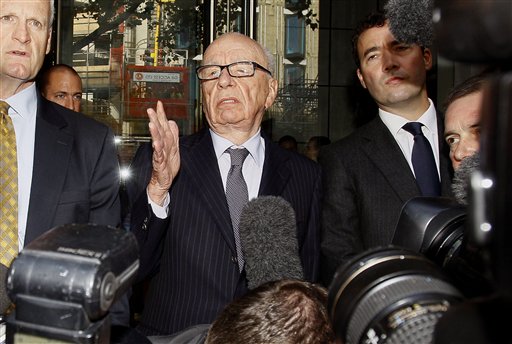
Rupert Murdoch

Rupert Murdoch, CEO of News Corporation and 20th Century Fox and other significant properties, has managed to become the media baron of the world. He became a feared leader of conservative politics and also someone who seemed to believe he was not required to follow the rules of behavior and law that others felt obliged to obey.

It is inconceivable that he or his lieutenants were unaware of the hacking of cell phones in the U.K. There have been accusations that his news media tried to obtain phone lists of family members of 9-11 victims.

Murdoch’s British lieutenant, Rebekah Brooks, stepped down earlier today, Friday. Then this very same day Les Hinton, chief executive of the Murdoch-owned Dow Jones & Co. and publisher of the Wall Street Journal, announced he was resigning immediately. No yet knows the real reason for the Hinton resignation.

Obviously there are many people in the media who would like to see his empire fail. In this case his hubris really has brought his stumble. I hope it’s his downfall. He deserves a little humbling.

World’s Most Expensive Cities

Which cities have the most expensive cost of living?

Mercer Human Resources Consulting, a world-wide firm with offices in North America, South America, Europe, the Middle East, and Asia has sufficient respect that its evaluations are reported in major newspapers and magazines.  The company has developed a Worldwide Cost of Living survey.  The results were reported in the Toronto Star today.  The entire listing is not posted to the web but can be purchased for $600USD.

Following is an abridged summary that was posted on the Mercer web site.

  • Luandain, Angola is the world’s most expensive city for expatriates; Karachi is the cheapest
  • Top 10 ranked cities are dominated by Africa, Europe and Asia
  • London drops 1 place to rank 18; Singapore and São Paolo join the top 10 list
  • New York is the most expensive in the United States followed by Los Angeles.
  • Los Angeles, the second most expensive U.S. city, fell 22 places to 77th place.

The survey covers 214 cities across five continents and measures the comparative cost of over 200 items in each location, including housing, transport, food, clothing, household goods and entertainment. It is the world’s most comprehensive cost of living survey and is designed to help multinational companies and governments determine compensation allowances for their expatriate employees.New York is used as the base city and all cities are compared against New York. Currency movements are measured against the US dollar. The cost of housing – often the biggest expense for expatriates – plays an important part in determining where cities are ranked.

New entries in the top 10 list of the costliest cities in the world are Singapore(8), up from 11, and São Paolo (10), which has jumped 11 places since the 2010 ranking.Karachi(214) is ranked as the world’s least expensive city, and the survey found that Luanda, in top place, is more than three times as costly as Karachi. Recent world events, including natural disasters and political upheavals, have impacted the rankings for many regions through currency fluctuations, cost inflation for goods and services and volatility in accommodation prices.

Down one place from last year, London(18) is the UK’s most expensive city, followed by Aberdeen(144), Glasgow(148) and Birmingham(150), Belfast(178) is ranked as the UK’s least expensive city.

The survey covers 214 cities across five continents and measures the comparative cost of over 200 items in each location, including housing, transport, food, clothing, household goods and entertainment. It is the world’s most comprehensive cost of living survey and is designed to help multinational companies and governments determine compensation allowances for their expatriate employees. New Yorkis used as the base city and all cities are compared against New York. Currency movements are measured against the US dollar. The cost of housing – often the biggest expense for expatriates – plays an important part in determining where cities are ranked.

At rank 32, New York is the most expensive city in the United States.Los Angeles(77) and Chicago(108) have dropped significantly in the rankings (22 and 17 places respectively) as price increases on goods and services have been moderate compared to New York. Washington, however, also at ranking 108, has climbed three places, as rental accommodation prices have increased significantly.

Portland(186) and Winston-Salem(197) are the least expensive cities in the United States. Up 17 places, Toronto(59) has overtaken Vancouver(65) to become the most expensive Canadian city in the ranking, followed by Montreal(79) and Calgary(96). Ranking 114, Ottawa is the least expensive city in Canada.

Rankings

March 2011 March 2010 City Country
1 1 LUANDA ANGOLA
2 2 TOKYO JAPAN
3 3 N’DJAMENA CHAD
4 4 MOSCOW RUSSIA
5 5 GENEVA SWITZERLAND
6 6 OSAKA JAPAN
7 8 ZURICH SWITZERLAND
8 11 SINGAPORE SINGAPORE
9 8 HONG KONG HONG KONG
10 21 SÂO PAULO BRAZIL
11 19 NAGOYA JAPAN
12 7 LIBREVILLE GABON
12 29 RIO DE JANEIRO BRAZIL
14 24 SYDNEY AUSTRALIA
15 11 OSLO NORWAY
16 22 BERN SWITZERLAND
17 10 COPENHAGEN DENMARK
18 17 LONDON UNITED KINGDOM
19 14 SEOUL SOUTH KOREA
20 16 BEIJING CHINA
21 25 SHANGHAI CHINA
21 33 MELBOURNE AUSTRALIA
23 23 NIAMEY NIGER
24 19 TEL AVIV ISRAEL
25 13 VICTORIA SEYCHELLES
25 15 MILAN ITALY
27 17 PARIS FRANCE
28 67 OUAGADOUGOU BURKINA FASO
29 30 ST. PETERSBURG RUSSIA
30 60 PERTH AUSTRALIA
31 55 BRISBANE AUSTRALIA
32 27 NEW YORK CITY,NY UNITED STATES
33 70 BRASILIA BRAZIL
34 26 ROME ITALY
34 74 CANBERRA AUSTRALIA
36 28 VIENNA AUSTRIA
37 38 NOUMÉA NEW CALEDONIA
38 38 GUANGZHOU CHINA
39 62 DJIBOUTI DJIBOUTI
39 76 STOCKHOLM SWEDEN
41 62 LAGOS NIGERIA
42 31 HELSINKI FINLAND
43 42 SHENZHEN CHINA
44 32 DAKAR SENEGAL
44 141 KHARTOUM SUDAN
46 90 ADELAIDE AUSTRALIA
47 47 PRAGUE CZECH REPUBLIC
48 36 BAKU AZERBAIJAN
49 33 BANGUI CENTRAL AFRICAN REPUBLIC
50 35 AMSTERDAM NETHERLANDS

First to Worst

Smug Californians thought they were so smart when they passed Proposition 13 (officially named the People’s Initiative to Limit Property Taxation) by 65%. The law set the initial property tax at 1.25% of the purchase price and restricts annual increases of assessed value of real property to an inflation factor, not to exceed 2% per year. I was one of those who voted for the law.

“We’ve chosen mediocre public service, and more private money. We’ve decided not to tax ourselves as much. We’ve basically turned our back on schools. It’s a choice we made within our state.” John Mockler, First to Worst

We were warned that there would be a price to pay for the imposition of the regulaton but we ignored the politicians.

This year many of us supported the anticipated 1% reduction in sales tax and a reduction in auto licensing fees.

Now we have to face the consequences of our choices. State parks are being closed, the highways are falling apart, and the schools lack funds to employ all the needed teachers. The final blow is our famed higher education system is now too expensive for the middle class. Even community college are asking students to pay $26.00 per unit in Los Angeles.

I earned by four year college degree by attending a junior college for two years at a cost of $6.50 per semester and two years at a state university at $42 a semester. The books cost more than the enrollment fees. I graduated in 1962.

In 1960, UCLA tuition fees were practically non-existent. However, by 1985 they had reached $722. Today University of California 2011-12, systemwide tuition and fees for California residents will be $11,124.

All students enrolling at California State University pay the systemwide State University Fee which is currently $4230 per academic year for undergraduate students enrolling in more than 6 units per term.

The consequence of our selfish decision to control property taxes is the 11.9% unemployment rate, the growing number of poorly educated citizens that lack the skills to compete in a more technologically demanding society, the deteriorating highway system, the closing of state parks, etc.

By the way California is not alone. Massachusetts, Oregon, Colorado and Florida all went on to copy key provisions of the Proposition 13, while voters in 18 other states passed nearly 40 statewide tax-limiting measures.

It should come as no surprise that Programme for International Student Assessment (PISA) report, which compares the knowledge and skills of 15-year-olds in 70 countries around the world, ranked the United States 14th out of 34 Organisation for Economic Co-operation and Development (OECD) countries for reading skills, 17th for science and a below-average 25th for mathematics.

Jon Stewart on Fox News Sunday

Let’s be clear about this situation.  It is Fox News that uses the words “Fair and Balanced.”  Those are not the words of Jon Stewart or anyone else.  I saw the interview on Fox News and then I watched Jon Stewart’s Daily Show on Monday, June 20. Jon suggested everyone watch the unedited clip of his appearance on Fox News Sunday.  Listen to Chris Wallace’s words.  “finally telling the other side of the story”, confirming what we already knew.  Fox is not “fair and balanced.”  It is presenting the right-wing view of the world even if it is distorted.

$ Ayn Rand, Goddess of the Market $

I just finished reading Jennifer Burns’ biography of Ayn Rand.   The exact title is “Goddess of the Market Ayn Rand and the American Right”The author is an Assistant Professor of History at the University of Virginia.  The 286 page book was printed in 2009 and its Epilogue includes opinion of our 2008 – 2011 Great Recession and how it relates to Rand.  Each chapter of the book starts with a dollar sign.

Ayn Rand was clearly irrevocably impacted by her childhood in Czarist and Communist Russia.  Her undying allegiance to a form of society that does not exist, except in theory, is the absolute opposite of some kind of free society that Karl Marx had envisioned.  Watch Youtube videos of Mike Wallace interviews of Ayn Rand and you will understand that she was unmovable by his reasonable questions about her allegiance to a theory.

The last sentence in the book tells it all. “…Rand lay facing the world in an open casket.  Next to her coffin was an enormous topiary, shaped into the sign of the dollar.”

Unfortunately too many American conservatives think such a society can exist.