Earthquake – Northridge 1994 Magnitude 6.7

Northridge Earthquake Apartment Building

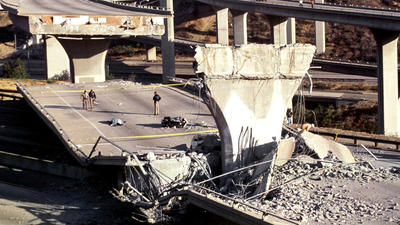
Aerial photo of Santa Monica Freeway

Aerial photo of Santa Monica Freeway

Freeway Collapse Northridge Earthquake 1994

It was 4:30 a.m. on January 17, 1994 when the house rumbled and swayed.  “Everybody into the hall”, I yelled.  With the doors closed to the bedrooms we sat there on the floor until the swaying had stopped.  Our neighbor was pounding on the front door.  He yelled, “Is everybody OK?”  That is when we left the hall and I opened the front door.

We were all OK and the damage was minor.  I missed two days of work because the freeways had collapsed.

New York City, Washington – what you experienced was a minor shake.  Here in Los Angeles we just go back to work.  Around the Pacific Ocean we are not alone.  Earthquakes on the San Andreas Fault are here.

World’s Wealthiest Man

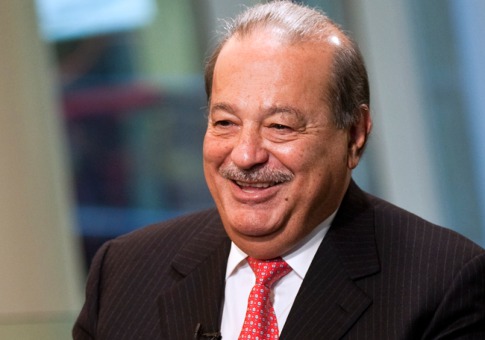
Carlos Slim Helú & family have $74 billion.

The world’s richest person for a second year in a row, the Mexican telecom mogul is also the year’s biggest gainer, having added $20.5 billion to his fortune and widened the gap between him and No. 2, Microsoft cofounder Bill Gates, to $18 billion. A 19% rise in the Mexican stock market, a stronger peso, and successful mining and real estate spinoffs from conglomerate Grupo Carso all contributed to the astonishing increase. He also merged his fixed-line telecom company into America Movil, Latin America’s largest wireless carrier; the Slim family stake in that holding accounts for 62% of his net worth. He has other holdings in retailer Saks and the New York Times. Recently unveiled a new building for his Soumaya Museum, which houses his vast art collection. It is open to the public for free.

Poor Bill Gates is number 2 on the list with a wealth of $56 billon.

This data according to Forbes magazine.  Forbes provides a list of the 20 wealthiest at http://www.forbes.com/2011/03/09/billionaires-20-richest_slide.html

Hewlett-Packard is Losing its Roots

Can you imagine McDonald’s deciding to change their menu so drastically that they would no longer sell hamburgers?  That is the kind of change Hewlett-Packard is contemplating.

It was 1983 and I was working for Dataproducts Corporation.  That was one of the largest manufacturers in the world of line printers that used dot matrix technology and printed a complete line of data at one time.  There was manufacturing of both the printers and the ribbons that fit them.  The company also manufactured ribbons for many other printer manufacturers.

There I was standing on the shipping dock when a quality control person informed me and another employee that Hewlett-Packard was testing a new technology called ink jet printing.  No printer ribbon was required.  I whistled and said Dataproducts would be dead if it did not develop new technology.  I was correct.  There is no Dataproducts  today. 

Very shortly after that discussion I owned an HP DeskJet 500 printer.  I still own an HP inkjet printer and an HP computer.  HP went on to buy Compaq Computer.  Now HP has decided to abandon its biggest unit that builds both computers and printers.  Those two product groups have been the heart of the company.

Léo Apotheker became HP’s new chief executive and president this past year.  His experience is at SAP.  SAP is a software company so it is no surprise that he would direct the company to a software orientation.  This is a mistake because the company has a history of hardware development and marketing.  The dramatic drop in the company’s stock price tells me that I am not alone in this view.

Stop Coddling the Super-Rich

The New York Times
The Opinion Pages

Op-Ed Contributor

Stop Coddling the Super-Rich

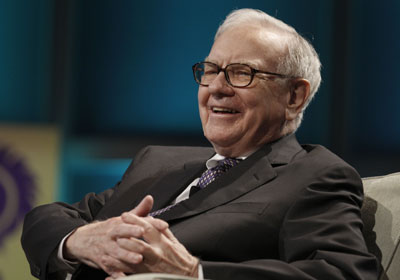
By WARREN E. BUFFET

Published: August 14, 2011

OUR leaders have asked for “shared sacrifice.” But when they did the asking, they spared me. I checked with my mega-rich friends to learn what pain they were expecting. They, too, were left untouched.

While the poor and middle class fight for us in Afghanistan, and while most Americans struggle to make ends meet, we mega-rich continue to get our extraordinary tax breaks. Some of us are investment managers who earn billions from our daily labors but `are allowed to classify our income as “carried interest,” thereby getting a bargain 15 percent tax rate. Others own stock index futures for 10 minutes and have 60 percent of their gain taxed at 15 percent, as if they’d been long-term investors.

These and other blessings are showered upon us by legislators in Washington who feel compelled to protect us, much as if we were spotted owls or some other endangered species. It’s nice to have friends in high places.

Last year my federal tax bill — the income tax I paid, as well as payroll taxes paid by me and on my behalf — was $6,938,744. That sounds like a lot of money. But what I paid was only 17.4 percent of my taxable income — and that’s actually a lower percentage than was paid by any of the other 20 people in our office. Their tax burdens ranged from 33 percent to 41 percent and averaged 36 percent.

If you make money with money, as some of my super-rich friends do, your percentage may be a bit lower than mine. But if you earn money from a job, your percentage will surely exceed mine — most likely by a lot.

To understand why, you need to examine the sources of government revenue. Last year about 80 percent of these revenues came from personal income taxes and payroll taxes. The mega-rich pay income taxes at a rate of 15 percent on most of their earnings but pay practically nothing in payroll taxes. It’s a different story for the middle class: typically, they fall into the 15 percent and 25 percent income tax brackets, and then are hit with heavy payroll taxes to boot.

Back in the 1980s and 1990s, tax rates for the rich were far higher, and my percentage rate was in the middle of the pack. According to a theory I sometimes hear, I should have thrown a fit and refused to invest because of the elevated tax rates on capital gains and dividends.

I didn’t refuse, nor did others. I have worked with investors for 60 years and I have yet to see anyone — not even when capital gains rates were 39.9 percent in 1976-77 — shy away from a sensible investment because of the tax rate on the potential gain. People invest to make money, and potential taxes have never scared them off. And to those who argue that higher rates hurt job creation, I would note that a net of nearly 40 million jobs were added between 1980 and 2000. You know what’s happened since then: lower tax rates and far lower job creation.

Since 1992, the I.R.S. has compiled data from the returns of the 400 Americans reporting the largest income. In 1992, the top 400 had aggregate taxable income of $16.9 billion and paid federal taxes of 29.2 percent on that sum. In 2008, the aggregate income of the highest 400 had soared to $90.9 billion — a staggering $227.4 million on average — but the rate paid had fallen to 21.5 percent.

The taxes I refer to here include only federal income tax, but you can be sure that any payroll tax for the 400 was inconsequential compared to income. In fact, 88 of the 400 in 2008 reported no wages at all, though every one of them reported capital gains. Some of my brethren may shun work but they all like to invest. (I can relate to that.)

I know well many of the mega-rich and, by and large, they are very decent people. They love America and appreciate the opportunity this country has given them. Many have joined the Giving Pledge, promising to give most of their wealth to philanthropy. Most wouldn’t mind being told to pay more in taxes as well, particularly when so many of their fellow citizens are truly suffering.

Twelve members of Congress will soon take on the crucial job of rearranging our country’s finances. They’ve been instructed to devise a plan that reduces the 10-year deficit by at least $1.5 trillion. It’s vital, however, that they achieve far more than that. Americans are rapidly losing faith in the ability of Congress to deal with our country’s fiscal problems. Only action that is immediate, real and very substantial will prevent that doubt from morphing into hopelessness. That feeling can create its own reality.

Job one for the 12 is to pare down some future promises that even a rich America can’t fulfill. Big money must be saved here. The 12 should then turn to the issue of revenues. I would leave rates for 99.7 percent of taxpayers unchanged and continue the current 2-percentage-point reduction in the employee contribution to the payroll tax. This cut helps the poor and the middle class, who need every break they can get.

But for those making more than $1 million — there were 236,883 such households in 2009 — I would raise rates immediately on taxable income in excess of $1 million, including, of course, dividends and capital gains. And for those who make $10 million or more — there were 8,274 in 2009 — I would suggest an additional increase in rate.

My friends and I have been coddled long enough by a billionaire-friendly Congress. It’s time for our government to get serious about shared sacrifice.

Warren E. Buffett is the chairman and chief executive of Berkshire Hathaway.

Apple Plans To Invest In a Sharp Factory

Apple Inc. (AAPL), that is the company that manufactures iPod, iPad, and iPhone, has $76 billion in cash on hand.  That is more money than the GDP of 2/3 of the world’s countries.

Morningstar reported today that Apple will “invest $1 billion in Sharp’s Kameyama plant in Japan, without elaborating.  Their source is a Reuters news agency report.

One comment on this story read in part:                                                              “But not in the USA. Now, if we are talking about job creation tell us Mr. Jobs why Apple is not helping out. Surely we can make LCD screens here. Where is your corporate responsibility to country?”

A second comment contradicts the first saying in part:                                      “You can’t force (or expect) companies to accept lower returns due to patriotism, nationalism etc. Capital is portable, it is agnostic. It seeks the highest risk adjusted returns, just like water flowing downhill. The solution is creating an environment where Companies are better off investing here, rather than outside the country. There are tons of drivers for this, regulatory, legal, labor costs, tax, FX hedging etc.”

My opinion is both are correct.  We are faced with a conundrum.  A company’s first loyalty should be to its shareholders.  At the same time there ought to be some loyalty to your nation.  Here is perfect opportunity for the president of the United States to get on the phone and talk to the COO of Apple, Timothy D. Cook , and perhaps to Steve Jobs too.  “How can we induce you to bring jobs back to the States?”  A good negotiator could make some headway.  Perhaps the negotiator is the president’s chief of staff, Bill Daley, who is known to have excellent ties to the business community.

When Bill Daley is done talking to Apple executives he needs to move on to the leaders of other large American companies.

David McCullough appears on Fareed Zakaria GPS

Listen carefully to the words of David McCullough. He points out the use of the English language by our leaders. He points to Canada as an example of what America seems to have lost.  He points out the difficulty of being president of the United States especially in the 21st century.  If you think it’s easy just look at the color of President Barack Obama’s hair in just 2 1/2 years.

Some Computers cannot read the youtube video.  It is available on the Huffington Post

http://www.huffingtonpost.com/2011/07/25/david-mccullough_n_908569.html

Alternate link:
http://www.youtube.com/watch?v=UFhE3OJDzyQ

Gunned Down In Acapulco

Acapuclo Deaths
Acapuclo Deaths

The above photo was scanned from today’s Los Angeles Times.  That is the reason for the blurriness of the picture.

Two bodies lie covered near a crowded beach in the Mexican resort city of Acapulco. Gunmen reportedly killed the victims while children and other beachgoers were watching a show featuring sea lions.  Previous news items about killings in Acapulco contended that the killing in that city was not in areas where tourists visited.

Latest Federal Debt Commission has no Skin In the Game

The group of Congressmen that are supposed to reach a debt reduction plan by November 23, 2011 is generally being called “The Gang of 12”. The problem is they have no motivation to accomplish the assigned task. 

For those Americans who don’t understand the debt deal it’s government by hostage taking. Congress formed a gang of 12 who are supposed to agree on a way to cut the deficit. If the gang fails or Congress doesn’t pass what they recommend, then the trigger is pulled and each hostage is shot.

The hostage for the Democrats is the elderly. The hostage for the Republicans is the military. If a deal fails, then wounded solders and the elderly are out on the street. Is this any way to run a country? Is this what America has come to?

I think Congress should have used themselves as a hostage. Why didn’t they pass a bill where if Congress doesn’t cut the deficit then they lose their pay? Better yet they should put their lifetime pension on the table. Here in California if the legislature doesn’t pass a budget on time, then they don’t get paid. They should have put their money on the table – not ours.