Obama and Romney: Where they stand on the issues

The Associated Press offered a detailed and lengthy run down of where Obama and Romney stand on the issues that we all to consider in the next election. Following is a summary. You can read the detail at http://my.earthlink.net/article/pol?guid=20120430/fe9b4c4c-15ca-43a7-9a4d-2605576b3e73


ABORTION and BIRTH CONTROL:
  

Obama: Supports abortion rights.

Romney: Opposes abortion rights.
  

DEBT:

Obama: Federal spending is estimated at 23.5 percent of gross domestic product this year, up from about 20 percent in previous administration, and is forecast to decline to 21.8 percent by 2016. Calls for tackling the debt with a mix of spending cuts and revenue increases. Central to Obama’s plan is to let Bush-era tax cuts expire for couples making more than $250,000. Debt reduction is based upon a stepped 10 year plan.

Romney: Would cap federal spending at 20 percent of gross domestic product by end of first term. Proposes broad but largely unspecified cuts in federal spending. Among the few details: 10 percent cut in federal workforce, elimination of $1.6 billion in Amtrak subsidies and cuts of $600 million in support for the arts and broadcasting.

ECONOMY:

Obama: Continued implementation of Wall Street and auto industry bailouts begun under George W. Bush. Proposes tax breaks for U.S. manufacturers producing domestically or repatriating jobs from abroad, and tax penalties for U.S. companies outsourcing jobs. Won approval of South Korea, Panama and Colombia free-trade pacts begun under previous administration, completing the biggest round of trade liberalization since the North American Free Trade Agreement and other pacts of that era.

Romney: Lower taxes, less regulation, balanced budget, more trade deals to spur growth. Replace jobless benefits with unemployment savings accounts. Proposes repeal of the (Dodd-Frank) law toughening financial-industry regulations after the meltdown in that sector. Proposes repeal of the (Sarbanes-Oxley) law tightening accounting regulations in response to corporate scandals, and replacing it with less onerous rules to ease the accountability burden on smaller businesses.

EDUCATION:

Obama: Has approved waivers freeing states from the most onerous requirements of the Bush-era No Child Left Behind law with their agreement to improve how they prepare and evaluate students. “Race to the Top” competition has rewarded winning states with billions of dollars for pursuing education policies Obama supports. Won approval for a college tax credit worth up to $10,000 over four years and more money for Pell grants for low-income college students. Wants Congress to agree to reduce federal aid to colleges that go too far in raising tuition.

Romney: Supported the federal accountability standards of No Child Left Behind law. In 2007, said he was wrong earlier in career when he wanted the Education Department shut because he came to see the value of the federal government in “holding down the interests of the teachers’ unions” and putting kids and parents first. Has said the student testing, charter-school incentives and teacher evaluation standards of Obama’s “Race to the Top” competition “make sense” although the federal government should have less control of education.

ENERGY and ENVIRONMENT

Obama: Proposes Congress give oil market regulators more power to control price manipulation by speculators and stiffer fines for doing so. Failed to persuade a Democratic Congress to pass limits he promised on carbon emissions. Shelved plan to toughen health standards on lung-damaging smog. Rejected Keystone XL oil pipeline from Canada but supports fast-track approval of a segment of it. Proposes ending subsidies to oil industry but has failed to persuade Congress to do so.


Romney: Supports opening the Atlantic and Pacific outer continental shelves to drilling, as well as Western lands, the Arctic National Wildlife Refuge and offshore Alaska; and supports exploitation of shale oil deposits. Wants to reduce obstacles to coal, natural gas and nuclear energy development, and accelerate drilling permits in areas where exploration has already been approved for developers with good safety records.


GAY RIGHTS:

Obama: Once opposed federal recognition of same-sex marriage, later said his views were “evolving” and has not taken a position on that since.

Romney: Favors constitutional amendment to ban gay marriage.

HEALTH CARE:

Obama: Achieved landmark legislation and if the Supreme Court upholds the heath care law and its mandate for almost everyone to obtain insurance.

Romney: Promises to work for the repeal of the federal health care law.

IMMIGRATION:

Obama: Failed to deliver on a promised immigration overhaul. . Says he is still committed to it.

Romney: Favors U.S.-Mexico border fence, opposes education benefits to illegal immigrants. Opposes offering legal status to illegal immigrants who attend college, but would do so for those who serve in the armed forces. Proposes more visas for holders of advanced degrees in math, science and engineering who have U.S. job offers, and would award permanent residency to foreign students who graduate from U.S. schools with a degree in those fields.

SOCIAL SECURITY:

Obama: Has not proposed a comprehensive plan to address Social Security’s long-term financial problems.

Romney: Protect the status quo for people 55 and over but, for the next generations of retirees, raise the retirement age for full benefits by one or two years and reduce inflation increases in benefits for wealthier recipients.

TAXES:

Obama: Wants to raise taxes on the wealthy and ensure they pay 30 percent of their income at minimum. Supports extending Bush-era tax cuts for everyone making under $200,000, or $250,000 for couples.

Romney: Drop all tax rates by 20 percent, bringing the top rate, for example, down to 28 percent from 35 percent and the lowest rate to 8 percent instead of 10 percent. Curtail deductions, credits and exemptions for the wealthiest. End Alternative Minimum Tax for individuals, eliminate capital gains tax for families making below $200,000 and cut corporate tax to 25 percent from 35 percent.

TERRORISM:

Obama: Largely carried forward Bush’s key anti-terrorism policies, including detention of suspects at Guantanamo Bay despite promise to close the prison. Also has continued with military commissions instead of civilian courts for detainees and invocation of state secrets privilege in court. Expanded use of unmanned drone strikes against terrorist targets in Pakistan and Yemen.

Romney: No constitutional rights for foreign terrorism suspects. He does not consider waterboarding to be torture.

WAR:

Obama: Declined to repeat the Libya air power commitment for Syrian opposition. Opposes a near-term military strike on Iran, either by the U.S. or by Israel, to sabotage nuclear facilities that could be misused to produce a nuclear weapon. Says the U.S. will never tolerate a nuclear-armed Iran but negotiation and pressure through sanctions are the right way to prevent that outcome. Reserves the right to one day conclude that only a military strike can stop Iran from getting the bomb.


Romney: Has not specified the troop numbers behind his pledge to ensure the “force level necessary to secure our gains and complete our mission successfully” in Afghanistan. Would increase strength of armed forces, including number of troops andwarships, adding almost $100 billion to the Pentagon budget in 2016.
Economy is Job One!

May 4, 2012 Addendum.  The April jobs report confirmed my worst fears.  The U.S. economy added just 115,000 jobs and yet the unemployment rate is down another tenth of a percent to 8.1%.  In other words more people have given up the search.  This is another great day for Mitt  Romney.  Everything I wrote on April 28 remains valid.  The difference  is it has just been reinforced.    

Is the recession over? Not if you are unemployed. Over 12 million Americans are in that status. Most of those people have families that have been impacted. The impact is more likely on three to four times that number. Worse is that the number is not the real number because many more people are no longer counted as unemployed. Most economists add about 50% to the official numbers to reach that real number.

The Obama administration failed to address the primary issue facing the nation. That is the condition of our economy.

Where is the plan to change our course of outsourced jobs? It does not exist.

The latest pieces of economic data support the feeling that the economy is struggling to recover from the Great Recession. New claims for unemployment benefits dropped to 351,000 in the week ending February 11 of this year but have been increasing every week since then with one exception. Gross Domestic Product (GDP) for the first quarter of 2012 grew 2.2% versus a growth of 3% in the last quarter of 2011. The president can’t be held responsible for everything in our economy but there is little he has done or proposed to improve the situation.

 The problem is that Mitt Romney has not enunciated any actions he would take that would change our desperate employment situation. The number of unemployed reached over 14 million people and has now dropped to under 13 million. However the number of long term unemployed has not been significantly reduced and still remains over 5 million people. Obama’s policies did save the country’s auto manufacturers but too many products and services are now provided in other countries.

Americans are the employer of the president. We have the right to expect results. Barack Obama’s four year contract is almost up. Unfortunately the alternate candidate for the job has not told us what he would do to change our economic situation.

The Social Security Time Bomb

Rather than focusing on our broken political system this article is focusing on a solution to the Social Security time bomb. Only yesterday the Social Security Trustees said that the system will not have sufficient funds for the promised payouts in 2033.

Regular ongoing monthly Social Security benefits started in January 1940. Despite what some will claim we are experiencing longer lives. The system was counting on almost everyone dying within ten years of retirement. The problem for the program is that too many are living into their 80s and 90s.

The Democrats have not faced the reality of longer lives. The Republicans have but their solutions are unacceptable to most of us. Interestingly it was George W. Bush who tried to resolve the issue but the two parties seem bent upon disagreement even when they know there is a solution.

We all know that many people are relying on the system as their only source of income. Cutting benefits for the poorest is not a reasonable solution.

There are a few things we can do:
1. Establish a “means test” that would deny benefits to those with higher retirement income.
2. Raise the maximum taxable contributions from the current level.
3. Raise the retirement age.

To do these things will require courage. That is lacking in our representatives.

Things are Getting Better?

The unemployment rate decreased .1% last month. That sounds good but the cause was more people giving up on searching for a job.  There weren’t even enough jobs created last month to keep up with increased population. 

Today’s Bureau of Labor Statistics report included the following statement. “The number of long-term unemployed (those jobless for 27 weeks and over)was essentially unchanged at 5.3 million in March. These individuals accounted for 42.5 percent of the unemployed. Since April 2010, the number of long-term unemployed has fallen by 1.4 million.”

There is the problem that neither President Obama nor Mitt Romney has addressed. American industry doesn’t need most of those long term unemployed. The reason is that technology and the export of American jobs has reduced the numbers of people required in the United States.

The president’s job plan does include the following proposals
– A $4,000 tax credit to employers for hiring long-term unemployed workers.
– Prohibiting employers from discriminating against unemployed workers when hiring.
Nice gestures that do not answer the question of who will hire these un-needed people?

I have found nothing in Mitt Romney’s proposals that even suggest any solutions. His focus is on “free market.” My question is, where were the free markets under George W. Bush when the economy was in free fall?

My solution is higher tariffs on all imported products. Neither Obama nor Romney agree with that solution.  They don’t have a solution!

A Festival of Lies

OP-ED COLUMNIST in the New York Times
A Festival of Lies
By THOMAS L. FRIEDMAN
Published: March 24, 2012

THE historian Victor Davis Hanson recently wrote a brutally clear-eyed piece in The National Review, looking back at America’s different approaches to Iraq, Iran, Libya, Syria, Egypt, Pakistan and Afghanistan and how, sadly, none of them could be said to have worked yet.

“Let us review the various American policy options for the Middle East over the last few decades,” Hanson wrote. “Military assistance or punitive intervention without follow-up mostly failed. The verdict on far more costly nation-building is still out. Trying to help popular insurgents topple unpopular dictators does not guarantee anything better. Propping up dictators with military aid is both odious and counterproductive. Keeping clear of maniacal regimes leads to either nuclear acquisition or genocide — or 16 acres of rubble in Manhattan. What have we learned? Tribalism, oil, and Islamic fundamentalism are a bad mix that leaves Americans sick and tired of the Middle East — both when they get in it and when they try to stay out of it.”

And that is why it’s time to rethink everything we’re doing out there. What the Middle East needs most from America today are modern schools and hard truths, and we haven’t found a way to offer either. Because Hanson is right: What ails the Middle East today truly is a toxic mix of tribalism, Shiite-Sunni sectarianism, fundamentalism and oil — oil that constantly tempts us to intervene or to prop up dictators.
This cocktail erodes all the requirements of a forward-looking society — which are institutions that deliver decent government, consensual politics that provide for rotations in power, women’s rights and an ethic of pluralism that protects minorities and allows for modern education. The United Nations Arab Human Development Report published in 2002 by some brave Arab social scientists also said something similar: What ails the Arab world is a deficit of freedom, a deficit of modern education and a deficit of women’s empowerment.

So helping to overcome those deficits should be what U.S. policy is about, yet we seem unable to sustain that. Look at Egypt: More than half of its women and a quarter of its men can’t read. The young Egyptians who drove the revolution are desperate for the educational tools and freedom to succeed in the modern world. Our response should have been to shift our aid money from military equipment to building science-and-technology high schools and community colleges across Egypt. 

Yet, instead, a year later, we’re in the crazy situation of paying $5 million in bail to an Egyptian junta to get U.S. democracy workers out of jail there, while likely certifying that this junta is liberalizing and merits another $1.3 billion in arms aid. We’re going to give $1.3 billion more in guns to a country whose only predators are illiteracy and poverty.

In Afghanistan, I laugh out loud whenever I hear Obama administration officials explaining that we just need to train more Afghan soldiers to fight and then we can leave. Is there anything funnier? Afghan men need to be trained to fight? They defeated the British and the Soviets!

The problem is that we turned a blind eye as President Hamid Karzai stole the election and operated a corrupt regime. Then President Obama declared that our policy was to surge U.S. troops to clear out the Taliban so “good” Afghan government could come in and take our place. There is no such government. Our problem is not that Afghans don’t know the way to fight. It is that not enough have the will to fight for the government they have. How many would fight for Karzai if we didn’t pay them?

And so it goes. In Pakistan, we pay the Pakistani Army to be two-faced, otherwise it would be only one-faced and totally against us. In Bahrain, we looked the other way while ruling Sunni hard-liners crushed a Shiite-led movement for more power-sharing, and we silently watch our ally Israel build more settlements in the West Bank that we know are a disaster for its Jewish democracy.

But we don’t tell Pakistan the truth because it has nukes. We don’t tell the Saudis the truth because we’re addicted to their oil. We don’t tell Bahrain the truth because we need its naval base. We don’t tell Egypt the truth because we’re afraid it will walk from Camp David. We don’t tell Israel the truth because it has votes. And we don’t tell Karzai the truth because Obama is afraid John McCain will call him a wimp.

Sorry, but nothing good can be built on a soil so rich with lies on our side and so rich with sectarianism, tribalism and oil-fueled fundamentalism on their side. Don’t get me wrong. I believe change is possible and am ready to invest in it. But it has got to start with them wanting it. I’ll support anyone in that region who truly shares our values — and the agenda of the Arab Human Development Report — and is ready to fight for them. But I am fed up with supporting people just because they look less awful than the other guys and eventually turn out to be just as bad.

Where people don’t share our values, we should insulate ourselves by reducing our dependence on oil. But we must stop wanting good government more than they do, looking the other way at bad behavior, telling ourselves that next year will be different, sticking with a bad war for fear of being called wimps and selling more tanks to people who can’t read.

A version of this op-ed appeared in print on March 25, 2012, on page SR13 of the New York edition with the headline: A Festival of Lies.

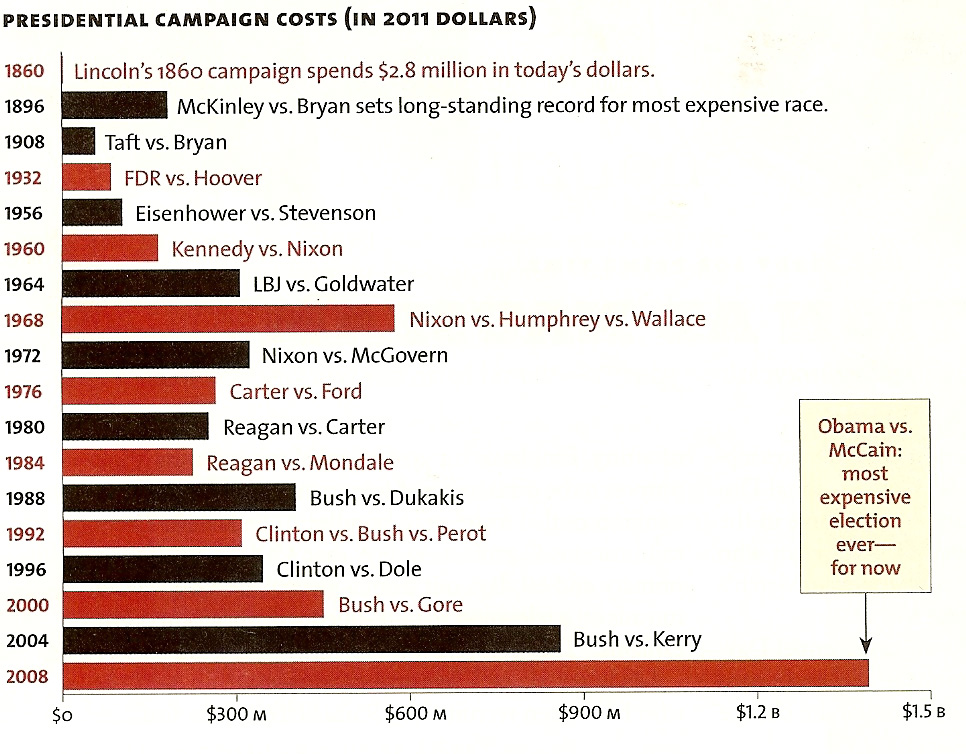
What will the next Presidential Campaign Cost?

The White House may be the ultimate recession-proof commodity. Barack Obama spent $730 million getting elected in 2008-twice as much as George W. Bush spent 4 years earlier and more than 260 times what Abraham Lincoln spent nearly 150 years earlier. -Dave Gilson

Lincoln’s 1860 campaign spends $2.8 million in today’s dollars.

McKinley vs. Bryan sets long-standing record for most expensive race.

If this chart does not prove that campaigns are won with the most money than what will?

This data from Mother Jones magazine.

The rabbi who guided Reform Judaism

An obituary appearing in THE WEEK magazine dated February 24, 2012.  W. Gunther Plaut (1912-2012)

The rabbi whose commentary on the Torah helped introduce tens of thousands of Reform Jews to their faith got an early lesson in the importance of literary interpretation soon after arriving in America, in 1935. He saw a newspaper in Cincinnati that, to his eyes, announced surprising news of a revolution in Italy. The headline: “Reds Murder Cardinals.”

Wolf Gunther Plaut was born in Munster, Germany, and earned a doctorate in law at the University of Berlin, said the Toronto National Post. But when the Nazis came to power, they barred Jews from practicing law, so Plaut began studying Jewish theology. “I wanted to know what it truly meant to be a Jew if I was made to suffer for it,” he later said. He received a scholarship to study in the U.S. in 1935, was ordained as a rabbi in 1939, and became a U.S. citizen in 1943. Having enlisted with the U.S. Army as a chaplain, he witnessed the liberation of the Mittelbau-Dora concentration camp at the end of the war. He recalled the survivors as desperate for theological relief. “Their first request was not for food, but for Jewish religious items,” he said.

Plaut settled in Toronto, said The New York Times, where he wrote his “magnum opus,” a modern commentary on the Jewish holy scriptures that became a “touchstone for Judaism’s liberal branches” upon its publication in 1981. Prior to Plaut’s edition, the only available translation of the Torah was one published in the 1920s with an Orthodox commentary. Plaut’s Torah interpreted Hebrew scripture “in ways that a strict adherence to tradition did not admit.” The book is now used in Reform synagogues throughout the U.S. and Canada. “You may never have met Rabbi Plaut personally,” said U.S. Reform Rabbi Jan Katzew, “yet it is likely that he taught you Torah.”

Plaut was a fierce opponent of discrimination and prejudice throughout his life, said the Toronto Star, whether it was directed against Jews in the Soviet Union or racial minorities in North America. “He was a defender of human and civil rights at a time when many didn’t even know its meaning,” said Bernie Farber, former head of the Canadian Jewish Congress. “We stand on the shoulders of such men.”

Thoughts on Politics

When I was a boy I was told that anybody could become President; I’m beginning to believe it. ~Clarence Darrow

If God wanted us to vote, he would have given us candidates. ~Jay Leno

Politicians are people who, when they see light at the end of the tunnel, go out and buy some more tunnel. ~John Quinton
 

I offer my opponents a bargain:ï if they will stop telling lies about us, I will stop telling the truth about them.~Adlai Stevenson, campaign speech, 1952

A politician is a fellow who will lay down your life for his country.~ Texas Guinan
 

Politics is supposed to be the second-oldest profession.   I have come to realize that it bears a very close resemblance to the first.~Ronald Reagan
 

Instead of giving a politician the keys to the city, it might be better to change the locks.~Doug Larson
 

There ought to be one day — just one — when there is open season on senators. ~Will Rogers

Obama vs. Israel: Priority No.1? Stop Israel

Although Charles Krauthammer is an excellent commentator I rarely agree with his opinion. This time he does make me think.

Is this an uh-oh moment for Israel?

By Charles Krauthammer, published in a local paper today

IT’S Lucy and the football, Iran-style. After ostensibly tough talk about preventing Iran from going nuclear, the Obama administration acquiesced to yet another round of talks with the mullahs.

This, 14 months after the last group-of-six negotiations collapsed in Istanbul because of blatant Iranian stalling and unseriousness. Nonetheless, the new negotiations will be both without precondition and preceded by yet more talks to decide such trivialities as venue.

These negotiations don’t just gain time for a nuclear program about whose military intent the IAEA is issuing alarming warnings. They make it extremely difficult for Israel to do anything about it (while it still can), lest Israel be universalfy condemned for having aborted a diplomatic solution.

If the administration were serious about achievement rather than appearance, it would have warned that this was the last chance for Iran to come clean and would have demanded a short timeline. After all, President Obama insisted on deadlines for the Iraq withdrawal, the Afghan surge and Israeli-Palestinian negotiations .. Why leave these crucial talks open-ended when the nuclear clock is ticking?

This re-engagement comes immediately after Obama’s campaign-year posturing about Iran’s nukes. Last Sunday in front of AlPAC, he warned that “Iran’s leaders should have no doubt about the resolve of the United States.” This just two days after he’d said (to the Atlantic) of possible U.S. military action, “I don’t bluff.” Yet on Tuesday he returns to the very engagement policy that he admits had previously failed.

Won’t sanctions make a difference this time, however? Sanctions are indeed hurting Iran economically. But when Obama’s own director of national intelligence was asked by the Senate intelligence committee whether sanctions had any effect on the course of Iran’s nuclear program, the answer was simple: No. None whatsoever.

Obama garnered much AlPAC applause by saying that his is not a containment policy but a prevention policy. But what has he prevented? Keeping a coalition of six together is not success. Holding talks is not success. Imposing sanctions is not success.

Success is halting and reversing the program. Yet Iran is tripling its uranium output, moving enrichment facilities deep under a mountain near Qom and impeding IAEA inspections of weaponization facilities.

So what is Obama’s real objective? “We’re trying to make the decision to attack as hard as possible for Israel,” an administration official told the Washington Post in the most revealing White House admission since “leading from behind.”

Revealing and shocking. The world’s greatest exporter of terror (according to the State Department), the systematic killer of Americans in Iraq and Afghanistan, the self-declared enemy that invented “Death to America Day” is approaching nuclear capability – and the focus of U.S. policy is to prevent a democratic ally threatened with annihilation from pre-empting the threat?

Indeed it is. The new open-ended negotiations with Iran fit well with this strategy of tying Israel down. As does Obama’s “I have Israel’s back” reassurance, designed to persuade Israel and its supporters to pull back and outsource to Obama what for Israel are life-and-death decisions.

Yet 48 hours later, Obama tells a news conference that this phrase is just a historical reference to supporting such allies as Britain and Japan – contradicting the intended impression he’d given AlP AC that he was offering special protection to an ally under threat of physical annihilation.

To AlPAC he declares that “no Israeli government can tolerate a nuclear weapon in the hands of a regime that denies the Holocaust, threatens to wipe Israel off the map, and sponsors terrorist groups committed to Israel’s destruction” and affirms “Israel’s sovereign right to make its own decisions … to meet its security needs.”

And then he pursues policies – open-ended negotiations, deceptive promises of tough U.S. backing for Israel, boasts about the efficacy of sanctions, grave warnings about “war talk” – meant, as his own official admitted, to stop Israel from exercising precisely that sovereign right to self-protection.

Yet beyond these obvious contradictions and walk-backs lies a transcendent logic: As with the Keystone pipeline postponement, as with the debt-ceiling extension, as with the Afghan withdrawal schedule, Obama wants to get past Nov. 6 without any untoward action that might threaten his re-election.

For Israel, however, the stakes are somewhat higher: the very existence of a vibrant nation and its 6 million Jews. The asymmetry is stark. A fair-minded observer might judge that Israel’s desire to not go gently into the darkness carries higher moral urgency than the political future of one man, even if he is president of the United States.