The Issue is Long Term Unemployment

From the Bureau of Labor Statistics report dated today, March, 9, 2012.
“The number of long-term unemployed (those jobless for 27 weeks and over) was little changed at 5.4 million in February. These individuals accounted for 42.6 percent of the unemployed.”

“The number of persons employed part time for economic reasons(sometimes referred to as involuntary part-time workers) was essentially unchanged at 8.1 million in February. These individuals were working part time because their hours had been cut back or because they were unable to find a full-time job.”

Perhaps this answers the question, why is one in seven Americans receiving aid to buy food?

Millions of people lost jobs in the last four years, and being plunged into poverty made them eligible for food assistance. “That’s the way this program is designed,” said Kevin Concannon, the head of the USDA’s Food and Nutrition Service. Some 15 percent of the population-the highest rate since 1993-now lives at or below the poverty level, which is defined as $19,090 per year for a family of three. The average food stamp household of 2.2 people receives $287 in monthly food-assistance benefits, or about $72 a week. That’s not a lot to feed two people, but food stamp spending adds up: It has quadrupled in the course of the last 10 years, to a total this year of $80.4 billion. Critics blame that cost explosion on relaxed eligibility standards that began under the Bush administration, and on a boost in monthly benefits put through by Obama as part of the 2009 stimulus package. Obama increased the amount of time people could stay on food stamps, and added about $80 to the monthly benefits of a family of four. “No program in our government has surged out of control more dramatically than food stamps,” said Sen. Jeff Sessions of Alabama.

The issue is the millions who are unemployed with no job opportunities on the horizon. Our nation’s leaders in both political parties have not offered any solutions. 

HAVE THEY?

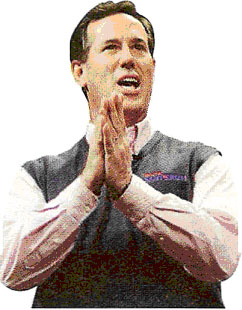
Rick Santorum is Pulling the GOP Too Far to the Right

   He is a sincere man who is clearly outside the mainstream of American opinion on the place of religion in our society.  He wants religion to participate in government and direct everyone’s behavior.  He couldn’t be more wrong. The First Amendment to the Constitution specifically says that “Congress shall make no law respecting an establishment of religion, or prohibiting the free exercise thereof.”  Those are the very first words of that amendment.

From The Week magazine

Rick Santorum may be leading Mitt Romney in the polls, said Jennifer Rubin in WashingtonPost.com, but the sweater­vested Pennsylvanian reminded us this week of why the GOP would “get slaughtered with Santorum as the nominee.”

 In a speech on President Obama’s energy policy, the devout Catholic veered off into an attack on Obama’s “phony theol­ogy” that, he later explained, “elevates the earth above man.” Then Santorum set off a fresh controversy by saying he opposes free prenatal testing for pregnant women because it can lead to abortions of fetuses with birth defects. With Santorum heading the Republican ticket this November, one GOP senator moaned this week, “we’d lose 35 states,” and the House of Representatives, too. Santorum’s social conservatism would be less problematic if he weren’t so abrasive, said David Kuhn in ReaIClearPolitics.com. But he has compared the battle to defeat President Obama to the struggle against Hitler in World War II, and this week, a tape surfaced of Santorum telling a crowd in 2008 that “Satan has his sights on the United States of America.” This fire-and-brimstone rhetoric is clearly helping Santorum with the social conservatives who vote in GOP primaries, but it’s a major turnoff to “the independent voters who elect American presidents.”

 Santorum’s appeal to these voters is not hard to understand, said Harold Meyerson in The Washington Post. His worldview “summons the ghosts of religious and patriarchal orders that once regulated much of working-class life,” for which many conservatives are deeply nostalgic.

But Americans also value personal freedom, said Conor Friedersdorf in TheAtlantic.com. Are voters really going to hand the presidency to a man who wants to criminalize abortion even in the case of incest and rape, opposes contraception even for married couples, and famously equated homosexuality with “man-on­dog” sex? Republican presidential candidates don’t have to be Ron Paul libertarians, said Philip Klein in WashingtonExaminer.com, but Santorum seems “actively hostile” to the idea that people have a right to make their own moral decisions. Nominating a smug scold who wants to “lecture Americans about their sex lives” would “ensure a Democratic rout in November.”

 “Santorum’s style of social conservatism is deeply American,” said Rich Lowry in National Review, despite what “the media and political elite” would have you believe. He walks the walk, as the father of seven children, including one with a serious birth defect that often leads other couples to choose abortion. His “pas­sionate intensity” plays very well with blue-collar voters, many of whom share Santorum’s belief that issues of family and culture are inextricably bound up with “the struggles of the working class.”

Santorum should probably avoid “the weeds of theological debate,” said William McGurn in The Wall Street Journal. He should also stop criticizing contraception. But the core of his appeal is that he’s a “conviction politician,” and even those who might not share all his views “are hungry for a nominee who does not bend with the wind.” Perhaps so, said David Weigel in Slate.com. But even Santorum now realizes that as a front-runner, he needs to tone down the harsh rhetoric. “Santorum 2.0” is saying that gays should be “treated with respect,” and noting that as a senator, he voted for two international aid programs that provided contraception. His problem is that, as the 2008 “Satan” speech illustrates, Santorum 1.0 has left a mother lode of extremist positions and off-the-wall statements for the media and his opponents to mine. And the digging “has only just begun.”

What do candidates really believe?

Want to know what candidates really believe?  Listen to what they say after they speak without a teleprompter or written notes.  If they subsequently say things like “my words were taken out of context” or “I didn’t understand the question” then you know that they meant exactly what you understood.  This is valid for talk show hosts, congressional candidates as well as presidential candidates.

President Barack Obama was quoted saying “They cling to guns or religion” Obama was explaining his difficulty with winning over working-class voters in Pennsylvania  and the Midwest, saying they have become frustrated with economic conditions:

“And it’s not surprising then that they get bitter, they cling to guns or religion or antipathy to people who aren’t like them or anti-immigrant sentiment or anti-trade sentiment as a way to explain their frustrations,” Obama said.

“Obviously, if I worded things in a way that made people offended, I deeply regret that,” Obama said in a phone interview with the Winston-Salem Journal. “But the underlying truth of what I said remains, which is simply that people who have seen their way of life upended because of economic distress are frustrated and rightfully so.”

Rush Limbaugh, “My choice of words was not the best, and in the attempt to be humorous, I created a national stir,” Limbaugh said on his website. “I sincerely apologize to Ms. Fluke for the insulting word choices.”

Mitt Romney’s wife has two Cadillacs and he is “great friends” with some NASCAR team owners.

John F. Kennedy’s 1960 speech on the separation of church and state made Rick Santorum want to “throw up.”  He thinks the president is a “snob” for urging people to go to college or obtain more education than a high school diploma.

Can candidates make real mistakes? Of course.  The difficulty is trying to understand the true views and opinions of a candidate.

Based upon the words spoken in the GOP primaries it is clear that Mitt Romney will say whatever his audience wants to hear.

Rick Santorum is a sincere orthodox Catholic who would be likely to follow church doctrine in his decision making process.  That would be the exact opposite of JFK.  Non-Catholics be afraid.  Be very afraid.

Three Economic Misconceptions That Need to Die

Thought this article very interesting.  Especially with information cited coming from notable sources.  This among so many other issues can only leave us wondering how much misinformation we are fed . . . or simply on the face of it, how much we choose to believe.

Love the quote from Evan Thomas who said. . . “You are entitled to your own opinion, but you’re not entitled to your own facts.”  Hmmmm
Three Economic Misconceptions That Need to Die
By Morgan Housel, Columnist at The Motley Fool, USC graduate in Economics


At a conference in Philadelphia last October, a Wharton professor noted that one of the country’s biggest economic problems is a tsunami of misinformation. You can’t have a rational debate when facts are so easily supplanted by overreaching statements, broad generalizations, and misconceptions. And if you can’t have a rational debate, how does anything important get done? As author William Feather once advised, “Beware of the person who can’t be bothered by details.” There seems to be no shortage of those people lately.

Here are three misconceptions that need to be put to rest.

Misconception No. 1: Most of what Americans spend their money on is made in China.

Fact: Just 2.7% of personal consumption expenditures go to Chinese-made goods and services. 88.5% of U.S. consumer spending is on American-made goods and services. I used that statistic in a recent article, and the response from readers was overwhelming: Hogwash. People just didn’t believe it.


The figure comes from a Federal Reserve report. You can read it here.

A common rebuttal I got was, “How can it only be 2.7% when almost everything in Walmart (WMT) is made in China?” Because Walmart’s $260 billion in U.S. revenue isn’t exactly reflective of America’s $14.5 trillion economy. Walmart might sell a broad range of knickknacks, many of which are made in China, but the vast majority of what Americans spend their money on is not knickknacks.


The Bureau of Labor Statistics closely tracks how an average American spends their money in an annual report called the Consumer Expenditure Survey. In 2010, the average American spent 34% of their income on housing, 13% on food, 11% on insurance and pensions, 7% on health care, and 2% on education. Those categories alone make up nearly 70% of total spending, and are comprised almost entirely of American-made goods and services (only 7% of food is imported, according to the USDA).
Even when looking at physical goods alone, Chinese imports still account for just a small fraction of U.S. spending. Just 6.4% of nondurable goods — things like food, clothing and toys — purchased in the U.S. are made in China; 76.2% are made in America. For durable goods — things like cars and furniture — 12% are made in China; 66.6% are made in America.

Another way to grasp the value of Chinese-made goods is to look at imports. The U.S. imported $399 billion worth of goods from China last year, which is 2.7% of our $14.5 trillion economy. Is that a lot? Yes. Is it most of what we spend our money on? Not by a long shot.


Part of the misconception is likely driven by the notion that America’s manufacturing base has been in steep decline. The truth, surprising to many, is that real manufacturing output today is near an all-time high. What’s dropped precipitously in recent decades is manufacturing employment. Technology and automation has allowed American manufacturers to build more stuff with far fewer workers than in the past. One good example: In 1950, a U.S. Steel (X) plant in Gary, Ind., produced 6 million tons of steel with 30,000 workers. Today, it produces 7.5 million tons with 5,000 workers. Output has gone up; employment has dropped like a rock.


Misconception No. 2:We owe most of our debt to China.

Fact: China owns 7.6% of U.S. government debt outstanding.

As of November, China owned $1.13 trillion of Treasuries. Government debt stood at $14.9 trillion that month. That’s 7.6%.

Who owns the rest? The largest holder of U.S. debt is the federal government itself. Various government trust funds like the Social Security trust fund own about $4.4 trillion worth of Treasury securities. The Federal Reserve owns another $1.6 trillion.

Both are unique owners: Interest paid on debt held by federal trust funds is used to cover a portion of federal spending, and the vast majority of interest earned by the Federal Reserve is remitted back to the U.S. Treasury.

The rest of our debt is owned by state and local governments ($700 billion), private domestic investors ($3.1 trillion), and other non-Chinese foreign investors ($3.5 trillion).

Does China own a lot of our debt? Yes, but it’s a qualified yes. Of all Treasury debt held by foreigners, China is indeed the largest owner ($1.13 trillion), followed by Japan $1 trillion) and the U.K. ($429 billion).

Right there, you can see that Japan and the U.K. combined own more U.S. debt than China. Now, how many times have you heard someone say that we borrow an inordinate amount of money from Japan and the U.K.? I never have. But how often do you hear some version of the “China is our banker” line? Too often, I’d say.

Misconception No. 3:We get most of our oil from the Middle East. Fact: Just 9.8% of oil consumed in the U.S. comes from the Middle East.

According the U.S. Energy Information Administration, the U.S. consumes 19.2 million barrels of petroleum products per day. Of that amount, a net 49% is produced domestically. The rest is imported.

Where is it imported from? Only a small fraction comes from the Middle East, and that fraction has been declining in recent years. Last year, imports from the Persian Gulf region — which includes Bahrain, Iran, Iraq, Kuwait, Qatar, Saudi Arabia, and the United Arab Emirates — made up 9.8% of total petroleum supplied to the U.S. In 2001, that number was 14.1%.

The U.S. imports more than twice as much petroleum from Canada and Mexico than it does from the Middle East. Add in the share produced domestically, and the majority of petroleum consumed in the U.S. comes from North America.

This isn’t to belittle our energy situation. The nation still relies on imports for about half of its oil. That’s bad. But should the Middle East get the attention it does when we talk about oil reliance? In terms of security and geopolitical stability, perhaps. In terms of volume, probably not.