Ugly Truths Beneath Jobs Report

Beneath Jobs Report Surface Lies Some Ugly Truths

Published: Friday, 5 Aug 2011

By: Jeff Cox

CNBC.com Staff Writer

Before getting too excited about the modest uptick in net job creation and a slight downward move in the unemployment rate, it’s probably worth a look under the hood.

As is usually the case, there is far more than meets the eye to the Labor Department’s report that the economy added 117,000 jobs last month and the unemployment rate fell to 9.1 percent.

Let’s start with the reality that fewer people actually were working in July than in June.

According to a Bureau of Labor Statistics breakdown, there were 139,296,000 people working in July, compared to 139,334,000 the month before, or a drop of 38,000.

But the job creation number was positive and the unemployment rate went down, right? So how does that work?

It’s a product of something the government calls “discouraged workers,” or those who were unemployed but not out looking for work during the reporting period.

This is where the numbers showed a really big spike—up from 982,000 to 1.119 million, a difference of 137,000 or a 14 percent increase. These folks are generally not included in the government’s various job measures.

So the drop in the unemployment rate is fairly illusory—stick all those people back in the workforce and you wipe out the job creation and the drop in unemployment.

For once, some of the government’s other tools of economic voodoo didn’t help the count.

The vaunted birth-death model, a byzantine approximation of business creation and failure, actually subtracted 18,000 from the total job creation after a five-month run where it added a total of 741,000 positions to the count.

And the so-called “real” unemployment rate, which adds in discouraged workers and others not counted as part of the headline unemployment rate, actually pulled back one notch to 16.1 percent.

But there’s plenty of bad news to go around otherwise.

The average duration of unemployment rose for the third straight month and is now at a record 40.4 weeks—about 10 months and now double where it was when President Obama took office in January 2009. The total number unemployed for more than half a year now stands at 6.18 million, 130 percent higher than when the president’s term began.

Among the nuggets of good news—the jobless rate for blacks slipped to 15.9 percent and for Latinos to 11.3 percent, both at four-month lows.

But how good or bad the unemployment picture really may not come into view until next month, because of distortions from seasonal adjustments.

Including teachers and others who experience seasonal unemployment, total joblessness actually rose 1.23 million.

via Beneath Jobs Report Surface Lies Some Ugly Truths – CNBC.

Canada Rising

Whether you fly into Canada or drive into Canada from the United States you will hardly notice the differences.  With the exception of Quebec most Canadians speak English.  They watch most of the television shows broadcast in the United States, their dress and behavior is similar to Americans. 

Some of the most famous Americans are really Canadians.  Alex Trebek, host of the television game show “Jeopardy”; Justin Bieber, pop/R&B singer; Ali Velshi, television journalist best known for his work on CNN; Pamela Anderson (actress, animal activist, former pinup); Alexander Graham Bell, He invented the telephone; etc.

Canada has a population of just over 33 million people.  That number is less than the total number of people living in California.

The Canadian economy created 28,000 jobs last month (June 2011).  Economists had expected an overall increase of 10,000 jobs.  By comparison,U.S.employers added just 18,000 workers in June.  Our population is over 300 million people.

Canada’s economy expanded at a 3.9% annualized pace in January through March, the fastest clip in a year.  Compare that number with the revised U.S. growth of 0.4% in the United States for January to March and 1.3% in the second quarter.

What are the differences between these two nations that enables Canada to grow at a faster pace?

According to Statistics Canada, the equivalent of the United States bureau of Bureau of Economic Analysis, businesses replenished inventories and boosted investment spending and exports rose while consumer and government spending stalled.  So they do have some ofAmerica’s problems.

Canada is experiencing a construction boom that is a combination of government infrastructure and private enterprise. Toronto, the largest city in the country has projects in process throughout the metropolitan area.  Pricewaterhouse Coopers is forecasting a five year boom thanks to Oilsands, hydro projects and transportation.

The cost of homes inToronto’s central city area is comparable to Los Angeles and New York City.  Demand is strong unlike the United States.  Down payments required are 20% and there is no deduction on income tax for the interest payments.

The income tax structure is similar to the U.S. but they also have a national value added tax in addition to a provincial sales tax that results in a total tax on all purchases of approximately 12% (varies from province to province).

Canada is not likely to obtain the GDP or the power of the United States.  However, the United States ought to function more successfully than Canada simply because of its size.  Politics does make a difference.

A Rise in Mexican Poverty

Poverty grew in Mexico to nearly half the population

This summary is based upon a report in the Los Angeles Times dated July 30, 2011.

Mexico’s National Coun­cil for the Evaluation of So­cial Development Policy, an autonomous but federally fi­nanced agency has conducted the most comprehensive study of poverty to date for that nation.  Following are the results.

The number of Mexicans living in poverty grew to 52 million in 2010, up by more than 3 million people from two years earlier, the report says. That means 46.2% of the population lives in pov­erty. Within that group, 11.7 million people live in ex­treme poverty, a figure that held steady over the same period.

“This government like no other has sought to give op­portunity to the poor,” Presi­dent Felipe Calderon said in response to the report. Heriberto Felix Guerra, who as minister of social de­velopment is in charge of poverty-reduction pro­grams, also defended the government’s efforts, saying the administration took steps to contain the damage from the global financial meltdown of 2008-09, which started in the United States, Mexico’s most important economic partner.

The council defines pov­erty as a monthly earning in urban zones of less than 2,114 pesos, or about $180. Extreme poverty is less than 978 pesos, or about $83.

Is it any wonder that Mexicans are willing to risk their lives to enter the United States illegally?

“Uncertainty” and the Soap Opera

Republicans have been making hay with this word.  They have been claiming that it’s been uncertainty that has caused business to delay investment in new equipment and hiring of new employees.  However, the idea of re-doing another federal debt limit hike debate in six months is not going to cause uncertainty does not seem to have crossed their minds.  Or perhaps it has.  After all the primary Republican mantra has been “we want lower taxes.”

The current “debate” has been the recent and primary cause of the hesitation that has been the driving force in both business and politics.  Politicians fear they won’t be re-elected if they vote the wrong way.  The problem is they do not know what their constituents want.  Simultaneously investors are selling their stocks and bonds fearing that their investments may be in jeopardy.

It is indecision by our leaders that is most dismaying.  This soap opera should end now but it won’t.  Soap operas can last a life time.  Perhaps Congress should appear on a national network under the name “Days of our Lives.”  After all we are all wondering what will happen next.  One thing is certain.  If we miss a day or two it won’t really matter.

Significance of the Debt Ceiling Debate

America is heading for a crash landing. The extremists have taken control of the government­. Unless the Wise suddenly come out of the shadows, the United States is doomed as a world leader. This nation is looking more like Mexico where a group of oligarchs control society and most people are on the edge of starvation­. Oligarchie­s are the historical pattern to maintain a subservien­t and servant class of people. That is our current direction. Like sheep, we are being taken to that place.

8 signs you’re flirting with financial ruin

I am totally sympathetic with the plight of financial distress.  I have been there.  The pain is ongoing and follows you day and night.  This situation is particularly difficult if you are retired and living on a fixed income.

1. Paying late fees and juggling bills

A serious symptom of financial distress is juggling monthly bills by making payments big enough and frequently enough to keep services flowing, but never paying balances on time and in full.

2. Counting on a future windfall

Basing your plans for financial stability on a future payoff, such as an inheritance, a run-up in the value of your home or a big tax refund

3. Multiple credit card hocus-pocus

If your credit card debt is consistently rising and you’re unable to make more than the minimum payments, your balance will continue to rise.

4. Fighting with your partner over finances

Most couples have occasional fights about debt, but if you regularly fight with your spouse about money, it can be a sign there’s not enough disposable income to finance the family’s spending.

5. Regularly paying overdraft fees

If you’re constantly incurring fees for overdrawing your checking account, you could be on the brink of financial disaster.

6. You have a savings rate of zero

If you’re unable to set aside a small amount of money for savings in your budget, your finances are on unstable footing.

7. Covering expenses with retirement savings

Borrowing or withdrawing retirement funds from your 401(k) is a common thread in many of the cases of financial distress.

8. Treating your home like a piggy bank

Such moves are especially ominous if they’re not due to a serious financial need but to a desire for “wants” like a vacation or a new car.

Read more: 8 signs youre flirting with financial ruin | Bankrate.com http://www.bankrate.com/finance/debt/8-signs-you-re-flirting-with-financial-ruin-1.aspx#ixzz1T8qjU5CZ

Bad News for the Unemployed

Businesses Use of More Automation means Fewer Workers

CBS Evening News featured a news item this past week about a Georgia factory, Impulse Manufacturing, that uses robots to do much of the welding, lasers to cut through sheets of steel, and computers to track productivity.  The owner, Ron Baysden, says a laser can churn out one part in 30 seconds — work that used to take 18 men and 30 minutes to complete.  He went on to say “A lot of my competitors did not survive 2009.  We survived because we spent a lot of money and investments in technology.”

Newsweek also had an article this week titled “Who Needs Humans?”  The article offered the same message.  The magazine provided these five situations that are humorous but ominous.

Librarian
A new library at the University of Chicago boasts a robotic system that can find and fetch books faster than humans can.

Bartender
Ohio’s Motoman Robotics sells a robot bartender called RoboBar that mixes drinks in less time than humans-and can crack lame jokes, too.

Taxi Driver                                                                                                  Google has been working on a car that can drive itself, and is asking the city of Las Vegas for permission to try it out as a taxi service.

Call Girl                                                                                                             Why hire an “escort” when you can buy Roxxxy, a sex robot by Bell Labs, who comes with lifelike skin and artificial intelligence?

Soldiers
The Pentagon is making a big push into robotic fighting systems, like the MULE, Lockheed Martin’s robotic truck that can fire missiles at an enemy.

Then there are the maquiladoras.  They are the manufacturing plants in Mexico located near the United States border.  They are located in many of the towns and cities from Tijuana to Reynosa and Rio Bravo.  Maquiladoras are owned by U.S., Japanese, and European countries and some could be considered “sweatshops” composed of young women working for as little as 50 cents an hour, for up to ten hours a day, six days a week.  Courtesy of NAFTA (the North American Free Trade Agreement), taxes and custom fees are almost nonexistent, which benefit the profits of corporations.

What is even more astonishing is that the Obama administration along with Republicans is planning to pass free trade agreements with Colombia, Panama, and South Korea.  They will create jobs.  The jobs happen to be in those countries, not the United States.  The explanation for this is simple.  Our elected officials want to be re-elected.  It’s big business that give the big donations. 

After the Revolution

Pat Buchanan

After the Revolution

Sign-Up

“Democracy … arises out of the notion that those who are equal in any respect are equal in all respects,” said Aristotle.

But if the Philosopher disliked the form of government that arose out of the fallacy of human equality, the Founding Fathers detested it.

“A democracy is nothing more than mob rule,” said Thomas Jefferson, “where 51 percent of the people may take away the rights of the other 49.” James Madison agreed, “Democracy is the most vile form of government.” Their Federalist rivals concurred.

“Democracy,” said John Adams, “never lasts long. It soon wastes, exhausts and murders itself. There is never a democracy that did not commit suicide.”

“You people, sir, is a great beast,” Alexander Hamilton is said to have remarked. If he did not, it was not far from his view.

Said John Winthrop, the Pilgrim father whose vision of a “city on a hall” so inspired Ronald Reagan, “A democracy is … accounted the meanest and worst form of government.”

But did not the fathers create modernity’s first democracy?

No. They created “a republic, if you can keep it,” as Ben Franklin said, when asked in Philadelphia what kind of government they had given us. A constitutional republic, to protect and defend God-given rights that antedated the establishment of that government.

We used to know that. Growing up, we daily pledged allegiance “to the flag of the United States of America and to the Republic for which it stands,” not some democracy. As Walter Williams writes, Julia Ward Howe did not write the “Battle Hymn of the Democracy.”

Today, we are taught to worship what our fathers abhorred to such an extent that politicians and ideologues believe America was put on Earth to advance a worldwide revolution to ensure that all nations are democratic.

Only then, said George W. Bush, can America be secure.

The National Endowment for Democracy was established for this quintessentially neoconservative end and meddles endlessly in the internal affairs of nations in a fashion Americans would never tolerate.

The democratists are now celebrating the revolutions across the Islamic world in the same spirit, if in less exalted language, as William Wordsworth celebrated the French Revolution, “Bliss was it in that dawn to be alive/But to be young was very heaven!”

After 1789 ushered in Robespierre and Saint-Just, the Terror, the dictatorship and the Napoleonic wars, enthusiasm cooled. But with the Lenin-Trotsky revolution of 1917, Mao’s revolution of 1949, and Castro’s revolution of 1959, the exhilaration returned, only to see the bright hopes dashed again in blood and terror.

Last month, the Egyptian revolution enraptured us, with “pro-democracy” demonstrators effecting, through the agency of the Egyptian army, the overthrow of President Hosni Mubarak, a friend and ally for three decades.

In the exhilaration of their democratic triumph, some of the boys in Tahrir Square celebrated with serial sexual assaults on American journalist Lara Logan. A week after the triumph, returned Sheikh Yusuf al-Qaradawi addressed a crowd estimated at 1 million in Tahrir Square.

In January 2009, Qaradawi had declared that “throughout history, Allah has imposed upon the (Jews) people who would punish them for their corruption. The last punishment was carried out by Hitler. … Allah willing, the next time will be in the hand of the believers.”

“Qaradawi is very much in the mainstream of Egyptian society,” wrote the Christian Science Monitor.

In 2004, this centrist was apparently offered the leadership of the Muslim Brotherhood.

Today, we read that, liberated from Mubarak, Muslims set fire to a Christian church in Sol, south of Cairo, then attacked it with hammers.

When enraged Christians set up roadblocks in Cairo demanding the government rebuild the church, they were set upon by Muslims as soldiers stood by. Thirteen people, most of them Coptic Christians, were shot to death on Tuesday, and more than a hundred were wounded in the worst religious violence in years.

Revolutions liberate people from tyranny, but also free them up to indulge old hates, settle old scores and give vent to their passions.

What are the passions that will be unleashed by the revolution that has the Arab nation of 300 million aflame?

Surely, one is for greater freedom, good jobs and prosperity, such as the West and East Asia have been able to produce for their people.

Yet if even European nations like Greece, Ireland and Spain, which used to deliver this, no longer seem able to do so, how will these Arab nations, which have never produced freedom, prosperity or progress on a large scale, succeed in the short time they will have?

Answer: They will not. The great Arab revolution will likely fail.

And when it does, those other passions coursing through the region will rise to dominance. And what are they but ethnonationalism, tribalism and Islamic fundamentalism?

What will eventually unite this turbulent region — when its peoples fail to achieve what they are yearning for — is who and what they are all against.

Ask not for whom the bell tolls.

Riding the Boehner and Obama Roller Coaster

The New York Times is reporting that “Boehner and Obama Nearing Deal on Cuts and Taxes.”  We can only hope this is accurate.

It is difficult to understand the debate in Washington over the debt ceiling.  After all the debts that are being debated are those that have already been created.  Congress made the commitments and now wants to renege on their promise to pay back the money owed.  At the same time the country is continuing to borrow more money even though there is little chance that the nation can repay the money already borrowed.  It’s mystery why anyone would continue to buy bonds and treasury notes when the country cannot live within its means.  Still they do buy those bonds and at interest rates that are remarkably low.

So President Obama says he is agreeable to cutting government spending by $4 trillion over the next decade but the Republicans are saying no to that deal because they do not want to raise the debt ceiling.  The president looks like the reasonable guy in the room and the Republicans look foolish.  Perhaps it’s the gadfly, Grover Norquest, who has them in knots.  After all he has not been elected to any office.  Perhaps it was the promises of new GOP members of congress that has them tied in knots.  At the end of the day those new members along with other conservative congressmen seem to prefer putting the nation’s AAA financial rating in jeopardy than living up to the government’s commitments.

In a way this foolish debate is like the scariest roller coaster I have ever ridden.  Every once in a while someone does fall off.  Is that what is going to happen to the United States?  I am gripping the bar they bring down as I seat myself on the coaster.  I am asking, why did I choose this ride?  Wasn’t there another more fun thing to do in the carnival?

Don’t Hold Your Breath Waiting for Muni Armageddon

From MorningstarAdvisor

by Russel Kinnel | 07-18-11

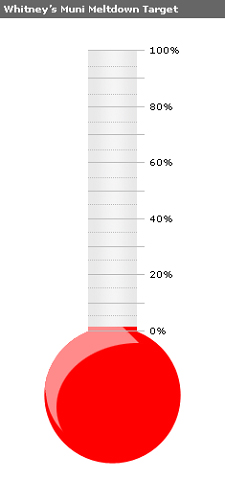
What happened to the muni catastrophe? Meredith Whitney ended 2010 scaring the daylights out of municipal-bond investors by predicting “hundreds of billions” in municipal-bond defaults in the coming year. No doubt her prediction on “60 Minutes” played a part in the net redemptions seen in municipal-bond funds for most of this year.

Yet here we are at the halfway point, and defaults are running at a trickle. Rather than the $200 billion or more of defaults Whitney predicted, we’ve had $746 million according to Income Securities Advisor. DWS estimates that, at that rate, we’ll have about $1.7 billion in defaults for the year. In fact, DWS and Income Securities Advisor’s Distressed Debt Securities newsletter say defaults have dropped significantly from the prior three years. The market peaked at about $8 billion in defaults in 2008, so this year could be one fourth of that or less.

For those scoring at home, that means we’ve only reached 1% of Whitney’s predicted default level.

You’ve no doubt read about the problems in Illinois, Florida, and California, where deficits have grown and governments have been forced to make cuts. But there are good reasons why the system is strained but not breaking. Governments can raise taxes and cut spending to get themselves out of their messes, and that’s what they are doing. Moreover, they need to come back to municipal markets to continue to borrow so they have strong incentives to treat bondholders well.

In addition, an improving economy has meant rising tax revenues. Municipalities’ tax revenues started rising in late 2010 and have continued to do so. Income tax and sales-tax revenues naturally rise as the economy improves.

This means that, if you own a well-run muni-bond fund, you’re in pretty good shape. These funds usually have bonds from a hundred or more issuers, so one default won’t have much impact. And, of course, they do thorough credit research to steer clear of most, though not all, defaults. With some munis paying better tax-free yields than many high-quality taxable bonds, this isn’t a bad time to get in. In fact, some taxable-bond managers are even buying munis because they look attractive even without the tax break factored in. That said, fewer new munis have been issued so far in 2011, so additional waves of new debt could drive prices lower in the short term.

Investors may have noticed the divergence between dire predictions and reality as muni-fund flows turned positive in June after fairly steady redemptions. The $980 million flowing into munis isn’t a huge amount but it does indicate that the fear level is dropping. I don’t expect this to turn into really big inflows soon, but it may mean a market headwind is going away.